





CorKit

Coronagraph Science Kit
CorKit is an open-source Python library designed to streamline the retrieval and preprocessing of solar coronagraph data. Its primary aim is to democratize access to coronagraph data, enabling a broader community of solar scientists to engage in research without the need for proprietary software like IDL. It's derived from Solarsoft:
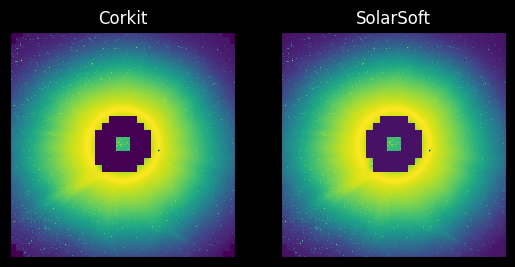
Key Features:
-
Open Source Accessibility: CorKit removes barriers to entry by providing free access to solar coronagraph data. Its open-source nature ensures that researchers, educators, and enthusiasts can easily retrieve and analyze data without worrying about proprietary software licenses.
-
User-Friendly Interface: With simple and intuitive methods, CorKit makes it effortless for users to retrieve and preprocess coronagraph data. This user-centric approach allows researchers to focus more on their scientific analysis and less on navigating complex data retrieval processes.
-
Advancing Solar Science: By empowering researchers with the tools needed to preprocess and analyze coronagraph data, CorKit contributes to the advancement of solar science. Researchers can explore the intricate connections between the Sun and Earth, leading to new insights and discoveries.
-
Community Collaboration: CorKit fosters collaboration and knowledge sharing within the solar science community. By providing a common platform for data access and preprocessing, the library encourages interdisciplinary collaborations and accelerates scientific progress.
Coronagraph data supported


Contact
Acknowledgements
This project was inspired by the work of researchers in the field of coronagraphy. We would like to thank the contributors to SolarSoft for their foundational work in this area.
License
This project is licensed under the MIT License - see the LICENSE file for details.
Citation
@misc{corkit,
  author = {Jorge Enciso},
  title = {Corkit: An Open-Source Coronagraph Data Downloader and Calibrator},
  howpublished = {\url{https://github.com/Jorgedavyd/CorKit}},
  year = {2024}
}
1 maintainer

Metadata
1 maintainer
Release files for corkit 1.0.16
For a detailed explanation of source distributions (sdists) and built distributions (wheels), please see the package formats documentation.
Source distribution (sdist)
| File | Size | Uploaded | Provenance | Actions |
|---|---|---|---|---|
| corkit-1.0.16.tar.gz | 35.3 kB | Without provenance | Details for corkit-1.0.16.tar.gz |
Built distribution (wheel)
| File | Interpreter | ABI | Platform | Actions Reset |
|---|---|---|---|---|
| corkit-1.0.16-py3-none-any.whl | Python 3 | none | any | Details for corkit-1.0.16-py3-none-any.whl |
Total release size: 70.6 kB
Release files / corkit-1.0.16.tar.gz
| Download URL | corkit-1.0.16.tar.gz |
|---|---|
| Size | 35.3 kB |
| Tags | Source |
|
SHA-256 checksum How to use checksums |
36075dd4490fdf0e18d5b1a20060898e59681efe69d6d701292f60a93bba9416
|
|
BLAKE2b-256 checksum How to use checksums |
a922d2868f8360585560e745040e8e57ae4594f290569f33883db7b6b4059388
|
| Upload date | |
|
Uploaded using Trusted Publishing? What is trusted publishing? |
No |
| Uploaded via |
twine/5.0.0 CPython/3.12.7
|
Release files / corkit-1.0.16-py3-none-any.whl
| Download URL | corkit-1.0.16-py3-none-any.whl |
|---|---|
| Size | 35.3 kB |
| Tags | Python 3 |
|
SHA-256 checksum How to use checksums |
d36c1452f5a7ac16cd04716b4e4496f6a561db6030b748cc2b002618ad3e1f87
|
|
BLAKE2b-256 checksum How to use checksums |
7f64a0252d3cec5bf5953fa927ed276e612f01c1daf13001c039db56329bb626
|
| Upload date | |
|
Uploaded using Trusted Publishing? What is trusted publishing? |
No |
| Uploaded via |
twine/5.0.0 CPython/3.12.7
|
Security for corkit 1.0.16
Provenance
Provenance describes where a file came from. On PyPI, provenance is shared via attestations, which provide a verifiable record of the build or publishing details. View details, limitations and caveats.
No provenance found
None of the files in this release were uploaded with provenance metadata.
A note on package security
PyPI is a repository for distributing packages, not a service for auditing them. While third-party security researchers and our staff do their best to detect and remove malicious packages, PyPI cannot guarantee the quality, security or suitability of any given package.
To learn more about protecting yourself from malicious actors, visit our package security documentation.














