
Coronelli ◉
A tool for building literary atlases by hand.
Coronelli is inspired by the craft of historical cartographers. You read a book, work through it section by section, and decide what goes on the map — what places exist, how they relate, what they look like. The result is a navigable world you can orbit and inspect.
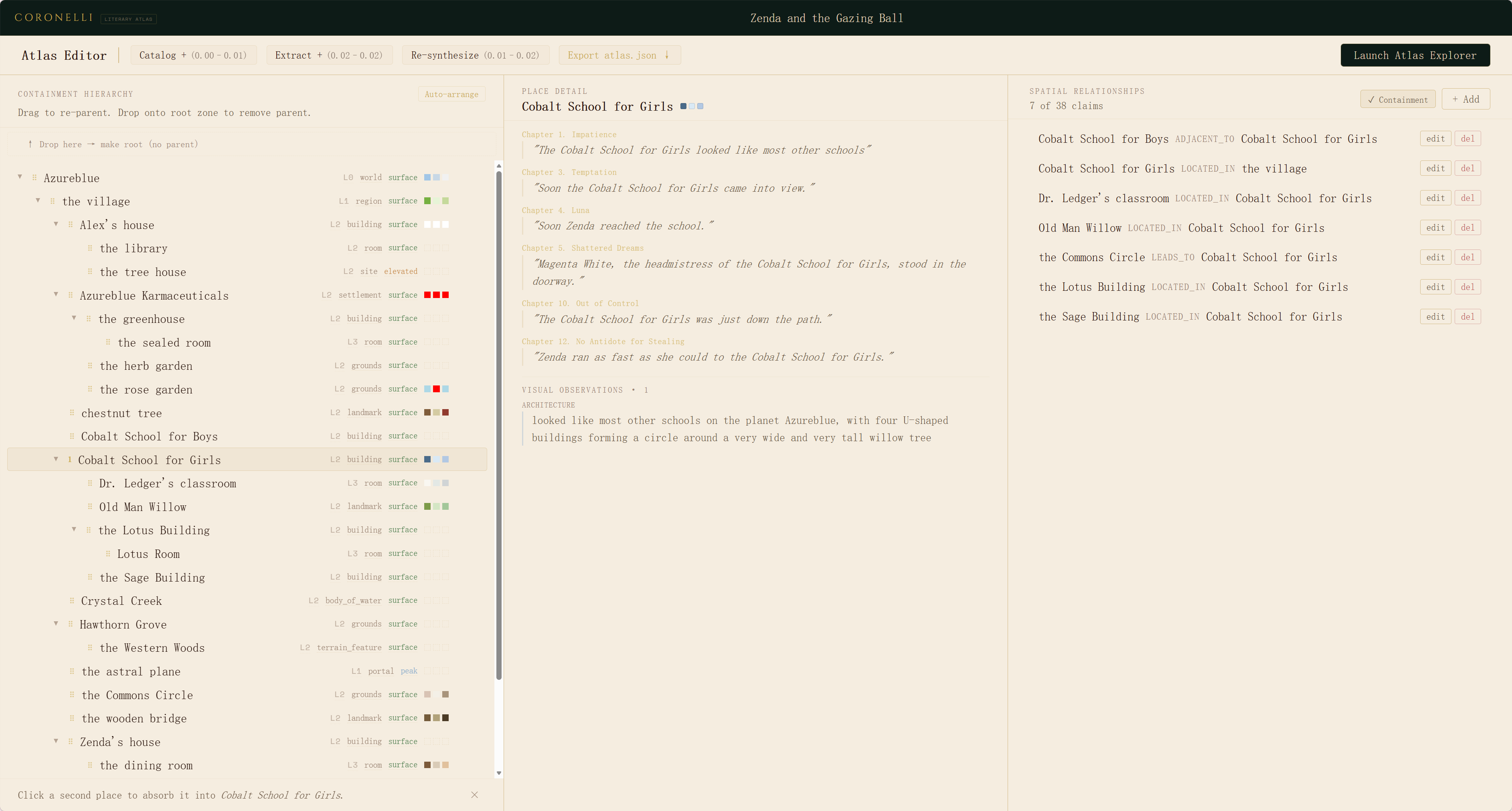
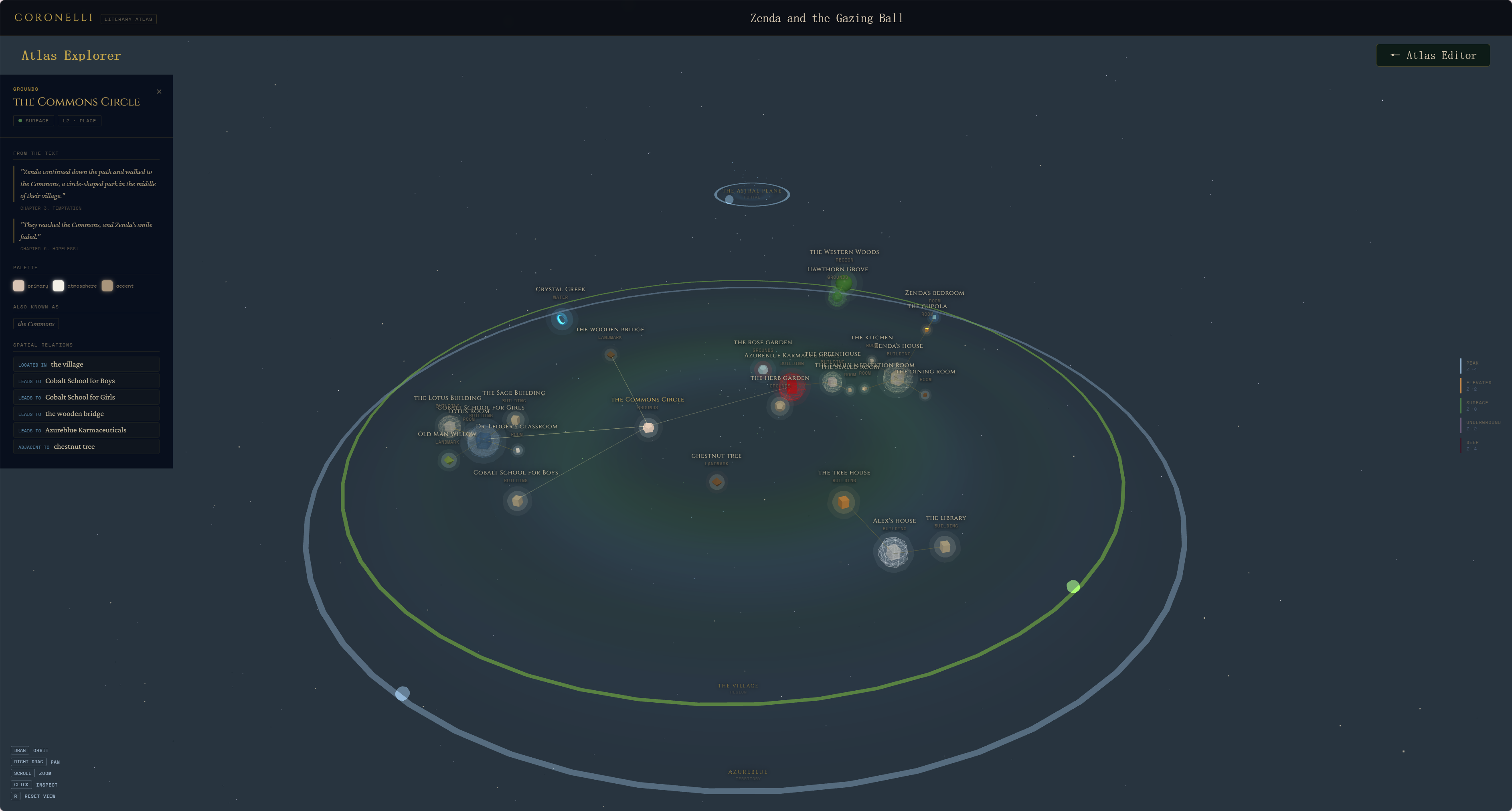
Upload → Catalog → Extract → Synthesize → Atlas Editor → 3D Explorer
- Import
.txt,.md, and text-bearing.pdffiles - A pipeline surfaces candidate places, relationships, and descriptions as raw material
- You review every candidate — accepting, editing, or rejecting — before anything lands on the map
- Refine in the Atlas Editor: rename places, assign hierarchy, merge duplicates, add relationships
- Explore the finished atlas in a 3D scene: zone rings, floating nodes, force-directed layout
Installation
Requires Python 3.12+. Install with uv:
uv tool install coronelli
Then launch:
coronelli
Coronelli opens in your browser at http://localhost:8000. Your atlas data is stored locally:
| Platform | Location |
|---|---|
| Windows | %LOCALAPPDATA%\Coronelli\coronelli.db |
| macOS | ~/Library/Application Support/Coronelli/coronelli.db |
| Linux | ~/.local/share/Coronelli/coronelli.db |
Set your OpenAI API key before running extraction:
# in your shell profile, or in %LOCALAPPDATA%\Coronelli\.env  (Windows)
#                                ~/Library/Application Support/Coronelli/.env  (macOS)
OPENAI_API_KEY=sk-...
Cost and caching
Each pipeline stage shows an estimated cost before you run it. Sections you have already processed are served from cache, so you only pay for new work.
License
Source-available, personal non-commercial use only. See LICENSE.
1 maintainer

Metadata
1 maintainer
Release files for coronelli 0.1.4
For a detailed explanation of source distributions (sdists) and built distributions (wheels), please see the package formats documentation.
Source distribution (sdist)
| File | Size | Uploaded | Provenance | |
|---|---|---|---|---|
| coronelli-0.1.4.tar.gz | 427.0 kB | Without provenance | Details |
Built distribution (wheel)
| File | Interpreter | ABI | Platform | Reset |
|---|---|---|---|---|
| coronelli-0.1.4-py3-none-any.whl | Python 3 | none | any | Details |
Total release size: 767.9 kB
Release files / coronelli-0.1.4.tar.gz
| Download URL | coronelli-0.1.4.tar.gz |
|---|---|
| Size | 427.0 kB |
| Tags | Source |
|
SHA-256 checksum How to use checksums |
80c8b393bda3366fcb920d3afcdc1fd7ca2343b4542cb4177cd6d32cbe24d07e
|
|
BLAKE2b-256 checksum How to use checksums |
0f25b069b4c2c658f4bb3a80e974bd29bb3969b39ffc008dbbf2796e31d54e31
|
| Upload date | |
|
Uploaded using Trusted Publishing? What is trusted publishing? |
No |
| Uploaded via |
uv/0.11.21 {"installer":{"name":"uv","version":"0.11.21","subcommand":["publish"]},"python":null,"implementation":{"name":null,"version":null},"distro":null,"system":{"name":null,"release":null},"cpu":null,"openssl_version":null,"setuptools_version":null,"rustc_version":null,"ci":null}
|
Release files / coronelli-0.1.4-py3-none-any.whl
| Download URL | coronelli-0.1.4-py3-none-any.whl |
|---|---|
| Size | 340.9 kB |
| Tags | Python 3 |
|
SHA-256 checksum How to use checksums |
3a2ab21d643e4f74bed26ced066627877164004c2be8fc2e75fd2365af430831
|
|
BLAKE2b-256 checksum How to use checksums |
1a7657b4671a27893084884eb782d88e52bb1aee9e0852b08a4f0a6960e5560f
|
| Upload date | |
|
Uploaded using Trusted Publishing? What is trusted publishing? |
No |
| Uploaded via |
uv/0.11.21 {"installer":{"name":"uv","version":"0.11.21","subcommand":["publish"]},"python":null,"implementation":{"name":null,"version":null},"distro":null,"system":{"name":null,"release":null},"cpu":null,"openssl_version":null,"setuptools_version":null,"rustc_version":null,"ci":null}
|
Security for coronelli 0.1.4
Provenance
Provenance describes where a file came from. On PyPI, provenance is shared via attestations, which provide a verifiable record of the build or publishing details. View details, limitations and caveats.
No provenance found
None of the files in this release were uploaded with provenance metadata.
A note on package security
PyPI is a repository for distributing packages, not a service for auditing them. While third-party security researchers and our staff do their best to detect and remove malicious packages, PyPI cannot guarantee the quality, security or suitability of any given package.














