
CoSMIM
Covariance of Spatial Multi-scale Integrated Microenvironment: a training-free representation for spatial domain identification.
Many spatial domain methods describe the neighbourhood of a cell by its mean gene expression. CoSMIM describes it by the gene–gene covariance of the neighbourhood at several spatial scales (the cell and its 5, 15 and 45 nearest neighbours). The scales are fused with weights learned for each section, the fused matrix is shrunk towards a scaled identity, and the matrix square root is used as a Euclidean feature. Standard PCA and Leiden clustering of this feature give the spatial domains; nothing is trained.
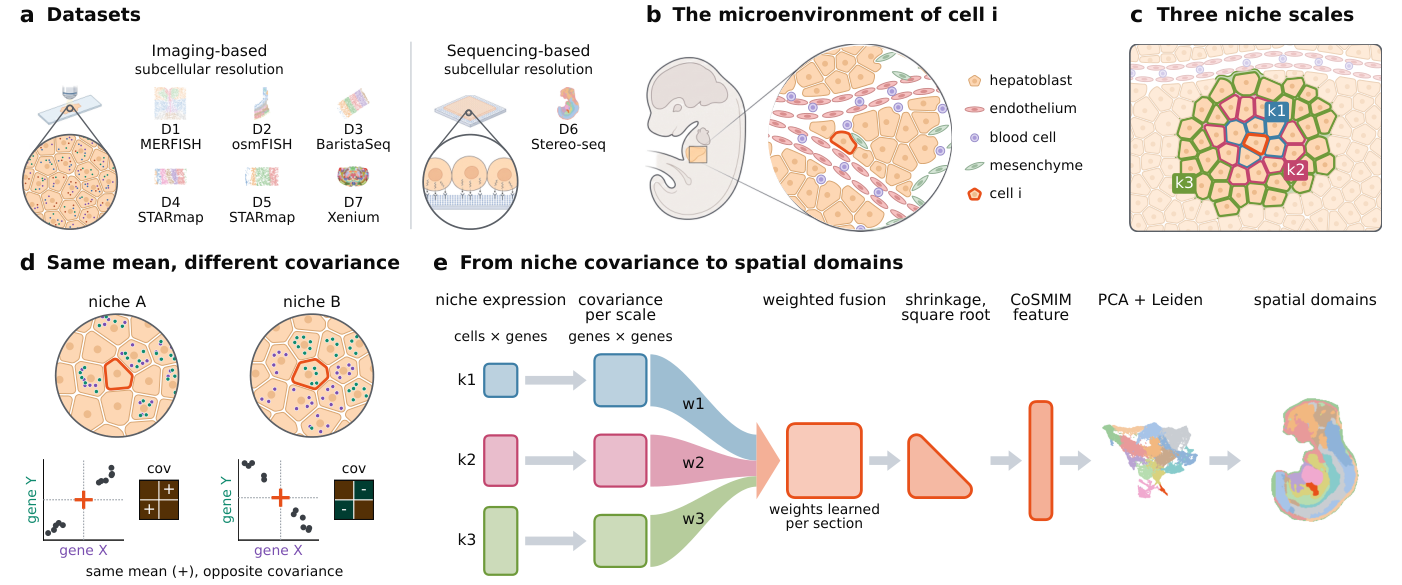
Fig. 1: Overview of CoSMIM.
Install
pip install "cosmim[metrics]" # [metrics] adds squidpy, needed for Moran's I and Geary's C
To use the package versions the paper's results were computed with:
git clone https://github.com/barondu/cosmim.git
cd cosmim
conda env create -f environment.yml
conda activate cosmim
pip install -e .
CoSMIM needs no GPU.
Quick start
import scanpy as sc
import cosmim

adata = sc.read_h5ad("data/D4_STARmap_VisualCortex/STARmap_20180505_BY3_1k.h5ad")
result = cosmim.run(adata, annotation_key="Region", strategy="svg_only", n_top_hvg=64,
                    n_pcs=30, n_neighbors=200)
result.obs["cosmim"]                                           # the spatial domains
cosmim.calc_all_metrics(result, gt_key="Region", pred_key="cosmim")   # the nine metrics
run clusters a section into as many domains as annotation_key has annotated domains. On a section without an annotation, give the number of domains (max_labels=...), or call the steps directly and give a Leiden resolution:
adata_raw, adata_hvg = cosmim.spatial_preprocess_pipeline(adata, strategy="svg_hvg", n_top_hvg=64)
features, weights = cosmim.compute_cosmim(adata_hvg, k=[5, 15, 45], entropy_reg=10, alpha=0.1)
adata_raw.obs["cosmim"] = cosmim.run_leiden_partition(features, resolution=1.0, n_pcs=30,
                                                      n_neighbors=50)
Parameters
| Parameter | Default (the paper) | Options |
|---|---|---|
strategy |
"svg_hvg": spatially variable genes, then the most highly variable |
"svg_only" (largest Moran's I), "hvg_only" |
n_top_hvg |
64 | number of genes of the feature |
k |
[5, 15, 45] |
the scales (numbers of neighbours) |
cov_type |
"shift": centred on the mean of the section |
"traditional": on the mean of the niche |
exclude_target |
False |
leave the cell out of its own niche |
entropy_reg |
10 | λ, the entropy term of the scale weights |
weight_strategy |
"sampled": weights learned on 1,000 cells |
"global": on all cells |
weights |
learned | fixed weights, for example [1/3, 1/3, 1/3] |
alpha |
0.1 | shrinkage towards a scaled identity |
feature_transform |
"sqrt": the matrix square root |
"logm" (log-Euclidean), "raw" (no map) |
dtype |
float64 |
float32 halves the memory of the returned feature |
n_pcs, n_neighbors |
30, 50 | PCA components and graph neighbours of the clustering |
Tutorials
| Notebook | Data | What it shows |
|---|---|---|
| 1_dataset4_STARmap | dataset4, STARmap mouse visual cortex, 1 section | CoSMIM step by step and the nine metrics |
| 2_dataset1_MERFISH_benchmark | dataset1, MERFISH mouse hypothalamus, 5 sections | CoSMIM on the five sections, the benchmark of sixteen methods and its statistical tests, gene–gene correlations across domains |
| 3_dataset6_StereoSeq | dataset6, Stereo-seq mouse embryo E10.5_E1S1 and E10.5_E2S1 | the liver and the brain found by each method, and the niche covariance of the liver |
The notebooks were run with the versions in environment.yml on Linux (aarch64). On other machines and library builds a few cells can change cluster, so the scores can differ from the paper.
Benchmark
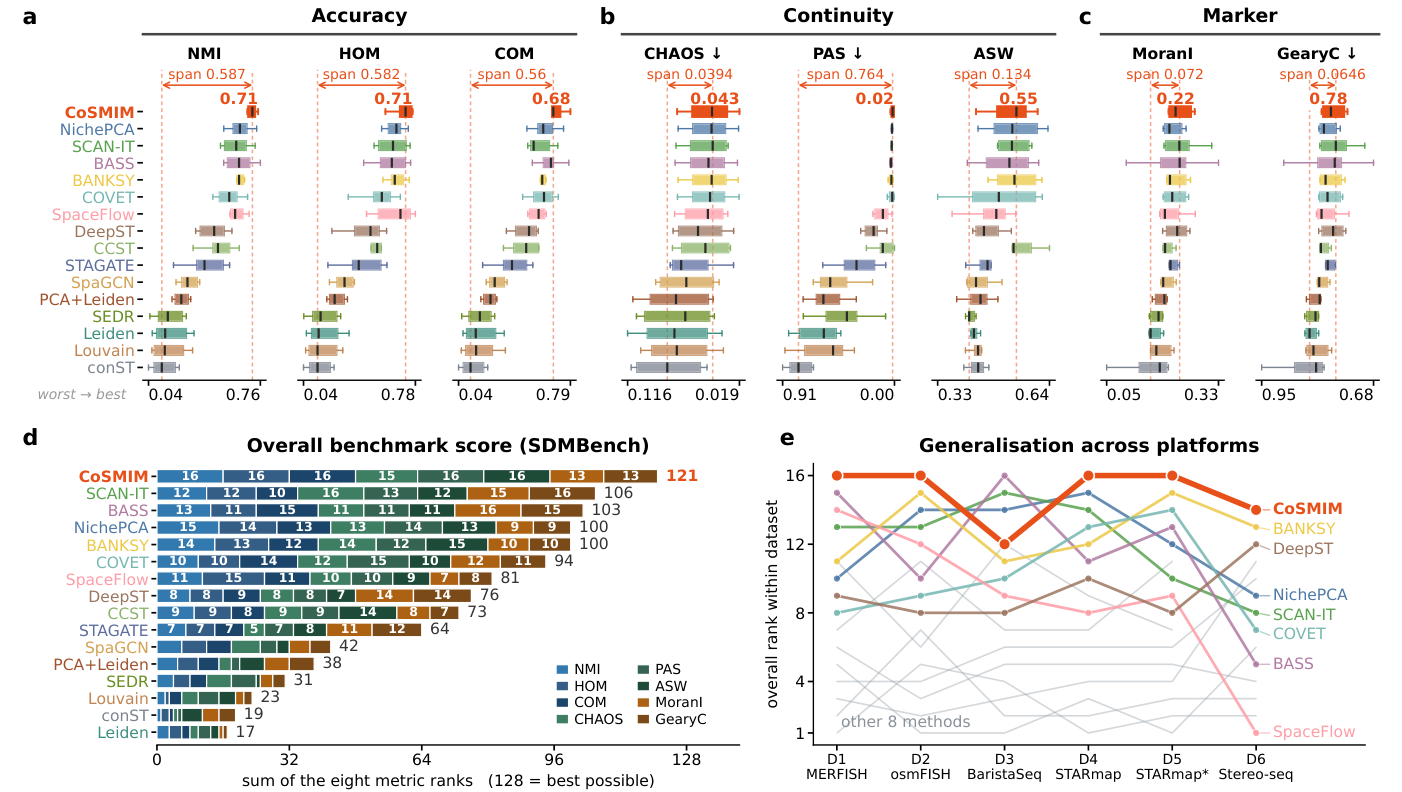
Fig. 2: Benchmarking of 16 spatial domain identification methods on six datasets (22 sections). Sixteen methods on dataset1–6, scored with eight metrics. CoSMIM has the highest overall score (summed rank 121 of 128; the second method has 106). Tutorial 2 computes the ranks and the statistical tests from the per-section scores.
Data
The seven datasets of the paper. Datasets 1–6 are those distributed with SDMBench (Yuan et al., Nat. Methods 21, 712–722 (2024)), whose published scores of eleven methods are part of the benchmark table.
| Platform | Tissue | Reference | |
|---|---|---|---|
| dataset1 | MERFISH | mouse hypothalamic preoptic region, 5 sections | Moffitt et al., Science 362, eaau5324 (2018); domain labels of Li & Zhou, Genome Biol. 23, 168 (2022) |
| dataset2 | osmFISH | mouse somatosensory cortex, 1 section | Codeluppi et al., Nat. Methods 15, 932–935 (2018) |
| dataset3 | BaristaSeq | mouse visual cortex, 3 sections | Chen et al., Nucleic Acids Res. 46, e22 (2018); Long et al., arXiv:2301.08436 (2023) |
| dataset4 | STARmap | mouse visual cortex, 1 section | Wang et al., Science 361, eaat5691 (2018); second annotation (smoothed_manual, tutorial 1) of Singhal et al., Nat. Genet. 56, 431–441 (2024) |
| dataset5 | STARmap | mouse medial prefrontal cortex, 3 sections | Wang et al., Science 361, eaat5691 (2018) |
| dataset6 | Stereo-seq | mouse embryo E9.5 and E10.5, 9 sections | Chen et al., Cell 185, 1777–1792 (2022) |
| dataset7 | Xenium | mouse brain, 3 sections | 10x Genomics; region annotation of Bhuva et al., Genome Biol. 25, 99 (2024) |
Citation
The preprint is on bioRxiv: https://doi.org/10.64898/2026.10.20.760373
@article{du2026cosmim,
  title   = {Multi-scale microenvironment covariance for unsupervised spatial domain identification},
  author  = {Du, Bairui and Kiryu, Hisanori},
  journal = {bioRxiv},
  year    = {2026},
  doi     = {10.64898/2026.10.20.760373}
}
License
The code is under the BSD 3-Clause License (see LICENSE). The data files keep the terms of their sources listed above; the figures are those of the paper.
1 maintainer

Metadata
1 maintainer
Release files for cosmim 1.0.1
For a detailed explanation of source distributions (sdists) and built distributions (wheels), please see the package formats documentation.
Source distribution (sdist)
| File | Size | Uploaded | Provenance | Actions |
|---|---|---|---|---|
| cosmim-1.0.1.tar.gz | 17.2 kB | Without provenance | Details for cosmim-1.0.1.tar.gz |
Built distribution (wheel)
| File | Interpreter | ABI | Platform | Actions Reset |
|---|---|---|---|---|
| cosmim-1.0.1-py3-none-any.whl | Python 3 | none | any | Details for cosmim-1.0.1-py3-none-any.whl |
Total release size: 33.3 kB
Release files / cosmim-1.0.1.tar.gz
| Download URL | cosmim-1.0.1.tar.gz |
|---|---|
| Size | 17.2 kB |
| Tags | Source |
|
SHA-256 checksum How to use checksums |
460b4eb26c346dc843a7f3190e7d4a386f56eccf429a0a8364dc76bd6eaaa23b
|
|
BLAKE2b-256 checksum How to use checksums |
242cd421d7cad3d1dc770b423d1b0dc9dca30d201ac3a7cf03643e0719e2f2e3
|
| Upload date | |
|
Uploaded using Trusted Publishing? What is trusted publishing? |
No |
| Uploaded via |
twine/7.0.0 CPython/3.12.10
|
Release files / cosmim-1.0.1-py3-none-any.whl
| Download URL | cosmim-1.0.1-py3-none-any.whl |
|---|---|
| Size | 16.1 kB |
| Tags | Python 3 |
|
SHA-256 checksum How to use checksums |
186ef7bcb111f1734346858963cce175c565e69eae1694bf211c4b48cfeec30b
|
|
BLAKE2b-256 checksum How to use checksums |
0ee3f7a4941cbda6a6216d57fe0699e2eb3500aa0473df211c014849fdf07c1d
|
| Upload date | |
|
Uploaded using Trusted Publishing? What is trusted publishing? |
No |
| Uploaded via |
twine/7.0.0 CPython/3.12.10
|
Security for cosmim 1.0.1
Provenance
Provenance describes where a file came from. On PyPI, provenance is shared via attestations, which provide a verifiable record of the build or publishing details. View details, limitations and caveats.
No provenance found
None of the files in this release were uploaded with provenance metadata.
A note on package security
PyPI is a repository for distributing packages, not a service for auditing them. While third-party security researchers and our staff do their best to detect and remove malicious packages, PyPI cannot guarantee the quality, security or suitability of any given package.
To learn more about protecting yourself from malicious actors, visit our package security documentation.














