
A deep learning framework built from scratch. Reverse-mode autograd, tensors, CUDA, and a transformer trained on top of it.

Project description
Cotangent



Cotangent: a deep learning framework built from scratch. Autograd, tensors, CUDA, and a transformer trained on top of it.
Reverse-mode autodiff propagates cotangents backward through the computation graph, one backward() call at a time; the framework is named for exactly what it computes, not for a metaphor about the process.
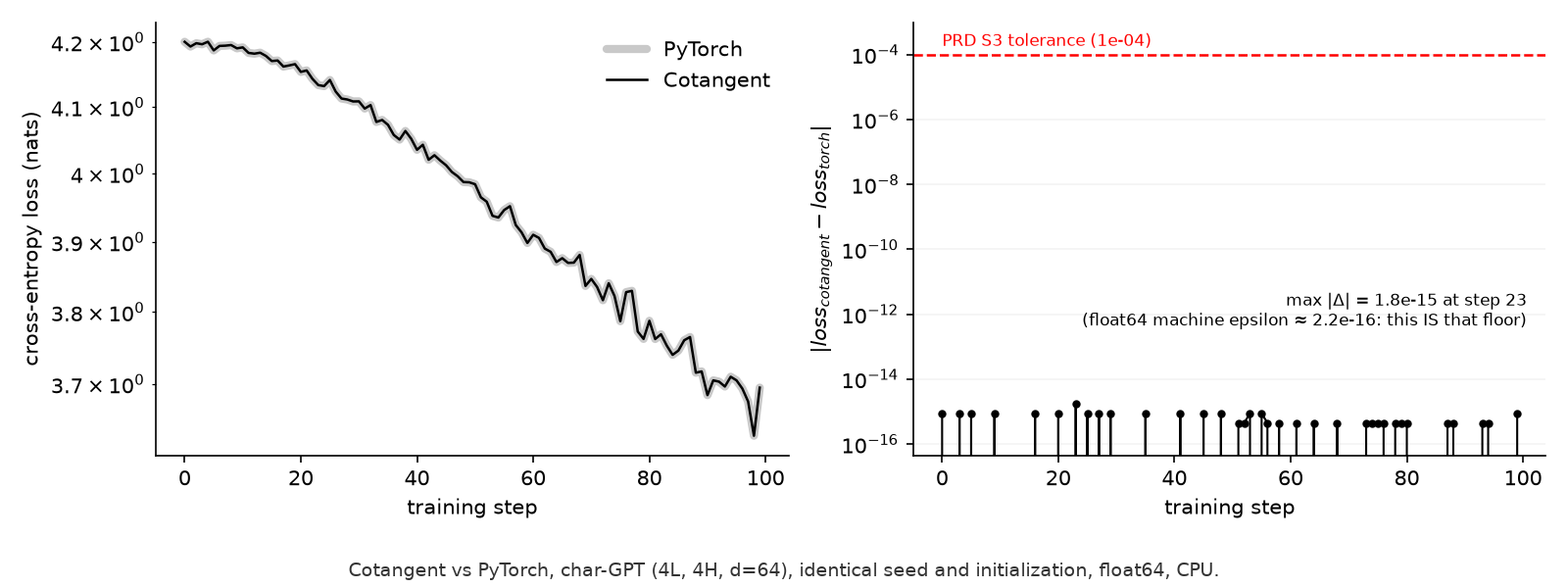
Cotangent's loss curve and an identical PyTorch model's are indistinguishable (left); the residual (right) sits at the float64 machine floor, with max divergence 1.78e-15, and does not grow.
The runtime framework is entirely self-contained: torch is not a runtime dependency. PyTorch appears only in the test suite, as a numerical oracle to validate every operation against; the cotangent package never imports it, enforced by a fail-closed CI grep gate (.github/workflows/ci.yml's no-unsafe-deserialization job).
What this is
A deep learning framework built from scratch in NumPy and CuPy: reverse-mode automatic differentiation over a dynamically-built computation graph, an N-dimensional Tensor with NumPy-style broadcasting, a CPU/GPU device abstraction with one hand-written CUDA kernel, SGD/Adam/AdamW, an nn.Module layer, and a char-level GPT (causal self-attention, weight tying, pre-norm residual blocks) trained on top of it. Every implemented op is verified against PyTorch to float64 machine precision (1e-10), not "close enough": see docs/gradcheck.md and docs/design.md for the numbers.
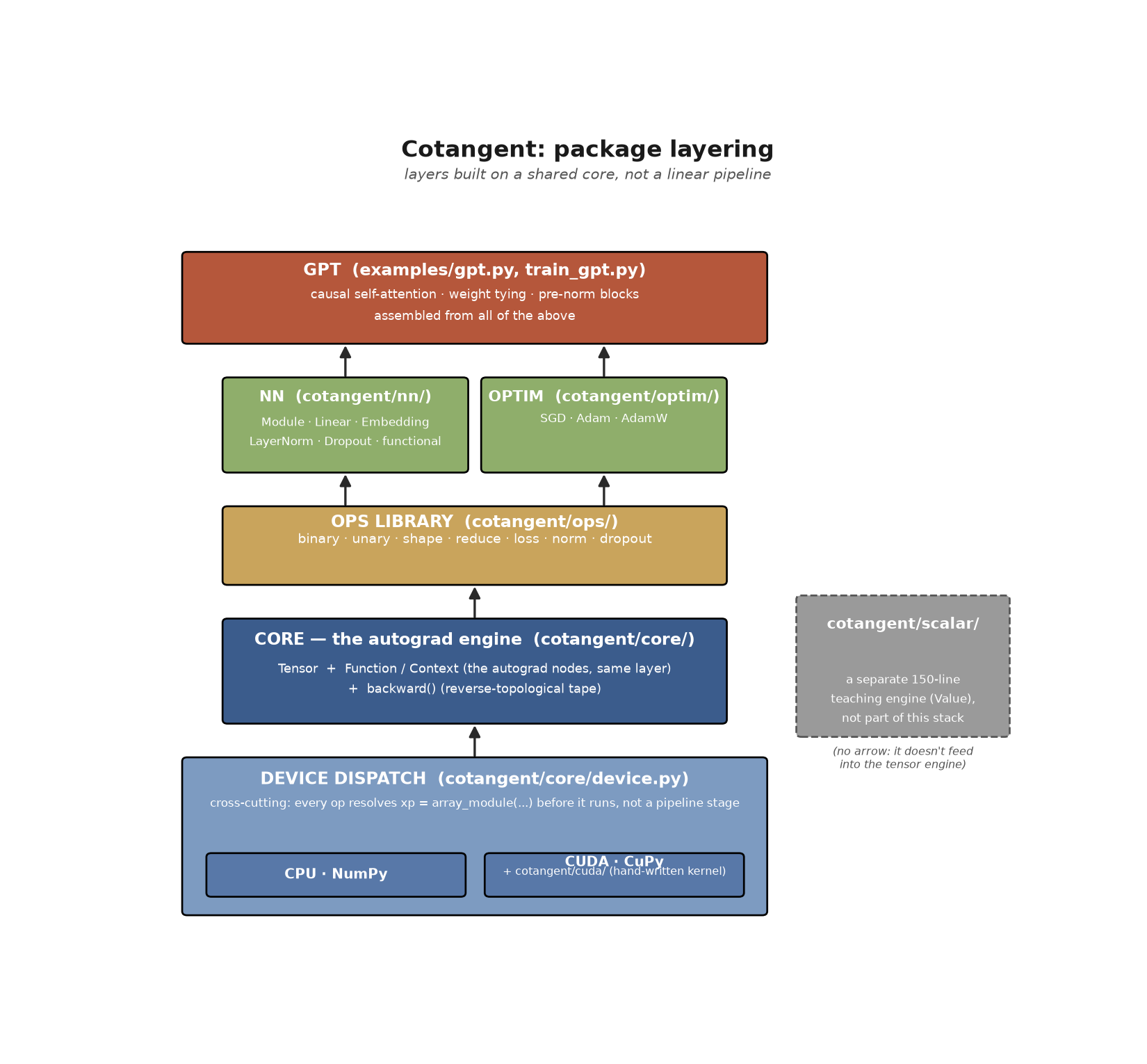
This is not a linear Tensor -> Autograd -> CUDA -> nn -> Optimizer -> GPT pipeline. Tensor and Function/Context are the same layer (Functions are the autograd nodes); device dispatch (cotangent/core/device.py) sits underneath everything as a cross-cutting concern every op resolves through, not a stage any op passes through once; and the ops library, nn, optim, and the GPT are genuinely layers, each built on the one below it, with nn and optim as siblings rather than one stacked on the other. cotangent/scalar/ (the 150-line teaching engine below) is deliberately not part of this stack at all.
import cotangent as ct

x = ct.tensor([[2.0, 3.0]], requires_grad=True)
w = ct.randn(2, 1, requires_grad=True)
loss = (x @ w).relu().sum()
loss.backward()
print(x.grad)
Tensor([[-0.27666122, 2.0209932 ]], dtype=float32)
Run verbatim, this session: w is unseeded here, so the exact values differ run to run. The shape, dtype, and that it runs through the public Tensor method surface (@, .relu(), .sum(), .backward()) do not.
How it's built
Scalar autograd (cotangent/scalar/, a 150-line teaching artifact that stays in the repo) → an N-dimensional Tensor engine with Function/Context and full broadcasting → a CPU/GPU device abstraction (xp dispatch over NumPy/CuPy), optimizers, and nn.Module → a char-level GPT trained on TinyShakespeare. The GPT's forward/backward math is proven identical to PyTorch's (the plot above); its trained loss is a separate, honestly-short-of-target number; see "What's proven, and what isn't" below before assuming the second follows from the first. docs/plan/02_TECHNICAL_ARCHITECTURE.md section 9 has the full 40-step build order this repo's commit history follows one step per commit.

The scalar engine's own graph, rendered after backward(): two leaves (data=2, data=3) feed a multiply and an add, both feeding a final multiply, and every node carries the gradient backward() actually computed for it, not a hand-worked example. docs/graph.dot is the checked-in, reproducible source; see "Install and run" below to regenerate it.
What's proven, and what isn't
Proven, and reproducible from this repo:
-
Every implemented op (forward, backward, gradcheck, torch-parity) verified to
1e-10in float64.docs/gradcheck.md(pytest --report) has the per-op table: 36 ops, worst-case max relative error2.7e-6, most in the1e-8–1e-9range. -
The assembled GPT (causal mask, multi-head attention, weight tying, pre-norm blocks) matches an identical PyTorch model to the float64 floor over a real training run: the plot above,
1.78e-15max residual, not merely "close." -
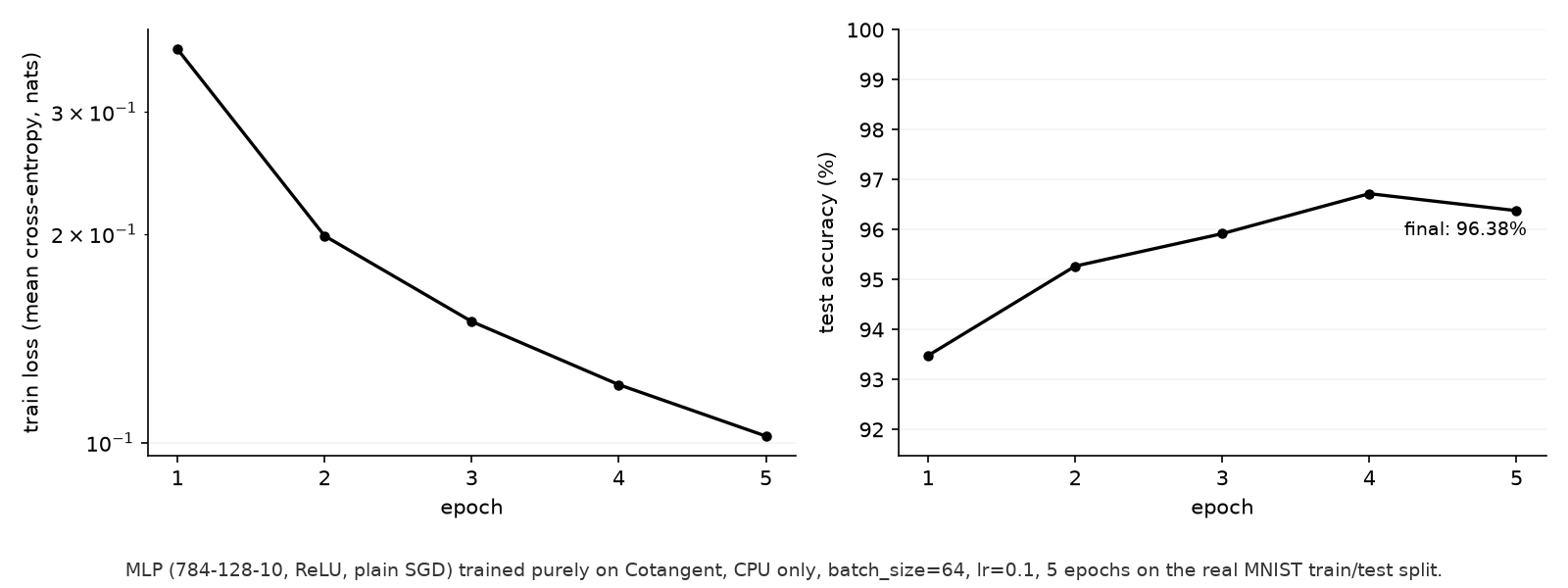
An MLP trained purely on Cotangent reaches 96.38% test accuracy on MNIST, CPU only:
examples/mnist_curve.py(5 epochs, batch_size=64, lr=0.1, plain SGD, the same runexamples/mnist_mlp.pytrains) writes this plot anddocs/mnist_curve.csvtogether. The 96.38% above is this run's own last data point, not a separately quoted number. -
grep -rn "import torch" cotangent/is clean, checked in CI.
Not claimed:
- The GPT does not hit the paper-loss target. Trained 8000 steps (warmup + cosine LR decay, causal char-GPT,
d=128, 4 heads, 4 layers) on TinyShakespeare: final validation loss 2.965 bits/char, against a target of<1.6. Stated as-is, not hidden, not dressed up.docs/design.md's "Where the gaps are" section has the full diagnosis: three separate pieces of direct evidence point at a model-capacity/data-scale limit, not a schedule or correctness bug (a flat-LR run and the scheduled run land at nearly the same loss at matched step count; the loss plateaus while LR is still actively decaying; weight tying's own measured regularization cost is~0.4bits/char). The model does generate real structure at this scale (character-name-style tags, dialogue-shaped line breaks, real short words), which is the qualitative bar a model this size clears;1.6bits/char is a further, quantitatively distinct bar this repo does not claim to have cleared. - The custom CUDA kernel is not fast.
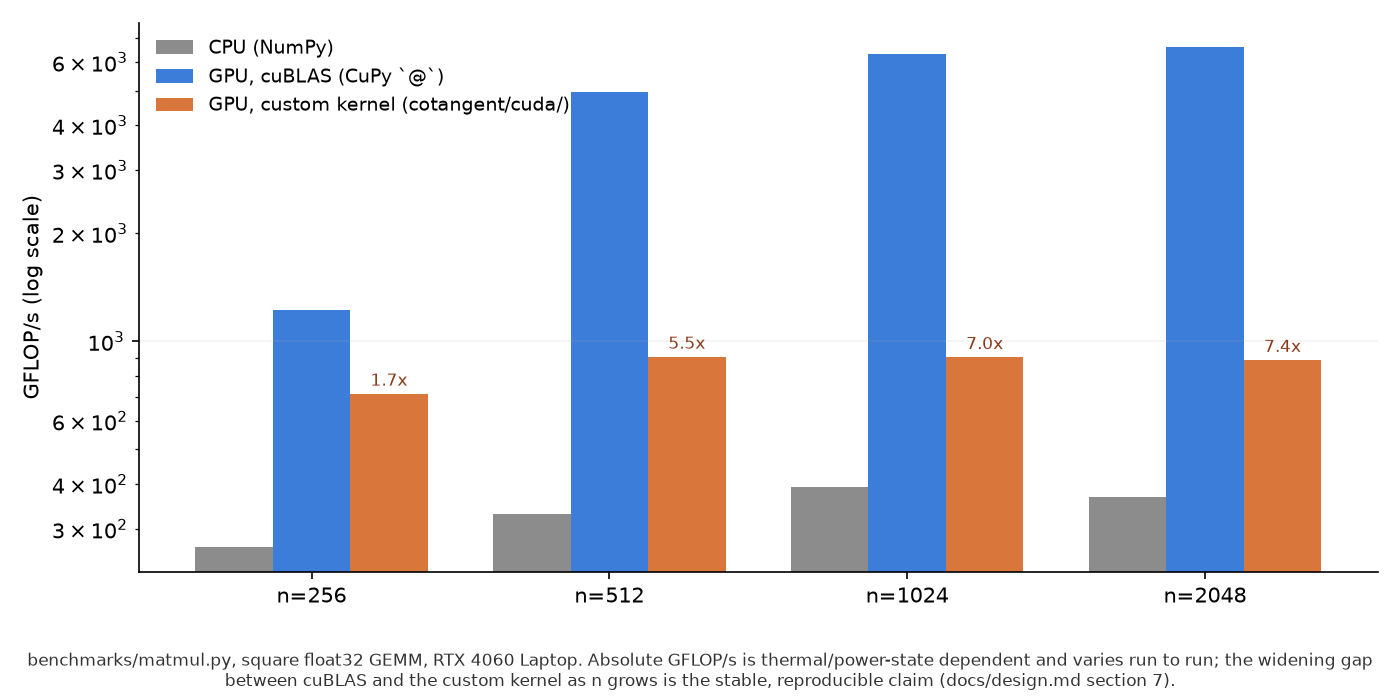
cotangent/cuda/kernels.py's hand-written tiled matmul loses to cuBLAS by roughly5x–7xonce past the smallest problem size, the gap widening with problem size (see the benchmark chart below). It exists to prove the raw-CUDA capability, not to compete with a production BLAS.docs/design.mdnames the four missing optimizations (tensor cores, register blocking, bank-conflict-free layout, occupancy autotuning) and why each matters. - Not a production framework. No operator fusion, no memory planner, no
torch.compileequivalent, no in-place ops, no higher-order gradients, no distributed training, no mixed precision.docs/design.md's "Where the gaps are" section quantifies what this costs (e.g.~8%measured graph-construction overhead per forward pass) and states what PyTorch does instead, for each gap.
The benchmark
benchmarks/matmul.py, CPU (NumPy) vs. GPU (CuPy/cuBLAS) vs. the hand-written kernel, real GFLOP/s on an RTX 4060 Laptop:
| n | CPU GFLOP/s | cuBLAS GFLOP/s | custom kernel GFLOP/s | custom / cuBLAS |
|---|---|---|---|---|
| 256 | 267.0 | 1219.9 | 713.5 | 1.7x |
| 512 | 330.1 | 4957.0 | 904.4 | 5.5x |
| 1024 | 391.4 | 6309.9 | 902.2 | 7.0x |
| 2048 | 368.7 | 6590.6 | 886.0 | 7.4x |
GFLOP/s varies somewhat run to run with this hardware's thermal/power state; the gap and its direction (cuBLAS pulling further ahead as the problem grows) is the stable, reproducible claim, and docs/design.md explains the mechanism. Every GPU number here is cp.cuda.Stream.null.synchronize()-gated before the clock stops (CuPy queues kernels asynchronously; an unsynchronized read times the empty queue, not the compute). benchmarks/plot_matmul.py writes the chart and docs/benchmark.csv together from a single run; the table above is that same run's numbers, not a separately quoted one.
Install and run
pip install -e ".[dev]"
Runtime dependencies are exactly numpy>=1.26 and, optionally, cupy-cuda12x (pip install -e ".[cuda]") for the GPU path; cotangent/ imports nothing else. torch is a [dev]-only dependency, used solely as the parity oracle in tests/ and examples/parity_gpt.py; it is never imported under cotangent/.
graphviz in [dev] is the Python wrapper package only. It shells out to the dot binary at render time; pip cannot install that binary. Install it separately:
apt-get install graphviz  # Debian/Ubuntu
brew install graphviz     # macOS
Verify with dot -V. docs/graph.png is generated from docs/graph.dot, the checked-in, reproducible source of truth:
dot -Tpng docs/graph.dot -o docs/graph.png
Run the test suite (1134 tests, float64 gradcheck + torch parity throughout):
pytest
Regenerate docs/gradcheck.md from a real run:
pytest --report
Train the toy examples and regenerate the charts above:
python examples/xor.py          # M1: a 2-4-4-1 MLP, loss below 1e-3
python examples/mnist_mlp.py    # M2: 96.38% test accuracy, CPU only
python examples/mnist_curve.py  # writes docs/mnist_curve.png + .csv
python examples/train_gpt.py    # M4: the char-GPT, checkpointed to examples/.cache/
python benchmarks/plot_matmul.py  # writes docs/benchmark.png + .csv (requires CUDA)
Further reading
docs/design.md: the real writeup, covering why a tape and not a closure-based graph, the gradcheck tolerance taxonomy, the weight-tying invariant enforced at three separate boundaries, why the custom kernel loses to cuBLAS, and the full "Where the gaps are" honesty section.docs/gradcheck.md: the per-op gradcheck table, generated bypytest --report.docs/plan/: the four binding planning docs (PRD, architecture, security, frontend spec) this repo was built against, one build-order step per commit.
Release history Release notifications | RSS feed


Download files
Download the file for your platform. If you're not sure which to choose, learn more about installing packages.
Source Distribution
Built Distribution
Filter files by name, interpreter, ABI, and platform.
If you're not sure about the file name format, learn more about wheel file names.
Copy a direct link to the current filters
File details
Details for the file cotangent-0.1.1.tar.gz.
File metadata
- Download URL: cotangent-0.1.1.tar.gz
- Upload date:
- Size: 632.5 kB
- Tags: Source
- Uploaded using Trusted Publishing? No
- Uploaded via: twine/6.2.0 CPython/3.13.14
File hashes
| Algorithm | Hash digest | |
|---|---|---|
| SHA256 |
803a8cbaaef84eaaa1f510ea48c444b1fed530465b1d7de5b5979a8db50577f4
|
|
| MD5 |
18d2b643014f379fb8abf271e18704a2
|
|
| BLAKE2b-256 |
7e1db816c4be6c335381d46ac972e6e65c92f83553ad014d5822967562f02af8
|
File details
Details for the file cotangent-0.1.1-py3-none-any.whl.
File metadata
- Download URL: cotangent-0.1.1-py3-none-any.whl
- Upload date:
- Size: 73.5 kB
- Tags: Python 3
- Uploaded using Trusted Publishing? No
- Uploaded via: twine/6.2.0 CPython/3.13.14
File hashes
| Algorithm | Hash digest | |
|---|---|---|
| SHA256 |
fadddc449adc5f1622edfc9bb0a9a57406d5bed3f933156bfdc42378170b414e
|
|
| MD5 |
0c4dec75e988134608cda6d471dbe248
|
|
| BLAKE2b-256 |
a48c91929c3335afa9263ce31b17acf9d05ba3ca242c1df4f75928a9785c3219
|






