
This release is a pre-release and may not be stable for production use.
cpbenchy
Benchmark CPMpy solvers under proper resource limits,
change anything using plugins.









Documentation: docs.cpbenchy.com
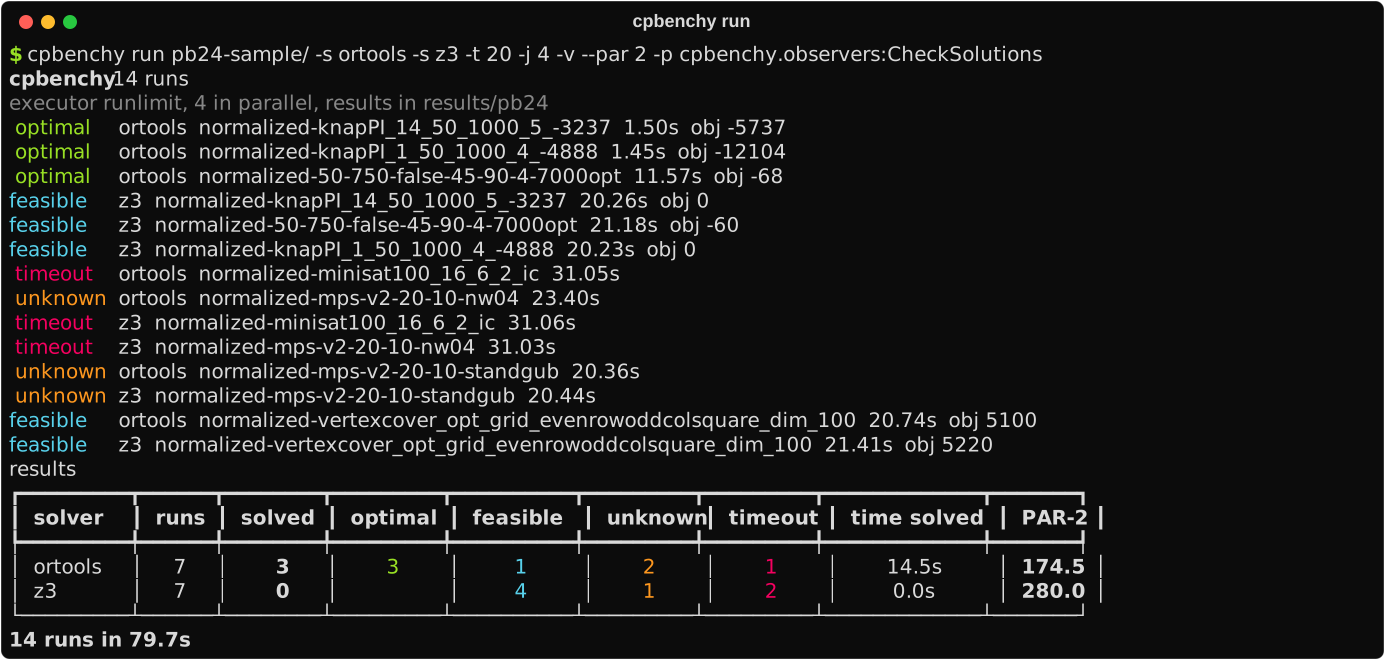
Reliably benchmark CPMpy solvers. Every run gets its own process, its own cores and resource limits, get back one record per run: status, objective, times and memory.
From the command line or from the Python API. Interrupt it, and resume later.
Key features
- Measured properly: BenchExec's
runexecwith cgroups, CPU time and peak memory, pinned cores - Any instance: XCSP3, OPB, WCNF, DIMACS, MPS and more, compressed or not, any CPMpy dataset
- Any solver: every solver CPMpy supports
- Competition-ready: follow the XCSP3 and PB competitions' rules and output
- Checked answers: every solution checked against the model
- Analysis-friendly: one record per run, access as a pandas DataFrame, get PAR-k scores
- Extensible: your own measurements, formats, ... a flexible plugin architecture
Install
pip install cpbenchy
cpbenchy doctor          # check install
Linux, Python 3.10+. For reliable limits, install BenchExec with cgroups v2; see Installation.
Quick start
# a benchmark set: the PB24 optimisation instances (or any instance files of your own)
python -c "from cpmpy.tools.datasets import OPBDataset; OPBDataset(root='data', year=2024, track='OPT-LIN', download=True)"

cpbenchy run data/opb/ -s ortools -s exact -t 60 --limit 10   # two solvers, ten instances, 60 s each
cpbenchy show                                                 # the summary, from cpbenchy-results/
Run it again without --limit, and only the missing runs get performed.
Creat your first benchmark.
From Python
import cpbenchy

results = cpbenchy.run("data/opb/", solvers=["ortools", "exact"], time_limit=60)
results.to_pandas().groupby("solver").solved.sum()
For different settings per solver, results as they come in, or asyncio, see Experiments.
Make it yours
Record anything about each run with an observer, a class following the observer pattern:
class SolverTime(cpbenchy.Observer):
    def on_finish(self, ctx):                      # at the end of each run
        ctx.record("solver_time_s", ctx.solver.status().runtime)
Load your own formats, choose runs, or replace any step: see Extending cpbenchy.
What's included
- Competition rules: the limits, signals and output of the XCSP3 and PB competitions, or your own:
--rules xcsp3-2025 - Competition output: answers printed as the XCSP3, PB, MaxSAT and SAT competitions expect them
- Solution checking: during the run, or afterwards on stored solutions:
cpbenchy check - PAR-k scores: rank solvers as competitions do:
--par 2 - Stopping at the limit: SIGTERM at the limit, and the best solution so far:
--terminate - CPU time limits, seeds, solver parameters, cores per run, and runs in parallel
- Experiments in Python: settings per solver, results as they come in, asyncio
- Competition submissions (work in progress): a self-contained submission from rules and a solver
- From your framework (work in progress): cpbenchy measures, your framework decides and stores
The library lists everything ready to use, and the examples are there to copy.
License
cpbenchy is licensed under the Apache License 2.0.
1 maintainer

Metadata
1 maintainer
Release files for cpbenchy 0.1.0.dev0
For a detailed explanation of source distributions (sdists) and built distributions (wheels), please see the package formats documentation.
Source distribution (sdist)
| File | Size | Uploaded | |
|---|---|---|---|
| cpbenchy-0.1.0.dev0.tar.gz | 77.1 kB | Details |
Built distribution (wheel)
| File | Interpreter | ABI | Platform | Reset |
|---|---|---|---|---|
| cpbenchy-0.1.0.dev0-py3-none-any.whl | Python 3 | none | any | Details |
Total release size: 176.4 kB
Release files / cpbenchy-0.1.0.dev0.tar.gz
| Download URL | cpbenchy-0.1.0.dev0.tar.gz |
|---|---|
| Size | 77.1 kB |
| Tags | Source |
|
SHA-256 checksum How to use checksums |
f1e2b44eaa44f0bcba76cf3190390d5d63d26c3a5e6cfc187252748af91b00e1
|
|
BLAKE2b-256 checksum How to use checksums |
5e8a26601acd7f3bfd6bfd14200300f631471d9be498ff0f2af9e907a097add9
|
| Upload date | |
|
Uploaded using Trusted Publishing? What is trusted publishing? |
Yes |
| Uploaded via |
twine/7.0.0 CPython/3.13.14
|
Provenance
Provenance describes where a file came from. On PyPI, provenance is shared via attestations, which provide a verifiable record of the build or publishing details. View details, limitations and caveats.


PyPI Publish Attestation
PyPI verified that this artifact, at this checksum, originated from the publisher listed below.
Signed by GitHub Actions, verified by PyPI on Oct 6, 2026.
Transparency logRelease files / cpbenchy-0.1.0.dev0-py3-none-any.whl
| Download URL | cpbenchy-0.1.0.dev0-py3-none-any.whl |
|---|---|
| Size | 99.3 kB |
| Tags | Python 3 |
|
SHA-256 checksum How to use checksums |
d5dbded94f4fa63028b0336163d4d4e0a8f1aeece71415bd9ee45c0c1fffdb6b
|
|
BLAKE2b-256 checksum How to use checksums |
a6607b1fa286103901719d35624e2cf1e402f8d28e98c16f45ebc7de6b4510b5
|
| Upload date | |
|
Uploaded using Trusted Publishing? What is trusted publishing? |
Yes |
| Uploaded via |
twine/7.0.0 CPython/3.13.14
|
Provenance
Provenance describes where a file came from. On PyPI, provenance is shared via attestations, which provide a verifiable record of the build or publishing details. View details, limitations and caveats.
PyPI Publish Attestation
PyPI verified that this artifact, at this checksum, originated from the publisher listed below.
Signed by GitHub Actions, verified by PyPI on Oct 6, 2026.
Transparency log












