
crashlab


Crash-test your AI agents. Your agent failed in production. crashlab replays the exact run offline, tells you which step broke and why, and checks whether a fix works before you ship it.
crashlab is an open-source, framework-agnostic Python library that turns agent failures into fixes you can trust. It works today:
- Record every LLM and tool call from your existing agent loop (OpenAI, Anthropic, LiteLLM), with no rewrite.
- Replay any failed run exactly, offline, and fork it at any step.
- Diagnose the failing step and its root cause, backed by verbatim evidence from the trace.
- Verify a proposed fix by rerunning the failure and your past good runs.
- Export the failure as a pytest regression test.
pip install "crashlab[openai] @ git+https://github.com/Mpasha17/crashlab" # not on PyPI yet
Then try it offline with no API key or see the Quickstart.
Status: pre-alpha (0.0.1). Today crashlab records runs, lets you inspect them, replays them strictly offline, grades them with
@crashlab.checkoracles, forks them at any step with typed patches and diffs two runs. It also diagnoses failed runs, proposes fixes and verifies them with repeated live forks, then exports a pytest regression test and a shareable HTML report (see ARCHITECTURE.md). Not on PyPI yet.
Reproduced a real upstream bug
We pointed crashlab at well-known open-source agent examples, with oracles from their documented behaviour — no injected faults.
Flagship: huggingface/smolagents
examples/text_to_sql.py. This is a known, still-unmerged bug with an open fix PR
(#2475, opened 8 Jul 2026 by xiangyuhao723); crashlab reproduced and
diagnosed it independently. The example builds sqlite:///:memory:, then
LocalPythonExecutor runs every code block in a fresh ThreadPoolExecutor.
SQLAlchemy's default SingletonThreadPool for :memory: opens a new, empty
database in that thread, so the agent hits no such table: receipts and invents a
failure. Direct calls on the main thread work, which hides the bug. crashlab adds a
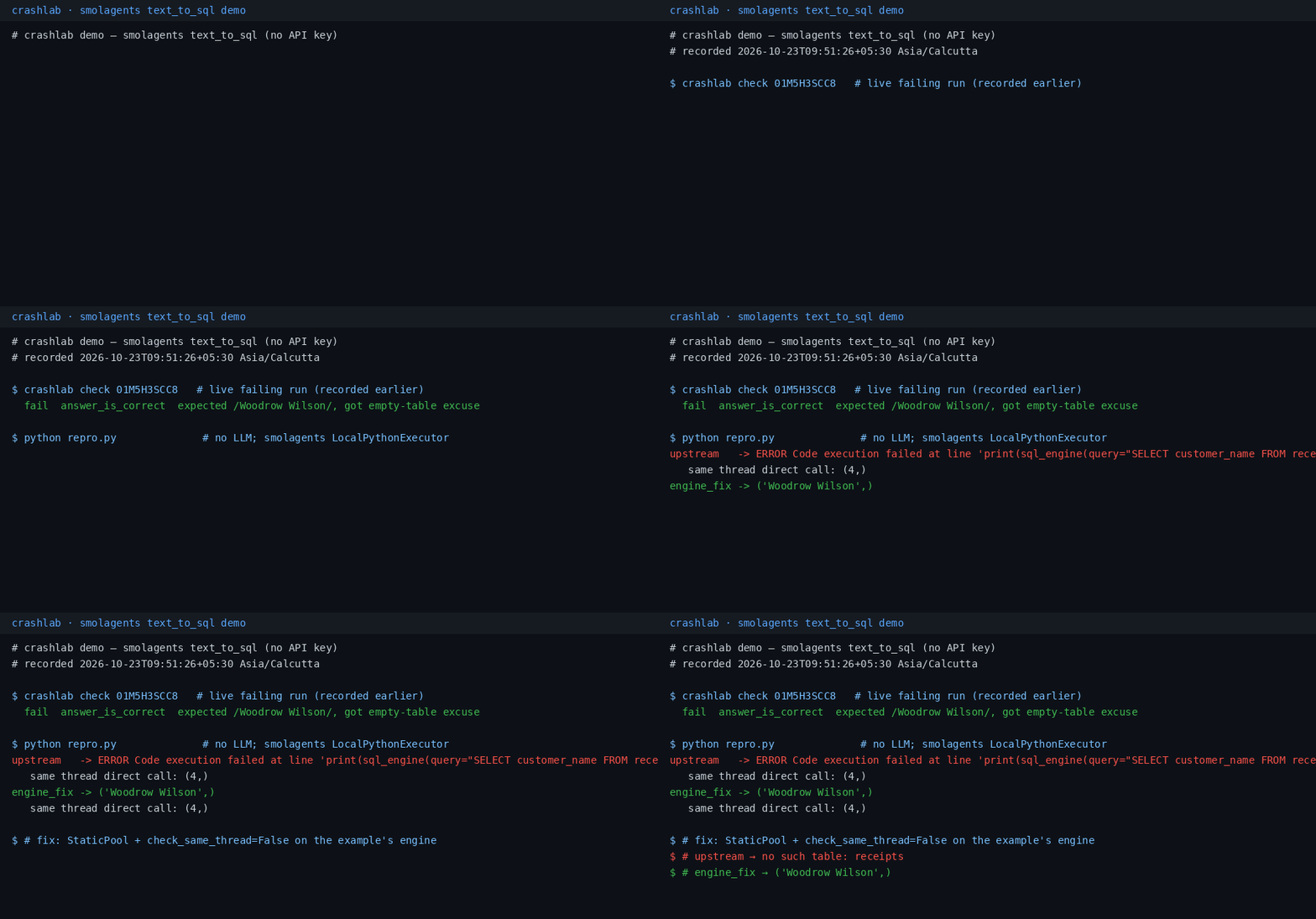
no-LLM repro through smolagents' own LocalPythonExecutor: upstream → error,
StaticPool + check_same_thread=False → ('Woodrow Wilson',).
Case studies: docs/case-studies/. Flagship write-up: smolagents text_to_sql. Terminal demo (no keys): docs/demo/ (GIF above). We did not file an upstream issue: it would duplicate PR #2475.
Also tried: OpenAI Agents SDK examples/customer_service (Triage Agent answers
follow-up FAQ questions itself on a smaller open model; two scoped prompt patches were
correctly REJECTED by crashlab verify for regressing past FAQ runs — the rejection
is the point). CrewAI: recording gap on with_raw_response.create fixed; 3/3 live
scenarios pass. Integration notes: examples/integrations/.
Results so far
Live runs of the bundled demo refund agent with injected faults, on free tiers. Each
fix was checked by crashlab verify: patched forks vs unpatched controls, plus past good
runs as a regression check. Small n; the labels are deliberately conservative.
| fault in the demo agent | model | verdict |
|---|---|---|
policy_drop: the 30-day refund-window rule is missing from the system prompt |
Groq gpt-oss-120b | VERIFIED: patched 5/5 vs control 0/5, 2/2 past good runs still pass, $0.002 |
policy_drop (same restore-policy patch) |
Groq gpt-oss-20b, Gemini flash-lite | VERIFIED: 3/3 vs control 0/3 on each |
misleading_desc: the tool description says to refund total * 0.9 |
Groq gpt-oss-20b, Gemini flash-lite | VERIFIED: 3/3 vs control 0/3, regression run passes (gpt-oss-120b: INCONCLUSIVE, rate-limited) |
html_502: get_order returns an HTML 502 page and the agent retries in a loop |
Groq gpt-oss-120b | LIKELY only: 3/3 vs control 1/3 (intervals overlap) |
On a real, unmodified example (OpenAI Agents SDK customer_service), both prompt
patches for a genuine triage failure were REJECTED because they broke past good FAQ
runs. That is the verifier doing its job.
Evidence: live scoreboard, case studies, Verify a fix.
What works today
crashlab.wrap(client)records LLM calls, sync and async:- OpenAI
OpenAI/AsyncOpenAIand any OpenAI-compatible endpoint (Ollama, vLLM, LiteLLM proxy ...):chat.completions.createandresponses.create. - Anthropic
Anthropic/AsyncAnthropic:messages.createandmessages.stream(...).
- OpenAI
- LiteLLM:
crashlab.integrations.litellm.patch()(orcrashlab.wrap(litellm)) recordslitellm.completion/litellm.acompletion;unpatch()restores them. - Streaming: with
stream=True(and Anthropic'smessages.stream()), chunks reach your code unchanged; crashlab assembles and records the final response when the stream ends, errors, or is closed early (marked incomplete). - One common shape for every provider: system, messages as typed parts (text,
tool calls, tool results, images/audio/files as placeholders, reasoning), tools, params,
plus finish reason and token usage. The same conversation on OpenAI and Anthropic
normalizes to the same messages, and each request gets a stable sha256
request_hash. @crashlab.tool(side_effects=...)records tool arguments, results and exceptions;@crashlab.agent(name=...)/with crashlab.record(name, input=...)mark runs (input, output, status, usage totals, entry point, git sha).- Threads:
crashlab.bind_context(fn),crashlab.ContextThreadPoolExecutorandcrashlab.run_in_thread(fn, ...)keep recording tool/LLM calls made in worker threads (asyncio tasks andasyncio.to_threadwork out of the box). - Local store
.crashlab/(or$CRASHLAB_DIR): a SQLite index plus one JSONL cassette per run. API keys, auth headers (Authorization,x-api-key...) and token-like strings are redacted before anything is written; add your own rules withcrashlab.redaction.add_pattern(...),add_key(...),add_hook(fn). - Strict offline replay:
crashlab.replay(run)/crashlab replay <run_id|last>re-runs the recorded entry point with every LLM and tool call served from the cassette: no API key, no network (outbound connections are blocked), and tools never run, soside_effects=Truetools cannot fire. Calls are matched by step order plus the normalized request hash; anything else raisesDivergenceErrorwith the step, the differing fields and a diff. Works for OpenAI chat / Responses, Anthropic (messages.stream()included) and LiteLLM, plain and streamed, sync and async. The replay is stored as a new run withreplay_ofpointing at the source. - Outcome oracles:
@crashlab.check("agent-name")functions get the finished run and pass (returnTrue/None) or fail (False, a message string, or a failedassert). They run when a run ends and setoutcometopass/fail;crashlab check <run_id>re-runs them on a stored run. - Fork at step N with a patch:
crashlab.fork(run, at_step=N, patch=...)/crashlab fork <run> --at N ...re-runs the agent with steps before N served strictly from the cassette and step N onwards live (or against a client you pass), with the patch applied to every LLM request from N on. Tool calls identical to the parent's are served from the cassette;side_effects=Truetools never run live (an identical call gets the recorded result, anything else is blocked and recorded as an attempt). The fork is a new run linked byforked_from,fork_stepand the patch. - Typed patches (pydantic, JSON/YAML-serializable, composable with
+, each renders a human-readable diff):SystemPromptPatch(replace / append / prepend / insert, replace or delete a line / substitute; optionalwhenscopes to one agent's prompt),MessagePatch,InjectMessagePatch,ToolResultPatch(counterfactual tool result or error),ToolDescriptionPatch,ToolSchemaPatch,ModelParamPatch(model and params). Work for OpenAI chat / Responses, Anthropic and LiteLLM. crashlab diff A B/crashlab.diff(a, b): how the runs relate (fork / replay), outcome and check changes, tokens / steps / time side by side, a step-by-step comparison (same, different request, different response, only in A / B) and the first divergence with a field diff.Bdefaults toA's parent.- Runtime checks (built in, on by default): cheap deterministic detectors that run
while the agent is recorded and on stored runs (
crashlab check). They emit typed findings (kind, severityinfo/warn/error/critical, steps, a message and verbatim evidence quotes):step_repetition(same tool + arguments again and again, near-identical LLM requests),tool_error_streak,bad_tool_args(validated against the tool's JSON schema),suspicious_tool_result(HTML / error pages, empty or truncated results, a result whose shape drifted from earlier results of the same tool),budget(steps, LLM / tool calls, tokens, USD, seconds) andlength_cutoff. Findings are stored with the run and shown byshow,diffandls --flagged. They describe how a run behaved;@crashlab.checkoracles still decide whether it passed. Opt-in circuit breaker: a critical finding stops the agent (CircuitBreakerError), and strict replay stops at the same step. - Cost estimates per step and per run in USD, from a small built-in price table
(OpenAI, Anthropic, Groq, Gemini; dated prices) plus LiteLLM's cost map when LiteLLM is
installed. Local servers (Ollama, localhost) cost $0. Unknown models show no cost; prices
are never guessed. Your own prices:
crashlab.pricing.set_price(...)or[tool.crashlab.prices]. - Diagnose:
crashlab diagnose RUN/crashlab.diagnose(run, model=...)names the failing step, a failure label (TOOL_ERROR_MISHANDLED,BAD_TOOL_ARGUMENTS,WRONG_TOOL_SELECTION,STEP_REPETITION,TASK_SPEC_VIOLATION,EXTERNAL_FAILURE, orNO_FAILURE/UNKNOWN), a one-sentence root cause and verbatim evidence quotes, from one LLM call over a compacted trace with the checks and findings as hints. Every quote is checked against the step it cites; an answer without valid evidence becomesUNKNOWN. Any model works (Groq, Gemini, Ollama, OpenAI, Anthropic, LiteLLM);--heuristicneeds none. Stored with the run, shown bycrashlab show, cached. - Fix proposals:
crashlab fix RUN/crashlab.propose_fixes(run)makes a second, separate LLM call that turns the diagnosis into 1-3 ranked typed patches (system prompt line, tool description or schema, model params, a message; tool-result counterfactuals are marked test-only), each with a rationale and expected effect. A proposal is kept only if it parses, its target exists in the run (dry-run diff), it is small, and it does not hard-code this run's data (order ids, amounts ...). Kept fixes are stored with the run and saved as patch files forcrashlab fork --patch;--tryforks once with the top fix and shows the checks. crashlab report RUN: one screen with the outcome, checks, findings, diagnosis, fixes with diffs and the next commands to run (crashlab diagnose --fixprints it too).- Share runs:
crashlab export RUN -o run.jsonl/crashlab import run.jsonl(redacted again on the way out). - CLI:
crashlab ls,crashlab show <run_id|last>,crashlab replay,crashlab check,crashlab diagnose,crashlab fix,crashlab report,crashlab fork,crashlab diff,crashlab export,crashlab import; in Python,crashlab.load("last").
Not yet: a live HTML viewer server. Streamed calls replay as a synthetic stream rebuilt from the recorded
final response (same content, different chunk boundaries).
Also not intercepted yet: Anthropic client.beta.messages, OpenAI
chat.completions.stream() / responses.stream() helpers. OpenAI
chat.completions.with_raw_response.create is recorded (CrewAI path).
OpenAI streams only report token usage if you pass stream_options={"include_usage": True}.
Quickstart
pip install "crashlab[openai] @ git+https://github.com/Mpasha17/crashlab"
# or crashlab[anthropic], crashlab[litellm]
import crashlab
from openai import OpenAI

client = crashlab.wrap(OpenAI())          # or OpenAI(base_url="http://localhost:11434/v1", api_key="ollama")
# client = crashlab.wrap(anthropic.Anthropic())

@crashlab.tool()
def get_order(order_id: str) -> dict: ...

@crashlab.tool(side_effects=True)
def issue_refund(order_id: str, amount: float) -> dict: ...

@crashlab.agent(name="refund-bot")
def run_agent(user_msg: str) -> str:
    ...                                    # your existing tool-calling loop, unchanged

@crashlab.check("refund-bot")              # outcome oracle: pass / fail
def refund_not_above_total(run) -> None:
    for step in run.tool_calls("issue_refund", ok_only=True):
        assert step.args["amount"] <= 49.0, f"refunded {step.args['amount']}"

run_agent("Refund my order A17, it arrived broken")

run = crashlab.load("last")                # Run with .steps (chat / execute_tool), .outcome
replayed = crashlab.replay(run)            # offline; raises DivergenceError if it differs

# what if the prompt had said so? fork at the first LLM call with a patch, run live
branch = crashlab.fork(run, at_step=0, patch=crashlab.SystemPromptPatch(
    op="append", text="Never refund more than the order total."))
print(crashlab.diff(run, branch).summary())
crashlab ls            # runs: id, name, status, outcome, steps, tokens, cost, findings
crashlab ls --flagged  # only runs with runtime-check findings (--min-severity error)
crashlab show last     # checks, findings + step table: idx, op, name, args / result, error
crashlab replay last   # offline re-run from the cassette; exit 1 + diff on divergence
crashlab check last    # re-run the oracles and the runtime checks (--save to store them)
crashlab check --all --findings-only --max-cost 0.05 --fail-on error   # e.g. in CI
crashlab fork last --at 0 --system-append "Never refund more than the order total."
crashlab fork last --at 2 --patch fix.yaml --dry-run   # show the patch diff, run nothing
crashlab diff last     # the fork vs its parent: checks, usage, steps, first divergence
Runtime checks are configured per run or in pyproject.toml, and record(checks=...)
wins over pyproject:
@crashlab.agent(name="refund-bot", checks={"max_steps": 20, "max_cost_usd": 0.10,
                                           "circuit_breaker": True})
[tool.crashlab.checks]
circuit_breaker = true          # stop the agent on a critical finding (default: off)
max_steps = 20                  # budget: also max_llm_calls, max_tool_calls, max_tokens,
max_cost_usd = 0.10             #   max_seconds; warn at 80% (budget.warn_at)
[tool.crashlab.checks.step_repetition]
threshold = 3                   # warn at 3 identical tool calls, critical at 5
Try it with no API key and no model
The repo ships five real recorded runs of the demo agent (secrets and local paths scrubbed): a clean refund, a policy violation the oracles fail, a 502 retry loop the runtime checks flag, a run the circuit breaker stopped, and a small local model passing a bad argument.
git clone https://github.com/Mpasha17/crashlab && cd crashlab
python -m venv .venv && . .venv/bin/activate && pip install -e ".[openai]"
export CRASHLAB_DIR=/tmp/crashlab-demo
for f in examples/refund_bot/demo/*.jsonl; do crashlab import "$f"; done
crashlab ls                        # 5 runs, with cost and findings
crashlab show 01M57GM9Q5           # Groq gpt-oss-120b retrying an HTML 502 page 3 times
crashlab check --all               # oracles + runtime checks, offline (exit 1: C03 fails)
crashlab replay 01M57GM7H9         # strict offline replay of the policy violation
crashlab diagnose 01M57GM7H9 --heuristic   # failing step + label from checks/findings
crashlab fork 01M57GM7H9 --at 0 --dry-run \
  --system-append "Never refund an order delivered more than 30 days ago."
Diagnose a run
# any OpenAI-compatible endpoint; the key is read from the env var you name
crashlab diagnose 01M57GM7H9 --model openai/gpt-oss-120b \
  --base-url https://api.groq.com/openai/v1 --api-key-env GROQ_API_KEY
crashlab diagnose last --model gemini/gemini-flash-latest      # via LiteLLM
crashlab diagnose last --model qwen2.5:7b --base-url http://localhost:11434/v1  # Ollama
crashlab diagnose last --show-prompt   # the compacted trace the diagnoser reads, no call
d = crashlab.diagnose(run, model="openai/gpt-oss-120b",
                      base_url="https://api.groq.com/openai/v1", api_key=key)
d.label, d.failing_step, d.root_cause, d.evidence   # also run.diagnosis, `crashlab show`
Or set CRASHLAB_DIAGNOSER_MODEL / CRASHLAB_DIAGNOSER_BASE_URL /
CRASHLAB_DIAGNOSER_API_KEY. The diagnoser's own calls are recorded in
.crashlab/diagnoser/, apart from your runs.
On 31 hand-labelled live runs of the demo agent (bench/diagnose_eval.py, details in
bench/README.md), with prompt v3 Groq openai/gpt-oss-120b gets the label
right on 90% and Gemini gemini-flash-lite-latest on 87% (heuristic baseline: 81%, tuned on
the same set); exact culprit step on 71% / 76% of the failing runs, with no false alarms
on clean runs.
Propose a fix and try it
crashlab fix 01M57GM7H9 --model openai/gpt-oss-120b \
  --base-url https://api.groq.com/openai/v1 --api-key-env GROQ_API_KEY
crashlab report 01M57GM7H9          # diagnosis, fix-1 with its diff, next commands
# --try forks once with fix-1, live: the agent uses its own client, e.g. on Groq
OPENAI_BASE_URL=https://api.groq.com/openai/v1 OPENAI_API_KEY=$GROQ_API_KEY \
  crashlab fix 01M57GM7H9 --model openai/gpt-oss-120b \
  --base-url https://api.groq.com/openai/v1 --api-key-env GROQ_API_KEY --try
Verify a fix
# 5 forks with fix-1 + 5 unpatched controls + the patch rerun on past good runs
OPENAI_BASE_URL=https://api.groq.com/openai/v1 OPENAI_API_KEY=$GROQ_API_KEY \
  crashlab verify 01M57GM7H9 --fix fix-1 -k 5 --regress 01M57GM0VB,01M57GM5RH --max-cost 0.50
# or all in one: diagnose (if needed) -> fix -> verify
crashlab fix 01M57GM7H9 --model ... --verify -k 5
Verdicts: VERIFIED (patched Wilson 95% lower bound above the control's upper bound,
or controls all fail and patched all pass; no regression), LIKELY (better, but not
significant or incomplete), INCONCLUSIVE (too few usable trials), REJECTED (a
past good run now fails, or no better than control). Provider errors (429/5xx) are
counted as errored, never as fails. --no-control, --regress none|tag:X|ID,ID,
--json, --pace SECONDS (free-tier rate limits). Child runs are tagged verify:<id>; crashlab report lists fix attempts.
On Groq gpt-oss-120b: policy_drop fix-1 went 5/5 vs control 0/5, 2/2 good runs still
pass (VERIFIED, $0.002).
Export a regression test and an HTML report
crashlab export-test 01M5GTK1FR --fix auto -o tests/crashlab   # test + cassettes
pytest --crashlab            # runs only exported tests: offline, no keys, no network
crashlab report 01M5GTK1FR --html report.html   # one self-contained file to share
The exported test replays the failing run and asserts its @check results, and (with
--fix) replays a passing patched run from crashlab verify with the fix re-applied,
asserting it still passes. The pytest plugin (auto-loaded) adds --crashlab, the
@pytest.mark.crashlab marker and the crashlab_replay(path) / crashlab_store
fixtures. Store and home paths are replaced in exported cassettes. See
examples/refund_bot/tests, which CI runs.
The HTML report has the outcome, checks, findings, diagnosis with quotes, fixes with
diffs, verification stats and the step timeline; inline CSS, no scripts, no external
assets.
Free, local, with Ollama
Running the demo agent, or a fork for real (without --dry-run), needs a model. A local
one is free:
ollama pull qwen2.5:3b             # or llama3.2:3b / qwen2.5:7b: any tool-calling model
OPENAI_BASE_URL=http://localhost:11434/v1 OPENAI_API_KEY=ollama MODEL=qwen2.5:3b \
  python -m examples.refund_bot "Refund my order A17, it arrived broken"
FAULT_HTML_502=1 OPENAI_BASE_URL=http://localhost:11434/v1 OPENAI_API_KEY=ollama MODEL=qwen2.5:3b \
  python -m examples.refund_bot "Refund my order A17"     # get_order returns an HTML 502 page
# or through LiteLLM (pip install -e ".[litellm]"): ollama_chat/ uses Ollama's native tools
python -m examples.refund_bot --provider litellm --model ollama_chat/qwen2.5:3b "Refund A17"
crashlab ls && crashlab show last  # cost: $0
crashlab replay last               # no model server needed

# the same agent on Anthropic
PROVIDER=anthropic ANTHROPIC_API_KEY=sk-ant-... MODEL=claude-haiku-4-5 \
  python -m examples.refund_bot "Refund my order A17, it arrived broken"
See examples/refund_bot for details.
See CHANGELOG.md for what landed in 0.0.1.
Benchmark (seed, small n)
crashlab bench injects 4 faults into 2 demo agents (3 episodes per cell, fixes verified
with k=3) and scores the diagnoser on a held-out agent (sql-analyst) that nothing was
tuned on. On Gemini flash-lite, the LLM diagnoser labelled 6/6 triggered faults
correctly (Wilson 95% CI 61–100%); the heuristic baseline got 2/6 (10–70%). No fix was
VERIFIED on the held-out agent (0/3, 1/3 LIKELY): its faults were in the tool and the
database, which a prompt patch can't repair, so the rejections are correct. On Groq
gpt-oss-120b the LLM diagnoser labelled only 3/11 (10–57%) on the held-out agent.
Samples are small and the intervals are wide; details, all CIs and caveats in
bench/README.md.
Development
python -m venv .venv && . .venv/bin/activate
pip install -e ".[dev,openai,anthropic,litellm]"
ruff check . && ruff format --check . && pytest
The tests use fake clients and the real SDKs over mocked HTTP transports (LiteLLM via
mock_response), so they need no network access and no API key. Tests for SDKs that are
not installed are skipped.
Security notes: SECURITY.md.
License
Apache-2.0
1 maintainer

Metadata
1 maintainer
Release files for crashlab 0.0.1
For a detailed explanation of source distributions (sdists) and built distributions (wheels), please see the package formats documentation.
Source distribution (sdist)
| File | Size | Uploaded | Provenance | Actions |
|---|---|---|---|---|
| crashlab-0.0.1.tar.gz | 459.2 kB | With provenance | Details for crashlab-0.0.1.tar.gz |
Built distribution (wheel)
| File | Interpreter | ABI | Platform | Actions Reset |
|---|---|---|---|---|
| crashlab-0.0.1-py3-none-any.whl | Python 3 | none | any | Details for crashlab-0.0.1-py3-none-any.whl |
Total release size: 641.6 kB
Release files / crashlab-0.0.1.tar.gz
| Download URL | crashlab-0.0.1.tar.gz |
|---|---|
| Size | 459.2 kB |
| Tags | Source |
|
SHA-256 checksum How to use checksums |
f8747c08e3b9060a167eda9ada7afc29d5db5e636b61c781478dfccf7c1b9b1d
|
|
BLAKE2b-256 checksum How to use checksums |
5adf43d81c89b405c68cdc8e559417cd125ad2cef15b573471acb63ae2e6a58b
|
| Upload date | |
|
Uploaded using Trusted Publishing? What is trusted publishing? |
Yes |
| Uploaded via |
twine/7.0.0 CPython/3.13.16
|
Provenance
Provenance describes where a file came from. On PyPI, provenance is shared via attestations, which provide a verifiable record of the build or publishing details. View details, limitations and caveats.


PyPI Publish Attestation
PyPI verified that this artifact, at this checksum, originated from the publisher listed below.
Signed by GitHub Actions, verified by PyPI on Oct 28, 2026.
Transparency logRelease files / crashlab-0.0.1-py3-none-any.whl
| Download URL | crashlab-0.0.1-py3-none-any.whl |
|---|---|
| Size | 182.4 kB |
| Tags | Python 3 |
|
SHA-256 checksum How to use checksums |
23e2a79d21b521719aadc2163c8d7f359453059f15eb8fe97a1e9b434bf0aa65
|
|
BLAKE2b-256 checksum How to use checksums |
13341c43a94336788fc77461965290272d35ec126500b473ef6f439b5ed08595
|
| Upload date | |
|
Uploaded using Trusted Publishing? What is trusted publishing? |
Yes |
| Uploaded via |
twine/7.0.0 CPython/3.13.16
|
Provenance
Provenance describes where a file came from. On PyPI, provenance is shared via attestations, which provide a verifiable record of the build or publishing details. View details, limitations and caveats.
PyPI Publish Attestation
PyPI verified that this artifact, at this checksum, originated from the publisher listed below.
Signed by GitHub Actions, verified by PyPI on Oct 28, 2026.
Transparency logSecurity for crashlab 0.0.1
Provenance
Provenance describes where a file came from. On PyPI, provenance is shared via attestations, which provide a verifiable record of the build or publishing details. View details, limitations and caveats.
Full provenance
Both files in this release have been uploaded with provenance metadata.
Attestation for crashlab-0.0.1.tar.gz
PyPI Publish Attestation
PyPI verified that this artifact, at this checksum, originated from the publisher listed below.
Signed by GitHub Actions, verified by PyPI on Oct 28, 2026.
Transparency logA note on package security
PyPI is a repository for distributing packages, not a service for auditing them. While third-party security researchers and our staff do their best to detect and remove malicious packages, PyPI cannot guarantee the quality, security or suitability of any given package.
To learn more about protecting yourself from malicious actors, visit our package security documentation.














