
CRATE: Clustering-based Nonlinear Analysis of Materials

Project description
What is CRATE?
Docs | Installation | GitHub | PyPI
Summary
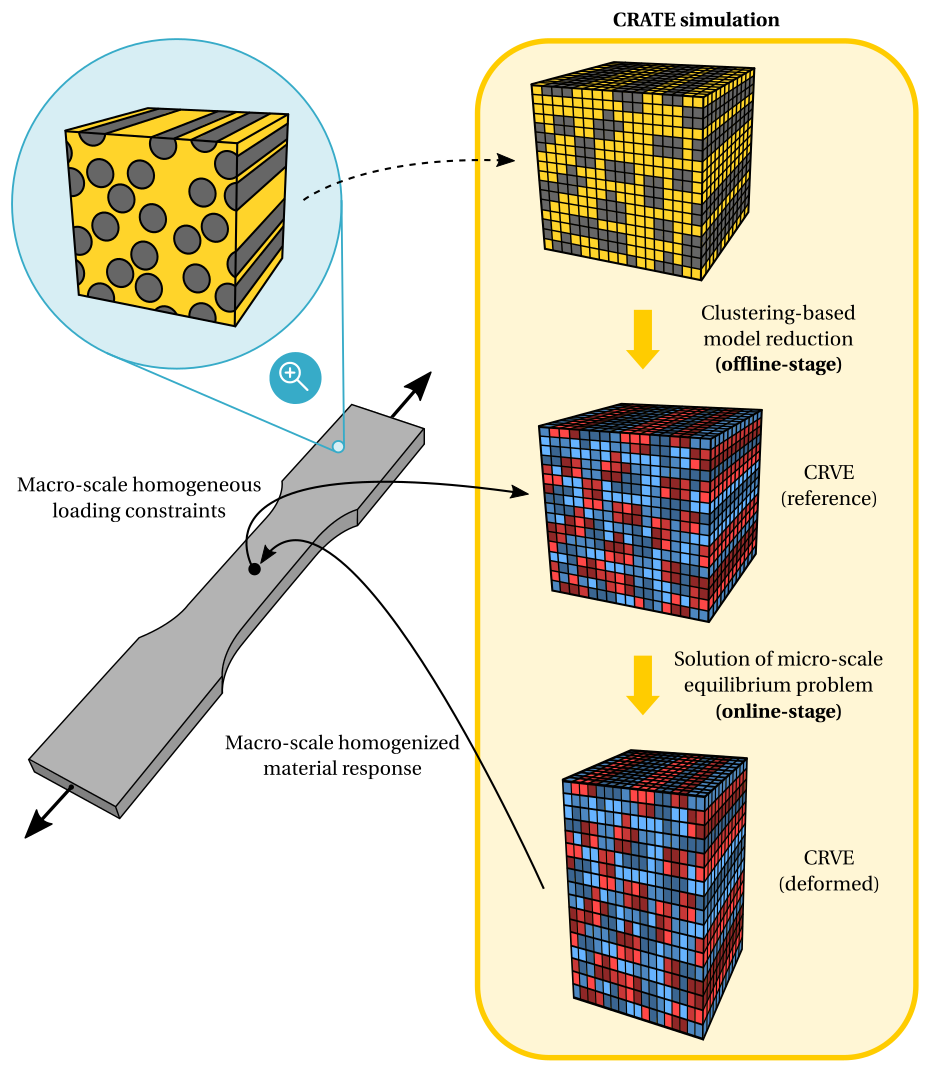
CRATE (Clustering-based Nonlinear Analysis of Materials) is a Python project (package cratepy) developed in the context of computational mechanics to aid the design and development of new materials. Its main purpose is performing multi-scale nonlinear analyses of heterogeneous materials through a suitable coupling between first-order computational homogenization and clustering-based reduced-order modeling: given a representative volume element of the material microstructure and the corresponding material phase properties, CRATE computes the material's effective mechanical response when subject to a prescribed macro-scale loading path.
Statement of need
cratepy is essentially a numerical tool for any application that requires material multi-scale simulations. Given the intrinsic clustering-based reduced-order modeling approach (e.g., SCA, ASCA), CRATE is mostly useful in applications where the computational cost of standard simulation methods is prohibitive, namely to solve lower-scales in coupled hierarchical multi-scale simulations (e.g., B.P. Ferreira (2022)) and to generate large material response databases for data-driven frameworks based on machine learning (e.g., Bessa et al. (2017)). Clustering-based reduced-order models achieve a striking balance between accuracy and computational cost by first performing a clustering-based domain decomposition of the material model and then solving the equilibrium problem formulated over the resulting reduced model.
In the particular case of a research environment, cratepy is designed to easily accommodate further developments, either by improving the already implemented methods or by including new numerical models and techniques. It also provides all the fundamental means to perform comparisons with alternative methods, both in terms of accuracy and computational cost. In a teaching environment, cratepy is a readily available tool for demonstrative purposes and/or academic work proposals in solid mechanics and material-related courses.
Authorship & Citation
CRATE was originally developed by Bernardo P. Ferreira1 in the context of his PhD Thesis2.
If you use CRATE in a scientific publication, it is appreciated that you cite this PhD Thesis:
@phdthesis{ferreira:2022a,
  title = {Towards Data-driven Multi-scale Optimization of Thermoplastic Blends: Microstructural Generation, Constitutive Development and Clustering-based Reduced-Order Modeling},
  author = {Ferreira, B.P.},
  year = {2022},
  langid = {english},
  school = {University of Porto},
  url={https://hdl.handle.net/10216/146900}
}
1 Profile: LinkedIN, ORCID, ResearchGate
2 Ferreira, B.P. (2022). Towards Data-driven Multi-scale Optimization of Thermoplastic Blends: Microstructural Generation, Constitutive Development and Clustering-based Reduced-Order Modeling. PhD Thesis, University of Porto (see here)
Getting started
You can find everything you need to know in CRATE documentation!
Community Support
If you find any issues, bugs or problems with CRATE, please use the GitHub issue tracker to report them. Provide a clear description of the problem, as well as a complete report on the underlying details, so that it can be easily reproduced and (hopefully) fixed!
You are also welcome to post there any questions, comments or suggestions for improvement in the GitHub discussions space!
Please refer to CRATE's Code of Conduct.
Note:
Bear in mind that CRATE is a program developed in an academic environment and that I'm currently the only developer as a side project. This means that I'll do my best to address all the issues, questions and suggestions, but do expect a reasonable time frame! ~ Bernardo P. Ferreira
Credits
-
Bernardo P. Ferreira is deeply thankful to Francisco Pires and Miguel Bessa for supervising the PhD Thesis that motivated the development of CRATE.
-
Bernardo P. Ferreira acknowledges the pioneering development of clustering-based reduced-order models by Zeliang Liu, namely by proposing the Self-Consistent Clustering Analysis (SCA), that established the conceptual framework and foundations for the development of CRATE.
License
Copyright 2020, Bernardo Ferreira
All rights reserved.
CRATE is a free and open-source software published under a BSD 3-Clause License.


Download files
Download the file for your platform. If you're not sure which to choose, learn more about installing packages.
Source Distribution
Built Distribution
Filter files by name, interpreter, ABI, and platform.
If you're not sure about the file name format, learn more about wheel file names.
Copy a direct link to the current filters
File details
Details for the file cratepy-1.0.3.tar.gz.
File metadata
- Download URL: cratepy-1.0.3.tar.gz
- Upload date:
- Size: 195.5 kB
- Tags: Source
- Uploaded using Trusted Publishing? No
- Uploaded via: twine/4.0.2 CPython/3.9.12
File hashes
| Algorithm | Hash digest | |
|---|---|---|
| SHA256 |
4d3403e8323a42bc70f4db03c055fb00aee16d9623b7a91dd3c4abee0cf5b889
|
|
| MD5 |
64fa996b9f5ba15835176259e8b03b94
|
|
| BLAKE2b-256 |
63cbb2f30045d5b7eefffae1fcdcd38cbd92d1b182f6e995b81ac96a32e39af6
|
File details
Details for the file cratepy-1.0.3-py3-none-any.whl.
File metadata
- Download URL: cratepy-1.0.3-py3-none-any.whl
- Upload date:
- Size: 222.0 kB
- Tags: Python 3
- Uploaded using Trusted Publishing? No
- Uploaded via: twine/4.0.2 CPython/3.9.12
File hashes
| Algorithm | Hash digest | |
|---|---|---|
| SHA256 |
109f5e7969fdac618c9214d20f00741ee258b5c2de52fb751dbddffb82dde874
|
|
| MD5 |
9bc87be13d6d7d177dc05648bf9ad3fb
|
|
| BLAKE2b-256 |
6ba623df40ca7b56a05ef4b951cb42e0bfe3c4b17455e72c2b0fd9b82a41c422
|






