
AI-powered threat hunting and incident response MCP server for Elasticsearch/OpenSearch with 79 tools, 6,060 detection rules, and baseline behaviour analysis
Verified details
These details have been verified by PyPIProject links
GitHub Statistics
Maintainers

Project description

CrowdSentinel MCP Server
AI-Powered Threat Hunting & Incident Response Framework








MCP Official Registry · PyPI Package
Open-source threat hunting orchestrator connecting LLMs to enterprise security data via Model Context Protocol (MCP)
Quick Start · Installation · CLI Usage · Features · Architecture · Documentation · Examples
Demo
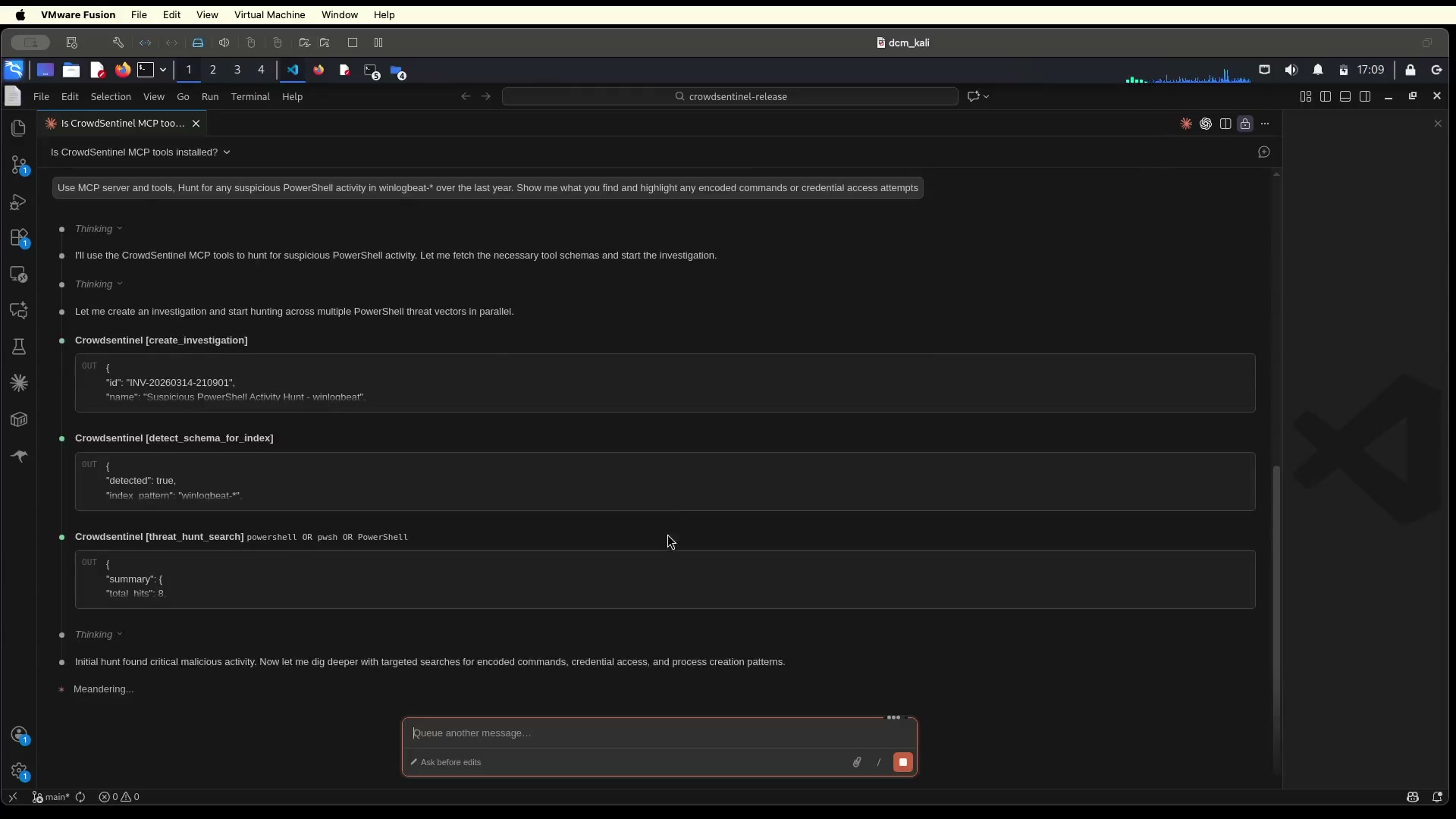
Click the image above to watch the full demo video.
What is CrowdSentinel?
CrowdSentinel transforms traditional SIEM querying into intelligent, framework-driven investigations using natural language. It serves as a unified security intelligence layer that connects large language models to enterprise security data sources, enabling:
- Natural Language Threat Hunting — Query Elasticsearch using plain English
- AI-Guided Investigation Workflows — Built-in prompts guide agents through proper IR methodology
- Persistent Investigation State — Memory-managed IoC tracking, forensic timelines, and cross-query correlation that survives across sessions (8GB FIFO storage)
- Cross-Tool IoC Correlation — IoCs discovered in one tool are automatically available to all others
- Multi-Source Analysis — Elasticsearch, EVTX logs (Chainsaw), PCAP files (Wireshark)
- Standalone CLI — Full threat hunting from the terminal without an MCP client
Installation
Install from PyPI (recommended)
# Install with pip
pip install crowdsentinel-mcp-server

# Or install with uv
uv pip install crowdsentinel-mcp-server

# Download detection rules, Chainsaw, and Sigma rules (one-time)
crowdsentinel setup
Detection rules (6,060 Lucene + EQL + ES|QL) are bundled with the package — no download needed. The setup command downloads additional tools:
- Chainsaw binary for EVTX analysis
- 3,000+ Sigma rules for Chainsaw
Downloaded tools are stored in ~/.crowdsentinel/ and persist across package upgrades.
System dependency for PCAP analysis:
# Required for network traffic analysis and cross-tool IoC correlation
sudo apt install tshark    # Debian/Ubuntu/Kali
sudo dnf install wireshark-cli  # Fedora/RHEL
brew install wireshark     # macOS
Run directly with uvx (no install needed)
# Elasticsearch 8.x (default)
uvx crowdsentinel-mcp-server

# Other backends
uvx crowdsentinel-mcp-server-es7   # Elasticsearch 7.x
uvx crowdsentinel-mcp-server-es9   # Elasticsearch 9.x
uvx opensearch-mcp-server          # OpenSearch 1.x/2.x/3.x
Install from source
git clone https://github.com/thomasxm/CrowdSentinels-AI-MCP.git
cd CrowdSentinels-AI-MCP
chmod +x setup.sh && ./setup.sh
The setup script will:
- Install dependencies (pipx, uv, Claude Code CLI if needed)
- Bundle 6,060 detection rules and download Chainsaw binary
- Prompt for Elasticsearch credentials (never hardcoded)
- Configure the MCP server with Claude Code
- Validate your connection
Installed Size
CrowdSentinel bundles 6,060 detection rules and integrates with external analysis tools. Below is the full disk space breakdown so you can plan accordingly.
Core package (via pip or uvx):
| Component | Size | Notes |
|---|---|---|
| CrowdSentinel package | 49 MB | The server itself |
— Bundled Sigma rules (src/rules/) |
30 MB | 6,060 pre-converted detection rules |
— Elastic TOML rules (src/detection-rules/) |
17 MB | Original TOML format rules + hunting queries |
| — Python code (clients, tools, etc.) | 2 MB | Actual application code |
| Dependencies | 64 MB | All transitive deps |
— cryptography |
14 MB | Largest dependency (TLS) |
— elasticsearch |
8.3 MB | ES Python client |
— pygments |
5.2 MB | Syntax highlighting |
— pydantic_core |
5 MB | Validation engine |
— opensearchpy |
3.6 MB | OpenSearch client |
| — Others (27 packages) | ~28 MB | mcp, fastmcp, httpx, anthropic, etc. |
| Core total | 113 MB | pip install crowdsentinel-mcp-server |
Additional tools (via crowdsentinel setup):
| Component | Download | Installed | Notes |
|---|---|---|---|
| Chainsaw binary (v2.13.1) | ~3 MB | ~15 MB | EVTX log analysis engine |
| Sigma rules (SigmaHQ) | ~3 MB | ~30 MB | 3,000+ Sigma rules for Chainsaw |
| Chainsaw mappings | — | <1 MB | Event log source mappings |
| Setup total | ~6 MB | ~46 MB | Stored in ~/.crowdsentinel/ |
System dependency (via package manager):
| Component | Installed | Install Command | Notes |
|---|---|---|---|
| tshark + Wireshark libs | ~132 MB | sudo apt install tshark |
PCAP network analysis — required for cross-tool IoC correlation |
Full installation summary:
| Scenario | Total Disk Space |
|---|---|
Core only (pip install) |
~113 MB |
Core + setup (crowdsentinel setup) |
~159 MB |
| Full platform (+ tshark) | ~291 MB |
Note: PyPI download size is only 8.9 MB (wheel) thanks to compression of the bundled detection rules.
Quick Start
1. Set environment variables
export ELASTICSEARCH_HOSTS="https://localhost:9200"
export ELASTICSEARCH_API_KEY="your_api_key"
# Or use username/password:
# export ELASTICSEARCH_USERNAME="elastic"
# export ELASTICSEARCH_PASSWORD="your_password"
export VERIFY_CERTS="false"
2. Connect to an MCP Client
CrowdSentinel works with any MCP-compatible AI agent. Choose your client below:
Claude Code (CLI)
claude mcp add crowdsentinel \
  -e ELASTICSEARCH_HOSTS="https://localhost:9200" \
  -e ELASTICSEARCH_API_KEY="your_api_key" \
  -e VERIFY_CERTS="false" \
  -- uvx crowdsentinel-mcp-server
Claude Desktop
Edit ~/.config/Claude/claude_desktop_config.json (Linux) or ~/Library/Application Support/Claude/claude_desktop_config.json (macOS):
{
  "mcpServers": {
    "crowdsentinel": {
      "command": "uvx",
      "args": ["crowdsentinel-mcp-server"],
      "env": {
        "ELASTICSEARCH_HOSTS": "https://localhost:9200",
        "ELASTICSEARCH_API_KEY": "your_api_key",
        "VERIFY_CERTS": "false"
      }
    }
  }
}
VS Code Copilot
Create .vscode/mcp.json in your workspace:
{
  "servers": {
    "crowdsentinel": {
      "command": "uvx",
      "args": ["crowdsentinel-mcp-server"],
      "env": {
        "ELASTICSEARCH_HOSTS": "https://localhost:9200",
        "ELASTICSEARCH_API_KEY": "your_api_key",
        "VERIFY_CERTS": "false"
      }
    }
  }
}
Then enable MCP in VS Code settings: "chat.mcp.enabled": true
Cursor
Create or edit ~/.cursor/mcp.json:
{
  "mcpServers": {
    "crowdsentinel": {
      "command": "uvx",
      "args": ["crowdsentinel-mcp-server"],
      "env": {
        "ELASTICSEARCH_HOSTS": "https://localhost:9200",
        "ELASTICSEARCH_API_KEY": "your_api_key",
        "VERIFY_CERTS": "false"
      }
    }
  }
}
Roo Code (VS Code Extension)
Create .roo/mcp.json in your workspace:
{
  "mcpServers": {
    "crowdsentinel": {
      "command": "uvx",
      "args": ["crowdsentinel-mcp-server"],
      "env": {
        "ELASTICSEARCH_HOSTS": "https://localhost:9200",
        "ELASTICSEARCH_API_KEY": "your_api_key",
        "VERIFY_CERTS": "false"
      }
    }
  }
}
Or configure via Roo Code settings panel: Settings > MCP Servers > Add Server.
5ire
In 5ire settings (v0.15.0+), add an MCP server with:
- Command:
uvx - Arguments:
crowdsentinel-mcp-server - Environment Variables:
ELASTICSEARCH_HOSTS=https://localhost:9200ELASTICSEARCH_API_KEY=your_api_keyVERIFY_CERTS=false
Note: 5ire v0.14.0 has known MCP compatibility issues. Use v0.15.0+ for reliable operation.
Any MCP Client (Generic)
stdio transport (default — works with most clients):
{
  "mcpServers": {
    "crowdsentinel": {
      "command": "uvx",
      "args": ["crowdsentinel-mcp-server"],
      "env": {
        "ELASTICSEARCH_HOSTS": "https://localhost:9200",
        "ELASTICSEARCH_API_KEY": "your_api_key",
        "VERIFY_CERTS": "false"
      }
    }
  }
}
SSE transport (for web-based clients):
crowdsentinel-mcp-server --transport sse --port 8001
# Connect to: http://localhost:8001/sse/
HTTP transport (for REST API clients):
crowdsentinel-mcp-server --transport streamable-http --port 8001
# Connect to: http://localhost:8001/mcp/
3. Or use the CLI directly
# Download rules and tools (one-time)
crowdsentinel setup

# Check cluster health
crowdsentinel health

# Hunt for threats
crowdsentinel hunt "powershell encoded" -i winlogbeat-*

# Run detection rules
crowdsentinel rules -p windows --tactic credential_access
crowdsentinel detect windows_builtin_win_alert_mimikatz_keywords_lucene -i winlogbeat-*

# Analyse PCAP files
crowdsentinel pcap overview capture.pcap
crowdsentinel pcap beaconing capture.pcap

# Hunt EVTX logs with Chainsaw
crowdsentinel chainsaw hunt /path/to/evtx/ --sigma-rules /path/to/sigma/
CLI Usage
CrowdSentinel provides a full CLI for threat hunting from the terminal:
pip install crowdsentinel-mcp-server
crowdsentinel setup    # Download rules, Chainsaw, Sigma (one-time)
crowdsentinel --help
Available Commands
| Command | Description | Example |
|---|---|---|
setup |
Download detection rules, Chainsaw, and Sigma rules | crowdsentinel setup |
health |
Show cluster health | crowdsentinel health |
indices |
List all indices | crowdsentinel indices |
hunt |
IR-focused threat hunt with IoC extraction | crowdsentinel hunt "powershell" -i winlogbeat-* |
eql |
Execute an EQL query | crowdsentinel eql "process where process.name == 'cmd.exe'" -i winlogbeat-* |
esql |
Execute an ES|QL query | crowdsentinel esql "FROM logs-* | LIMIT 10" |
detect |
Execute a detection rule by ID | crowdsentinel detect win_susp_logon -i winlogbeat-* |
rules |
List available detection rules | crowdsentinel rules -p windows --tactic credential_access --type eql |
schema |
Detect schema for an index pattern | crowdsentinel schema -i winlogbeat-* |
ioc |
Hunt for a specific Indicator of Compromise | crowdsentinel ioc 203.0.113.42 --type ip -i winlogbeat-* |
analyse |
Analyse search results from stdin (JSON) | cat results.json | crowdsentinel analyse -c "context" |
pcap |
Analyse PCAP files (overview, beaconing, lateral movement) | crowdsentinel pcap beaconing capture.pcap |
chainsaw |
Hunt EVTX logs with Chainsaw and Sigma rules | crowdsentinel chainsaw hunt /path/to/evtx/ |
Output Formats
All commands support --output/-o with three formats:
crowdsentinel hunt "failed login" -i winlogbeat-* -o json     # Structured JSON (default)
crowdsentinel hunt "failed login" -i winlogbeat-* -o table    # Human-readable table
crowdsentinel hunt "failed login" -i winlogbeat-* -o summary  # Condensed summary
Pipeline Example
# Hunt then analyse (mirrors the MCP investigation workflow)
crowdsentinel hunt "powershell encoded" -i winlogbeat-* -o json | \
  crowdsentinel analyse -c "Encoded PowerShell commands" -o summary
Key Features
79 MCP ToolsThreat hunting, detection rules, forensics, network analysis — all accessible via natural language 6,060 Detection RulesPre-built Lucene, EQL & ES|QL rules with automatic MITRE ATT&CK mapping Investigation StatePersistent IoC tracking across tools and sessions with FIFO storage |
4 Security Frameworks
3 Data Sources
|
Architecture
┌─────────────────────────────────────────────────────────────────┐
│                 LLM Client / Claude Code CLI                    │
└─────────────────────────────┬───────────────────────────────────┘
                              │ MCP Protocol (stdio/SSE/HTTP)
                              ▼
┌─────────────────────────────────────────────────────────────────┐
│                    CrowdSentinel MCP Server                      │
│  ┌───────────────┐ ┌───────────────┐ ┌───────────────────────┐  │
│  │   79 Tools    │ │ 6,060 Rules   │ │ Security Frameworks   │  │
│  │ - Hunting     │ │ - Lucene      │ │ - Cyber Kill Chain    │  │
│  │ - Detection   │ │ - EQL         │ │ - Pyramid of Pain     │  │
│  │ - Forensics   │ │ - Sigma       │ │ - Diamond Model       │  │
│  │ - Network     │ │               │ │ - MITRE ATT&CK        │  │
│  └───────────────┘ └───────────────┘ └───────────────────────┘  │
│  ┌─────────────────────────────────────────────────────────────┐│
│  │              Investigation State (Persistent)                ││
│  │         Cross-tool IoC sharing, timeline, reporting         ││
│  └─────────────────────────────────────────────────────────────┘│
└─────────────────────────────┬───────────────────────────────────┘
                              │
        ┌─────────────────────┼─────────────────────┐
        ▼                     ▼                     ▼
┌───────────────┐    ┌───────────────┐    ┌───────────────┐
│ Elasticsearch │    │   Chainsaw    │    │   Wireshark   │
│  /OpenSearch  │    │  (EVTX/Sigma) │    │    (PCAP)     │
└───────────────┘    └───────────────┘    └───────────────┘
                              │
                              ▼ (Roadmap)
┌───────────────┐    ┌───────────────┐    ┌───────────────┐
│    Splunk     │    │ Velociraptor  │    │     Zeek      │
│               │    │  (EDR/DFIR)   │    │   (NSM/IDS)   │
└───────────────┘    └───────────────┘    └───────────────┘
What's Included
Tool Categories (79 Tools)
| Category | Tools | Description |
|---|---|---|
| Elasticsearch Core | 18 | Index, document, cluster, alias, data stream operations |
| Threat Hunting | 12 | Attack pattern detection, IoC hunting, timeline analysis |
| Detection Rules | 9 | 6,060 rule library — list, execute, validate, suggest |
| Kill Chain Analysis | 5 | Stage hunting, progression tracking, adjacent stage prediction |
| Investigation Prompts | 5 | Fast triage spine — 10 critical IR questions |
| Chainsaw (EVTX) | 6 | Sigma rule hunting, iterative IoC discovery |
| Wireshark (PCAP) | 11 | Network forensics, beaconing, lateral movement detection |
| Investigation State | 13 | Persistent IoCs, cross-tool sharing, export, reporting |
Security Frameworks
| Framework | Purpose |
|---|---|
| Cyber Kill Chain | Hunt by attack stage (7 stages), predict adversary's next move |
| Pyramid of Pain | Prioritise IoCs by difficulty for attackers to change (6 levels) |
| Diamond Model | Map adversary, capability, infrastructure, victim relationships |
| MITRE ATT&CK | Automatic technique mapping for all detections |
Detection Rules (6,060 Rules)
| Type | Count | Source | Description |
|---|---|---|---|
| Lucene | 1,966 | Sigma-converted | Fast pattern matching queries |
| EQL | 3,963 | Sigma-converted + Elastic | Event sequences and correlations |
| ES|QL | 131 | Elastic TOML rules | Pipe-based query language (ES 8.11+) |
Platforms: Windows, Linux, macOS, Cloud (AWS/Azure/GCP), Network, Identity
Log Sources: PowerShell, Sysmon, Security Events, Process Creation, Audit logs
Configuration
Environment Variables
# Connection (required — choose one)
ELASTICSEARCH_HOSTS="https://localhost:9200"       # Self-hosted
# OR
ELASTICSEARCH_CLOUD_ID="deployment:base64..."      # Elastic Cloud

# Authentication — choose one (in priority order):
ELASTICSEARCH_BEARER_TOKEN="service_token_here"    # Service/bearer token
ELASTICSEARCH_API_KEY="your_api_key"               # API key (recommended)
ELASTICSEARCH_USERNAME="elastic"                   # Basic auth
ELASTICSEARCH_PASSWORD="your_password"

# TLS / Certificate verification
VERIFY_CERTS="true"                                # Verify against system CA bundle
# VERIFY_CERTS="/path/to/ca.crt"                   # Verify against custom CA certificate
# ELASTICSEARCH_CA_CERT="/path/to/ca.crt"          # Explicit CA certificate path
# ELASTICSEARCH_CLIENT_CERT="/path/to/client.crt"  # Client certificate (mTLS)
# ELASTICSEARCH_CLIENT_KEY="/path/to/client.key"   # Client private key (mTLS)

# Options
REQUEST_TIMEOUT="30"                               # Request timeout in seconds
DISABLE_HIGH_RISK_OPERATIONS="true"                # Block all write operations
Security Warning: Never use
VERIFY_CERTS="false"or plain-text passwords in production. Use API keys or service tokens with TLS certificate verification enabled. For self-signed certificates, setELASTICSEARCH_CA_CERTto your CA certificate path.
Production Configuration Examples
Elastic Cloud
ELASTICSEARCH_CLOUD_ID="my-deployment:dXMtY2VudHJhbC0x..."
ELASTICSEARCH_API_KEY="your_cloud_api_key"
VERIFY_CERTS="true"
Self-Hosted with Custom CA
ELASTICSEARCH_HOSTS="https://es-cluster.internal:9200"
ELASTICSEARCH_API_KEY="your_api_key"
ELASTICSEARCH_CA_CERT="/etc/elasticsearch/certs/ca.crt"
VERIFY_CERTS="true"
Mutual TLS (mTLS)
ELASTICSEARCH_HOSTS="https://es-cluster.internal:9200"
ELASTICSEARCH_CA_CERT="/etc/elasticsearch/certs/ca.crt"
ELASTICSEARCH_CLIENT_CERT="/etc/elasticsearch/certs/client.crt"
ELASTICSEARCH_CLIENT_KEY="/etc/elasticsearch/certs/client.key"
VERIFY_CERTS="true"
Development / Testing (insecure)
ELASTICSEARCH_HOSTS="http://localhost:9200"
ELASTICSEARCH_USERNAME="elastic"
ELASTICSEARCH_PASSWORD="test123"
VERIFY_CERTS="false"
This configuration is not suitable for production. Use API keys with TLS in production environments.
Transport Modes
| Mode | Use Case | Command |
|---|---|---|
| stdio (default) | MCP clients (Claude Code, etc.) | Auto-configured by setup.sh |
| SSE | Web/streaming clients | --transport sse --port 8000 |
| HTTP | REST API access | --transport streamable-http |
Disabling Write Operations
For read-only access (recommended for production):
DISABLE_HIGH_RISK_OPERATIONS="true"
This hides destructive tools: create_index, delete_index, index_document, delete_document, delete_by_query, create_data_stream, delete_data_stream, put_alias, delete_alias, general_api_request
Usage Examples
Example 1: Hunt for Brute Force Attacks
You: Hunt for brute force attacks in the last hour

CrowdSentinel: Searching for failed authentication attempts...
[Calls hunt_by_timeframe with attack_types=["brute_force"]]

Found 47 failed login attempts from 3 source IPs targeting the "admin" account.
Top sources:
- 192.168.1.105: 28 attempts
- 10.0.0.42: 15 attempts
- 172.16.0.8: 4 attempts
Example 2: Investigate a Suspicious Host
You: Show me all activity on host DESKTOP-ABC123 in the last 24 hours

CrowdSentinel: Generating a forensic timeline for that host...
[Calls get_host_activity_timeline]

Timeline shows:
- 09:15: User "jsmith" logged in (Event 4624)
- 09:17: PowerShell executed encoded command
- 09:18: New scheduled task created "WindowsUpdate"
- 09:22: Outbound connection to 203.0.113.42:443
- 09:25: LSASS memory access detected
Example 3: Kill Chain Analysis
You: We found C2 beaconing. What should we hunt for next?

CrowdSentinel: Hunting adjacent kill chain stages...
[Calls hunt_adjacent_stages with current_stage="COMMAND_AND_CONTROL"]

Looking backwards (Installation stage):
- Found scheduled task persistence on 3 hosts
- Registry Run key modifications detected

Looking forwards (Actions on Objectives):
- Lateral movement to 2 additional hosts via SMB
- Credential dumping attempts detected
Example 4: Network Traffic Analysis
You: Analyse this PCAP for C2 beaconing

CrowdSentinel: Checking for regular connection intervals...
[Calls detect_beaconing on the PCAP file]

Detected beaconing pattern:
- Host: 192.168.1.50 → 203.0.113.100:443
- Interval: 60 seconds (±2s jitter)
- Duration: 4 hours
- Confidence: HIGH

Recommend blocking 203.0.113.100 and investigating 192.168.1.50.
Example 5: CLI Threat Hunt
# Hunt for encoded PowerShell
crowdsentinel hunt "powershell -enc" -i winlogbeat-* --timeframe 1440 -o json

# Pipe results to analysis
crowdsentinel hunt "event.code:4625" -i winlogbeat-* -o json | \
  crowdsentinel analyse -c "Failed authentication investigation"

# Search detection rules for lateral movement
crowdsentinel rules --tactic lateral_movement -p windows
Compatibility
| Package | Backend | Install |
|---|---|---|
crowdsentinel-mcp-server |
Elasticsearch 8.x (default) | pip install crowdsentinel-mcp-server |
crowdsentinel-mcp-server-es7 |
Elasticsearch 7.x | pip install crowdsentinel-mcp-server-es7 |
crowdsentinel-mcp-server-es9 |
Elasticsearch 9.x | pip install crowdsentinel-mcp-server-es9 |
opensearch-mcp-server |
OpenSearch 1.x, 2.x, 3.x | pip install opensearch-mcp-server |
For Developers
Project Structure
crowdsentinel-mcp-server/
├── src/
│   ├── server.py                 # MCP server entry point
│   ├── version.py                # Version constant
│   ├── risk_config.py            # Write operation controls
│   │
│   ├── cli/                      # Standalone CLI
│   │   └── main.py               # CLI entry point (argparse)
│   │
│   ├── clients/                  # Backend logic layer
│   │   ├── base.py               # Base client, authentication
│   │   ├── exceptions.py         # Exception handling decorators
│   │   └── common/
│   │       ├── client.py         # Unified SearchClient (multiple inheritance)
│   │       ├── threat_hunting.py # Threat hunting queries
│   │       ├── ioc_analysis.py   # IoC extraction & analysis
│   │       ├── cyber_kill_chain.py # Kill chain logic
│   │       ├── rule_loader.py    # Detection rule loading
│   │       └── chainsaw_client.py # EVTX/Sigma integration
│   │
│   ├── tools/                    # MCP tool interfaces (thin wrappers)
│   │   ├── register.py           # Dynamic tool registration
│   │   ├── threat_hunting.py     # Hunting tool definitions
│   │   ├── rule_management.py    # Rule management tools
│   │   ├── chainsaw_hunting.py   # Chainsaw tools
│   │   ├── wireshark_tools.py    # Network analysis tools
│   │   └── investigation_state_tools.py # State management tools
│   │
│   ├── storage/                  # Persistent investigation state
│   │   ├── investigation_state.py # Core state management
│   │   ├── storage_manager.py    # File system storage (8GB FIFO)
│   │   └── models.py             # Pydantic models (IoC, Investigation)
│   │
│   └── wireshark/                # Network traffic analysis
│       ├── core/                 # TShark execution, PCAP parsing
│       ├── hunting/              # Beaconing, lateral movement, IoC hunting
│       ├── baseline/             # Traffic baseline creation
│       ├── extraction/           # File carving from traffic
│       └── reporting/            # NCSC-style reports, timelines
│
├── rules/                        # 6,060 detection rules (EQL + Lucene)
├── chainsaw/                     # Chainsaw binary + 3,000+ Sigma rules
├── skills/                       # Claude Code agent skills
└── tests/                        # Test suites
Design Patterns
| Pattern | Usage |
|---|---|
| Multiple Inheritance | SearchClient composes all specialised clients |
| Decorator | Exception handling via @handle_exceptions |
| Factory | create_search_client() creates appropriate client |
| Plugin Architecture | Tools registered dynamically via ToolsRegister |
| Auto-Capture | Tool results automatically analysed for IoCs |
Adding a New Tool
- Create client method in
src/clients/common/your_module.py:
class YourClient(SearchClientBase):
    def your_method(self, param: str) -> dict:
        # Implementation
        return results
- Add to SearchClient in
src/clients/common/client.py:
class SearchClient(YourClient, OtherClients, ...):
    pass
- Create tool wrapper in
src/tools/your_tools.py:
class YourTools:
    def __init__(self, client, mcp):
        self.client = client
        self.mcp = mcp

    def register_tools(self):
        @self.mcp.tool()
        def your_tool(param: str) -> str:
            """Tool description for LLM."""
            result = self.client.your_method(param)
            return json.dumps(result)
- Register in server in
src/server.py:
from src.tools.your_tools import YourTools

def _register_tools(self):
    # ... existing tools ...
    YourTools(self.client, self.mcp).register_tools()
Running Tests
# All tests
uv run pytest

# Specific module
uv run pytest tests/test_investigation_state.py

# With coverage
uv run pytest --cov=src
Local Testing Environment
# Start Elasticsearch
docker-compose -f docker-compose-elasticsearch.yml up -d

# Start OpenSearch
docker-compose -f docker-compose-opensearch.yml up -d
Default credentials (testing only):
- Elasticsearch:
elastic/test123 - OpenSearch:
admin/admin
Roadmap
| Feature | Status | Description |
|---|---|---|
| Velociraptor Integration | Planned | EDR/DFIR artifact collection and live response via Velociraptor API |
| Zeek Integration | Planned | Network security monitoring — parse Zeek logs (conn, dns, http, ssl, x509) for threat hunting |
| Splunk Integration | Planned | Add Splunk as a data source alongside Elasticsearch |
| Sigma Rule Converter | Planned | Convert Sigma rules to native ES/Splunk queries |
| Threat Intel Feeds | Planned | Automatic IoC enrichment from MISP, OTX, etc. |
| Case Management | Planned | Export investigations to TheHive, JIRA |
| Custom Rule Builder | Planned | Create detection rules via natural language |
See CHANGELOG.md for detailed version history.
Documentation
User Guides
| Document | Description |
|---|---|
| FIRST_TIME_SETUP.md | Detailed first-time setup instructions |
| HOW_TO_USE.md | Comprehensive usage guide |
| QUICK_START.md | 5-minute quick start |
| TRANSPORT_MODES.md | stdio, SSE, HTTP configuration |
Feature Guides
| Document | Description |
|---|---|
| THREAT_HUNTING_GUIDE.md | Threat hunting workflows |
| DETECTION_RULES_GUIDE.md | Using 6,060 detection rules |
| CYBER_KILL_CHAIN_GUIDE.md | Kill chain analysis |
| CHAINSAW_GUIDE.md | EVTX log analysis with Sigma |
| INVESTIGATION_PROMPTS_GUIDE.md | Fast triage spine |
| AI_AGENT_INTEGRATION.md | Workflow guidance for AI agents |
Developer Guides
| Document | Description |
|---|---|
| ARCHITECTURE.md | Detailed architecture documentation |
| CONTRIBUTING.md | Contribution guidelines |
Contributing
Contributions are welcome! Please see CONTRIBUTING.md for guidelines.
Licence
GNU General Public Licence v3.0 — See LICENSE for details.
Acknowledgements
- MCP Framework: Model Context Protocol by Anthropic
- Chainsaw: EVTX log analyser by WithSecure Labs
- Detection Rules: Community-contributed Sigma and custom rules
- Frameworks: Cyber Kill Chain (Lockheed Martin), Pyramid of Pain (David J. Bianco), Diamond Model, MITRE ATT&CK
Made for the security community by medjedtxm


Project details
Verified details
These details have been verified by PyPIProject links
GitHub Statistics
Maintainers
Release history Release notifications | RSS feed


Download files
Download the file for your platform. If you're not sure which to choose, learn more about installing packages.
Source Distribution
Built Distribution
Filter files by name, interpreter, ABI, and platform.
If you're not sure about the file name format, learn more about wheel file names.
Copy a direct link to the current filters
File details
Details for the file crowdsentinel_mcp_server-0.3.9.tar.gz.
File metadata
- Download URL: crowdsentinel_mcp_server-0.3.9.tar.gz
- Upload date:
- Size: 1.2 MB
- Tags: Source
- Uploaded using Trusted Publishing? Yes
- Uploaded via: twine/6.1.0 CPython/3.13.7
File hashes
| Algorithm | Hash digest | |
|---|---|---|
| SHA256 |
29f4aa8c0bafaf3eb6de1da23271d1087dadc78340c09de231aeed8ff7eeb1fc
|
|
| MD5 |
a0748a869ab0fbe189e38ca72b820ffb
|
|
| BLAKE2b-256 |
264272417b64db69811a8a061e54ad77ac4327f2b59095f0a74c0dc2dd9a41d5
|
Provenance
The following attestation bundles were made for crowdsentinel_mcp_server-0.3.9.tar.gz:
Publisher:
pypi-publish.yaml on thomasxm/CrowdSentinels-AI-MCP
-
Statement:
-
Statement type:
https://in-toto.io/Statement/v1 -
Predicate type:
https://docs.pypi.org/attestations/publish/v1 -
Subject name:
crowdsentinel_mcp_server-0.3.9.tar.gz -
Subject digest:
29f4aa8c0bafaf3eb6de1da23271d1087dadc78340c09de231aeed8ff7eeb1fc - Sigstore transparency entry: 1107830644
- Sigstore integration time:
-
Permalink:
thomasxm/CrowdSentinels-AI-MCP@4db8d0ca2f9c0f8eb865ee1fb0bf5872bf8e45e5 -
Branch / Tag:
refs/heads/main - Owner: https://github.com/thomasxm
-
Access:
private
-
Token Issuer:
https://token.actions.githubusercontent.com -
Runner Environment:
github-hosted -
Publication workflow:
pypi-publish.yaml@4db8d0ca2f9c0f8eb865ee1fb0bf5872bf8e45e5 -
Trigger Event:
workflow_run
-
Statement type:
File details
Details for the file crowdsentinel_mcp_server-0.3.9-py3-none-any.whl.
File metadata
- Download URL: crowdsentinel_mcp_server-0.3.9-py3-none-any.whl
- Upload date:
- Size: 9.3 MB
- Tags: Python 3
- Uploaded using Trusted Publishing? Yes
- Uploaded via: twine/6.1.0 CPython/3.13.7
File hashes
| Algorithm | Hash digest | |
|---|---|---|
| SHA256 |
6e67fb84b1a8a8a7621811b8e240a08d21351f7ced480ae52a7321f322b5d1f0
|
|
| MD5 |
6dec2967287b6dbd5040b42f9a4d9ae2
|
|
| BLAKE2b-256 |
e705e23798f04a76875befbf740be2ab32afc51a4655bb12c6364d4c91e9cab4
|
Provenance
The following attestation bundles were made for crowdsentinel_mcp_server-0.3.9-py3-none-any.whl:
Publisher:
pypi-publish.yaml on thomasxm/CrowdSentinels-AI-MCP
-
Statement:
-
Statement type:
https://in-toto.io/Statement/v1 -
Predicate type:
https://docs.pypi.org/attestations/publish/v1 -
Subject name:
crowdsentinel_mcp_server-0.3.9-py3-none-any.whl -
Subject digest:
6e67fb84b1a8a8a7621811b8e240a08d21351f7ced480ae52a7321f322b5d1f0 - Sigstore transparency entry: 1107830648
- Sigstore integration time:
-
Permalink:
thomasxm/CrowdSentinels-AI-MCP@4db8d0ca2f9c0f8eb865ee1fb0bf5872bf8e45e5 -
Branch / Tag:
refs/heads/main - Owner: https://github.com/thomasxm
-
Access:
private
-
Token Issuer:
https://token.actions.githubusercontent.com -
Runner Environment:
github-hosted -
Publication workflow:
pypi-publish.yaml@4db8d0ca2f9c0f8eb865ee1fb0bf5872bf8e45e5 -
Trigger Event:
workflow_run
-
Statement type:






