
Batteries-included, transport-agnostic authentication for FastAPI.

Project description

Batteries-included, transport-agnostic authentication for FastAPI.





crudauth gives you one CRUDAuth object that wires cookie sessions, JWT bearer tokens, OAuth, and email flows (verify / reset / change) - with CSRF, escalating login lockout, sudo mode, and multi-device session management - over your own SQLAlchemy User model. App policy lives in hooks, not in forked dependency code. Sessions and bearer both resolve to the same Principal, so narrowing or adding a transport never changes how you authorize a route.
Features
- Transport-agnostic: cookie sessions and JWT bearer tokens behind a single
Principal; first credential present wins, and authorization code never depends on which transport authenticated. - Your model, your schema: works over your existing SQLAlchemy
Uservia a logical-fieldcolumn_map- no forced renames, no second user table. - Secure by default: synchronizer-token CSRF, escalating per-IP/per-user login lockout, bcrypt with SHA-256 pre-hash (no 72-byte truncation), timing-equalized login, and trusted-proxy IP resolution.
- OAuth: Google, GitHub, or a custom provider - with the
statebound to the initiating browser to block login CSRF. - Email flows: verify / reset / change - you implement the
EmailSenderport, the package mints and verifies the signed, single-use tokens. - Sudo mode: short-lived re-authentication to gate sensitive actions, stamped on the session and cleared on logout.
- Multi-device sessions: list, revoke one, or "sign out everywhere", with a configurable per-user session cap.
- App policy in hooks:
AuthHooksfor welcome email, trial grant, audit logging - fired uniformly across every auth path. - Pluggable backends: in-memory for dev, Redis for production - for sessions, CSRF, lockout counters, and one-time tokens.
- Fully typed & async: ships
py.typed, built on SQLAlchemy 2.0 and Pydantic v2.
Requirements
- Python 3.10+
- FastAPI, SQLAlchemy 2.0+, Pydantic v2 (installed as dependencies)
Install
pip install crudauth            # core (session + bearer)
pip install "crudauth[all]"     # + httpx (oauth), redis, user-agents
Or with uv:
uv add crudauth
Quickstart
Sessions are the default - no transports= needed. You get cookie auth, CSRF,
login lockout, secure cookies, and /login /logout /register /me.
from fastapi import FastAPI, Depends
from crudauth import CRUDAuth, Principal
from myapp.db import get_session
from myapp.models import User

auth = CRUDAuth(session=get_session, user_model=User, SECRET_KEY="change-me")

app = FastAPI()
app.include_router(auth.router)

@app.get("/dashboard")
async def dashboard(me: Principal = Depends(auth.current_user())):
    return {"hello": me.user.username}
The user model
Inherit the mixin and get every column the package needs; your own columns coexist freely.
from sqlalchemy.orm import Mapped, mapped_column
from crudauth.models import AuthUserMixin
from myapp.db import Base

class User(Base, AuthUserMixin):
    __tablename__ = "users"
    full_name: Mapped[str | None] = mapped_column(default=None)
Existing table with different names? Map the contract, don't rename your schema:
auth = CRUDAuth(
    session=get_session, user_model=LegacyAccount, SECRET_KEY=...,
    column_map={"id": "account_id", "email": "email_address", "hashed_password": "pw_hash"},
)
Protecting routes - one factory, every case a kwarg
auth.current_user()                              # required, 401 if anon
auth.current_user(optional=True)                 # None instead of raising
auth.current_user(superuser=True)                # 403 unless is_superuser
auth.current_user(verified=True)                 # 403 unless email_verified
auth.current_user(scopes=["reports:read"])       # 403 unless scopes ⊇ required
auth.current_user(transport="bearer")            # narrow to one transport
auth.current_user(superuser=True, check=my_predicate)  # extra per-route check
The resolved Principal carries user_id, is_superuser, scopes,
transport (which transport authed the request), and user (your resolved
row).
Multiple transports, one identity
from crudauth import CRUDAuth, SessionTransport, BearerTransport

auth = CRUDAuth(
    session=get_session, user_model=User, SECRET_KEY=...,
    transports=[
        SessionTransport(backend="redis", redis_url=..., csrf=True),  # browsers
        BearerTransport(access_ttl=900, refresh="cookie"),            # apps/scripts
    ],
)
When both credentials are present, the first transport in the list wins. CSRF is a property of the session transport - it appears only where sessions do, never on bearer/api-key paths.
Storage & lifespan
Server-side backends open connections on startup - call initialize() /
shutdown() in your lifespan:
@asynccontextmanager
async def lifespan(app: FastAPI):
    await auth.initialize()
    yield
    await auth.shutdown()
OAuth, email, hooks, sudo
See the usage cookbook for OAuth (Google / GitHub / custom providers), email
flows (implement the EmailSender port; the package mints/verifies the signed
tokens), lifecycle hooks (AuthHooks - welcome email, trial grant, audit log),
sudo mode (sudo=SudoConfig() + auth.require_sudo()), and dropping to
primitives.
Architecture
crudauth is ports-and-adapters with feature slices and a single composition
root (CRUDAuth). The layering and the import-direction rules live in
crudauth/ARCHITECTURE.md - read it before adding a
transport, OAuth provider, or storage backend; each is meant to be a drop-in
file, not a cross-cutting edit.
License
Contact
Benav Labs – benav.io, Discord
The Benav Labs FastAPI family
crudauth is part of a family of composable FastAPI building blocks - use whichever you need:
- FastCRUD - powerful CRUD methods and automatic endpoint creation for your SQLAlchemy models.
- CRUDAdmin - a modern, secure admin interface generated straight from your models.
- Fastro (FastAPI-boilerplate) - a batteries-included FastAPI starter: auth, CRUD, jobs, caching, and rate-limits.
- FastroAI - the complete FastAPI SaaS template: payments, entitlements, email, a frontend, and AI agents.
Build a full SaaS on FastAPI
crudauth handles authentication in FastroAI - the complete FastAPI SaaS template: auth, Stripe payments (subscriptions, credits, discounts), entitlements, transactional email, an Astro frontend, and PydanticAI agents, wired together and production-ready.
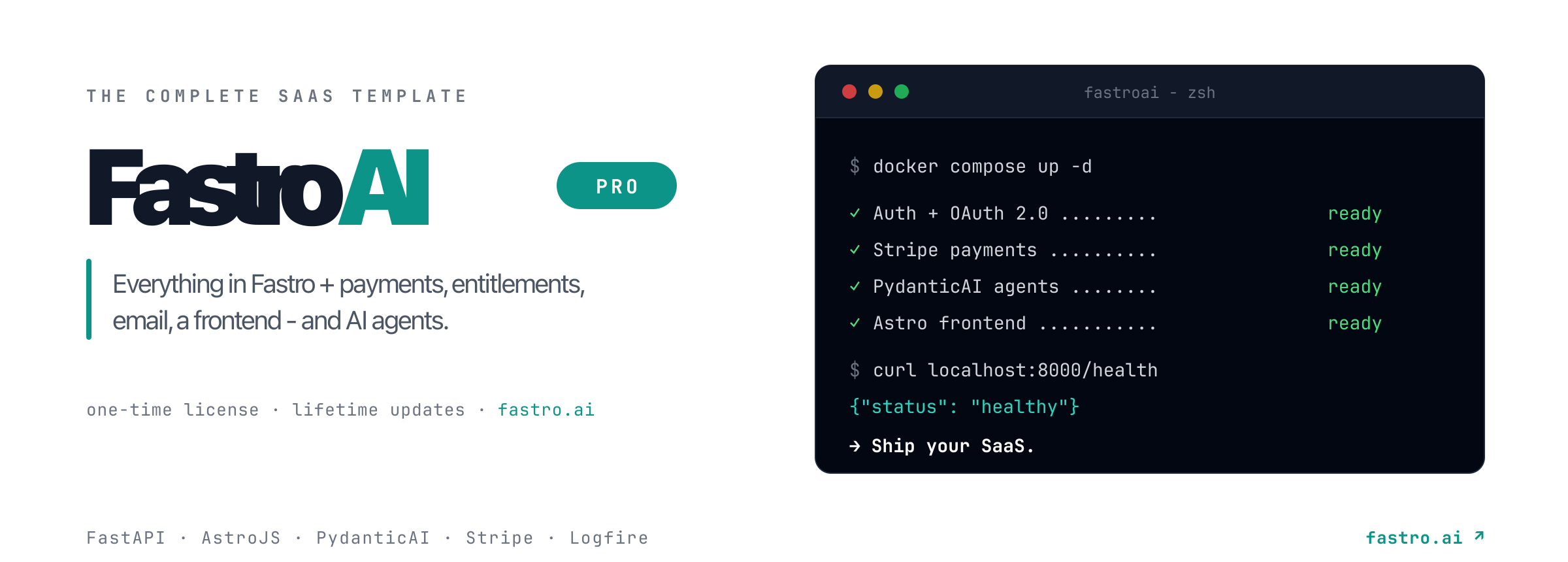
Ship your SaaS faster with FastroAI →



Download files
Download the file for your platform. If you're not sure which to choose, learn more about installing packages.
Source Distribution
File details
Details for the file crudauth-0.2.0.tar.gz.
File metadata
- Download URL: crudauth-0.2.0.tar.gz
- Upload date:
- Size: 75.6 kB
- Tags: Source
- Uploaded using Trusted Publishing? No
- Uploaded via: uv/0.10.11 {"installer":{"name":"uv","version":"0.10.11","subcommand":["publish"]},"python":null,"implementation":{"name":null,"version":null},"distro":{"name":"macOS","version":null,"id":null,"libc":null},"system":{"name":null,"release":null},"cpu":null,"openssl_version":null,"setuptools_version":null,"rustc_version":null,"ci":null}
File hashes
| Algorithm | Hash digest | |
|---|---|---|
| SHA256 |
69bc03d1c13b75fef9a5143da418e9719140fe05ecbe3d59d3db1a6b9849927d
|
|
| MD5 |
15d05c2a3f8bbe8191d2890d8f8fb231
|
|
| BLAKE2b-256 |
2bd953a3de86f7e52fb111a51a4b9338097e7f390b6b25efffb12f7b0e77bd2c
|






