
cryosweep

Analysis of Quantum Design PPMS and MPMS measurement files (.dat) — a Qt-free
analysis core with a JSON contract, a command-line interface, and a desktop GUI built on the
same analyzers.
One file in, physics out: cryosweep detects which measurement it is looking at, separates the sweeps, fits the appropriate models, and reports what it found — including when it cannot report something, and why.
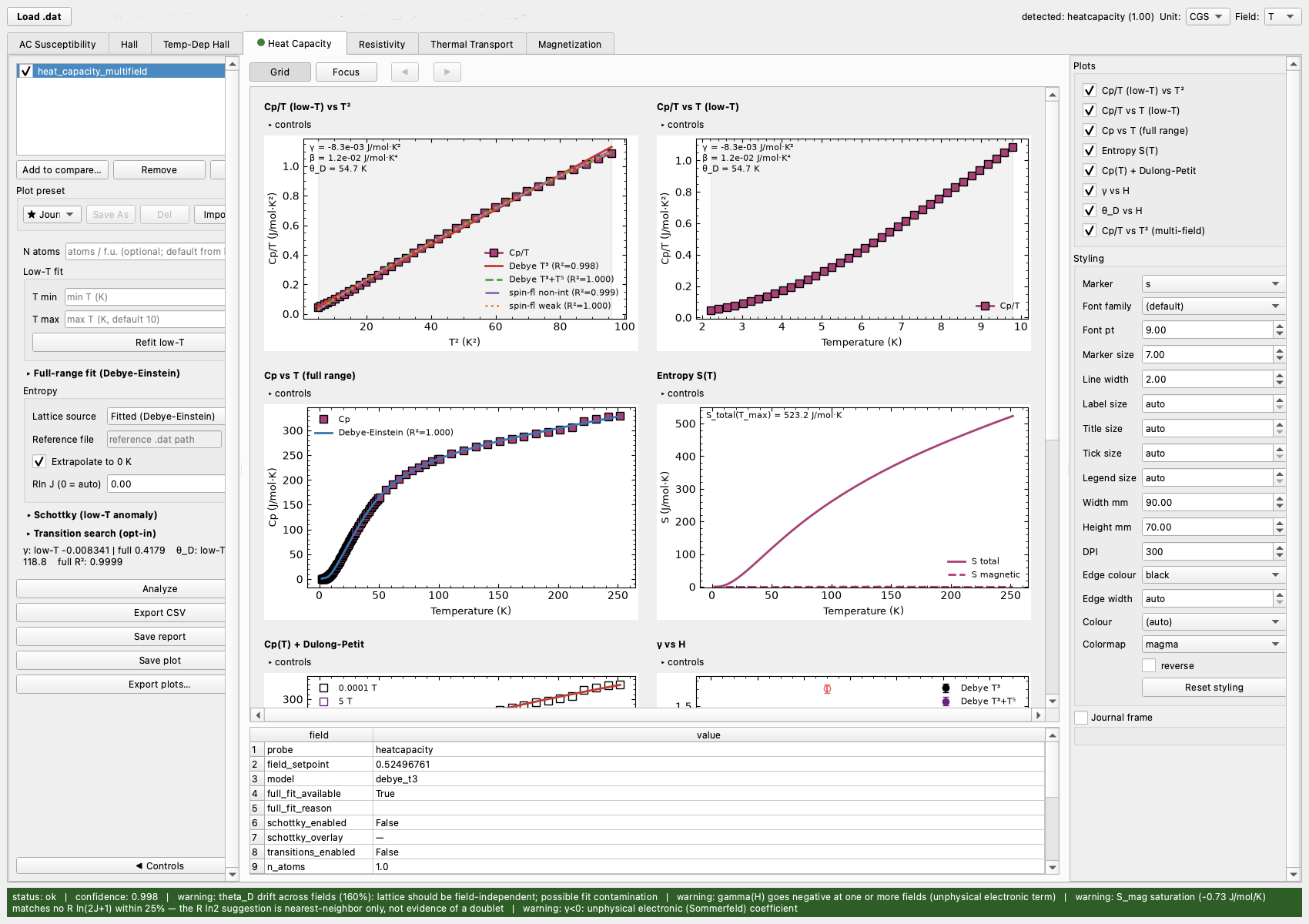
That last clause is the point. In the status bar above, cryosweep reports θ_D drifting 160 % across fields — the lattice should be field-independent — and a Sommerfeld coefficient γ that has gone negative. Neither is handed back as a result; both are flagged as physics that does not hold.
| Probe | What it fits |
|---|---|
| Magnetization (VSM) — QD + MPMS formats | χ, 1/χ, Curie-Weiss (θ, C, μ_eff) with a window-sensitivity ladder |
| AC susceptibility (ACMS) | χ′/χ″, superconducting screening step, T_c, χ″ peak / freezing temperature |
| Thermal transport (TTO) | κ, Seebeck, ZT, Wiedemann-Franz decomposition, Lorenz ratio, κ_ph power law |
| Resistivity — QD Resistivity + AC Transport | ρ(T), RRR ± σ, magnetoresistance, resistive T_c, power-law / Fermi-liquid fit |
| Heat capacity | Debye-Einstein Cp(T), low-T Cp/T vs T², spin-fluctuation models, entropy S(T), Schottky |
| Hall effect | Antisymmetrized R_xy, R_H, carrier density, mobility, R_H(T) |
The physics behind each — the models, the fitted quantities, and the criteria the detectors
use — is documented in docs/physics-reference.md.
Install
pip install cryosweep
That gives you the analysis core and the cryosweep command line. To add the desktop app:
pip install 'cryosweep[gui]'
The GUI is optional because the analysis core and CLI are Qt-free by design, and Qt is by far
the heaviest dependency here — leaving it out keeps an agent or CI install a quarter of the size.
Installing without it still gives you every analyzer; only cryosweep-gui needs the extra, and it
says so if you run it.
From a clone, for development:
python3 -m venv .venv
.venv/bin/pip install -e '.[gui]'
Python ≥ 3.11 (developed and tested on 3.14).
Quickstart
The examples/ folder has a runnable file per probe, so you can try
everything before pointing it at your own data (examples/README.md
says what each file shows and which tab/inputs to use — the Hall examples in particular
open on the Resistivity tab first, because Hall measurements share the resistivity file
format).
Those files ship with the repository rather than the wheel, so after a pip install fetch one
first — or clone the repo and run the commands as written:
curl -O https://raw.githubusercontent.com/Vova2B/cryosweep/main/examples/heat_capacity.dat
cryosweep analyze heat_capacity.dat
cryosweep analyze examples/magnetization_vsm.dat
cryosweep analyze examples/heat_capacity.dat
cryosweep analyze examples/thermal_transport.dat
cryosweep report examples/resistivity_superconductor.dat
cryosweep-gui
The first fits Curie-Weiss and reports θ = −10 K; report prints a Markdown summary instead
of JSON; cryosweep-gui opens the desktop app.
Some measurements need inputs the file does not carry. MPMS files hold no molar mass or sample mass, so the analyzer gates rather than guessing — supply them and it proceeds:
cryosweep analyze examples/magnetization_mpms.dat --molar-mass 200 --mass-mg 10
Hall measurements use the same file format as ordinary resistivity — only the wiring differs — so the Hall analyzer is invoked explicitly, with the channel and the sample thickness:
cryosweep hall examples/hall_field_sweeps.dat \
    --hall-channel 1 --thickness 0.5 --thickness-unit mm --long-channel 2
which reports R_H = -2.500e-07 m^3/C.
Built to be driven by a program
Every command prints one JSON object on stdout (logs go to stderr) and sets a meaningful exit code, so cryosweep is usable from a script, a pipeline, or an LLM agent without screen scraping:
| Command | What it gives you |
|---|---|
cryosweep probes |
available measurement types and what each one needs |
cryosweep schema analyze:vsm |
JSON Schema for the result shape |
cryosweep export <file> --out result |
tidy long-format CSVs, units in the headers |
cryosweep run pipeline.json |
batch |
Exit codes distinguish no result from a result you should look at: 0 ok, 10 gated (a
required input is missing — the payload names the flag), 11 low confidence, 2 bad input.
Codes 10 and 11 still print a full JSON envelope. Output is byte-stable for the same input, so
it diffs and caches cleanly. A ready-made agent guide ships in
skill/cryosweep/SKILL.md.
Example data
Everything in examples/ is written by tools/make_examples.py.
Eight of the ten files are synthetic, generated by the same builders that produce the test fixtures. The numbers are physically consistent and each file places a feature where it exercises the relevant analyzer — but they are not measurements of any real material.
Two are anonymized subsets of real measurements — magnetization_vsm_multifield.dat and
heat_capacity_multifield.dat — because no synthetic file reproduces what real multi-field
data does to the segmentation and window-selection paths. They are decimated, and everything
that identified the sample, the operator or the instrument has been replaced: sample material
and comment, all five instrument serial numbers, the acquisition date (the absolute
Time Stamp column is rebased to zero, since it decodes to the measurement instant), the
calibration free text in the Comment column, and the formula weight and sample mass, which
are neutral values chosen only so the fits report a plausible moment. The generators carry an
assert_no_identity_leak post-condition that refuses to write the file if any token of the
source identity survives. The measured shapes are real; the sample metadata is not, and no
scientific conclusion should be drawn from any file here.
Regenerate with (the two real-derived files are skipped, and left untouched, on any machine without the private source data):
.venv/bin/python tools/make_examples.py
Tests
QT_QPA_PLATFORM=offscreen .venv/bin/python -m pytest
Run it from the repository root — some tests build fixture paths relative to the working directory and launch the CLI as a subprocess.
The suite ships with synthetic .dat fixtures only. Tests that need real measurement files, or
the maintainer's local reference gallery, skip when those are absent, so a fresh clone is
green with no data at all. To exercise the optional real-data tests against your own files,
create real_data_map.json in the repository root mapping logical keys to paths.
File format and provenance
The .dat files this program reads are produced by Quantum Design instrument software and
retain their original ; Copyright …, Quantum Design, Inc. header lines; those are part of the
format and are preserved rather than stripped. The format is read, not redistributed.
This project is not affiliated with, endorsed by, or supported by Quantum Design, Inc. "PPMS" and "MPMS" are used only to identify the instruments and file formats cryosweep is compatible with. PPMS is a registered trademark of Quantum Design, Inc.
Licence
cryosweep is released under the PolyForm Noncommercial License 1.0.0.
Free for research and education — universities, public research institutes, national laboratories, government and nonprofit organizations, and individuals, regardless of how the work is funded. Use it, modify it, redistribute it, publish results with it.
Commercial use requires a licence. If you are a company, see
COMMERCIAL.md — it is a short email to info@cryosweep.org.
Third-party dependency licences, and what the LGPL requires of the Qt binding, are recorded in THIRD-PARTY-LICENSES.md.
Known issues
Known defects are listed in KNOWN-ISSUES.md. Most are display or ergonomics issues found by inspecting every rendered example, and each of those names the example file that reproduces it; none of them changes a fitted number or an exported value. Two exceptions are called out explicitly there — a temperature-setpoint binning bug in the Hall analyzer that can fabricate a carrier-density point, and the derived-quantity fallback that lets it reach the CSV. Both were found on real data and reproduce on no shipped example.
Versioning
Semantic versioning. While the version is 0.x the interfaces are not frozen: the CLI JSON envelope, the exit codes and the CSV columns may change between releases. Tagging 1.0.0 is what freezes them.
Plot appearance, GUI layout and the internal Python API are not covered by that promise at any version — figures are expected to improve, and doing so is not a breaking change.
Project documents
- CHANGELOG.md — what is in each release
- ROADMAP.md — what is planned for 1.0, with measured costs where they were measured
- KNOWN-ISSUES.md — known defects found and deferred, with what reproduces each
- CONTRIBUTING.md and CLA.md — how to contribute, and the one-time agreement
- SECURITY.md — reporting a vulnerability
- CODE_OF_CONDUCT.md
Contributing
Bug reports, files that break the loader, and pull requests are welcome — see CONTRIBUTING.md. Because the project is dual-licensed, a pull request needs a one-time Contributor License Agreement; you keep your copyright, and a bot walks you through it on your first PR.
Citing
If cryosweep contributes to work you publish, please cite it — see CITATION.cff.
1 maintainer

Download files
Download the file for your platform. If you're not sure which to choose, learn more about installing packages.
Source Distribution
Built Distribution
Filter files by name, interpreter, ABI, and platform.
If you're not sure about the file name format, learn more about wheel file names.
Copy a direct link to the current filters
File details
Details for the file cryosweep-0.4.0.tar.gz.
File metadata
- Download URL: cryosweep-0.4.0.tar.gz
- Upload date:
- Size: 292.8 kB
- Tags: Source
- Uploaded using Trusted Publishing? Yes
- Uploaded via:
twine/7.0.0 CPython/3.13.14
File hashes
| Algorithm | Hash digest | |
|---|---|---|
| SHA256 |
16f4083b2786f5ab94309aa2cb9e6fd2a7278d1197d53a938180a702ed9b0a76
|
|
| MD5 |
e6b4480c55160b8a65d0710179ae5b7a
|
|
| BLAKE2b-256 |
0ff6ab762cb977b927bfb802b50662d7df2bc5add2390ffc23a4ef09fc031ad9
|
Provenance
The following attestation bundles were made for cryosweep-0.4.0.tar.gz:
Publisher:
publish.yml on Vova2B/cryosweep
-
Statement:
-
Statement type:
https://in-toto.io/Statement/v1 -
Predicate type:
https://docs.pypi.org/attestations/publish/v1 -
Subject name:
cryosweep-0.4.0.tar.gz -
Subject digest:
16f4083b2786f5ab94309aa2cb9e6fd2a7278d1197d53a938180a702ed9b0a76 - Sigstore transparency entry: 2737948054
- Sigstore integration time:
-
Permalink:
Vova2B/cryosweep@2a113614735a24126c7dec34f4bbcd2a8dde2110 -
Branch / Tag:
refs/tags/v0.4.0 - Owner: https://github.com/Vova2B
-
Access:
public
-
Token Issuer:
https://token.actions.githubusercontent.com -
Runner Environment:
github-hosted -
Publication workflow:
publish.yml@2a113614735a24126c7dec34f4bbcd2a8dde2110 -
Trigger Event:
release
-
Statement type:
File details
Details for the file cryosweep-0.4.0-py3-none-any.whl.
File metadata
- Download URL: cryosweep-0.4.0-py3-none-any.whl
- Upload date:
- Size: 324.4 kB
- Tags: Python 3
- Uploaded using Trusted Publishing? Yes
- Uploaded via:
twine/7.0.0 CPython/3.13.14
File hashes
| Algorithm | Hash digest | |
|---|---|---|
| SHA256 |
ca85fbcc6efb43c9ced2ae3914dba53d88959bba8e241aacd80ecca51a00655a
|
|
| MD5 |
5aca32402c25b3b0533e39e787aa4b03
|
|
| BLAKE2b-256 |
08e280fab55c05f6812069d23dbb795fd80615ee915506ae7a5d03be8f9d2492
|
Provenance
The following attestation bundles were made for cryosweep-0.4.0-py3-none-any.whl:
Publisher:
publish.yml on Vova2B/cryosweep
-
Statement:
-
Statement type:
https://in-toto.io/Statement/v1 -
Predicate type:
https://docs.pypi.org/attestations/publish/v1 -
Subject name:
cryosweep-0.4.0-py3-none-any.whl -
Subject digest:
ca85fbcc6efb43c9ced2ae3914dba53d88959bba8e241aacd80ecca51a00655a - Sigstore transparency entry: 2737948068
- Sigstore integration time:
-
Permalink:
Vova2B/cryosweep@2a113614735a24126c7dec34f4bbcd2a8dde2110 -
Branch / Tag:
refs/tags/v0.4.0 - Owner: https://github.com/Vova2B
-
Access:
public
-
Token Issuer:
https://token.actions.githubusercontent.com -
Runner Environment:
github-hosted -
Publication workflow:
publish.yml@2a113614735a24126c7dec34f4bbcd2a8dde2110 -
Trigger Event:
release
-
Statement type:














