

An open framework for benchmarking target–indication evidence against clinical trial outcomes.




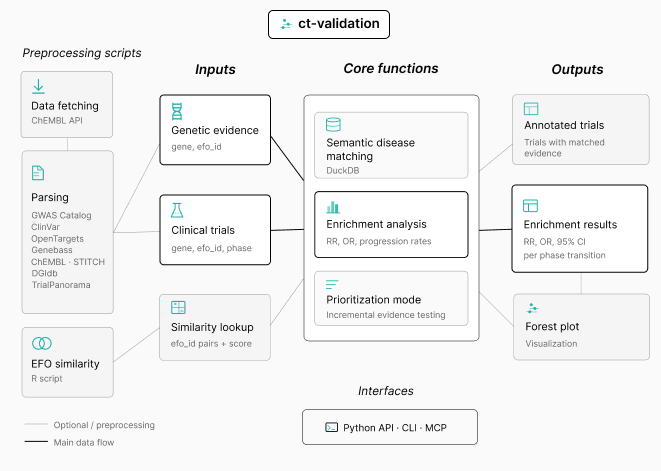
ct-validation tests whether target–indication pairs supported by a given evidence source are
enriched for clinical progression. The evidence may be genetic, omics-derived, computational or
curated — any set of (gene, disease) pairs.
import ct_validation as ctv

ctv.validate(
    clinical_trials="data/clinical_trials/aggregated/gene_indication_max_phase.parquet",
    targets="data/genetic_evidence/aggregated/genetic_evidence.parquet",
    similarity_lookup="data/mappings/efo_similarity_lookup_v3.93.0_0.5.parquet",
    gene_universe="data/mappings/protein_coding_genes.txt",
)
 phase_label  x_yes  n_yes    x_no     n_no    rr  rr_ci_lower  rr_ci_upper    p_value
        I→II  18962  19988 1756511  1904959  1.03         1.03         1.03   1.3e-49
      II→III  14056  18106 1065912  1629150  1.19         1.18         1.20  1.2e-277
III→Approved   8978  13261  542920   972049  1.21         1.20         1.23  7.6e-169
  I→Approved   8978  18337  542920  1683735  1.52         1.50         1.54        0.0
The final row is the phase I to approval composite: supported pairs progressed 1.52 times as
often as unsupported ones (95% CI 1.50–1.54).
rr is the relative success (RS) metric of Nelson et al.
(2015) and Minikel et al.
(2024) — a risk ratio of phase advancement.
Install
uv add ct-validation           # Python 3.11+
uv add "ct-validation[plot]"   # + forest plots
uv add "ct-validation[mcp]"    # + MCP server for agent workflows
Applications
Benchmarking a single evidence source
As in the example above. Any table carrying gene and efo_id columns is accepted; the framework is
agnostic to the provenance of the evidence.
Comparing evidence sources
results = ctv.validate(
    clinical_trials="ct.parquet",
    targets=["gwas_catalog.parquet", "clinvar.parquet", "genebass.parquet"],
    similarity_lookup="efo_similarity_lookup_0.5.parquet",
)
# one DataFrame per source
Incremental value over a baseline
results = ctv.validate(
    clinical_trials="ct.parquet",
    targets="novel_score.parquet",
    baseline_evidence="established_genetics.parquet",   # baseline-only pairs are excluded
)
Pairs supported only by the baseline are excluded, so the estimate reflects the incremental value of the new source rather than its overlap with established evidence.
Semantic disease matching
Evidence rarely uses the exact EFO term a trial was registered under. When a similarity lookup is
supplied, a clinical pair (gene, disease) is supported if the evidence contains (gene, disease′)
whose disease scores at or above the matching threshold (default 0.8; exact matches score 1):
expanded = ctv.get_expanded_disease_set(
    efo_ids={"EFO:0000270", "EFO:0000384"},          # asthma, Crohn's disease
    similarity_pairs="efo_similarity_lookup_0.5.parquet",
    similarity_threshold=0.8,
)
A clinical pair whose disease is absent from the lookup cannot be compared with any evidence, so
it is left out of both groups; validate() reports how many with an UnmatchableDiseaseWarning.
Visualization
results = ctv.validate(...)
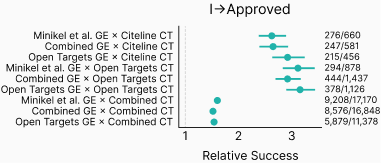
ctv.forest_plot(results, metric="rr", title="I→Approved")
Other interfaces
Command line
# from a config file
ct-validation --config configs/default.yaml

# or explicit arguments
ct-validation \
    --clinical-trials ct.parquet \
    --targets evidence.parquet \
    --similarity-lookup similarity.parquet \
    -o results/

# multiple sources at once
ct-validation --clinical-trials ct.parquet \
    --targets gwas.parquet --targets clinvar.parquet --targets genebass.parquet \
    -o results/

# also write the annotated trials and the matched-pair audit table
ct-validation --config configs/default.yaml --save-trials --save-matched-pairs -o results/
See configs/default.yaml for validation settings and configs/parsing.yaml for data source
paths. Every config value can be overridden by a CLI argument.
MCP server (agent workflows)
ct-validation-mcp
Two tools:
ct_validate— phase-transition enrichment, from Parquet paths or inline recordsexpand_disease_set— expand EFO IDs through semantic similarity
Inputs and outputs
Input schemas
| Input | Columns | Description |
|---|---|---|
clinical_trials |
gene, efo_id, max_phase, is_ongoing (optional) |
Target–indication pairs with highest phase reached, and whether that phase is still running |
targets |
gene, efo_id |
Gene–disease pairs with supporting evidence |
similarity_lookup |
efo_id_1, efo_id_2, similarity |
Pairwise EFO similarity, symmetric with diagonal (optional) |
baseline_evidence |
gene, efo_id |
Baseline evidence for prioritized mode (optional) |
gene_universe |
one gene per line (text file) | Restrict analysis to these genes (optional) |
All inputs accept Parquet paths or pandas DataFrames (except gene_universe, a text file or a
Python set).
clinical_trials must carry one row per (gene, efo_id) pair — rows are counted
individually, so a repeated pair would inflate the denominators. validate() raises on duplicates
rather than collapsing them, since only the caller knows what max_phase and is_ongoing should
be for a merged row.
The similarity lookup must be symmetric: matching probes a single orientation, so every pair
(a, b) needs (b, a) too, plus a self-similarity diagonal. Check one with
ctv.check_similarity_lookup(sim), or pass check_similarity=True to validate(); it raises
rather than silently dropping half of each disease neighbourhood.
Output schema
| Column | Description |
|---|---|
phase_from, phase_to |
Phase transition (e.g. 1→2, 1→4) |
phase_label |
Human-readable label (e.g. I→Approved) |
x_yes, x_no |
Pairs reaching the target phase (with/without evidence) |
n_yes, n_no |
Pairs entering the transition, less censored |
rate_yes, rate_no |
Progression rates |
rr, rr_ci_lower, rr_ci_upper |
Relative success (risk ratio) with 95% CI (Katz log method) |
or, or_ci_lower, or_ci_upper |
Odds ratio with 95% CI (Woolf logit method) |
p_value |
Two-sided Fisher's exact test p-value |
When either group is empty (n_yes=0 or n_no=0), the ratios, their intervals and p_value are
NaN. A Haldane–Anscombe correction of 0.5 is applied to all four cells when any one of them is
zero.
Exporting annotated trials and matched pairs
enrichment, trials = ctv.validate(..., return_trials=True)
enrichment, matched = ctv.validate(..., return_matched_pairs=True)
enrichment, trials, matched = ctv.validate(..., return_trials=True, return_matched_pairs=True)
The match-audit table can also be built on its own:
matched = ctv.create_matched_pairs_df(
    genetic_evidence=..., clinical_trials=..., similarity_pairs=...,
    similarity_threshold=0.8,
)
| Column | Description |
|---|---|
gene |
Gene symbol |
ct_efo_id |
Disease on the clinical trial row |
ge_efo_id |
Supporting evidence disease |
similarity |
Match score (1.0 for exact matches) |
match_type |
exact when ct_efo_id == ge_efo_id, else similarity |
How the enrichment is computed
For each transition, pairs that reached at least the starting phase are split into supported and unsupported groups, and
RS = (x_yes / n_yes) / (x_no / n_no)
Greater than one means supported pairs progress more often.
Censoring undetermined outcomes
When clinical_trials carries an is_ongoing column, a pair whose highest phase is still running
is censored from any transition it has not yet completed — dropped from both n and x where
is_ongoing and max_phase < phase_to. Such a pair has not failed the transition; its outcome is
not known yet. Censoring is per transition, so a pair that already reached phase_to still counts
as a success.
Without the column every pair counts as concluded, nothing is censored, and validate() warns
(MissingOngoingWarning) — a legitimate choice, and the only one available when the source
carries no trial status. A missing value reads as not-ongoing; non-boolean values raise.
is_ongoing is the caller's to define. The parsers in scripts/ set it where nothing concluded
at the pair's highest phase and that phase is below approval — reaching approval settles the
outcome however many post-marketing trials are still recruiting.
Clustered bootstrap intervals
Katz and Woolf assume independent rows, but one gene spans many indications — so their intervals
run narrow when the correlated unit is the gene rather than the pair. Pass cluster_col to add
percentile intervals that resample clusters with replacement instead of rows:
results = ctv.validate(..., cluster_col="gene")
This adds four columns — rr_boot_ci_lower, rr_boot_ci_upper, or_boot_ci_lower,
or_boot_ci_upper — and nothing else: resampling only re-estimates spread, so point estimates,
counts and closed-form intervals are unchanged. p_value is unaffected too — it stays a row-level
Fisher's exact test on the observed table, so it does not carry the clustering the intervals do.
bootstrap_replicates (default 10,000) and bootstrap_seed (default 0) control the resampling.
The percentile bounds carry Monte Carlo error falling as 1/√n; at the default each bound shifts
by a few percent of the interval's width across seeds. Both are ignored without cluster_col.
No continuity correction is applied, unlike the closed-form intervals — a percentile bootstrap
needs neither log(ratio) nor its standard error. A replicate that empties a cell keeps its
ratio, so a bound may be returned as 0 or infinite; relevant when log-scaling these columns.
Two clusters per arm is the floor for a defined interval, not a threshold at which one is trustworthy — a percentile cluster bootstrap undercovers badly on a few dozen clusters, so read bounds from a small cluster count as indicative.
Bounds are NaN when an arm holds fewer than two clusters, when the observed table has a zero
cell, or when over 25% of replicates leave a ratio undefined (0/0) — past 5% a
BootstrapReplicateLossWarning is emitted. The closed-form columns stay populated unless an arm is empty
outright.
Data
The scripts/ directory contains reproducible parsers that convert public databases into the two
input tables, harmonized on EFO.
What each parser covers
Genetic evidence (scripts/parse/genetic_evidence/):
- GWAS Catalog — genome-wide significant associations (p < 5e-8)
- ClinVar — pathogenic/likely pathogenic variants at high review confidence (somatic, susceptibility and response entries excluded)
- Open Targets — germline genetic evidence streams (direct score ≥ 0.5); somatic sources
(
eva_somatic,intogen) are opt-in via--include-somatic - Genebass — exome-wide associations (p < 1e-7)
Clinical trials (scripts/parse/clinical_trials/):
- ChEMBL — gene–drug links (pChEMBL ≥ 7.0); its indications are parsed but excluded from the aggregate, since they carry no trial status to censor on
- Open Targets — known drug and indication data
- STITCH — high-confidence activation/inhibition links
- DGIdb — drug–gene interactions
- TrialPanorama — interventional studies
Ontology (scripts/r/):
- EFO semantic similarity matrix (averaged normalized Resnik + Lin information content)
Benchmark comparator (scripts/parse/minikel.py):
- Minikel et al. (2024) — Citeline programmes with per-transition censoring, and their genetic associations, for the published-vs-ours comparison
Configure paths in configs/parsing.yaml, then:
python scripts/parse/gene_universe.py
python scripts/parse/minikel.py
python scripts/parse/run_parsing.py
See DATA_SOURCES.md for download links, versions, licences and fetching instructions.
Reproducing the paper
The paper's results were produced with release v0.4.3 (archived code
10.5281/zenodo.22901497) and benchmark data
10.5281/zenodo.22901451. The data deposit carries every
input notebooks/benchmark.py reads:
git clone https://github.com/gero-science/ct-validation
cd ct-validation
git checkout v0.4.3
curl -LO https://zenodo.org/records/22901451/files/ct-validation-data.tar.gz
tar xzf ct-validation-data.tar.gz
cd notebooks
uv run --with-requirements requirements.txt python benchmark.py   # v0.4.3's pinned env
The Zenodo code archive can stand in for the git checkout. Later releases may give different estimates as methods and data sources are updated; the release notes list the changes.
The full run takes about 10 minutes and peaks at 8.5 GB resident memory, so 16 GB of RAM is recommended.
To rebuild the parsed data from the sources instead, switch the configs back to the paper's sources: the defaults are Open Targets 26.09 and EFO 3.93 with obsolete ids remapped, and the paper used Open Targets 25.12 and EFO 3.84 without remapping (see DATA_SOURCES.md).
| Resource | Location |
|---|---|
| Source code | https://github.com/gero-science/ct-validation |
| Archived code (all versions) | 10.5281/zenodo.21840865 |
| Benchmark data (all versions) | 10.5281/zenodo.21839216 |
| Package | PyPI |
Development
CI runs on push/PR to main (Python 3.11–3.13, ruff, pytest):
uv sync --extra mcp --extra parse
uv run ruff check src tests scripts
uv run pytest tests/ -v
The benchmark notebook (notebooks/benchmark.py, paired with benchmark.ipynb by jupytext):
uv run --group notebook jupyter lab notebooks/
Citation
Kostiuk K, Igumnov D, Fedichev P, Feizi A. ct-validation: an open framework for benchmarking target–indication evidence against clinical trial outcomes. Bioinformatics (2026). https://doi.org/10.1093/bioinformatics/btag788
- Release used in the paper (v0.4.3) 10.5281/zenodo.22901497
- its benchmark data 10.5281/zenodo.22901451
- machine-readable metadata in CITATION.cff.
License
MIT
1 maintainer

Metadata
1 maintainer
Release files for ct-validation 0.5.1
For a detailed explanation of source distributions (sdists) and built distributions (wheels), please see the package formats documentation.
Source distribution (sdist)
| File | Size | Uploaded | Provenance | Actions |
|---|---|---|---|---|
| ct_validation-0.5.1.tar.gz | 33.5 kB | Without provenance | Details for ct_validation-0.5.1.tar.gz |
Built distribution (wheel)
| File | Interpreter | ABI | Platform | Actions Reset |
|---|---|---|---|---|
| ct_validation-0.5.1-py3-none-any.whl | Python 3 | none | any | Details for ct_validation-0.5.1-py3-none-any.whl |
Total release size: 74.2 kB
Release files / ct_validation-0.5.1.tar.gz
| Download URL | ct_validation-0.5.1.tar.gz |
|---|---|
| Size | 33.5 kB |
| Tags | Source |
|
SHA-256 checksum How to use checksums |
2256c8b907b629f615896874991b1026d37f8a028c2960e0dad24b5041a31ce4
|
|
BLAKE2b-256 checksum How to use checksums |
f275d2ec1208d7b6f266c6bd98eb8c33cff3c641b5768ba1a206307a60b43d51
|
| Upload date | |
|
Uploaded using Trusted Publishing? What is trusted publishing? |
No |
| Uploaded via |
uv/0.11.11 {"installer":{"name":"uv","version":"0.11.11","subcommand":["publish"]},"python":null,"implementation":{"name":null,"version":null},"distro":{"name":"Ubuntu","version":"24.04","id":"noble","libc":null},"system":{"name":null,"release":null},"cpu":null,"openssl_version":null,"setuptools_version":null,"rustc_version":null,"ci":null}
|
Release files / ct_validation-0.5.1-py3-none-any.whl
| Download URL | ct_validation-0.5.1-py3-none-any.whl |
|---|---|
| Size | 40.6 kB |
| Tags | Python 3 |
|
SHA-256 checksum How to use checksums |
191bc977b2706239bbe3a0224ad8f575466ab211c5b0833bf247f5875560db54
|
|
BLAKE2b-256 checksum How to use checksums |
fea1ccf1b0b58cfb65d01d7627b0cdfe11d8be1ef9cf380615ab5569365c810c
|
| Upload date | |
|
Uploaded using Trusted Publishing? What is trusted publishing? |
No |
| Uploaded via |
uv/0.11.11 {"installer":{"name":"uv","version":"0.11.11","subcommand":["publish"]},"python":null,"implementation":{"name":null,"version":null},"distro":{"name":"Ubuntu","version":"24.04","id":"noble","libc":null},"system":{"name":null,"release":null},"cpu":null,"openssl_version":null,"setuptools_version":null,"rustc_version":null,"ci":null}
|
Security for ct-validation 0.5.1
Provenance
Provenance describes where a file came from. On PyPI, provenance is shared via attestations, which provide a verifiable record of the build or publishing details. View details, limitations and caveats.
No provenance found
None of the files in this release were uploaded with provenance metadata.
A note on package security
PyPI is a repository for distributing packages, not a service for auditing them. While third-party security researchers and our staff do their best to detect and remove malicious packages, PyPI cannot guarantee the quality, security or suitability of any given package.
To learn more about protecting yourself from malicious actors, visit our package security documentation.














