
git diff for your agent's context window — a context-window debugger for LLM agents

Project description
ctxdiff





git diff for your agent's context window. See exactly what your LLM saw — turn by turn, block by block.
ctxdiff is a local-first debugger for the context window of LLM agents. Wrap your OpenAI, Anthropic, Gemini, or Bedrock client in one line, run your agent, and every call's context is recorded — as content-hashed, deduplicated blocks — into a single-file SQLite trace you can inspect, diff, and share. Nothing leaves your machine.
Prompt wording is ~10% of the battle. The other 90% is context engineering — what the model sees, in what order, at what cost. When an agent misbehaves at turn 8,
ctxdiffanswers the three questions a raw JSON log can't: what exactly did the model see, what changed since turn 7, and what did it cost?
from ctxdiff import trace
from openai import OpenAI

tracer = trace.init("customer-support-agent")
client = tracer.wrap(OpenAI())          # ← the only line you add

client.chat.completions.create(
    model="gpt-4o",
    messages=[{"role": "user", "content": "What's your refund window?"}],
)

tracer.close()                          # writes ./customer-support-agent-<id>.ctrace
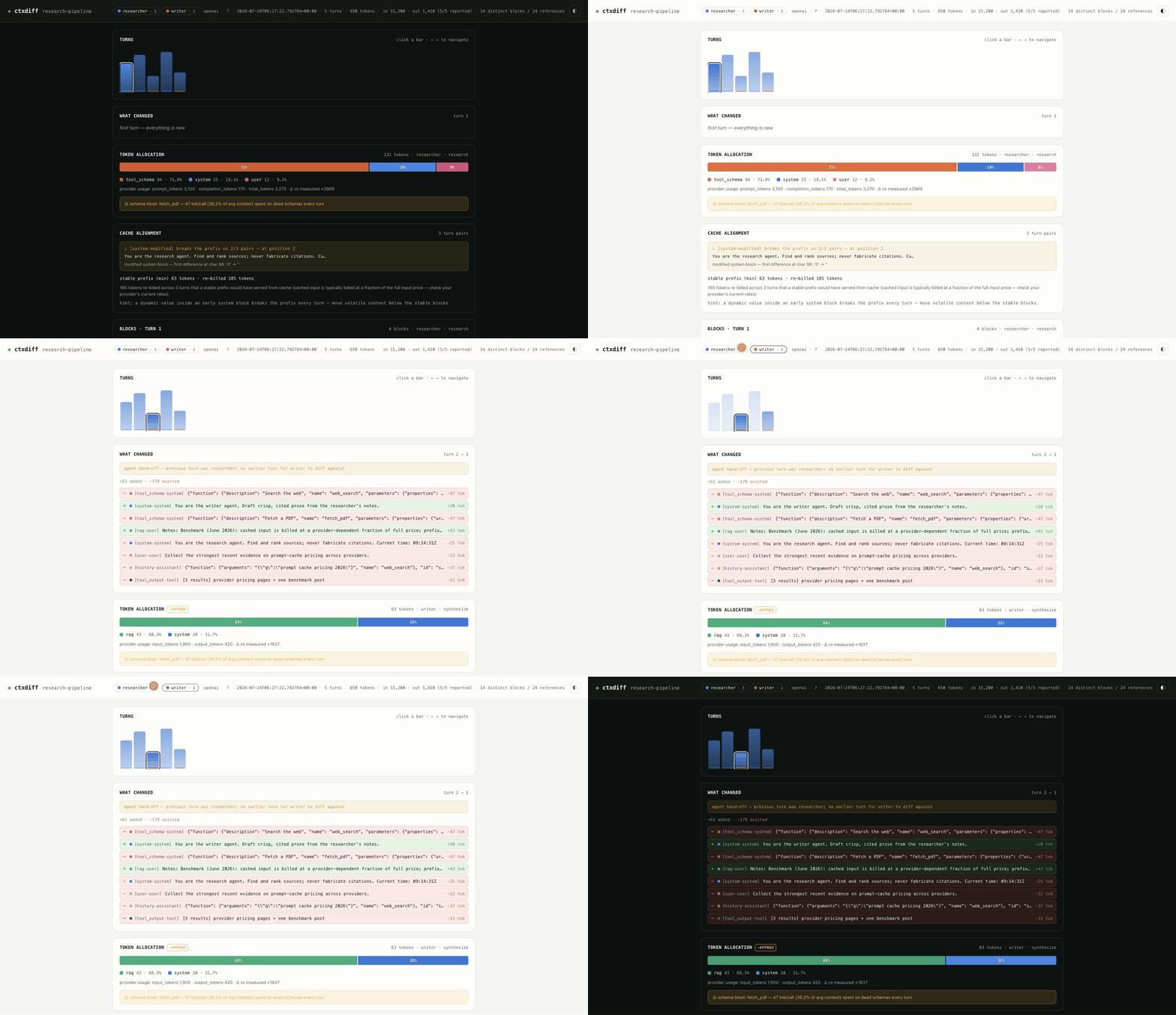
Then ctxdiff view opens the self-contained dashboard — here debugging a multi-agent run (researcher + writer), with agent filtering, turn-by-turn diffs, an agent handoff, and light/dark themes:
See it in 30 seconds — no API key, no setup:
pip install ctxdiff
ctxdiff demo          # builds a sample multi-agent trace and opens this dashboard
A realistic research-pipeline run (two agents, real SDK shapes, zero network) already showing turn diffs, token/schema-bloat, a cache-prefix break, and an agent hand-off.
How it's different
ctxdiff isn't a tracing platform. Tools like LangSmith, Langfuse, and Phoenix show you a list of calls — a snapshot of each request, aggregated across your fleet, for monitoring cost and health over time. That's a different job.
ctxdiff shows you the diff between calls — what got added, evicted, or modified in the context window, turn by turn, down to the character that broke your prompt-cache prefix. It's the debugger you reach for when one specific run went wrong at turn 8, not the dashboard you watch in production.
| Observability platforms | ctxdiff | |
|---|---|---|
| Question | Is my fleet healthy & cheap over time? | Why did this run break at turn 8? |
| Shows you | A list of calls (snapshot) | The diff between calls (delta) |
| Scope | Many runs, aggregated | One run, turn by turn |
| Runs | Hosted service / self-hosted server | Local — one pip install, one file |
| Your data | Sent to a platform | Never leaves your machine |
It's built to sit alongside your observability stack, not replace it. Use them for "is production okay"; use ctxdiff for "what exactly did the model see, and what changed."
Features
What ctxdiff does (each link jumps to the details):
- 🔌 One-line capture —
tracer.wrap(client)records every LLM call's full context, verbatim, into a single-file SQLite.ctrace. Fail-open by design: a ctxdiff error can never break your app. - 🧬 Content-hashed block storage — every message, content part, and tool schema is a deduplicated block; a stable system prompt across 40 turns is stored once.
- 🌐 Seven provider surfaces — OpenAI, Azure OpenAI, Anthropic, Google Gemini, AWS Bedrock (Converse), any OpenAI-compatible OSS endpoint (Ollama/vLLM/…), and LangChain via client injection.
- 🟩🟥🟨 Git-style turn diffing —
ctxdiff diff --turn 7 --turn 8: exactly which blocks were added, evicted, or modified (with char-level inline diffs) between any two turns. - 📊 Token attribution —
ctxdiff tokens: where the budget goes per turn (system / rag / history / schemas…), reconciled against provider-reported usage, plus schema-bloat detection — tools you registered but never call, taxing every request. - 💸 Prompt-cache profiling —
ctxdiff cache: finds exactly what breaks your cache prefix (down to the changed characters), counts re-billed tokens, and suggests the fix. - 🖥️ Self-contained HTML dashboard —
ctxdiff view/ctxdiff export: a one-file, zero-external-request dashboard with a turn scrubber, diff panel, token heatmap, cache findings, and block inspector — safe to attach to a bug ticket. - 🏷️ Semantic tagging —
tracer.tag("rag", chunks)for exact provenance labels; a cheap heuristic covers the rest. - 🤝 Multi-agent runs —
tracer.wrap(client, agent="researcher")andtracer.mark("step")attribute every call to the agent (and step) that made it;--agentfilters ondiff/tokens/cache, and the dashboard colors each agent's turns. Cross-agent hand-offs are never miscounted as cache breaks. - 🔒 Privacy first — local-first (no network, no telemetry), a redaction hook that runs before anything touches disk, and HTML exports that strip request params down to the model name.
- ✅ Honest numbers — exact
tiktokencounts for OpenAI; estimates are always marked as estimates, never passed off as precise.
What it doesn't do (yet):
- ⏳ Streaming usage — streamed calls are captured, but token
usageisn't (the response is a stream object at record time). - ⏳ Live tail — the dashboard is post-run; it doesn't update while the agent is still running.
- ⏳ Background recording — capture is synchronous on the call path (fast, but not zero-cost; threaded agents aren't recorded).
- ⏳ Native LangChain/LangGraph callbacks — LangChain works via client injection today; a first-class callback handler is planned.
- ⏳ VS Code extension — the dashboard will be embeddable in an editor panel.
See The CLI below for every subcommand, with real sample output.
Install
ctxdiff targets Python ≥ 3.10.
pip install ctxdiff
…or install from source
git clone https://github.com/salmanzafar949/ctxdiff
cd ctxdiff
pip install -e .
The only runtime dependency is tiktoken (for exact OpenAI token counts). The provider SDKs (openai, anthropic, …) are not dependencies — ctxdiff wraps whatever client you already use.
To run the real-SDK evaluation suite, install the optional extra:
pip install -e ".[eval]" # openai, anthropic, google-genai, boto3, langchain, respx — for tests only
Quickstart
Wrap a client, use it exactly as you normally would, then read the trace back.
from ctxdiff import trace
from ctxdiff.store.ctrace import CTrace
from openai import OpenAI

# 1. Start a trace and wrap your client
tracer = trace.init("support-agent")
client = tracer.wrap(OpenAI())

# 2. Use the client normally — every call is recorded
client.chat.completions.create(
    model="gpt-4o",
    messages=[
        {"role": "system", "content": "You are a support agent. Be precise."},
        {"role": "user", "content": "What's your refund window?"},
    ],
)
tracer.close()

# 3. Read the trace back
ct = CTrace.open(tracer.path)
for call in ct.get_calls():
    print(f"turn {call.seq}  usage={call.usage}")
    for cb in ct.get_call_blocks(call.id):
        b = cb.block
        print(f"  [{cb.label:<11}] {b.role:<9} {b.token_count:>4} tok  {b.text[:60]!r}")
ct.close()
turn 1  usage={'prompt_tokens': 24, 'completion_tokens': 8, 'total_tokens': 32}
  [system     ] system       9 tok  'You are a support agent. Be precise.'
  [user       ] user         5 tok  "What's your refund window?"
A .ctrace is just a SQLite file — you can also inspect it with any SQLite tool:
sqlite3 support-agent-*.ctrace "SELECT seq, usage FROM call ORDER BY seq;"
The CLI
Every subcommand reads a .ctrace; --run PATH picks which one, and defaults to the most recently modified *.ctrace in the current directory when omitted — the common case (one run in the working dir) needs no flag at all. Color is automatic (git-style ANSI) and turns off whenever stdout isn't a real terminal, or when NO_COLOR is set — the output below has NO_COLOR=1 so it pastes cleanly.
ctxdiff diff --turn N --turn M
Git-style block diff between two turns: added (+, green), evicted (−, red), and modified (~, yellow, with an inline char-level diff) blocks, with unchanged blocks folded into one summary line.
$ ctxdiff diff --turn 1 --turn 2
── turn 1 → turn 2 · 3 blocks changed · +56 −26 tokens ──
~ [system·system] You are a support agent. Be precise. Current time: 2026-07-24T10:00:0[-0-]{+4+}Z
+ [history·assistant] 'Checking that for you.'  +5 tok
+ [rag·user] 'Context: Refund policy: 30 days from delivery, unworn items only. Also…'  +25 tok
= 3 unchanged blocks · 138 tok
ctxdiff tokens [--turn N]
Token allocation per turn as a proportional bar chart, one label slice per row, biggest spender first; reconciles against provider-reported usage when available (Δ line); appends a schema-bloat warning when a registered tool schema is never invoked anywhere in the run.
$ ctxdiff tokens
turn 1 · 164 tokens
  ████████████████████████       tool_schema       133 tok   81.1%
  █████                          system             26 tok   15.9%
  █                              user                5 tok    3.0%
  provider reports 55 prompt tokens · Δ -109

turn 3 · 255 tokens
  ████████████████               tool_schema       133 tok   52.2%
  ██████                         history            50 tok   19.6%
  ████                           user               32 tok   12.5%
  ███                            system             26 tok   10.2%
  ██                             tool_output        14 tok    5.5%
  provider reports 85 prompt tokens · Δ -170

⚠ schema bloat: issue_refund — 1 of 2 registered tools never used this run — 77 tok (37.7% of avg context) spent on dead schemas every call
A call whose total mixes any estimate-method blocks in with exact ones is marked (~approx) next to its token total — never presented as exact when it isn't.
ctxdiff cache
Prefix-stability report across every consecutive turn pair: finds where the provider's byte-for-byte cache prefix breaks, attributes it to the responsible block, and estimates the wasted re-billed spend — price-free, since per-token discounts vary by provider and change over time.
$ ctxdiff cache
⚠ warning: [system·modified] breaks the prefix on every turn (2/2 pairs)
  'You are a support agent. Be precise. Current time: 2026-07-24T10:00:04Z'
  modified system block — first difference at char 69: '0' → '4'

stable prefix (min): 133 tokens
re-billed: 183 tokens
183 tokens re-billed across 2 turns that a stable prefix would have served from cache (cached input is typically billed at a fraction of the full input price — check your provider's current rates)
hint: a dynamic value inside an early system block breaks the prefix every turn — move volatile content below the stable blocks
A run with a stable prefix throughout prints a single green ✓ prefix stable across all N turn pairs line instead.
ctxdiff runs
Lists every *.ctrace in the working directory with its project, provider, and turn count — a quick "what runs do I have here" before picking one with --run.
ctxdiff export [--out FILE.html] / ctxdiff view [--no-open]
Write (export) or write-and-open (view) the self-contained HTML dashboard — see HTML dashboard below.
HTML dashboard
ctxdiff view opens a local time-travel dashboard for a run in your browser; ctxdiff export --out run.html writes the same dashboard to a path you choose, without opening anything — the one you attach to a bug ticket. Both call the same exporter, so they're always in sync.
The output is one self-contained .html file: the page, styles, script, and the entire run's data are embedded in a single JSON island — no CDN, no font, no image, no external request of any kind (asserted in tests: the file contains no http:///https:// substring anywhere). It opens from a file:// URL, works offline, and is safe to email or attach to an issue tracker.
Seven panels, all reading from the same precomputed analyzer output the CLI uses (one source of truth — the dashboard never re-implements diff/token/cache logic in JavaScript):
- Scrubber — a turn-by-turn strip across the top; click a bar or use ← → to jump between turns.
- Turn diff — the selected turn's added/evicted/modified blocks vs. the previous turn.
- Token allocation — the selected turn's label breakdown, same data as
ctxdiff tokens. - Cache alignment — every prefix break found across the run, same data as
ctxdiff cache. - Blocks — the full block list for the selected turn (role, kind, label, token count, an 8-char content-hash prefix).
- Growth — context size across turns, so a run that balloons is visible at a glance.
- Header stats — project, provider, run start time, distinct-vs-total block counts (the dedup story).
Block text is written into the page as a JSON island and rendered with textContent at view time — never innerHTML — so a captured block containing </script> or literal HTML markup can never execute or break out of the tag, even though it's shown verbatim. The one deliberate redaction on export: each call's stored params is reduced to {"model": ...} — sampling settings, API keys, or anything else that might have ridden along in params never makes it into the shareable file (block text redaction is still governed by your own redact() hook, applied earlier at capture time).
Supported providers
ctxdiff detects the provider from the client you pass to wrap() and applies the matching adapter. Detection keys off the client's module, so anything built on the OpenAI or Anthropic SDK works — including Azure and OpenAI-compatible OSS endpoints.
| Provider | Client | Notes |
|---|---|---|
| OpenAI | openai.OpenAI(...) |
Chat Completions and Responses API |
| Azure OpenAI | openai.AzureOpenAI(...) |
Same adapter, zero config |
| Anthropic / Claude | anthropic.Anthropic(...) |
Messages API |
| Google Gemini | google.genai.Client(...) |
Generate Content API (models.generate_content) |
| AWS Bedrock | boto3.client("bedrock-runtime") |
Converse API (client.converse(...)) |
| Open-source models | openai.OpenAI(base_url="http://localhost:11434/v1", ...) |
Any OpenAI-compatible endpoint — Ollama, vLLM, LM Studio, Together, Groq, … |
| LangChain | langchain_openai.ChatOpenAI(...) |
Via client injection — see LangChain |
Passing an unrecognized client raises immediately, so misconfiguration fails loudly at setup rather than silently at record time:
tracer.wrap(some_unknown_client)
# ValueError: ctxdiff: unrecognized client module '...'; supported providers: ['anthropic', 'bedrock', 'gemini', 'openai']
How it works
[ your agent ]
     │  client = tracer.wrap(OpenAI())
     ▼
[ CAPTURE ]   a transparent proxy intercepts the completion call
     │        · calls the real method first (host is never delayed or altered)
     │        · fail-open: a ctxdiff error can never break your app
     ▼
[ STORE ]     one SQLite .ctrace file per run
     │        · every message / content part / tool schema is a content-hashed "block"
     │        · identical blocks are stored once, referenced per call (dedup)
     ▼
[ READ ]      CTrace.open(path) → runs, calls, blocks
     ▼
[ ANALYZE ]   diff_turns / analyze_run / analyze_cache — pure functions the
     │        CLI and HTML viewer both call, so every number agrees
     ▼
[ RENDER ]    the CLI (colored text) or `ctxdiff view`/`export` (HTML)
Capture is deliberately dumb; interpretation lives downstream. The proxy records what was actually sent on the wire and nothing more. Whether a block is "a RAG chunk" or "history" is decided by labels, not baked into capture — so the recorder has no opinions to get wrong, and re-analysis of an old trace never needs a re-run.
The block model
The smallest independently-diffable unit of context is a block: one message, one content part, or one tool schema. Each block's identity is sha256(role + kind + text), so a stable system prompt reused across 40 turns is stored once and referenced 40 times. Diffing two turns then reduces to comparing two ordered lists of hashes.
Usage guide
Wrapping a client
trace.init() starts a run; wrap() returns a transparent proxy. The proxy behaves exactly like the original client — same attributes, same return values — it just records the completion call as a side effect.
tracer = trace.init(
    "my-agent",                     # project name (labels the run)
    path="runs/session-42.ctrace",  # optional; defaults to ./my-agent-<id>.ctrace
)
client = tracer.wrap(OpenAI())
# ... use client ...
tracer.close()
tracer.path tells you where the trace was written. Call tracer.close() when the run is done to close the store cleanly.
Async clients
wrap() transparently intercepts async clients too — AsyncOpenAI, AsyncAnthropic, and genai.Client(...).aio — via call-time awaitable detection, so awaited calls are captured exactly like sync ones, no extra config needed:
client = tracer.wrap(AsyncOpenAI())
resp = await client.chat.completions.create(model="gpt-4o", messages=[...])
(Bedrock stays sync-only — boto3 has no first-party async client.)
Semantic tagging
Blocks are auto-labeled by a cheap heuristic (system, user, history, tool_schema, tool_output). For exact provenance — especially distinguishing retrieved RAG chunks from ordinary user text — tag the content before the call it belongs to:
chunks = retriever.search("refund policy")          # your RAG retrieval
tracer.tag("rag", [c.text for c in chunks])         # applies to the NEXT call

client.chat.completions.create(
    model="gpt-4o",
    messages=[
        system_prompt,
        {"role": "user", "content": f"Context:\n{joined_chunks}\n\nAnswer: ..."},
    ],
)
Any block whose text contains a tagged string is stored with label="rag" and label_source="tagged". Untagged apps lose nothing but label precision — capture, dedup, and token counting all work regardless. tag() accepts a list of strings or dicts (it reads a text/content field from dicts).
Multi-agent runs
A single codebase often drives several agents — a researcher, a writer, a critic — sometimes across different providers, all within one run. Name each client's agent at wrap time, and optionally mark() the current step; every call is then attributed to the agent (and step) that made it, on one shared, monotonic global timeline.
tracer = trace.init("research-pipeline")
researcher = tracer.wrap(OpenAI(), agent="researcher")     # per-agent adapter + recorder
writer     = tracer.wrap(Anthropic(), agent="writer")      # a DIFFERENT provider, same run

tracer.mark("gather")                                       # sticky: labels every later call…
researcher.chat.completions.create(model="gpt-4o", messages=[...])
tracer.mark("draft")                                        # …until you change or clear it
writer.messages.create(model="claude-sonnet-4-5", messages=[...])
tracer.close()
wrap(client, agent=...)— each wrap builds its own provider adapter and recorder, so two agents on two providers each record correctly (no cross-contamination).agentis optional; unlabeled calls are grouped as(unlabeled).mark(step)— sets a sticky step label applied to every subsequent call across all agents until the nextmark();mark(None)clears it. (Contrasttag(), which is next-call-only.)--agent NAME— filtersctxdiff diff,tokens, andcacheto one agent's calls. Turn numbers stay globalseqvalues everywhere;diff --agentvalidates that both--turnvalues belong to that agent.- Agent-aware analysis — cache-prefix stability is computed within each agent's own timeline, so an adjacent cross-agent hand-off is never mistaken for a cache break.
ctxdiff tokensprints a per-agent token summary,ctxdiff runslists each trace's agents, and the HTML dashboard shows a colored chip per agent, an agent-colored underline on each turn bar, and an "agent hand-off" marker (diffing against that agent's own previous turn).
ctxdiff tokens also opens with a run-level rollup of provider-reported usage (input/output tokens, normalized across all four provider key shapes), with an honest coverage fraction and a per-agent breakdown:
run total · in 18,400 tok · out 640 tok (5/6 calls reported usage)
  researcher · in 12,900 · out 410
  writer     · in  5,500 · out 230
Reading a trace back
Traces are read through the CTrace API. A run has calls (one per LLM request, in seq order); each call has ordered blocks.
from ctxdiff.store.ctrace import CTrace

ct = CTrace.open("runs/session-42.ctrace")

run = ct.get_run()
# Run(id, project, started_at, provider, models, ctxdiff_version)

for call in ct.get_calls():
    # Call(id, run_id, seq, params, usage, latency_ms, error, agent, step, provider)
    print(call.seq, call.params.get("model"), call.usage, call.latency_ms, call.agent)

    for cb in ct.get_call_blocks(call.id):
        # CallBlock(block, position, label, label_source)
        b = cb.block
        # Block(content_hash, role, kind, text, token_count, token_method)
        print(cb.position, cb.label, b.role, b.token_count, b.token_method)

ct.close()
Because a .ctrace is plain SQLite, ad-hoc queries work too:
# how many DISTINCT blocks vs total references? (shows dedup at work)
sqlite3 session-42.ctrace "SELECT COUNT(*) FROM block;"
sqlite3 session-42.ctrace "SELECT COUNT(*) FROM call_block;"
Redaction
Context payloads are the most sensitive data in an AI stack — system prompts, retrieved customer documents, tool arguments — and .ctrace files get attached to bug tickets. A redact hook runs on every block before it is written to disk:
import dataclasses
from ctxdiff.models import Block

def scrub(block: Block) -> Block:
    """Return a redacted copy of the block (Block is a frozen dataclass)."""
    return dataclasses.replace(block, text=my_pii_scrubber(block.text))

tracer = trace.init("my-agent", redact=scrub)
The block's content_hash is computed from the original text (so dedup stays stable), and only the stored text is replaced. A redactor that raises does not break the run — the block's text falls back to "[redaction-error]" and capture continues.
Scope: redaction applies to block text. Request
params, providerusage, and error names are stored as-is — keep that in mind if you pass sensitive values as sampling params.
Fail-open guarantee
A debugging tool must never break the program it debugs. Every capture path is wrapped so that any error inside ctxdiff — an adapter bug, a full disk, a tokenizer failure — is caught, logged once, and swallowed; your original call proceeds and returns its real result. The only exception that propagates is your own LLM call's error, re-raised unchanged:
try:
    client.chat.completions.create(...)   # raises RateLimitError from the provider
except RateLimitError:
    ...   # you still get YOUR error — and the failed call is recorded with error set
Token counting
Every block records a token_count and an honest token_method:
- OpenAI-family → exact counts via
tiktoken(token_method="tiktoken"). - Anthropic, Gemini, Bedrock → a documented estimate, since none publishes a local tokenizer (
token_method="estimate").
Estimates are always labeled as such — never presented as exact. If tiktoken is unavailable for any reason, counting degrades to an estimate rather than dropping the capture, and never reaches the network at record time.
Provider recipes
OpenAI
from openai import OpenAI
client = tracer.wrap(OpenAI())
client.chat.completions.create(model="gpt-4o", messages=[...])
OpenAI Responses API
The same wrap() also captures client.responses.create(...) — the Responses API the OpenAI Agents SDK builds on — off the same wrapped client, no separate call. instructions is captured as the leading system block, flat tools schemas next, then input (string or a list of message/tool items); usage is read from input_tokens/output_tokens instead of prompt_tokens/completion_tokens, and previous_response_id is kept in params since it's chain linkage, not content.
from openai import OpenAI
client = tracer.wrap(OpenAI())
client.responses.create(
    model="gpt-4o",
    instructions="You are a support agent.",
    input="What's your refund window?",
)
Works async too, exactly like the chat path:
resp = await tracer.wrap(AsyncOpenAI()).responses.create(model="gpt-4o", input="hi")
Azure OpenAI
No special configuration — Azure clients live in the openai package, so the OpenAI adapter applies automatically.
from openai import AzureOpenAI
client = tracer.wrap(AzureOpenAI(
    azure_endpoint="https://<resource>.openai.azure.com",
    api_version="2024-02-01",
))
client.chat.completions.create(model="<deployment-name>", messages=[...])
Anthropic / Claude
The Anthropic adapter handles the top-level system field and input_tokens/output_tokens usage shape.
from anthropic import Anthropic
client = tracer.wrap(Anthropic())
client.messages.create(
    model="claude-opus-4-8",
    max_tokens=1024,
    system="You are a support agent.",
    messages=[{"role": "user", "content": "What's your refund window?"}],
)
Google Gemini
The Gemini adapter handles google-genai's shape: config.system_instruction/config.tools (a single bag that also carries sampling params like temperature) and contents (a string, or a list of role/parts entries).
from google import genai
client = tracer.wrap(genai.Client(api_key="..."))
client.models.generate_content(
    model="gemini-2.0-flash",
    contents="What's your refund window?",
    config={"system_instruction": "You are a support agent."},
)
AWS Bedrock
The Bedrock adapter handles boto3's bedrock-runtime Converse API: system (a list of {"text": ...} blocks, never a bare string), messages, toolConfig.tools, and inferenceConfig's sampling fields — detection keys off the client's class name (BedrockRuntime), since every boto3 service client shares the same botocore.client module.
import boto3
client = tracer.wrap(boto3.client("bedrock-runtime", region_name="us-east-1"))
client.converse(
    modelId="anthropic.claude-3-haiku-20240307-v1:0",
    system=[{"text": "You are a support agent."}],
    messages=[{"role": "user", "content": [{"text": "What's your refund window?"}]}],
    inferenceConfig={"maxTokens": 256},
)
Open-source models
Any model served behind an OpenAI-compatible endpoint (Ollama, vLLM, LM Studio, Together, Groq, …) is just an openai.OpenAI client with a custom base_url — it captures identically:
from openai import OpenAI
client = tracer.wrap(OpenAI(base_url="http://localhost:11434/v1", api_key="ollama"))
client.chat.completions.create(model="llama3", messages=[...])
LangChain
LangChain holds its own SDK client internally, so wrap the underlying OpenAI client and inject the proxy into ChatOpenAI:
from openai import OpenAI
from langchain_openai import ChatOpenAI

oa = OpenAI()
wrapped = tracer.wrap(oa)

llm = ChatOpenAI(
    client=wrapped.chat.completions,   # inject the wrapped resource
    root_client=wrapped,
    model="gpt-4o",
)

llm.invoke("What's your refund window?")   # captured, with usage
Wrapping the
ChatOpenAIobject directly raises (it isn't an SDK client) — inject as above. Streaming caveat: withstreaming=True, the call is captured but tokenusageis not (the interceptor sees the stream before it's consumed). Streaming usage capture is tracked for a later milestone.
The .ctrace format
One run = one SQLite file. The schema is small and stable, versioned by schema_version so an old or foreign file is rejected with a clear error rather than misread.
| Table | Row | Key columns |
|---|---|---|
run |
one per file | project, provider, started_at, ctxdiff_version, schema_version |
call |
one per LLM request | seq, params (JSON), usage (JSON), latency_ms, error |
block |
one per distinct context unit | content_hash (PK), role, kind, text, token_count, token_method |
call_block |
membership of a block in a call | call_id, block_id, position, label, label_source |
Block labels: system · user · history · rag · tool_schema · tool_output
Label source: heuristic (auto) · tagged (via tracer.tag)
Token method: tiktoken (exact) · estimate
Because blocks are content-addressed and stored once, a long run with a stable prefix stays compact, and future diffing is a hash comparison.
Design principles
- Local-first. No network calls, no telemetry, no external services. Your context never leaves your machine.
- Fail-open, always. Capture can never break your application.
- Wire-level truth. The proxy records what was actually sent, verbatim; interpretation is a separate, re-runnable layer.
- Honest numbers. Estimated token counts are always labeled as estimates.
- One file per run. The
.ctraceis the shareable artifact — no bundle, no server.
Roadmap
Everything under What it doesn't do (yet) is the roadmap, in rough priority order: streaming usage capture, live tail, background recording, a native LangChain callback handler, and the VS Code extension — plus smaller items tracked in the issues (e.g. rolling per-call model ids up onto run.models).
Development
pip install -e ".[dev]"     # ctxdiff + pytest
pytest                      # unit suite

pip install -e ".[eval]"    # + real provider SDKs and respx
pytest tests/eval           # real-SDK integration tests (HTTP stubbed, no network, no keys)
The eval suite drives the real openai, anthropic, google-genai, boto3, and langchain SDKs with their HTTP transport stubbed (respx for httpx-based SDKs, botocore.stub.Stubber for boto3), so it needs no API keys and makes no network calls. It skips cleanly if the eval extra isn't installed.
License


Download files
Download the file for your platform. If you're not sure which to choose, learn more about installing packages.
Source Distribution
Built Distribution
Filter files by name, interpreter, ABI, and platform.
If you're not sure about the file name format, learn more about wheel file names.
Copy a direct link to the current filters
File details
Details for the file ctxdiff-0.3.1.tar.gz.
File metadata
- Download URL: ctxdiff-0.3.1.tar.gz
- Upload date:
- Size: 106.2 kB
- Tags: Source
- Uploaded using Trusted Publishing? Yes
- Uploaded via: twine/6.1.0 CPython/3.13.14
File hashes
| Algorithm | Hash digest | |
|---|---|---|
| SHA256 |
99547cac3ba042bb09d35add03a357f14dcace3966ec03353b69e1c2746cbb96
|
|
| MD5 |
e0fa894f3e3973e3b9da45b7cc9756c7
|
|
| BLAKE2b-256 |
8fd24fead4ef43cc8b628da08b55075c495d544bea2769ebe98aa3db62ba629d
|
Provenance
The following attestation bundles were made for ctxdiff-0.3.1.tar.gz:
Publisher:
publish.yml on salmanzafar949/ctxdiff
-
Statement:
-
Statement type:
https://in-toto.io/Statement/v1 -
Predicate type:
https://docs.pypi.org/attestations/publish/v1 -
Subject name:
ctxdiff-0.3.1.tar.gz -
Subject digest:
99547cac3ba042bb09d35add03a357f14dcace3966ec03353b69e1c2746cbb96 - Sigstore transparency entry: 2232600288
- Sigstore integration time:
-
Permalink:
salmanzafar949/ctxdiff@f9160bb03b0d9471e5e714e92ec1b525b0d445d9 -
Branch / Tag:
refs/heads/main - Owner: https://github.com/salmanzafar949
-
Access:
public
-
Token Issuer:
https://token.actions.githubusercontent.com -
Runner Environment:
github-hosted -
Publication workflow:
publish.yml@f9160bb03b0d9471e5e714e92ec1b525b0d445d9 -
Trigger Event:
push
-
Statement type:
File details
Details for the file ctxdiff-0.3.1-py3-none-any.whl.
File metadata
- Download URL: ctxdiff-0.3.1-py3-none-any.whl
- Upload date:
- Size: 104.9 kB
- Tags: Python 3
- Uploaded using Trusted Publishing? Yes
- Uploaded via: twine/6.1.0 CPython/3.13.14
File hashes
| Algorithm | Hash digest | |
|---|---|---|
| SHA256 |
741d1608ad46670adab2fb0d01d57131259465428203f675143d4b4fe7cd68ea
|
|
| MD5 |
00a12ae3b131b116d52ba69da8ba6047
|
|
| BLAKE2b-256 |
bbad7c0362d1cc31bf971792b19804dc05d576bf7db2d6d282ec19f7c9ef63e9
|
Provenance
The following attestation bundles were made for ctxdiff-0.3.1-py3-none-any.whl:
Publisher:
publish.yml on salmanzafar949/ctxdiff
-
Statement:
-
Statement type:
https://in-toto.io/Statement/v1 -
Predicate type:
https://docs.pypi.org/attestations/publish/v1 -
Subject name:
ctxdiff-0.3.1-py3-none-any.whl -
Subject digest:
741d1608ad46670adab2fb0d01d57131259465428203f675143d4b4fe7cd68ea - Sigstore transparency entry: 2232600807
- Sigstore integration time:
-
Permalink:
salmanzafar949/ctxdiff@f9160bb03b0d9471e5e714e92ec1b525b0d445d9 -
Branch / Tag:
refs/heads/main - Owner: https://github.com/salmanzafar949
-
Access:
public
-
Token Issuer:
https://token.actions.githubusercontent.com -
Runner Environment:
github-hosted -
Publication workflow:
publish.yml@f9160bb03b0d9471e5e714e92ec1b525b0d445d9 -
Trigger Event:
push
-
Statement type:






