
CurveLab
Interactive curve fitting application for 1D experimental data, built on lmfit.
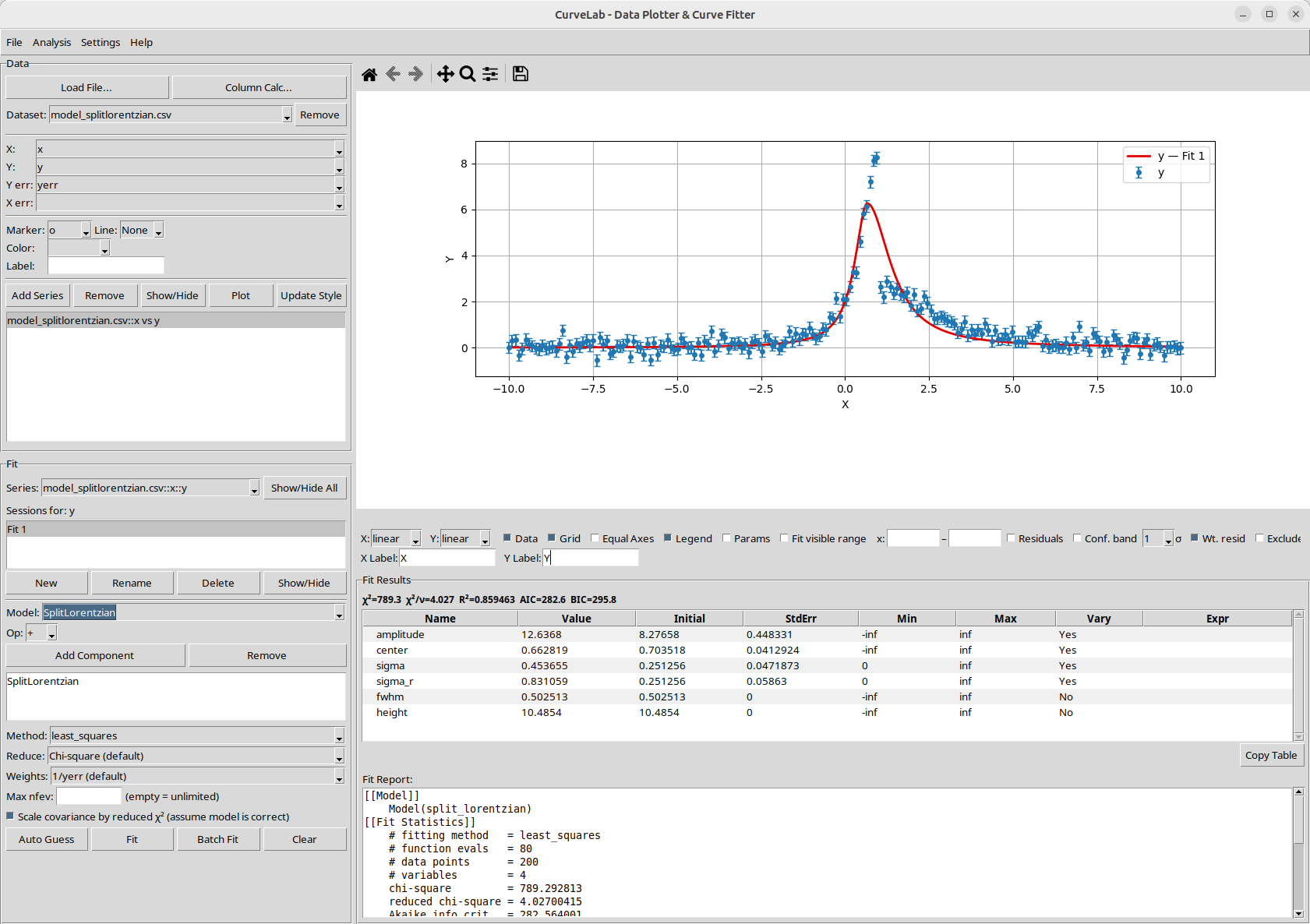
CurveLab provides a desktop GUI (Tkinter) and a Jupyter notebook widget for loading data, building composite models, fitting curves, and analyzing results -- all without writing code.
This project is also an experiment in AI-assisted coding.
Features
- 34 built-in models -- Gaussian, Lorentzian, Voigt, PseudoVoigt, exponential, polynomial (up to degree 7), spline, step, sine, and more, plus Bose and Fermi when lmfit >= 1.3 is installed. Custom expressions supported.
- Composite models -- combine components with
+,*,-,/operators - 14 fitting methods -- Trust Region Reflective (default), Levenberg-Marquardt, Nelder-Mead, differential evolution, basin-hopping, MCMC (emcee), brute-force grid search, ODR, and more
- 9 file formats -- CSV, TSV, TXT/DAT, Excel, ODS, JSON, Parquet, HDF5, SQLite, plus clipboard paste
- Multi-series / multi-session -- plot multiple datasets, run multiple fit sessions per series, batch fit across all series
- Statistical analysis -- confidence intervals, correlation/covariance matrices, diagnostic plots, bootstrap CI, profile likelihood, F-test, model comparison (AIC/BIC), uncertainty propagation, 2D confidence contours
- Data tools -- auto peak detection, derivative/integral, Savitzky-Golay smoothing, outlier detection (MAD-based sigma-clipping), point exclusion, column calculator, data simulation
- Export -- parameters (CSV), fit reports, curve data, plots (PNG/PDF/SVG), lmfit ModelResult (.sav)
- Workspace persistence -- save/load entire sessions as
.clwfiles - Jupyter support -- full-featured
CurveLabWidgetwith ipywidgets
Quick Start
pip install curvelab
curvelab
Or from a clone, for development:
git clone https://github.com/cosine-eu/curvelab.git
cd curvelab
pip install -e .
curvelab
In a Jupyter notebook:
%matplotlib widget
from curvelab.notebook import CurveLabWidget
CurveLabWidget()
See the Installation Guide for detailed instructions, optional dependencies, and troubleshooting.
Documentation
- Installation Guide -- prerequisites, setup, optional dependencies, troubleshooting
- User Manual -- comprehensive guide covering all features, workflows, and references
- AI-Assisted Coding Experiment -- background on how this project was built
Architecture
DataManager --> SeriesRecord --> PlotManager (display)
                            --> FitManager --> lmfit.Model --> FitResult
Core logic is GUI-agnostic. The two frontends (app.py for Tkinter, notebook.py for Jupyter) coordinate between the core modules. See the User Manual for details.
GUI-agnostic core:
| Module | Role |
|---|---|
fit_manager.py |
Composite model building, auto-guess, fitting, GOF metrics |
data_manager.py |
Tabular data loading with auto-detection |
models.py |
Registry of the built-in lmfit models |
session.py |
Dataclasses: SeriesRecord, FitSession, FitResult |
preprocessing.py |
Data cleaning (mask, range filter, NaN/inf, sort) |
analysis_tools.py |
Dialog numerics (peaks, smoothing, outliers, F-test) |
workspace.py |
JSON serialization for save/load |
plot_manager.py |
Matplotlib figure management (dual-axis, error bars, bands) |
Desktop application -- CurveLabApp is composed from mixins, one per
area of responsibility:
| Module | Role |
|---|---|
app.py |
CurveLabApp itself: composition, layout, parameter table |
app_menu.py |
Menu bar construction |
app_series.py |
Dataset/series/session lifecycle |
app_plotting.py |
Drawing series, fits, and residuals |
app_fit_handlers.py |
Fit, batch fit, abort, pre-fit validation |
app_analysis_handlers.py |
Analysis-menu dialog wiring |
app_data_tools.py |
Data-tool dialog wiring |
app_workspace.py |
Save/load workspace, exports |
User interface and notebook:
| Module | Role |
|---|---|
ui_panels.py |
Tkinter UI panels (data, fit, plot controls, results) |
ui_dialogs_analysis.py |
Statistical analysis dialogs (CI, contours, bootstrap, etc.) |
ui_dialogs_data.py |
Data tool dialogs (peaks, smooth, derivative, simulate) |
ui_common.py |
Shared widget helpers (BaseDialog, table row tints) |
notebook.py |
Jupyter notebook widget (ipywidgets) |
Dependencies
Core: numpy, pandas, matplotlib, scipy, lmfit, asteval, uncertainties, numdifftools, emcee, tqdm
Optional: ipywidgets/ipympl (notebook), openpyxl (Excel), odfpy (ODS), tables (HDF5), pyarrow (Parquet), odrpack (ODR), pytest/pytest-cov (test)
See the Installation Guide for how to install optional dependency groups.
BSD-3-Clause license
Copyright 2026 Giuseppe Vacanti giuseppe@vacanti.org
Redistribution and use in source and binary forms, with or without modification, are permitted provided that the following conditions are met:
1. Redistributions of source code must retain the above copyright
notice, this list of conditions and the following disclaimer.

2. Redistributions in binary form must reproduce the above
copyright notice, this list of conditions and the following
disclaimer in the documentation and/or other materials provided
with the distribution.

3. Neither the name of the copyright holder nor the names of its
contributors may be used to endorse or promote products derived
from this software without specific prior written permission.
THIS SOFTWARE IS PROVIDED BY THE COPYRIGHT HOLDERS AND CONTRIBUTORS "AS IS" AND ANY EXPRESS OR IMPLIED WARRANTIES, INCLUDING, BUT NOT LIMITED TO, THE IMPLIED WARRANTIES OF MERCHANTABILITY AND FITNESS FOR A PARTICULAR PURPOSE ARE DISCLAIMED. IN NO EVENT SHALL THE COPYRIGHT HOLDER OR CONTRIBUTORS BE LIABLE FOR ANY DIRECT, INDIRECT, INCIDENTAL, SPECIAL, EXEMPLARY, OR CONSEQUENTIAL DAMAGES (INCLUDING, BUT NOT LIMITED TO, PROCUREMENT OF SUBSTITUTE GOODS OR SERVICES; LOSS OF USE, DATA, OR PROFITS; OR BUSINESS INTERRUPTION) HOWEVER CAUSED AND ON ANY THEORY OF LIABILITY, WHETHER IN CONTRACT, STRICT LIABILITY, OR TORT (INCLUDING NEGLIGENCE OR OTHERWISE) ARISING IN ANY WAY OUT OF THE USE OF THIS SOFTWARE, EVEN IF ADVISED OF THE POSSIBILITY OF SUCH DAMAGE.
1 maintainer

Metadata
1 maintainer
Release files for curvelab 0.11.3
For a detailed explanation of source distributions (sdists) and built distributions (wheels), please see the package formats documentation.
Source distribution (sdist)
| File | Size | Uploaded | |
|---|---|---|---|
| curvelab-0.11.3.tar.gz | 168.4 kB | Details |
Built distribution (wheel)
| File | Interpreter | ABI | Platform | Reset |
|---|---|---|---|---|
| curvelab-0.11.3-py3-none-any.whl | Python 3 | none | any | Details |
Total release size: 316.4 kB
Release files / curvelab-0.11.3.tar.gz
| Download URL | curvelab-0.11.3.tar.gz |
|---|---|
| Size | 168.4 kB |
| Tags | Source |
|
SHA-256 checksum How to use checksums |
8fca875fc3de638e7205a7c09152e0778c096881e590ae7475e4820f42068420
|
|
BLAKE2b-256 checksum How to use checksums |
b5d0bc22da842a2c765ac9214d3f12374542e96b58caed5f6934cc0e7f5215e2
|
| Upload date | |
|
Uploaded using Trusted Publishing? What is trusted publishing? |
Yes |
| Uploaded via |
twine/7.0.0 CPython/3.13.14
|
Provenance
Provenance describes where a file came from. On PyPI, provenance is shared via attestations, which provide a verifiable record of the build or publishing details. View details, limitations and caveats.


PyPI Publish Attestation
PyPI verified that this artifact, at this checksum, originated from the publisher listed below.
Signed by GitHub Actions, verified by PyPI on Aug 3, 2026.
Transparency logRelease files / curvelab-0.11.3-py3-none-any.whl
| Download URL | curvelab-0.11.3-py3-none-any.whl |
|---|---|
| Size | 148.0 kB |
| Tags | Python 3 |
|
SHA-256 checksum How to use checksums |
c0de5dfc27c63b3a8f2aa246477709420d4507d47eb35a997b47675270597735
|
|
BLAKE2b-256 checksum How to use checksums |
9e41b7ed4166b40ed1241d176f261bc02408d097fee60a30b352b1118280bb9d
|
| Upload date | |
|
Uploaded using Trusted Publishing? What is trusted publishing? |
Yes |
| Uploaded via |
twine/7.0.0 CPython/3.13.14
|
Provenance
Provenance describes where a file came from. On PyPI, provenance is shared via attestations, which provide a verifiable record of the build or publishing details. View details, limitations and caveats.
PyPI Publish Attestation
PyPI verified that this artifact, at this checksum, originated from the publisher listed below.
Signed by GitHub Actions, verified by PyPI on Aug 3, 2026.
Transparency log













