



CvT-TensorFlow
TensorFlow 2.X reimplementation of CvT: Introducing Convolutions to Vision Transformers, Haiping Wu, Bin Xiao, Noel Codella, Mengchen Liu, Xiyang Dai, Lu Yuan, Lei Zhang.
- Exact TensorFlow reimplementation of official PyTorch repo, including
timmmodules used by authors, preserving models and layers structure. - ImageNet pretrained weights ported from PyTorch official implementation.
Table of contents
Abstract
Convolutional vision Transformers (CvT), improves Vision Transformers (ViT) in performance and efficienty by introducing convolutions into ViT to yield the best of both designs. This is accomplished through two primary modifications: a hierarchy of Transformers containing a new convolutional token embedding, and a convolutional Transformer block leveraging a convolutional projection. These changes introduce desirable properties of convolutional neural networks (CNNs) to the ViT architecture (e.g. shift, scale, and distortion invariance) while maintaining the merits of Transformers (e.g. dynamic attention, global context, and better generalization). Moreover the achieved results show that the positional encoding, a crucial component in existing Vision Transformers, can be safely removed in the model, simplifying the design for higher resolution vision tasks.
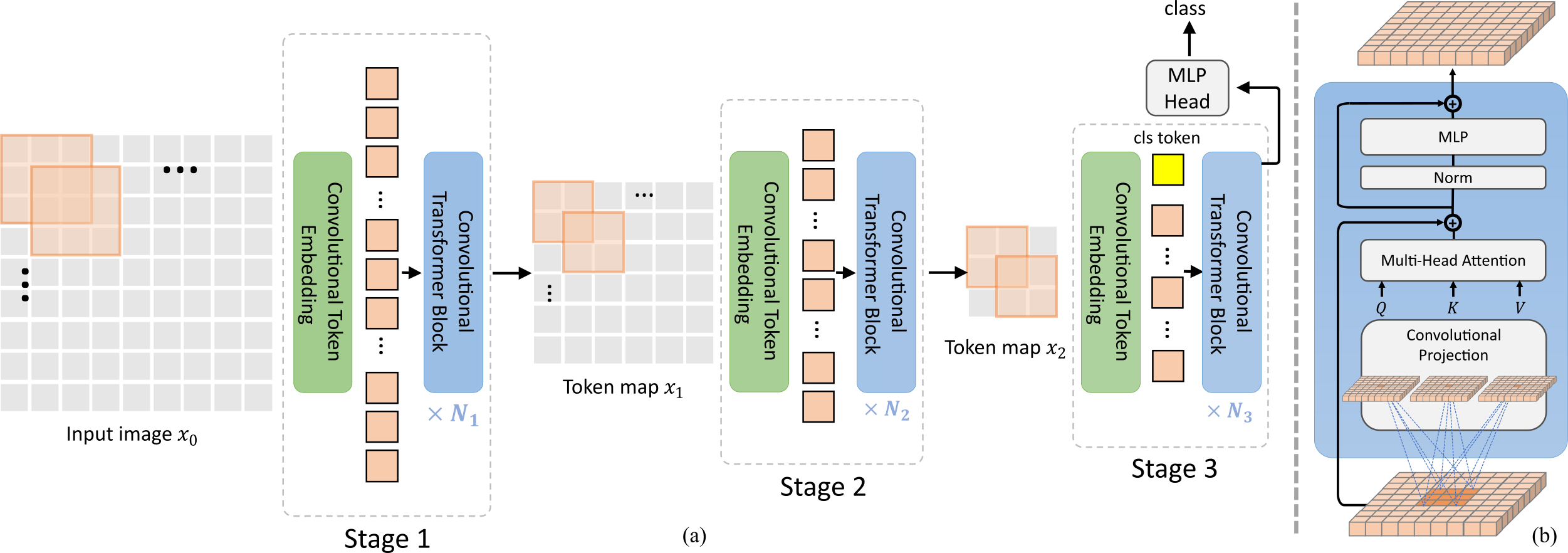
The pipeline of the CvT architecture. (a) Overall architecture, showing the hierarchical multi-stage structure facilitated by the Convolutional Token Embedding layer. (b) Details of the Convolutional Transformer Block, which contains the convolution projection as the first layer.
Results
TensorFlow implementation and ImageNet ported weights have been compared to the official PyTorch implementation on ImageNet-V2 test set.
Models pre-trained on ImageNet-1K
| Configuration | Resolution | Top-1 (Original) | Top-1 (Ported) | Top-5 (Original) | Top-5 (Ported) | #Params |
|---|---|---|---|---|---|---|
| CvT-13 | 224x224 | 69.81 | 69.81 | 89.13 | 89.13 | 20M |
| CvT-13 | 384x384 | 71.31 | 71.31 | 89.97 | 89.97 | 20M |
| CvT-21 | 224x224 | 71.18 | 71.17 | 89.31 | 89.31 | 32M |
| CvT-21 | 384x384 | 71.61 | 71.61 | 89.71 | 89.71 | 32M |
Models pre-trained on ImageNet-22K
| Configuration | Resoluton | Top-1 (Original) | Top-1 (Ported) | Top-5 (Original) | Top-5 (Ported) | #Params |
|---|---|---|---|---|---|---|
| CvT-13 | 384x284 | 71.76 | 71.76 | 91.39 | 91.39 | 20M |
| CvT-21 | 384x384 | 74.97 | 74.97 | 92.63 | 92.63 | 32M |
| CvT-W24 | 384x384 | 78.15 | 78.15 | 94.48 | 94.48 | 277M |
Max metrics difference: 9e-5.
Installation
- Install from PyPI
pip install cvt-tensorflow
- Install from Github
pip install git+https://github.com/EMalagoli92/CvT-TensorFlow
- Clone the repo and install necessary packages
git clone https://github.com/EMalagoli92/CvT-TensorFlow.git
pip install -r requirements.txt
Tested on Ubuntu 20.04.4 LTS x86_64, python 3.9.7.
Usage
- Define a custom CvT configuration.
from cvt_tensorflow import CvT

# Define a custom CvT configuration
model = CvT(
    in_chans=3,
    num_classes=1000,
    classifier_activation="softmax",
    data_format="channels_last",
    spec={
        "INIT": "trunc_norm",
        "NUM_STAGES": 3,
        "PATCH_SIZE": [7, 3, 3],
        "PATCH_STRIDE": [4, 2, 2],
        "PATCH_PADDING": [2, 1, 1],
        "DIM_EMBED": [64, 192, 384],
        "NUM_HEADS": [1, 3, 6],
        "DEPTH": [1, 2, 10],
        "MLP_RATIO": [4.0, 4.0, 4.0],
        "ATTN_DROP_RATE": [0.0, 0.0, 0.0],
        "DROP_RATE": [0.0, 0.0, 0.0],
        "DROP_PATH_RATE": [0.0, 0.0, 0.1],
        "QKV_BIAS": [True, True, True],
        "CLS_TOKEN": [False, False, True],
        "QKV_PROJ_METHOD": ["dw_bn", "dw_bn", "dw_bn"],
        "KERNEL_QKV": [3, 3, 3],
        "PADDING_KV": [1, 1, 1],
        "STRIDE_KV": [2, 2, 2],
        "PADDING_Q": [1, 1, 1],
        "STRIDE_Q": [1, 1, 1],
    },
)
- Use a predefined CvT configuration.
from cvt_tensorflow import CvT

model = CvT(
    configuration="cvt-21", data_format="channels_last", classifier_activation="softmax"
)
model.build((None, 224, 224, 3))
print(model.summary())
Model: "cvt-21"
_________________________________________________________________
 Layer (type)                Output Shape              Param #
=================================================================
 stage0 (VisionTransformer)  multiple                  62080

 stage1 (VisionTransformer)  multiple                  1920576

 stage2 (VisionTransformer)  ((None, 384, 14, 14),     29296128
                              (None, 1, 384))

 norm (LayerNorm_)           (None, 1, 384)            768

 head (Linear_)              (None, 1000)              385000

 pred (Activation)           (None, 1000)              0

=================================================================
Total params: 31,664,552
Trainable params: 31,622,696
Non-trainable params: 41,856
_________________________________________________________________
- Train from scratch the model.
# Example
model.compile(
    optimizer="sgd",
    loss="sparse_categorical_crossentropy",
    metrics=["accuracy", "sparse_top_k_categorical_accuracy"],
)
model.fit(x, y)
- Use ported ImageNet pretrained weights
# Example
from cvt_tensorflow import CvT

# Use cvt-13-384x384_22k ImageNet pretrained weights
model = CvT(
    configuration="cvt-13",
    pretrained=True,
    pretrained_resolution=384,
    pretrained_version="22k",
    classifier_activation="softmax",
)
y_pred = model(image)
Acknowledgement
CvT (Official PyTorch implementation)
Citations
@article{wu2021cvt,
  title={Cvt: Introducing convolutions to vision transformers},
  author={Wu, Haiping and Xiao, Bin and Codella, Noel and Liu, Mengchen and Dai, Xiyang and Yuan, Lu and Zhang, Lei},
  journal={arXiv preprint arXiv:2103.15808},
  year={2021}
}
License
This work is made available under the MIT License
1 maintainer

Metadata
1 maintainer
Release files for cvt-tensorflow 1.1.4
For a detailed explanation of source distributions (sdists) and built distributions (wheels), please see the package formats documentation.
Source distribution (sdist)
| File | Size | Uploaded | |
|---|---|---|---|
| cvt_tensorflow-1.1.4.tar.gz | 21.7 kB | Details |
Built distribution (wheel)
| File | Interpreter | ABI | Platform | Reset |
|---|---|---|---|---|
| cvt_tensorflow-1.1.4-py3-none-any.whl | Python 3 | none | any | Details |
Total release size: 46.5 kB
Release files / cvt_tensorflow-1.1.4.tar.gz
| Download URL | cvt_tensorflow-1.1.4.tar.gz |
|---|---|
| Size | 21.7 kB |
| Tags | Source |
|
SHA-256 checksum How to use checksums |
daa46df438c0a2a822fe37b5c07fdfb6a5c076f7769ce73512f155aedc950e7d
|
|
BLAKE2b-256 checksum How to use checksums |
5a3b9d2368399895a4d4dfc2d202a09761795d93d07dad10e4e3e6ea0c45f942
|
| Upload date | |
|
Uploaded using Trusted Publishing? What is trusted publishing? |
No |
| Uploaded via |
twine/4.0.1 CPython/3.11.1
|
Release files / cvt_tensorflow-1.1.4-py3-none-any.whl
| Download URL | cvt_tensorflow-1.1.4-py3-none-any.whl |
|---|---|
| Size | 24.8 kB |
| Tags | Python 3 |
|
SHA-256 checksum How to use checksums |
c66ca4ee364339c40fd6db954c84800fb184f536590db6780b5ae0ef0a7eee64
|
|
BLAKE2b-256 checksum How to use checksums |
81ddeb15627edce6475095949ee82b60fbd15d5085cf61ac3354304897dc52b5
|
| Upload date | |
|
Uploaded using Trusted Publishing? What is trusted publishing? |
No |
| Uploaded via |
twine/4.0.1 CPython/3.11.1
|













