
cyjwt
A fast drop-in replacement for PyJWT, with a
Cython 3 core. HMAC (HS256/384/512) needs nothing beyond the standard library;
the asymmetric algorithms (RS*, PS*, ES*, EdDSA) are available through the
optional cryptography extra.
The public API mirrors jwt: encode, decode, decode_complete,
get_unverified_header, PyJWT, PyJWS, register_algorithm,
unregister_algorithm, get_algorithm_by_name, and the exception hierarchy.
The compatibility target is PyJWT 2.15.1; parity is enforced by differential
tests against the installed PyJWT. Requires Python 3.12+, and is tested on
3.12, 3.13, 3.14, and 3.15.
What is accelerated, and how
The hot byte-level operations live in _core.pyx:
| Operation | Implementation |
|---|---|
| base64url encode/decode | table-driven loop, single allocation, no base64+replace, no extra copy for padding |
| compact JWS splitting | one pass over the token (header.payload.signature) |
| signature comparison | constant-time, in C (ct_equal) |
| algorithm-confusion guard | fast byte search for PEM/SSH markers and a JWK kty member |
On top of that, the Python layer caches the JSONEncoder (instead of building one
per encode), copies options only when needed, copies the payload dict only when
a datetime claim must be converted, uses time.time() instead of
datetime.now(), and passes bytes/memoryviews around instead of re-converting.
Everything that carries correctness weight (JSON, HMAC-SHA*, claim validation)
stays on the standard library; asymmetric signatures are delegated to
cryptography rather than hand-rolled.
Benchmarks
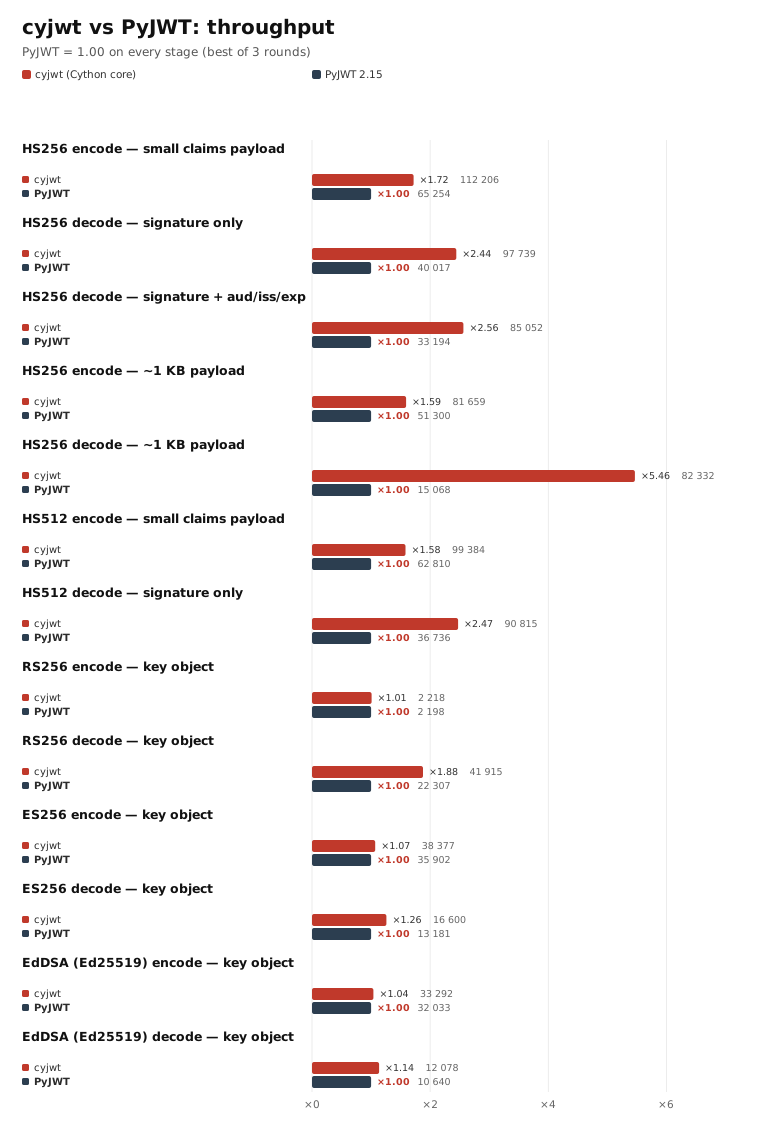
Same-session comparison against PyJWT 2.15.1 (one process, best of 3 rounds).
HS256 decode is ~2.5x faster, decode of a ~1 KB token ~5.4x, encode ~1.7x;
asymmetric stages are dominated by cryptography (RS256 encode is 1.00x) and
keep a smaller but consistent win on decode. Methodology, full tables and every
stage chart: docs/benchmarks.md.
Memory footprint (import and steady state, with and without cryptography) is
measured by benchmarks/memory.py; numbers are in
docs/benchmarks.md.
Run it yourself:
python benchmarks/bench.py                              # all stages + charts
python benchmarks/bench.py --stages encode-hs256,decode-hs256
python benchmarks/chart.py                              # re-render from results
python benchmarks/memory.py                             # memory probe
Charts are plain SVG generated with the standard library; PNG export needs
inkscape and is optional.
Supported
HS256,HS384,HS512,none(registered, butverify()always returnsFalse, as in PyJWT);- with
cyjwt[crypto]:RS256/384/512,PS256/384/512,ES256,ES256K,ES384,ES512,ES521, andEdDSA(Ed25519/Ed448). Keys may be passed ascryptographykey objects, PEM (private/public) or OpenSSH public keys; HMAC secrets additionally reject DER/x509 input; exp,nbf,iat,aud(includingstrict_aud),iss,sub,jti,options["require"],leeway(number ortimedelta);- detached payload (RFC 7797):
headers={"b64": False}+crit; kidandcritheader parameters,sort_headers,json_encoder;- HMAC key-length checks (
InsecureKeyLengthWarning,enforce_minimum_key_length); - custom
Algorithmregistration (including wrappers overcryptographyfor RS*/ES*/PS*/EdDSA).
Not supported (by design)
PyJWK, PyJWKSet and PyJWKClient (JWKS) are not implemented: raw JWK JSON is
not accepted as a key, and there are no JWK parsing/conversion helpers. Anything
else can still be plugged in as a custom Algorithm via register_algorithm.
Installation
python -m venv .venv && . .venv/bin/activate
pip install "cyjwt[crypto]"      # HMAC + asymmetric algorithms
pip install cyjwt                # HMAC only, zero dependencies
pip install -e ".[dev]"          # development (tests, lint, reference PyJWT)
A C compiler is required (gcc/clang or MSVC). Without cryptography, import cyjwt still works, get_default_algorithms() returns only HS*/none, and
requesting RS256 raises NotImplementedError with an install hint.
Usage
Code written against PyJWT works unchanged:
import cyjwt
from cyjwt.exceptions import ExpiredSignatureError

token = cyjwt.encode({"sub": "user", "exp": 4102444800}, "secret-key")
payload = cyjwt.decode(token, "secret-key", algorithms=["HS256"], audience="svc")
header = cyjwt.get_unverified_header(token)
Asymmetric algorithms:
token = cyjwt.encode(claims, private_pem, algorithm="RS256")
claims = cyjwt.decode(token, public_pem, algorithms=["RS256"])

token = cyjwt.encode(claims, ec_private_pem, algorithm="ES256")
claims = cyjwt.decode(token, ec_public_pem, algorithms=["ES256"])
Performance note: pass key objects for asymmetric algorithms
prepare_key parses PEM on every encode/decode. For RSA private keys
that parse runs OpenSSL key validation, which costs milliseconds rather than
microseconds (measured on this machine with cryptography 50: 25 ms at 2048
bits, 78 ms at 3072, 180 ms at 4096). The signature itself is 0.4/1.3/2.9 ms
respectively, so parsing dominates encode by ~60x. Pass an already-loaded
cryptography key object to avoid it:
from cryptography.hazmat.primitives.serialization import load_pem_private_key

key = load_pem_private_key(pem, password=None)  # once, at startup
token = cyjwt.encode(claims, key, algorithm="RS256")  # 417 us instead of 25.8 ms
Public PEM keys parse in ~7-9 us, so decode is less affected: at 2048 bits it
takes 35 us with PEM and 28 us with a key object.
Custom algorithm:
from cyjwt import PyJWS
from cyjwt.algorithms import Algorithm


class MyAlg(Algorithm):
    def prepare_key(self, key):
        return key

    def sign(self, msg, key): ...

    def verify(self, msg, key, sig): ...


jws = PyJWS()
jws.register_algorithm("MYALG", MyAlg())
Security
algorithmsis required whenverify_signature=True; the token'salgnever selects the algorithm on its own (RFC 8725 §2.1).- base64url is decoded strictly and canonically: stray characters, bad padding and
non-zero trailing bits raise
DecodeErrorinstead of decoding "somehow". - An HMAC secret cannot be a PEM/SSH key or raw JWK JSON (
InvalidKeyError) — the algorithm-confusion defence. - Signature comparison is constant-time.
- Short HMAC keys emit
InsecureKeyLengthWarning(RFC 7518 §3.2); theenforce_minimum_key_length=Trueoption turns that intoInvalidKeyError. RSA keys below 2048 bits warn the same way (NIST SP 800-131A). - EC algorithms pin the expected curve (
ES256only accepts P-256,ES256Konly secp256k1, and so on); a mismatched curve raisesInvalidKeyError. - ECDSA signatures are converted between JOSE
r || sand DER with the fixed width implied by the curve; a wrong-length signature is rejected. b64=falsewithoutcrit: ["b64"], and a non-empty payload segment whenb64=false, are rejected.
Deviation from PyJWT 2.15: PyJWT(options={"verify_signature": False}) actually
disables signature verification in decode here (in PyJWT 2.15.1 that
instance-level option is ignored by decode, which only looks at the options
argument of the call).
Layout
cyjwt/
├── pyproject.toml
├── setup.py                # Extension + cythonize only
├── MANIFEST.in
├── .gitignore
├── LICENSE
├── README.md
├── src/cyjwt/
│   ├── __init__.py         # public API
│   ├── _core.pyx           # base64url, JWS split, HMAC, key-shape checks
│   ├── _core.pxd           # cdef declarations for cimport
│   ├── _core.pyi           # type stubs
│   ├── algorithms.py       # Algorithm, HMAC/None, RSA, PSS, EC, EdDSA
│   ├── _crypto_backend.py  # optional cryptography imports + ECDSA conversion
│   ├── api_jws.py          # PyJWS: signing/verification, headers, crit, detached
│   ├── api_jwt.py          # PyJWT: claims, options, leeway
│   ├── exceptions.py
│   ├── warnings.py
│   ├── _version.py
│   └── py.typed
├── tests/
│   ├── test_core.py
│   ├── test_jws.py         # RFC 7515 and jwt.io vectors
│   ├── test_jwt.py
│   ├── test_asymmetric.py    # RS/PS/ES/EdDSA (skipped without crypto)
│   ├── test_compat_pyjwt.py  # differential HS* tests (require the dev extra)
│   └── test_compat_asymmetric.py  # differential RS/ES/PS/EdDSA tests
├── benchmarks/
│   ├── bench.py            # stage runner: cyjwt vs PyJWT, writes results/*.json
│   ├── chart.py            # SVG/PNG chart renderer (standard library + inkscape)
│   └── memory.py           # import / steady-state memory probe
└── docs/
    ├── benchmarks.md       # methodology, tables, chart index
    └── img/charts/         # generated stage and combined charts
Development
pytest                       # 200 tests, differential ones included
pytest --cov=cyjwt
mypy                         # strict
ruff check . && ruff format --check .
python benchmarks/bench.py   # cyjwt vs PyJWT + charts (docs/img/charts)
The differential tests require pyjwt==2.15.1 and cryptography (both part of
.[dev]) and are skipped without them. Rebuild the extension with
pip install -e . --no-build-isolation --force-reinstall.
Building distributions
python -m build
The generated src/cyjwt/_core.c is not committed: it goes into the sdist
(building without Cython) but not into the wheel.
1 maintainer

Metadata
1 maintainer
Release files for cyjwt 0.2.0
For a detailed explanation of source distributions (sdists) and built distributions (wheels), please see the package formats documentation.
Source distribution (sdist)
| File | Size | Uploaded | Provenance | Actions |
|---|---|---|---|---|
| cyjwt-0.2.0.tar.gz | 138.8 kB | Without provenance | Details for cyjwt-0.2.0.tar.gz |
Built distributions (wheels)
Total release size: 1.1 MB
Release files / cyjwt-0.2.0.tar.gz
| Download URL | cyjwt-0.2.0.tar.gz |
|---|---|
| Size | 138.8 kB |
| Tags | Source |
|
SHA-256 checksum How to use checksums |
7afe5cfb8d4cd2b525196cb85e489e0dcc9b5012b3691567c496d1cbc1dab83e
|
|
BLAKE2b-256 checksum How to use checksums |
7dddb3ab3e69a9883a94db2d4c96b920b1b37a88f471f1f8114fde149946e9b5
|
| Upload date | |
|
Uploaded using Trusted Publishing? What is trusted publishing? |
No |
| Uploaded via |
twine/7.0.0 CPython/3.13.16
|
Release files / cyjwt-0.2.0-cp315-cp315-manylinux1_x86_64.manylinux_2_28_x86_64.manylinux_2_5_x86_64.whl
| Download URL | cyjwt-0.2.0-cp315-cp315-manylinux1_x86_64.manylinux_2_28_x86_64.manylinux_2_5_x86_64.whl |
|---|---|
| Size | 243.5 kB |
| Tags | CPython 3.15 Linux glibc 2.28+ x86-64 Linux glibc 2.5+ x86-64 |
|
SHA-256 checksum How to use checksums |
fb9af4fc683a495dba13986bd88f617ac59253cbf00b406caf71d6160056deeb
|
|
BLAKE2b-256 checksum How to use checksums |
6285f8f61bbcaa916014499fc8617ec5f6e8155060ff7a19a54139be4c91e251
|
| Upload date | |
|
Uploaded using Trusted Publishing? What is trusted publishing? |
No |
| Uploaded via |
twine/7.0.0 CPython/3.13.16
|
Release files / cyjwt-0.2.0-cp314-cp314-manylinux1_x86_64.manylinux_2_28_x86_64.manylinux_2_5_x86_64.whl
| Download URL | cyjwt-0.2.0-cp314-cp314-manylinux1_x86_64.manylinux_2_28_x86_64.manylinux_2_5_x86_64.whl |
|---|---|
| Size | 242.8 kB |
| Tags | CPython 3.14 Linux glibc 2.28+ x86-64 Linux glibc 2.5+ x86-64 |
|
SHA-256 checksum How to use checksums |
f52b6188829adc20e82137483740e6aaf2eb6188aa95b19872df061ad8fced39
|
|
BLAKE2b-256 checksum How to use checksums |
3f95368da9c94b987e29ba5a937c8d547748c168c76c614bb7c9e4e18d4186bf
|
| Upload date | |
|
Uploaded using Trusted Publishing? What is trusted publishing? |
No |
| Uploaded via |
twine/7.0.0 CPython/3.13.16
|
Release files / cyjwt-0.2.0-cp313-cp313-manylinux1_x86_64.manylinux_2_28_x86_64.manylinux_2_5_x86_64.whl
| Download URL | cyjwt-0.2.0-cp313-cp313-manylinux1_x86_64.manylinux_2_28_x86_64.manylinux_2_5_x86_64.whl |
|---|---|
| Size | 244.6 kB |
| Tags | CPython 3.13 Linux glibc 2.28+ x86-64 Linux glibc 2.5+ x86-64 |
|
SHA-256 checksum How to use checksums |
e8c379c6c14577fa2b75c2922af21b213e8c0543725b5ffb4e4bde528019f097
|
|
BLAKE2b-256 checksum How to use checksums |
1907cd9b85685cfdfea3726d00923e5eb86f6036bbe28e81dcab86d26f455618
|
| Upload date | |
|
Uploaded using Trusted Publishing? What is trusted publishing? |
No |
| Uploaded via |
twine/7.0.0 CPython/3.13.16
|
Release files / cyjwt-0.2.0-cp312-cp312-manylinux1_x86_64.manylinux_2_28_x86_64.manylinux_2_5_x86_64.whl
| Download URL | cyjwt-0.2.0-cp312-cp312-manylinux1_x86_64.manylinux_2_28_x86_64.manylinux_2_5_x86_64.whl |
|---|---|
| Size | 249.1 kB |
| Tags | CPython 3.12 Linux glibc 2.28+ x86-64 Linux glibc 2.5+ x86-64 |
|
SHA-256 checksum How to use checksums |
b636243151b068cb05606de4703488ddc2af7f5642daa1367adc95e5a87af96c
|
|
BLAKE2b-256 checksum How to use checksums |
aa647f9013b27f3f666ad01084a0c7af353c9e09c82dea312650b3849a786dc4
|
| Upload date | |
|
Uploaded using Trusted Publishing? What is trusted publishing? |
No |
| Uploaded via |
twine/7.0.0 CPython/3.13.16
|
Security for cyjwt 0.2.0
Provenance
Provenance describes where a file came from. On PyPI, provenance is shared via attestations, which provide a verifiable record of the build or publishing details. View details, limitations and caveats.
No provenance found
None of the files in this release were uploaded with provenance metadata.
A note on package security
PyPI is a repository for distributing packages, not a service for auditing them. While third-party security researchers and our staff do their best to detect and remove malicious packages, PyPI cannot guarantee the quality, security or suitability of any given package.
To learn more about protecting yourself from malicious actors, visit our package security documentation.













