
CytoCAD - Copy-number variation caller using low-depth whole-genome sequencing data






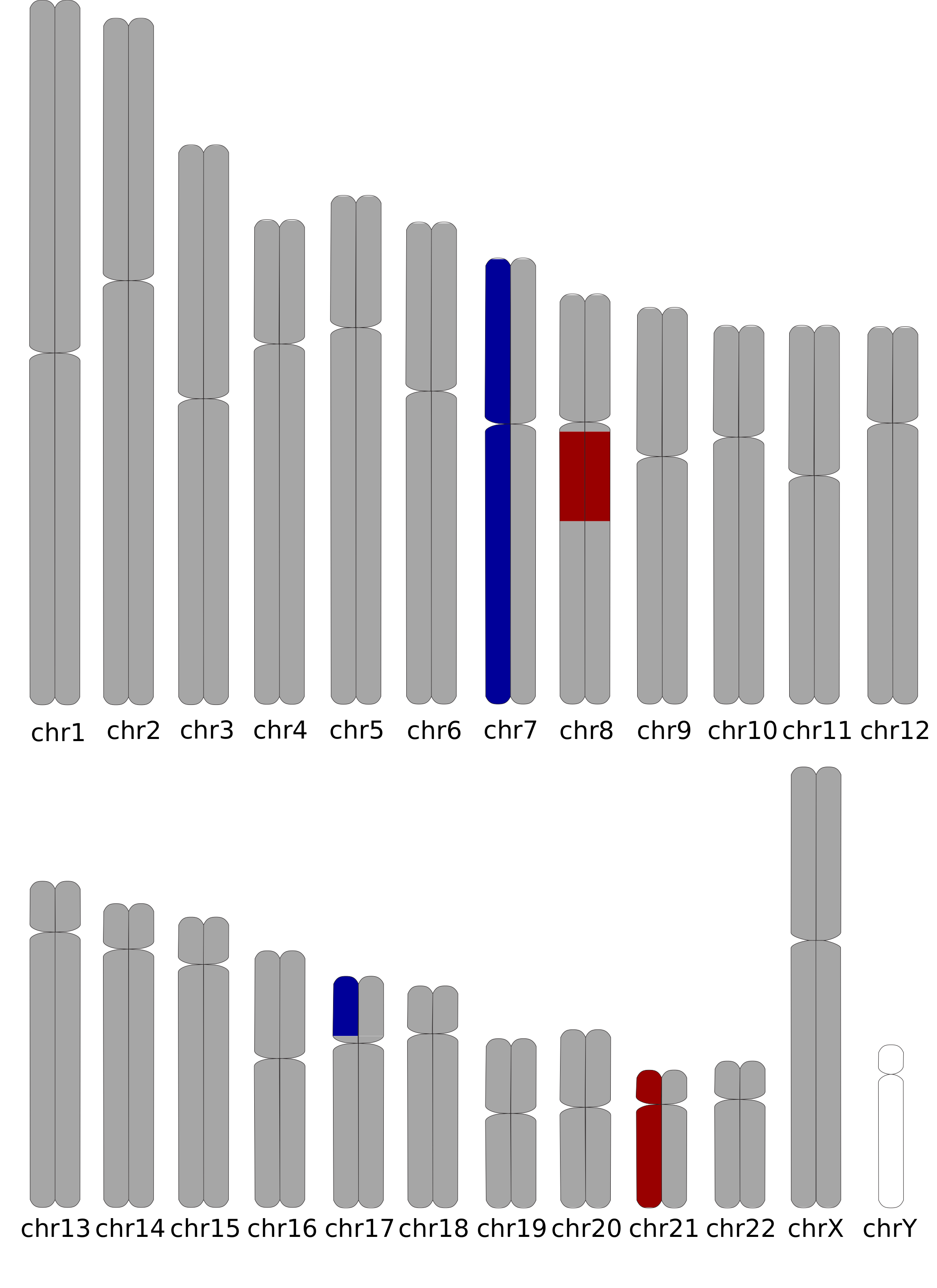
CytoCAD is a bioinformatics tool for the identification of large genomic copy-number variation through coverage anomaly detection (CAD) using mapped whole-genome sequencing (WGS) data. It has been tested in low-depth (~8X) Oxford Nanopore WGS long-read data. Its output displays chromosome illustrations demarcating regions of copy-number gains (Red) or losses (Blue). The above illustration shows a loss of one chromosome 7 copy, a gain of one chromosome 21 copy, a partial duplication of both chromosome 8 copies, and a loss of one chromosome 17 short arm. It also has two X chromosomes and no Y chromosome, suggesting a female sex.
Basic information:
- Takes as input a mapped whole-genome sequencing BAM file and output a BED file and a chromosome ideogram-like figure
- Uses Ruptures python package for change point detection of read coverage data per chromosome
- Uses tagore for chromosome ideogram illustrations
Getting Started
Quick run
cytocad [Options] sample.bam working_dir
| Argument | Comment |
|---|---|
| sample.bam | Input mapped WGS BAM file |
| working_dir | Working directory |
Output
| Output file | Comment |
|---|---|
| ${sample}.ideo.svg | Chromosome ideogram produced by tagore |
| ${sample}.CNV.bed | BED file of chromosome regions with CNV |
For more information, see wiki.
Operating system:
- Linux (x86_64 architecture, tested in Ubuntu 16.04)
Installation:
There are three ways to install CytoCAD:
Option 1: Conda (Recommended)
# Installing from bioconda automatically installs all dependencies
conda install -c bioconda cytocad
Option 2: PyPI (See dependencies below)
# Installing from PyPI requires own installation of dependencies, see below
pip install cytocad
Option 3: GitHub (See dependencies below)
# Installing from GitHub requires own installation of dependencies, see below
git clone https://github.com/cytham/cytocad.git
cd cytocad
pip install .
Installation of dependencies
- bedtools >=2.26.0
- samtools >=1.3.0
- rsvg-convert >=2.40.13
Please make sure each executable binary is in PATH.
1. bedtools
Please visit here for instructions to install.
2. samtools
Please visit here for instructions to install.
3. rsvg-convert
sudo apt-get update
sudo apt-get install librsvg2-bin
Versioning
See CHANGELOG
Citation
Not available yet
Author
- Tham Cheng Yong - cytham
License
This project is licensed under GNU General Public License - see LICENSE.txt for details.
Limitations
- Chromosome pairs illustrated by tagore may resemble sister chromatids, but they are in fact homologous pairs
- Phasing of CNVs for each chromosome homologous pair is not yet possible.
- The default minimum size of detectable CNV is about 500 kb. It can be adjusted by the 'interval' and 'rolling' parameters following the equation: minimum size ~= interval*rolling
- Other chromosomal structural variations, such as inversions, have to be detected by other tools, such as NanoVar. NanoVar has incorporated CytoCAD in its pipeline from version 1.4.0 onwards.
1 maintainer

Metadata
1 maintainer
Release files for cytocad 1.0.3
For a detailed explanation of source distributions (sdists) and built distributions (wheels), please see the package formats documentation.
Source distribution (sdist)
| File | Size | Uploaded | Provenance | |
|---|---|---|---|---|
| cytocad-1.0.3.tar.gz | 125.6 kB | Without provenance | Details |
Release files / cytocad-1.0.3.tar.gz
| Download URL | cytocad-1.0.3.tar.gz |
|---|---|
| Size | 125.6 kB |
| Tags | Source |
|
SHA-256 checksum How to use checksums |
16a0700e0acbe1ce9d0aefb8bc6b3dd8fb3a75f0d8f115c0b84ee540520e5d39
|
|
BLAKE2b-256 checksum How to use checksums |
286ae5e121d36273f6d4fde17661588604286e7bc41f364cf58ead1dca9afc2d
|
| Upload date | |
|
Uploaded using Trusted Publishing? What is trusted publishing? |
No |
| Uploaded via |
twine/1.15.0 pkginfo/1.5.0.1 requests/2.9.1 setuptools/42.0.2 requests-toolbelt/0.9.1 tqdm/4.38.0 CPython/3.5.2
|
Security for cytocad 1.0.3
Provenance
Provenance describes where a file came from. On PyPI, provenance is shared via attestations, which provide a verifiable record of the build or publishing details. View details, limitations and caveats.
No provenance found
None of the files in this release were uploaded with provenance metadata.
A note on package security
PyPI is a repository for distributing packages, not a service for auditing them. While third-party security researchers and our staff do their best to detect and remove malicious packages, PyPI cannot guarantee the quality, security or suitability of any given package.
To learn more about protecting yourself from malicious actors, visit our package security documentation.














