
Remote terminal control

Project description
daffi-terminals
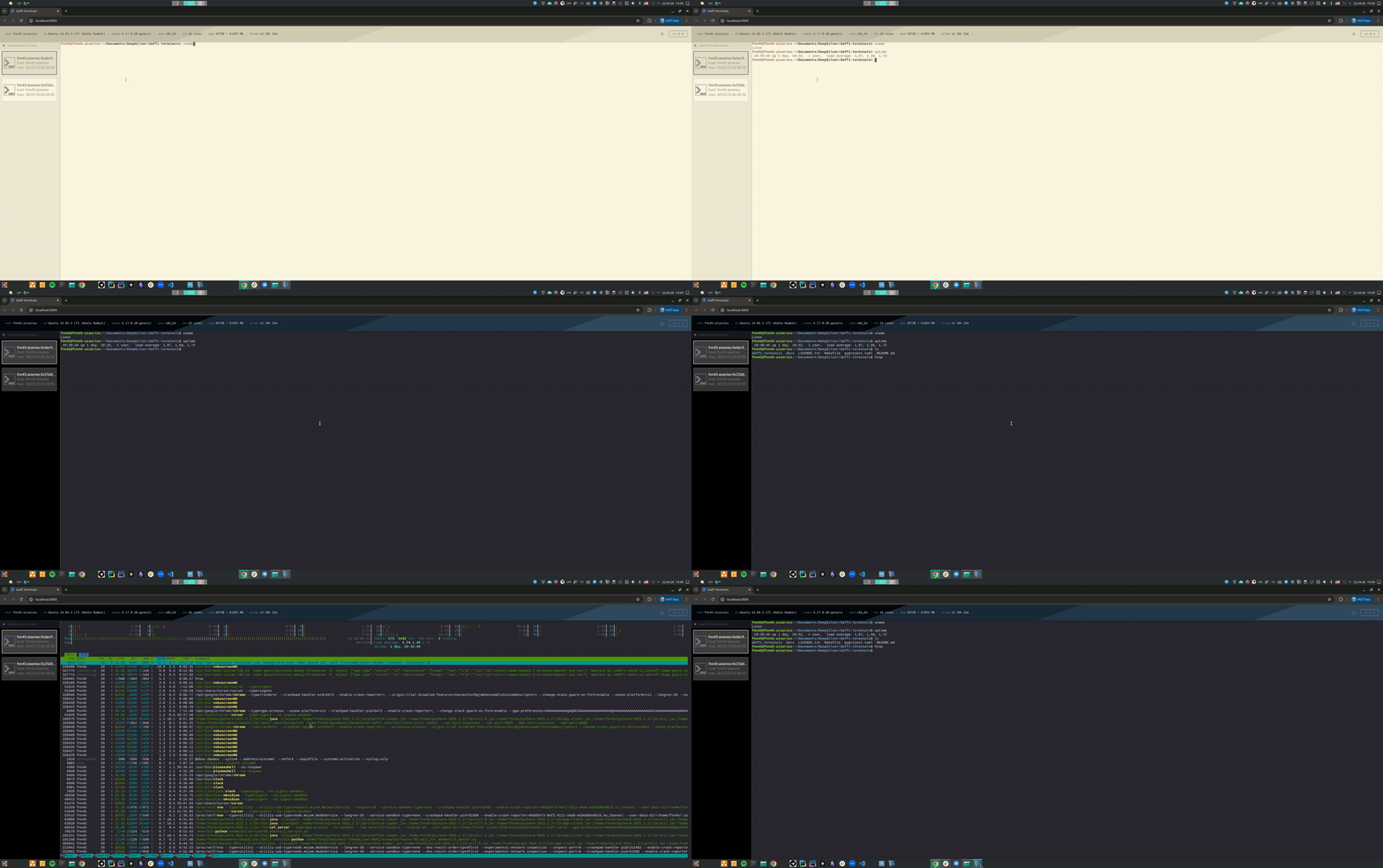
A lightweight, browser-based remote terminal manager. Connect any number of Linux/macOS hosts to a central router and open interactive shell sessions in your browser — no SSH, no VPN, no agent configuration required.
Features
| Multi-host | Connect unlimited remote nodes; each appears as a card in the sidebar |
| Live terminal | Full interactive shell with automatic resize as you resize the browser window |
| Autoreconnect | Workers reconnect to the router automatically after any network interruption |
| Host info | Hostname, OS, kernel, CPU, memory and uptime shown in the header when you open a session |
| Dark / Light theme | Theme switcher with Solarized-inspired palettes, persisted across reloads |
| Fuzzy search | Filter the worker sidebar by name or MAC address |
| TLS encryption | Optional encryption for both the browser connection and the worker transport |
| Zero footprint on workers | Workers need only Python and daffi — no SSH daemon, no open ports |
Installation
pip install daffi-terminals
Python 3.8+ is required.
Quick start
Terminal 1 — start the router (the machine your browser will connect to):
dterm start-router \
  --rpc-host 0.0.0.0 \
  --rpc-port 9999 \
  --web-host 0.0.0.0 \
  --web-port 8888
Open http://<router-host>:8888 in your browser.
Terminal 2, 3, … — connect workers (one per host you want to control):
dterm start-worker \
  --rpc-host <router-host> \
  --rpc-port 9999
Each worker appears in the sidebar within seconds. Click a card to open a shell session.
How it works
  Browser
     │  HTTP/WebSocket
     ▼
  Router  ──── RPC (TCP) ────►  Worker A  (any Linux/macOS host)
     │    ──── RPC (TCP) ────►  Worker B
     │    ──── RPC (TCP) ────►  Worker N  (as many as you need)
     │
  Web UI served on --web-port
  Workers registered on --rpc-port
The router is a single process that acts as both the RPC message broker (for worker communication) and the web server (for the browser UI). Workers connect outbound to the router — you never need to open ports on the worker hosts.
CLI reference
dterm start-router
| Argument | Required | Description |
|---|---|---|
--rpc-host |
yes | Address the router listens on for worker connections (use 0.0.0.0 to accept from any host) |
--rpc-port |
yes | Port for worker connections |
--web-host |
yes | Address the web server listens on (use 0.0.0.0 to accept from any host) |
--web-port |
yes | Port for the browser UI |
--ssl-cert |
no | TLS certificate for worker connections (PEM). Enables encrypted RPC when combined with --ssl-key |
--ssl-key |
no | TLS private key for worker connections (PEM) |
--web-ssl-cert |
no | TLS certificate for the web server. Enables HTTPS/WSS when combined with --web-ssl-key |
--web-ssl-key |
no | TLS private key for the web server |
dterm start-worker
| Argument | Required | Description |
|---|---|---|
--rpc-host |
yes | Hostname or IP of the router |
--rpc-port |
yes | Port of the router |
--name |
no | Name shown in the UI sidebar. Auto-generated as <hostname>-0x<hex> if omitted |
--group |
no | Visual group label. Workers with the same group appear together in a collapsible colored section (up to 7 groups) |
--ssl-cert |
no | TLS certificate (must match the router's certificate) |
--ssl-key |
no | TLS private key |
Examples
Worker groups
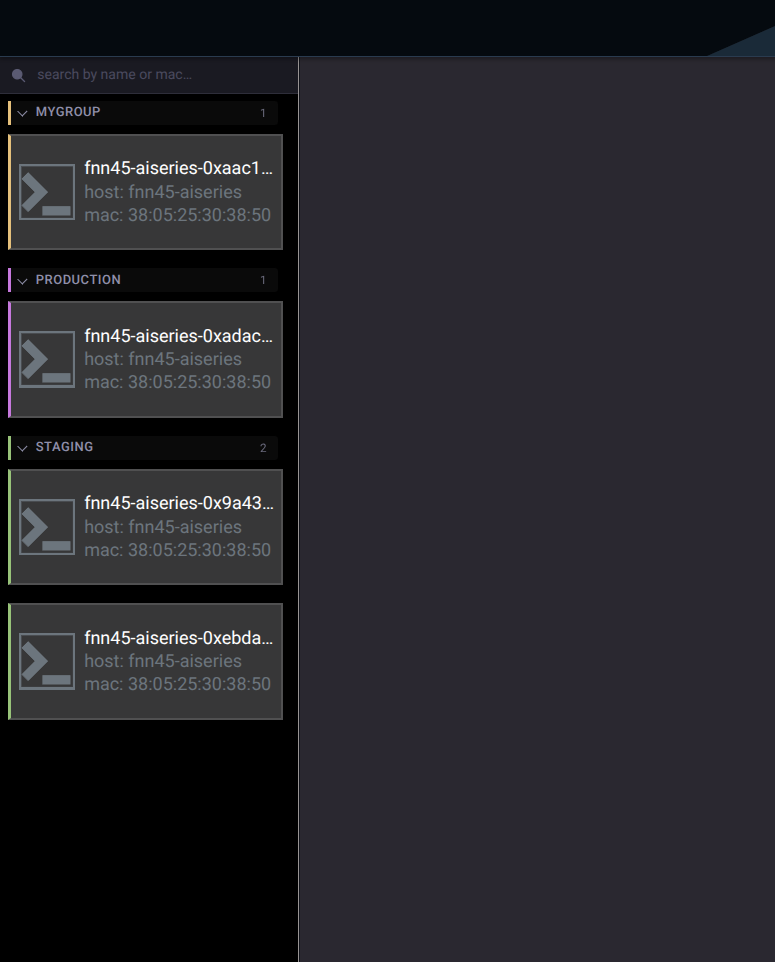
Workers can be organized into named groups using the --group flag.
Each group gets a distinct color and appears as a collapsible section in the sidebar,
sorted alphabetically. Workers without a group are listed at the top.
dterm start-worker --rpc-host router --rpc-port 9999 --group "production"
dterm start-worker --rpc-host router --rpc-port 9999 --group "production"
dterm start-worker --rpc-host router --rpc-port 9999 --group "staging"
dterm start-worker --rpc-host router --rpc-port 9999 --group "staging"
dterm start-worker --rpc-host router --rpc-port 9999   # ungrouped — shown at top
Up to 7 groups are supported, each with a unique color from the built-in rainbow palette. Click a group header to collapse or expand it. The collapsed state is remembered across page reloads.
Multiple workers on the same host
Give each worker a distinct name:
dterm start-worker --rpc-host router --rpc-port 9999 --name "web-server-1"
dterm start-worker --rpc-host router --rpc-port 9999 --name "web-server-2"
Or omit --name and let each instance generate its own unique identifier.
Workers on remote hosts
The router address must be reachable from the worker host.
Replace 192.168.1.10 with your router's IP or hostname:
# on the router host
dterm start-router --rpc-host 0.0.0.0 --rpc-port 9999 \
                   --web-host 0.0.0.0 --web-port 8888

# on each remote worker host
dterm start-worker --rpc-host 192.168.1.10 --rpc-port 9999
HTTPS + encrypted worker transport (TLS)
There are two ways to serve the web UI over HTTPS:
Option A — built-in TLS (simple, no extra software)
Pass certificate files directly to the router.
See examples/ssl/ for ready-to-run scripts:
# 1. generate a certificate (uses mkcert if available, otherwise openssl)
bash examples/ssl/gen-certs.sh

# 2. start router — HTTPS on the web UI, TLS on the worker port
bash examples/ssl/start-router.sh

# 3. connect workers with TLS
bash examples/ssl/start-worker.sh
Open https://localhost:8888. If you used the openssl fallback (no mkcert),
click Advanced → Accept the Risk and Continue once.
Option B — nginx reverse proxy (recommended for production)
Run the web server on plain HTTP and let nginx handle TLS termination. This is the standard production setup and works with any certificate, including Let's Encrypt.
Browser ──HTTPS──► nginx :443 ──HTTP──► dterm web server :8888
Minimal nginx site config:
server {
    listen 443 ssl;
    server_name terminals.example.com;

    ssl_certificate     /etc/letsencrypt/live/terminals.example.com/fullchain.pem;
    ssl_certificate_key /etc/letsencrypt/live/terminals.example.com/privkey.pem;

    location / {
        proxy_pass http://127.0.0.1:8888;

        # Required for WebSocket upgrade (used by /director and /terminal)
        proxy_http_version 1.1;
        proxy_set_header Upgrade    $http_upgrade;
        proxy_set_header Connection "upgrade";

        proxy_set_header Host              $host;
        proxy_set_header X-Real-IP         $remote_addr;
        proxy_set_header X-Forwarded-For   $proxy_add_x_forwarded_for;
        proxy_set_header X-Forwarded-Proto $scheme;

        # Keep terminal sessions alive during long idle periods
        proxy_read_timeout 3600s;
        proxy_send_timeout 3600s;
    }
}

# Redirect plain HTTP to HTTPS
server {
    listen 80;
    server_name terminals.example.com;
    return 301 https://$host$request_uri;
}
Start the router without any --web-ssl-* flags (nginx owns the cert):
dterm start-router \
  --rpc-host 0.0.0.0 --rpc-port 9999 \
  --web-host 127.0.0.1 --web-port 8888
The worker RPC transport is separate from the web server and can be
encrypted independently with --ssl-cert / --ssl-key regardless of
which HTTPS option you choose.
Running as a systemd service
Worker on a remote host that should start automatically on boot:
# /etc/systemd/system/dterm-worker.service
[Unit]
Description=daffi-terminals worker
After=network-online.target
Wants=network-online.target

[Service]
ExecStart=/usr/local/bin/dterm start-worker \
    --rpc-host router.example.com \
    --rpc-port 9999
Restart=on-failure
RestartSec=5

[Install]
WantedBy=multi-user.target
sudo systemctl enable --now dterm-worker
Makefile (development)
make start-router   # localhost:9999 (RPC) + localhost:8888 (web)
make start-worker   # connects to localhost:9999
Targets auto-detect the Python virtual environment in .venv/ inside the project root.
License
MIT — see LICENSE.txt.
Release history Release notifications | RSS feed


Download files
Download the file for your platform. If you're not sure which to choose, learn more about installing packages.
Source Distribution
Built Distribution
Filter files by name, interpreter, ABI, and platform.
If you're not sure about the file name format, learn more about wheel file names.
Copy a direct link to the current filters
File details
Details for the file daffi_terminals-2.0.1.tar.gz.
File metadata
- Download URL: daffi_terminals-2.0.1.tar.gz
- Upload date:
- Size: 735.2 kB
- Tags: Source
- Uploaded using Trusted Publishing? Yes
- Uploaded via: twine/6.1.0 CPython/3.13.12
File hashes
| Algorithm | Hash digest | |
|---|---|---|
| SHA256 |
d2d2250e559efe0d44edae36cf082dca546c57ed25ed52e4dd6d54ad5a88bc11
|
|
| MD5 |
34b795d182aa20a80a04b6c3edb70b45
|
|
| BLAKE2b-256 |
9266e8e5da268b8af3ba66192864ba816cba405efc5493e3f3549d925e3f9610
|
Provenance
The following attestation bundles were made for daffi_terminals-2.0.1.tar.gz:
Publisher:
publish.yml on 600apples/daffi-terminals
-
Statement:
-
Statement type:
https://in-toto.io/Statement/v1 -
Predicate type:
https://docs.pypi.org/attestations/publish/v1 -
Subject name:
daffi_terminals-2.0.1.tar.gz -
Subject digest:
d2d2250e559efe0d44edae36cf082dca546c57ed25ed52e4dd6d54ad5a88bc11 - Sigstore transparency entry: 1854227621
- Sigstore integration time:
-
Permalink:
600apples/daffi-terminals@00cf6c67146d9352ff7504b079b492b80d22ffb3 -
Branch / Tag:
refs/tags/2.0.1 - Owner: https://github.com/600apples
-
Access:
public
-
Token Issuer:
https://token.actions.githubusercontent.com -
Runner Environment:
github-hosted -
Publication workflow:
publish.yml@00cf6c67146d9352ff7504b079b492b80d22ffb3 -
Trigger Event:
push
-
Statement type:
File details
Details for the file daffi_terminals-2.0.1-py3-none-any.whl.
File metadata
- Download URL: daffi_terminals-2.0.1-py3-none-any.whl
- Upload date:
- Size: 738.6 kB
- Tags: Python 3
- Uploaded using Trusted Publishing? Yes
- Uploaded via: twine/6.1.0 CPython/3.13.12
File hashes
| Algorithm | Hash digest | |
|---|---|---|
| SHA256 |
2b8373136a6f5830878646e54673d0e94d7482ffdb859805c510ae2c72c70877
|
|
| MD5 |
a453a7e24b1b350aa8990585f834e83f
|
|
| BLAKE2b-256 |
34e2858310ac33635b47b93d1c70a6edb363a31da7d0b5a65151156a24e695be
|
Provenance
The following attestation bundles were made for daffi_terminals-2.0.1-py3-none-any.whl:
Publisher:
publish.yml on 600apples/daffi-terminals
-
Statement:
-
Statement type:
https://in-toto.io/Statement/v1 -
Predicate type:
https://docs.pypi.org/attestations/publish/v1 -
Subject name:
daffi_terminals-2.0.1-py3-none-any.whl -
Subject digest:
2b8373136a6f5830878646e54673d0e94d7482ffdb859805c510ae2c72c70877 - Sigstore transparency entry: 1854227643
- Sigstore integration time:
-
Permalink:
600apples/daffi-terminals@00cf6c67146d9352ff7504b079b492b80d22ffb3 -
Branch / Tag:
refs/tags/2.0.1 - Owner: https://github.com/600apples
-
Access:
public
-
Token Issuer:
https://token.actions.githubusercontent.com -
Runner Environment:
github-hosted -
Publication workflow:
publish.yml@00cf6c67146d9352ff7504b079b492b80d22ffb3 -
Trigger Event:
push
-
Statement type:






