
Certify the Decision, Not the Outcome: Bayesian Experimental Design on Search Graphs (dagcert)




Installable Python library (dagcert), full experimental suite (experiment/), bundled benchmark datasets, SHA-256-verified run archives (results/), Lean 4 formalizations (lean/), and complete reproduction scripts for Certify the Decision, Not the Outcome: Bayesian Experimental Design on Search Graphs.
- Manuscript:
manuscript/Joint_cert_manuscript.pdf(LaTeX source:manuscript/joint_cert_manuscript.tex) - Artifact-to-paper map:
REPRODUCIBILITY.mdmaps every table (Tables 1–69) and figure (Figures 1–14) to its archived logs and reproduction command — 100% coverage with zero missing experiments. - Formal mathematics:
lean/contains a Lean 4 formalization of the paper's 62 numbered results (62 proved as written, 0 false as written with a counterexample, 0 partial, 0 open); seelean/README.mdfor the status of each.
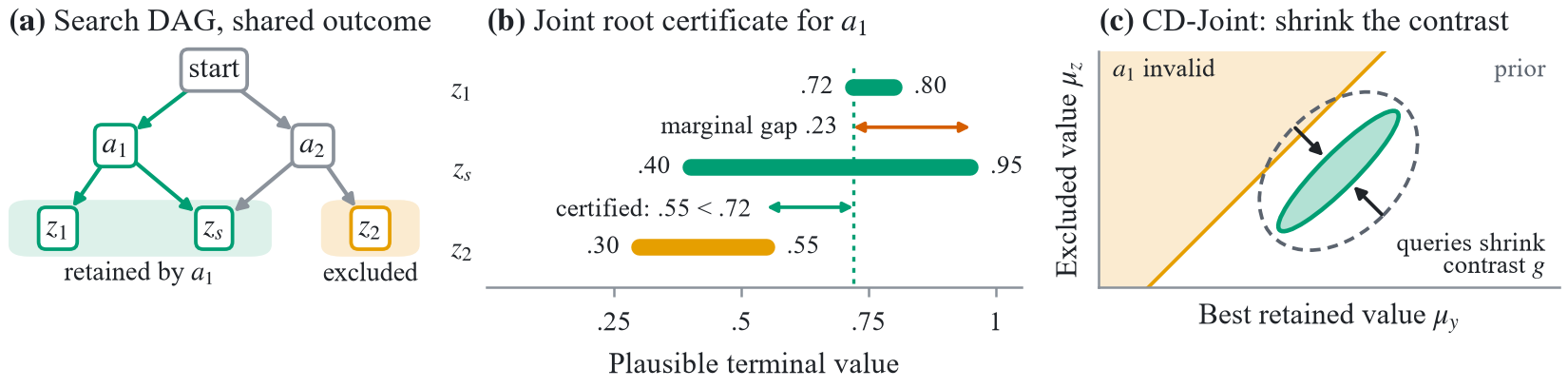
Shared outcomes change what can invalidate a root decision: a terminal that the chosen action can still reach cannot count against it, so only excluded outcomes matter.
Overview
In sequential decision-making, an initial commitment can be certified as $\varepsilon$-optimal long before its best full continuation is known. Many real search spaces — combinatorial protein design, agentic workflow configuration, routing, and puzzle lookahead — are directed acyclic graphs (DAGs) in which different action sequences reach overlapping terminal sets, and evidence about terminal outcomes is statistically correlated.
Joint Root Certification directly certifies that a root action $a$ retains access to an $\varepsilon$-optimal terminal outcome:
A commitment can be invalidated only by an excluded terminal $z \notin S(a)$ that beats every retained continuation $y \in S(a)$ by more than $\varepsilon$ under the same plausible environment.
Key methodological contributions implemented in dagcert:
- Structural sharing (exact outside-support regret): Evaluating all outcomes under a single common environment cancels shared continuations, replacing loose marginal action-value bounds with exact outside-vs-inside certificates.
- Statistical sharing (sparse ellipsoidal dual & CD-Joint): Under correlated Gaussian or fixed-feature uncertainty sets, worst-case decision regret admits an exact sparse conic dual (supported on at most $d+1$ inside witnesses). CD-Joint (Contrast-Directed Joint acquisition) targets the variance of the active outside–inside contrast, exploiting even low-valued but informative off-witness proxies while safeguarding against inside-witness stalling.
- Stopping-regime awareness: The library supports matched Bayesian joint credible ellipsoids (with exact contrast rank $r = \operatorname{rank}(\text{contrast } \Sigma)$ and radius $\sqrt{\chi^2_{r,1-\delta}}$), direct posterior-risk stopping, anytime-valid fixed-feature ellipsoids, unknown-variance sparse-refresh tracking (V34) with native C++17 outward-certified branch-and-bound, calibrated EB+LOO GP stopping, and formal distribution-free (Hoeffding / Empirical Bernstein) confidence boxes.
Installation & Python Library Quickstart
Requires Python 3.10 or newer. The core library depends only on NumPy and SciPy.
1. Install dagcert
pip install dagcert
Optional extras:
pip install "dagcert[audit]"         # CVXPY/Clarabel reference solvers (solver="cvxpy_socp") and oracle audits
pip install "dagcert[experiments]"   # matplotlib, pandas, requests, networkx: paper experiments and figures
pip install "dagcert[llm]"           # PyTorch / Transformers for the live Qwen3-0.6B workflow suites
pip install "dagcert[all]"           # everything, plus pytest, build and twine
To reproduce the paper, install from source instead:
git clone https://github.com/AI-MathPhys/dag-cert.git
cd dag-cert
python -m venv .venv
source .venv/bin/activate            # Windows PowerShell: .\.venv\Scripts\Activate.ps1
python -m pip install -e ".[dev,audit,experiments]"
Native C++17 accelerators (optional): when
$CXX,g++orclang++is available,dagcertcompiles its four-O3C++17 kernels on first use and caches the shared libraries in the system temporary directory (exact correlated KG, outward-certified branch-and-bound for unknown-variance tracking, graph-maintenance kernels, and SameGame playouts). Exact correlated KG falls back to a pure-Python implementation with identical results; the other three are research accelerators that require a compiler, and their tests are skipped when none is found.
2. Minimal Library Usage
import numpy as np
from dagcert import (
    SearchDAG,
    certify_root_action,
    exact_rectangular_regret,
)

# 1. Exact shared-support rectangular certificate (Figure 1b)
# Root action 0 reaches {0, 1}; root action 1 reaches {1, 2}. Shared terminal 1 cancels!
dag = SearchDAG.from_supports([{0, 1}, {1, 2}])
lo = np.array([0.72, 0.40, 0.30])
hi = np.array([0.80, 0.95, 0.55])
best_a, min_reg, regrets = exact_rectangular_regret(dag, lo, hi)
print(f"Best root action: {best_a}, exact regrets: {regrets.tolist()}")
# -> Best root action: 0, exact regrets: [0.0, 0.4]

# 2. Decision-aware Bayesian experimental design (CD-Joint vs. GP-OS vs. Correlated KG)
rng = np.random.default_rng(7)
dag = SearchDAG.from_supports([{0, 1, 2, 3}, {2, 3, 4, 5}, {4, 5, 6, 7}])
features = rng.normal(size=(8, 4))
kernel = features @ features.T + 0.05 * np.eye(8)
true_means = np.array([0.78, 0.72, 0.55, 0.50, 0.48, 0.42, 0.40, 0.35])

for policy in ("cd_joint", "gp_os", "kg"):
    noise = np.random.default_rng(123)
    res = certify_root_action(
        dag=dag,
        observe_fn=lambda z, r=noise: float(true_means[z] + r.normal(0.0, 0.15)),
        kernel=kernel,
        prior_mean=0.5,
        obs_std=0.15,
        policy=policy,
        stopping="credible_ellipsoid",   # rank-corrected sqrt(chi2_{r, 1-delta})
        epsilon=0.03,
        delta=0.05,
        max_evals=500,
    )
    print(f"{policy:9s} | certified={res.certified} | action={res.action} | evals={res.steps}")
3. Library Architecture (dagcert/)
| Module | Paper Concepts | Key Public Exports |
|---|---|---|
dagcert/graph.py |
Finite all-MAX search DAG, shared root supports, support overlap | SearchDAG (.from_supports, .root_supports, .root_regrets, .support_overlap_matrix), DAG, Problem, SupportStructure |
dagcert/certificates.py |
Exact rectangular regret, conic ellipsoidal dual, dual witness covers, bounded residuals | exact_rectangular_regret, JointEllipsoidCertifier, check_ellipsoid_stopping, DualWitnessCovers, CanonicalIntervals, NestedIntervals, RobustAwareJointCertifier |
dagcert/posteriors.py |
Conjugate Gaussian posterior, contrast rank $r$, $\sqrt{\chi^2_{r,1-\delta}}$, valid anytime posterior-risk MC | SharedGaussianPosterior, contrast_rank_of_kernel, chi2_credible_beta, contrast_ellipsoid_coverage, eval_direct_posterior_risk_valid |
dagcert/acquisition.py |
Decision-aware BED & BO baselines under matched posteriors | certify_root_action, MatchedModelBEDSession, CDJointPolicy, CorrelatedKGPolicy, GPOSPolicy, BayesianVOIPolicy, GPUCBPolicy, GPTSPolicy, NoisyGPEIPolicy |
dagcert/tracking.py |
Optimal information tracking ($T_*^\varepsilon$), unknown-variance sparse V34 tracker | RegularizedInfoTrackerSession, run_v34_tracker, CppV34BnBRunner, compute_characteristic_rate, solve_action_design_certified |
dagcert/search.py |
Passive trajectory-coupled UCT/PUCT certification monitors | TrajectoryCoupledUCT, RootPUCT, RecursivePUCT, CertifiedSearchSession, CppKernelRunner |
dagcert/benchmarks/ |
Bundled synthetic, GB1/TmTrpB protein, WorFBench workflow & SameGame DAG loaders | OverlapCorrelationDAGProblem, OffWitnessProxyDAGProblem, GB1MutationCampaignProblem, TrpBMutationCampaignProblem, WorFBenchWorkflowProblem, load_standard_samegame_boards |
dagcert/_native/ |
Optional auto-compiled -O3 C++17 accelerators |
_cpp_v12_kg.cpp, _cpp_v34_bnb.cpp, _cpp_kernels.cpp, _cpp_samegame.cpp |
Standalone runnable library examples live in examples/:
python examples/quickstart_cd_joint.py   # Fig. 1b + CD-Joint vs. GP-OS vs. KG + distribution-free
python examples/correlated_proxy.py      # Low-valued off-witness proxy allocation (Fig. 2e)
python examples/protein_dag_demo.py      # GB1 combinatorial mutation DAG certification
python examples/certify.py               # Trajectory-coupled passive UCT monitor parity
Headline Paper Results (Complete Coverage)
Every main-paper and appendix result is backed by executable code in experiment/ and SHA-256-verified logs in results/.
| Paper Location | Finding | Domain & Suite |
|---|---|---|
| §2.3, Table 1 | Lazy conic certificate updates scale from $0.70\text{ ms}$ ($M=64$) to $25.7\text{ ms}$ ($M=4{,}096$) | simulated (e6) |
| §3.1, Table 3; App. G.1 (Tables 7–9, Fig. 3) | Matched-model $M=64, K=8$ factorial: CD-Joint needs $2{,}358$ vs. Correlated KG $5{,}056$ capped evals ($2.14\times$ reduction; $2.53\times$ with overlap + correlation); $1.65\times$ under anytime-valid $d=8$ frequentist stopping | simulated (v12) |
| §3.1, Fig. 2d, Table 10 | Exact outside-support stopping needs $0.054\times$ the queries of marginal stopping at $M=256$, overlap $.88$ ($18.4\times$) | simulated (exp1) |
| §3.1, Fig. 2e, Tables 11 & 13 | CD-Joint routes $76.8%$ of queries to a low-valued proxy vs. $0.6%$ for direct-witness sampling; up to $48.5\times$ lower median cost | simulated (e0, v8_3) |
| §3.2, Fig. 2f–h, Table 4; App. H (Tables 24–26, Fig. 8) | 410 paired GB1 ($n=200$) & TmTrpB ($n=210$) campaigns: under rank-corrected $\sqrt{\chi^2_{r,.95}}$ ellipsoid, CD-Joint needs $17{,}678$ [70%] / $3{,}629$ [100%] assays vs. KG $25{,}000^*$ [0%] / $9{,}337$ [85.7%] ($2.57\times$ on TmTrpB); ranking reverses under direct posterior risk (KG $130$/$63$ vs. CD-Joint $240$/$92$) and independent-arm DF ($0%$ for GP-only CD-Joint) | protein_engineering (v14, v13) |
| §3.2, Table 27 | Empirical-Bayes protein audit: simultaneous terminal coverage $91.5%$ / $82.9%$, yet $100%$ root-regret-bound coverage across 410 campaigns | protein_engineering (v11_1) |
| §3.3, Table 5 (offline), Table 35 | WorFBench offline ($3^4=81$ workflows): OS certifies $100%$ in $1{,}937$ median evals ($0.95\text{ M}$ tokens) vs. Flat-LUCB $8{,}486$ ($4.78\text{ M}$ tokens) at identical held-out $F_1 = 0.529$ | agentic_workflows (exp12) |
| §3.3, Table 5 (live), Table 37, Fig. 9 | 36 fresh uncached Qwen3-0.6B campaigns across 4 domains: formal DF stops $0/36$ by 60 evals; model-based EB+LOO certifies $36/36$ in median $24$ evals ($14{,}291$ tokens, held-out $F_1 = 0.4717$) | agentic_workflows (v11_2) |
| App. J.3, Table 43, Fig. 13a | Unknown-variance sparse-refresh + action-local IUT tracker (V34): $50.4\times$ speedup at $K=64$, rank 2 ($34.0\text{ s} \to 0.675\text{ s}$) | simulated (v9_1) |
| App. L.5–L.6, Tables 68–69, Fig. 14 | Native C++17 outward-certified B&B achieves $31$–$82\times$ end-to-end speedup; zero-shared-code independent numerical-oracle audit passes $5/5$ checks | simulated (v10_1, v11_3) |
Reproducing the Paper (experiment/)
All experiments rely directly on the installed dagcert package and are organized into three domain folders mirroring Section 3 of the paper, plus unified plotting (experiment/plots/) and CLI (experiment/run_all.py):
experiment/simulated/— Section 3.1 + Appendices G, J, L (27 suites +passive_uct/v1 archive)experiment/protein_engineering/— Section 3.2 + Appendix H (10 GB1 & TmTrpB suites)experiment/agentic_workflows/— Section 3.3 + Appendix I (WorFBench offline & live Qwen3-0.6B suites)experiment/plots/— All manuscript data figures (Figures 2–14:figures/fig*.pdf,figures/supp_*.pdf) in one shared style, plus detailed suite figures
Fast Verification (~2 minutes, CPU only, offline)
# 1. Check bundled datasets, optional Hugging Face cache, and C++17 compiler
python scripts/fetch_data.py --check

# 2. Cryptographically verify SHA-256 manifests for ALL archived suites (v1--v14, zero gaps)
python experiment/run_all.py verify

# 3. Run all 88 unit, parity, library-API, and independent-oracle tests
python experiment/run_all.py test

# 4. Regenerate all 14 manuscript data figures (Figures 2–14: `figures/fig*.pdf`, `figures/supp_*.pdf`)
python experiment/run_all.py figures
Running Individual Domains or Suites
# List all 41 suites grouped by domain
python experiment/run_all.py list

# Fast non-destructive smoke tests (writes only to OS tempdir, never modifies results/)
python experiment/run_all.py benchmark --only v12 --smoke
python experiment/run_all.py benchmark --only v14 --smoke
python experiment/run_all.py benchmark --only e4  --smoke

# Re-run a full suite (or regenerate its CSV summaries from archived JSONL logs)
python experiment/run_all.py summaries --only v14
python experiment/run_all.py benchmark --domain protein_engineering --only v14
Paper Section to Suite Key Map
See REPRODUCIBILITY.md for the complete table-by-table mapping across Tables 1–69 and Figures 1–14.
| Paper Section | Tables / Figures | Domain | Suite Keys |
|---|---|---|---|
| §2.3, App. L.1 (conic update scaling & break-even) | Tables 1, 57, 58 | simulated |
e6, v8_4 |
| §3.1, App. G.1, App. L.1 (matched BED vs. KG/VOI/BO & $d=8$ anytime) | Table 3, Tables 7–9, 14, 59; Fig. 3 | simulated |
v12 |
| §3.1, App. G.2–G.3 (structural overlap & correlated proxy mechanisms) | Fig. 2d–e, Tables 10–13, 15; Figs. 4–5 | simulated |
exp1, e0, e1, e2, v8_3 |
| App. G.4–G.5 (DF baselines, witness ablations, SameGame & routing) | Tables 16–23; Figs. 6–7 | simulated |
exp5, exp6, exp8–exp11, v8_6 |
| §3.2, App. H.1–H.4 (matched GB1 & TmTrpB BED vs. KG & $\chi^2_{r,.95}$ audit) | Fig. 2f–h, Table 4, Tables 24–26; Fig. 8 | protein_engineering |
v14, v13 |
| §3.2, App. H.5–H.6 (calibration, validity ablation, extended GB1/TmTrpB) | Tables 27–34; Fig. 11 | protein_engineering |
v11_1, v8_1, exp12–exp14, e3 |
| §3.3, App. I (WorFBench offline & live uncached Qwen3-0.6B workflows) | Table 5, Tables 35–39; Figs. 9, 14c | agentic_workflows |
exp12, exp13, v11_2, v10_3, v8_5 |
| App. J.1–J.4 (info tracking, unknown variance V34, heteroscedastic bridge) | Tables 40–50; Figs. 10–13, 14b | simulated / protein_engineering |
v8_2, e5, v8_1, v9_1–v9_4, v10_2, v11_1 |
| App. J.5, L.2–L.4 (passive UCT/PUCT, C++ maintenance kernels, memory) | Tables 51–56, 60–67 | simulated |
passive_uct/, exp2–exp4, exp7 |
| App. L.5–L.6 (native C++17 B&B scaling, independent oracle audit) | Tables 68–69; Fig. 14a | simulated |
v10_1, v11_3 |
External Data & Models (scripts/fetch_data.py)
Four compact preprocessed .npz archives (dagcert/benchmarks/data/, 1.7 MB) and the 20-board SameGame set are bundled in Git so installation, verification, unit tests, and all CPU experiments run offline. Every upstream source can also be downloaded and rebuilt from scratch:
| Dataset / Asset | Upstream Source | Bundled File | Rebuild Command |
|---|---|---|---|
| GB1 (149,361 four-site variants; Wu et al. 2016) | FLIP | dagcert/benchmarks/data/gb1_wu2016_measured.npz |
python scripts/fetch_data.py --proteins |
| TmTrpB (159,129 four-site variants; Johnston et al. 2024) | Zenodo 15203754 | dagcert/benchmarks/data/trpb_johnston2024_measured.npz |
python scripts/fetch_data.py --proteins |
| WorFBench raw trajectories (4 domains) | zjunlp/WorfBench | cached in dagcert/benchmarks/data/worfbench_raw/ |
python scripts/fetch_data.py --worfbench-tasks |
Qwen/Qwen3-0.6B & Qwen/Qwen3-Embedding-0.6B |
Hugging Face Hub | local Hugging Face cache | python scripts/fetch_data.py --models |
| WorFBench $81\times 64$ & $81\times 32$ score matrices | generated from above | dagcert/benchmarks/data/worfbench_qwen3_*.npz |
python scripts/fetch_data.py --rebuild-worfbench |
Pass --out-dir build/rebuilt_data to rebuild alongside the bundled files for comparison, or --all to fetch everything. After caching models and trajectories, set HF_HUB_OFFLINE=1 to run live LLM suites offline.
Lean 4 Formalizations (lean/)
The lean/ directory holds a Lean 4 + Mathlib formalization of the paper's numbered results, with no sorry and no added axioms. Of the 62 results, 62 are proved as written up to harmless differences, 0 are false as written, 0 are proved only in a corrected or reformulated form because the manuscript statement is not established as written, and 0 are open, according to independent clause-by-clause reviews. lean/README.md gives, for every result, the Lean theorem names and exactly how the formal statement relates to the manuscript, a list of hypotheses the manuscript leaves implicit, and the limits of the formalization (for example: algorithms are specified by their selection rules, numerical oracles enter through the paper's contract, and running-time claims hold in an explicit step-counting model).
Build with cd lean && lake exe cache get && lake build (Lean toolchain pinned in lean/lean-toolchain).
Repository Structure
dag-cert/
├── dagcert/                         # Installable Python library (`pip install dagcert` / `-e .`)
│   ├── graph.py                     # SearchDAG, SupportStructure, regret & overlap utilities
│   ├── certificates.py              # Rectangular, conic ellipsoidal, witness-cover & DF bounds
│   ├── posteriors.py                # SharedGaussianPosterior, contrast rank, chi2 beta, post.-risk MC
│   ├── acquisition.py               # certify_root_action, CD-Joint, Correlated KG, GP-OS, VOI, BO
│   ├── tracking.py                  # Info-tracking (T_*^eps) & V34 unknown-variance sparse tracker
│   ├── search.py                    # Trajectory-coupled passive UCT & PUCT certification
│   ├── benchmarks/                  # Synthetic, GB1/TmTrpB, WorFBench & SameGame loaders + data/
│   ├── _native/                     # Optional auto-compiled -O3 C++17 accelerators
│   └── _core/                       # Verified low-level numerical engines
├── experiment/                      # Complete paper experiments organized by domain
│   ├── run_all.py                   # Unified CLI: list, verify, test, summaries, figures, benchmark
│   ├── simulated/                   # §3.1 + App. G, J, L (27 suites + passive_uct/ v1 archive)
│   ├── protein_engineering/         # §3.2 + App. H (10 GB1 & TmTrpB suites)
│   ├── agentic_workflows/           # §3.3 + App. I (WorFBench offline & live Qwen3-0.6B suites)
│   └── plots/                       # Generates manuscript Figures 2–14 + detailed suite plots
├── examples/                        # Standalone library quickstart & domain demos
├── tests/                           # 88 unit, parity, library-API & oracle tests (v1--v14)
├── results/                         # SHA-256-verified run archives, CSV summaries & manifests
├── figures/                         # README overview PNG + manuscript Figures 2–14 (vector PDF)
├── scripts/fetch_data.py            # Offline verifier & upstream data/model rebuild utility
├── lean/                            # Lean 4 + Mathlib formal proofs (status in lean/README.md)
├── manuscript/                      # Paper PDF & LaTeX source
├── reference/tables/                # Reference LaTeX tables for passive UCT archive
├── .github/workflows/               # CI (Linux and macOS) and PyPI release on version tags
├── pyproject.toml                   # Package metadata and optional extras
├── CITATION.cff                     # Machine-readable citation metadata
└── REPRODUCIBILITY.md               # Complete Table 1--69 & Figure 1--14 artifact map
Statistical Scope & Notes
- Validity depends on the stopping model. Bounded-observation Hoeffding and Empirical Bernstein boxes are distribution-free; fixed-feature ellipsoids and unknown-variance nuisance-KL e-processes provide anytime frequentist coverage under their respective parametric assumptions; bounded-residual ellipsoids require a misspecification bound $|b|\le\xi$; Bayesian credible ellipsoids, direct posterior risk, and EB+LOO stopping are model-based and do not inherit distribution-free validity (Table 2 and Appendix C).
- Protein & live-LLM experiments. Protein benchmarks simulate noisy assays against published measured GB1 and TmTrpB landscapes (no new wet-lab experiments). Live workflow suites execute fresh, uncached
Qwen3-0.6Binference on task pools strictly disjoint from calibration. - Determinism vs. timing. Statistical trajectories, operation counts, and SHA-256 manifests are deterministic; wall-clock times and wall-capped rates depend on host hardware.
Citation
If you use dagcert or this codebase in your research, please cite the accompanying manuscript (see also CITATION.cff):
@misc{pelissier2026dagcert,
  title  = {Certify the Decision, Not the Outcome: Bayesian Experimental Design on Search Graphs},
  author = {P{\'e}lissier, Aur{\'e}lien},
  year   = {2026},
  url    = {https://github.com/AI-MathPhys/dag-cert}
}
1 maintainer

Metadata
1 maintainer
Release files for dagcert 1.0.1
For a detailed explanation of source distributions (sdists) and built distributions (wheels), please see the package formats documentation.
Source distribution (sdist)
| File | Size | Uploaded | Provenance | Actions |
|---|---|---|---|---|
| dagcert-1.0.1.tar.gz | 1.7 MB | With provenance | Details for dagcert-1.0.1.tar.gz |
Built distribution (wheel)
| File | Interpreter | ABI | Platform | Actions Reset |
|---|---|---|---|---|
| dagcert-1.0.1-py3-none-any.whl | Python 3 | none | any | Details for dagcert-1.0.1-py3-none-any.whl |
Total release size: 3.3 MB
Release files / dagcert-1.0.1.tar.gz
| Download URL | dagcert-1.0.1.tar.gz |
|---|---|
| Size | 1.7 MB |
| Tags | Source |
|
SHA-256 checksum How to use checksums |
83b4c5b9b4bddcb0350a7fe3988cef510c39efe5e2f5683d0b16e5c6e3631ea8
|
|
BLAKE2b-256 checksum How to use checksums |
6a88fde98011aa04c85af58b3919f9cb41450b1bd392be8e4c8ea6fb2ac07ce4
|
| Upload date | |
|
Uploaded using Trusted Publishing? What is trusted publishing? |
Yes |
| Uploaded via |
twine/7.0.0 CPython/3.13.16
|
Provenance
Provenance describes where a file came from. On PyPI, provenance is shared via attestations, which provide a verifiable record of the build or publishing details. View details, limitations and caveats.


PyPI Publish Attestation
PyPI verified that this artifact, at this checksum, originated from the publisher listed below.
Signed by GitHub Actions, verified by PyPI on Nov 27, 2026.
Transparency logRelease files / dagcert-1.0.1-py3-none-any.whl
| Download URL | dagcert-1.0.1-py3-none-any.whl |
|---|---|
| Size | 1.7 MB |
| Tags | Python 3 |
|
SHA-256 checksum How to use checksums |
29c0767c493522dec53ad9744d67fadacfaa9e113e98dd625f90fc802329ba4d
|
|
BLAKE2b-256 checksum How to use checksums |
d8adcac667a9ff49b28dcffe42651b7653f22a638dd8d9e462eb91737de51240
|
| Upload date | |
|
Uploaded using Trusted Publishing? What is trusted publishing? |
Yes |
| Uploaded via |
twine/7.0.0 CPython/3.13.16
|
Provenance
Provenance describes where a file came from. On PyPI, provenance is shared via attestations, which provide a verifiable record of the build or publishing details. View details, limitations and caveats.
PyPI Publish Attestation
PyPI verified that this artifact, at this checksum, originated from the publisher listed below.
Signed by GitHub Actions, verified by PyPI on Nov 27, 2026.
Transparency logSecurity for dagcert 1.0.1
Provenance
Provenance describes where a file came from. On PyPI, provenance is shared via attestations, which provide a verifiable record of the build or publishing details. View details, limitations and caveats.
Full provenance
Both files in this release have been uploaded with provenance metadata.
Attestation for dagcert-1.0.1.tar.gz
PyPI Publish Attestation
PyPI verified that this artifact, at this checksum, originated from the publisher listed below.
Signed by GitHub Actions, verified by PyPI on Nov 27, 2026.
Transparency logA note on package security
PyPI is a repository for distributing packages, not a service for auditing them. While third-party security researchers and our staff do their best to detect and remove malicious packages, PyPI cannot guarantee the quality, security or suitability of any given package.
To learn more about protecting yourself from malicious actors, visit our package security documentation.














