
Implementation of the DAGMA algorithm

Project description
DAGMA: Faster and more accurate structure learning with a log-det constraint
This is an implementation of the following paper:
[1] Bello K., Aragam B., Ravikumar P. (2022). DAGMA: Learning DAGs via M-matrices and a Log-Determinant Acyclicity Characterization. NeurIPS'22.
If you find this code useful, please consider citing:
@inproceedings{bello2022dagma,
    author = {Bello, Kevin and Aragam, Bryon and Ravikumar, Pradeep},
    booktitle = {Advances in Neural Information Processing Systems},
    title = {{DAGMA: Learning DAGs via M-matrices and a Log-Determinant Acyclicity Characterization}},
    year = {2022}
}
Installing DAGMA
We recommend using a virtual environment via virtualenv or conda, and use pip to install the dagma package.
$ pip install dagma
See an example on how to use dagma in this iPython notebook.
Table of Content
Summary
We propose a new acyclicity characterization of DAGs via a log-det function for learning DAGs from observational data. Similar to previously proposed acyclicity functions (e.g. NOTEARS), our characterization is also exact and differentiable. However, when compared to existing characterizations, our log-det function: (1) Is better at detecting large cycles; (2) Has better-behaved gradients; and (3) Its runtime is in practice about an order of magnitude faster. These advantages of our log-det formulation, together with a path-following scheme, lead to significant improvements in structure accuracy (e.g. SHD).
The log-det acyclicity characterization
Let $W \in \mathbb{R}^{d\times d}$ be a weighted adjacency matrix of a graph of $d$ nodes, the log-det function takes the following form:
$$h^{s}(W) = -\log \det (sI-W\circ W) + d \log s,$$
where $I$ is the identity matrix, $s$ is a given scalar (e.g., 1), and $\circ$ denotes the element-wise Hadamard product. Of particular interest, we have that $h(W) = 0$ if and only if $W$ represents a DAG, and when the domain of $h$ is the set of M-matrices then $h$ is well-defined and non-negative. For more properties of $h(W)$ (e.g., being an invex function), $\nabla h(W)$, and $\nabla^2 h(W)$, we invite you to look at [1].
A path-following approach
Given the exact differentiable characterization of a DAG, we are interested in solving the following optimization problem:
\begin{array}{cl}
\min _{W \in \mathbb{R}^{d \times d}} & Q(W;\mathbf{X}) \\
\text { subject to } & h^{s}(W) = 0,
\end{array}
where $Q$ is a given score function (e.g., square loss) that depends on $W$ and the dataset $\mathbf{X}$. To solve the above constrained problem, we propose a path-following approach where we solve a few of the following unconstrained problems:
\hat{W}^{(t+1)} = \arg\min_{W}\; \mu^{(t)} Q(W;\mathbf{X}) + h(W),
where $\mu^{(t)} \to 0$ as $t$ increases. Leveraging the properties of $h$, we show that, at the limit, the solution is a DAG. The trick to make this work is to use the previous solution as a starting point when solving the current unconstrained problem, as usually done in interior-point algorithms. Finally, we use a simple accelerated gradient descent method to solve each unconstrained problem.
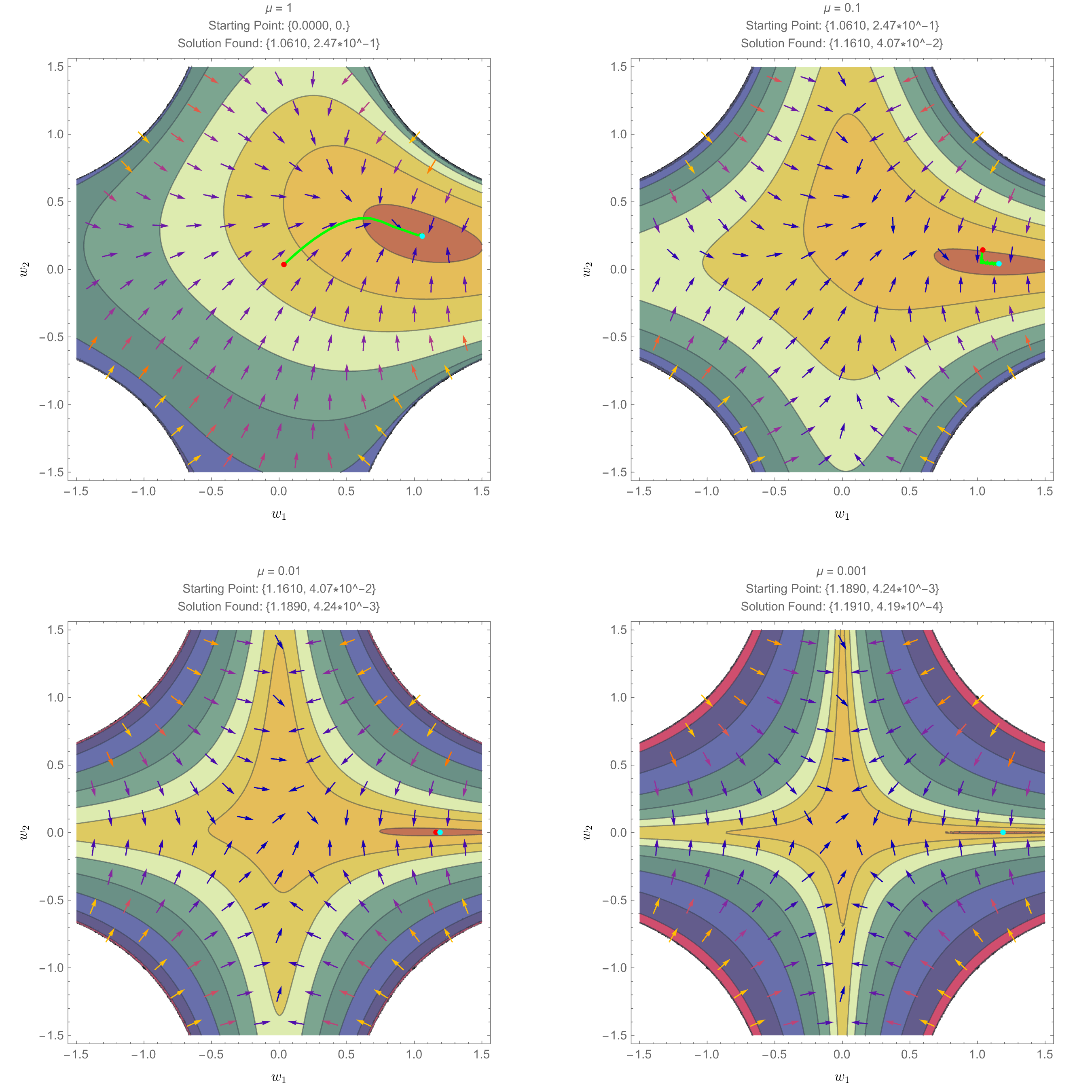
Let us give an illustration of how DAGMA works in a two-node graph (see Figure 1 in [1] for more details). Here $w_1$ (the x-axis) represents the edge weight from node 1 to node 2; while $w_2$ (y-axis) represents the edge weight from node 2 to node 1. Moreover, in this example, the ground-truth DAG corresponds to $w_1 = 1.2$ and $w_2 = 0$.
Below we have 4 plots, where each illustrates the solution to an unconstrained problem for different values of $\mu$. In the top-left plot, we have $\mu=1$, and we solve the unconstrained problem starting at the empty graph (i.e., $w_1 = w_2 = 0$), which corresponds to the red point, and after running gradient descent, we arrive at the cyan point (i.e., $w_1 = 1.06, w_2 = 0.24$). Then, for the next unconstrained problem in the top-right plot, we have $\mu = 0.1$, and we initialize gradient descent at the previous solution, i.e., $w_1 = 1.06, w_2 = 0.24$, and arrive at the cyan point $w_1 = 1.16, w_2 = 0.04$. Similarly, DAGMA solves for $\mu=0.01$ and $\mu=0.001$, and we can observe how the solution at the final iteration (bottom-right plot) is close to the ground-truth DAG $w_1 = 1.2, w_2 = 0$.
Requirements
- Python 3.7+
numpyscipyigraphtqdmtorch: Only used for nonlinear models.
Contents
linear.py- implementation of DAGMA for linear models with l1 regularization (supports L2 and Logistic losses).nonlinear.py- implementation of DAGMA for nonlinear models using MLPlocally_connected.py- special layer structure used for MLPutils.py- graph simulation, data simulation, and accuracy evaluation
Acknowledgments
We thank the authors of the NOTEARS repo for making their code available. Part of our code is based on their implementation, specially the utils.py file and some code from their implementation of nonlinear models.
Release history Release notifications | RSS feed


Download files
Download the file for your platform. If you're not sure which to choose, learn more about installing packages.
Source Distribution
Built Distribution
Filter files by name, interpreter, ABI, and platform.
If you're not sure about the file name format, learn more about wheel file names.
Copy a direct link to the current filters
File details
Details for the file dagma-1.0.0.tar.gz.
File metadata
- Download URL: dagma-1.0.0.tar.gz
- Upload date:
- Size: 18.7 kB
- Tags: Source
- Uploaded using Trusted Publishing? No
- Uploaded via: twine/4.0.2 CPython/3.8.8
File hashes
| Algorithm | Hash digest | |
|---|---|---|
| SHA256 |
9289c4565316ba89ff952c5e10f5159b6f048f512c9075b57241699c352e4363
|
|
| MD5 |
1c7ed3139f64e154903fbc769d644965
|
|
| BLAKE2b-256 |
f1dee455e917b2d5fd3fdfa753bbf32006b73918ee7fe22c82dbb0a39edd9be9
|
File details
Details for the file dagma-1.0.0-py3-none-any.whl.
File metadata
- Download URL: dagma-1.0.0-py3-none-any.whl
- Upload date:
- Size: 17.1 kB
- Tags: Python 3
- Uploaded using Trusted Publishing? No
- Uploaded via: twine/4.0.2 CPython/3.8.8
File hashes
| Algorithm | Hash digest | |
|---|---|---|
| SHA256 |
89ccb2b4da8813a3201a60c2fb2540da2047fa4e6d55a471b9247eb4025bcf61
|
|
| MD5 |
d5b148247da1548dfaf49ea3181d3b08
|
|
| BLAKE2b-256 |
d63847abd5fa241d631456df7038504e3f7a30d441b1063033c7d83cd3083027
|






