
One JAX/Flax backbone for AR, discrete-diffusion, and flow-matching LLMs — switch paradigm with a single config field.

Project description
DantinoX
"Nel mezzo del cammin di nostra vita mi ritrovai per una selva oscura..."
A research-grade JAX/Flax NNX transformer library for autoregressive (AR), discrete masked diffusion, and continuous flow-matching language models — one modular Transformer backbone, one trainer, one streaming generator, zero paradigm-specific boilerplate.








The idea in one snippet
The whole point of DantinoX: the generation paradigm is a single field. Everything else — backbone, weights layout, tokenizer, trainer, generator — stays byte-for-byte identical.
import dantinox as dx

base = dict(attention="gqa", kv_heads=2, ffn="mlp", use_swiglu=True,
            dim=512, n_heads=8, num_blocks=12, vocab_size=32_128)

cfg_ar   = dx.ModelConfig(paradigm="ar",         **base)   # causal + KV-cache decode
cfg_diff = dx.ModelConfig(paradigm="discrete",   **base)   # LLaDA masked diffusion
cfg_flow = dx.ModelConfig(paradigm="continuous", **base)   # ELF flow-matching

# one Trainer, one Generator — for every paradigm:
run = dx.Trainer(dx.Paradigm(cfg_diff), tcfg).fit("data/wiki.txt")
for chunk in dx.Generator(run).stream("Language models will", n_steps=50):
    print(chunk, end="", flush=True)
Attention (MHA/GQA/MLA), FFN (dense/MoE/LatentMoE), positional encoding, norm, tokenizer, optimizer, LoRA, and DP×TP sharding are all configuration flags on the same two dataclasses — thousands of valid combinations, zero code changes.
Watch the 2-minute demo
A single screencast walks the whole cycle — the paradigm switch, a live training run, the three inference signatures streaming side by side, zero-execution profiling, and the benchmark results — all from one API on one GPU.
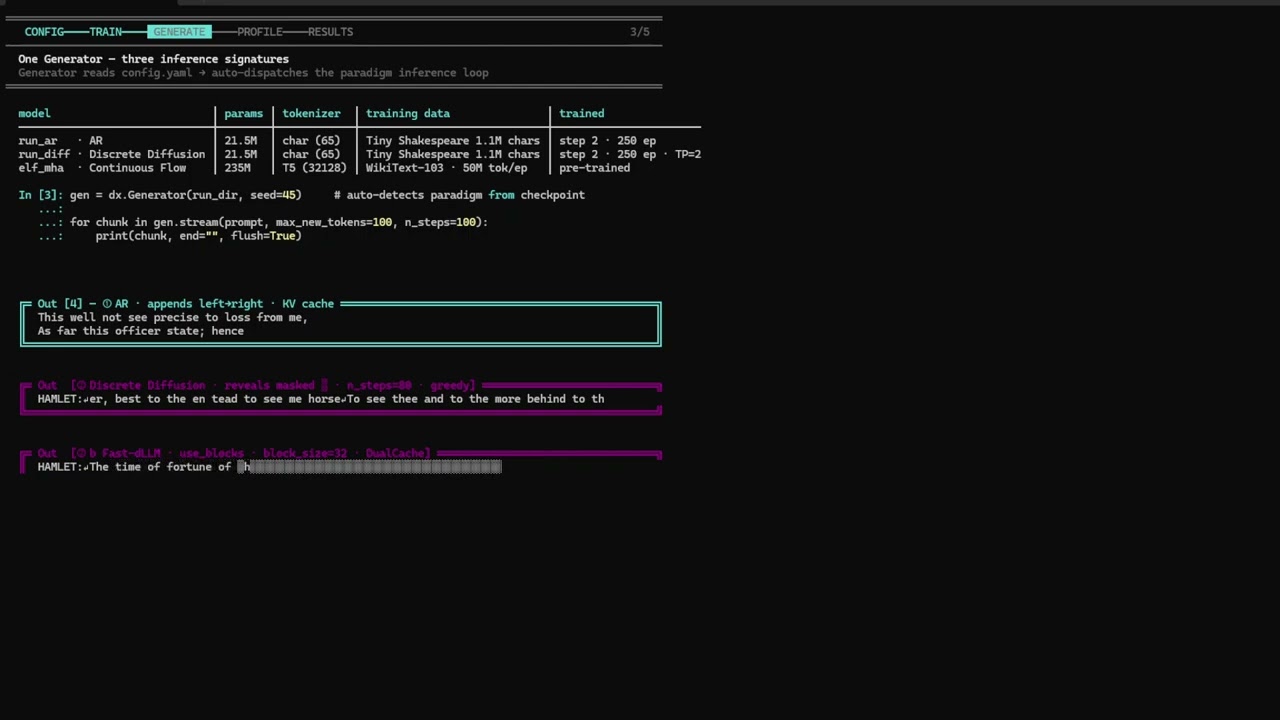
Reproduce it locally:
python examples/demo_video.py
Contents
- The idea in one snippet · Demo video
- Overview · Features · Installation
- Quick Start: one-liner · paradigm API · CLI
- Project Structure · Configuration
- Generation Paradigms: AR · Diffusion · Flow-Matching
- LoRA Fine-Tuning · Benchmarking · Development
- Documentation · Paper · License
Overview
Comparing autoregressive decoding, masked diffusion, and continuous flow-matching fairly is hard: each paradigm typically lives in its own codebase, so any measured difference may reflect tokenizer, initialization, or training-loop details rather than the paradigm itself. DantinoX removes that confound by separating the model backbone (attention, feed-forward, normalisation, positional encoding) from the generation method. Selecting a paradigm — AR, masked discrete diffusion (LLaDA), or continuous flow-matching (ELF) — is a single configuration field; the weights, tokenizer, and training loop stay identical across all three, enabling controlled cross-paradigm research within one API for training, streaming inference, and benchmarking.
DantinoX targets researchers running controlled paradigm/attention ablations without editing model code, educators who want one readable codebase covering AR + diffusion + flow-matching, and practitioners who need architectural variants (GQA, MLA, MoE, LoRA) without rewriting the trainer. It is the only framework we're aware of that unifies all three generation paradigms on a single JAX/Flax backbone alongside MHA/GQA/MLA attention, LoRA, multi-GPU scaling, and an integrated benchmarking suite — see the framework comparison for how this compares to HuggingFace, MaxText, Levanter, OpenLM, torchtune, Fairseq, xLM, and dLLM.
The library ships as an installable Python package with a unified CLI, a three-level programmatic API, typed configuration dataclasses, and a full test suite.
Features
| Layer | What you get |
|---|---|
| Attention | MHA · GQA · MLA (Multi-Head Latent) · Flash Attention · Sliding Window · Gated (attention-sink suppression) · Linear (bidirectional-only, O(T)) · Differential |
| Feed-Forward | Dense MLP (SwiGLU / GELU) · Sparse Mixture-of-Experts (Top-K) · LatentMoE (bottleneck-dimension experts) |
| Position | Rotary (RoPE, with NTK-aware scaling) · Absolute Sinusoidal · Learned · None |
| Paradigms | Autoregressive · Masked Diffusion (LLaDA) · Continuous Flow-Matching (ELF recipe) |
| Training | Paradigm-agnostic Trainer · AdamW / Lion / Muon / Adafactor / Adam · WSD / Cosine / Linear / Constant LR · Gradient accumulation & clipping · bfloat16 · Multi-GPU JAX SPMD (data + tensor parallel) |
| Inference | Static KV-cache · Fast-dLLM DualCache (1.4–2.1× speedup for diffusion) · Euler ODE/SDE + Classifier-Free Guidance for flow-matching · Streaming |
| Fine-tuning | Built-in LoRA (use_lora=True) · Auto-frozen base weights · merge_lora() for zero-overhead deployment |
| Benchmarking | BenchmarkSuite · Throughput / Latency / Perplexity tasks · count_flops (zero-execution FLOPs) · profile (latency + MFU) · CSV + plots |
| Integration | HuggingFace Hub push/pull · W&B sweeps · 14-subcommand CLI · Colab notebooks |
Installation
pip install dantinox                   # core only
pip install "dantinox[data]"          # + HuggingFace datasets
pip install "dantinox[benchmark]"     # + pandas / matplotlib / scipy
pip install "dantinox[all]"           # everything including dev tools
From source:
git clone https://github.com/winstonsmith1897/DantinoX.git
cd DantinoX
conda create -n dantinox python=3.10 -y && conda activate dantinox
make install
GPU: after
make install, runpip install -U "jax[cuda12]"for CUDA support.
Quick Start
One-liner API
import dantinox as dx

# Train an AR model
run_dir = dx.fit("ar", "data/wiki.txt",
                 dim=512, n_heads=8, head_size=64, num_blocks=12,
                 vocab_size=32_000, lr=3e-4, epochs=5)

print(dx.quick_generate(run_dir, "In the beginning"))
Switch paradigm by changing the first argument — the trainer, optimizer, and checkpoint logic are identical:
# Masked Diffusion (LLaDA)
run_dir = dx.fit("discrete", "data/wiki.txt",
                 dim=512, n_heads=8, head_size=64, num_blocks=12,
                 vocab_size=32_000, noise_schedule="cosine",
                 tokenizer_type="bpe", tokenizer_path="t5-base",
                 lr=1e-4, epochs=20)

# Continuous Flow-Matching (ELF recipe) — operates in a frozen T5 embedding space
run_dir = dx.fit("continuous", "data/wiki.txt",
                 embed_dim=768, bottleneck_dim=128,
                 dim=512, n_heads=8, head_size=64, num_blocks=12,
                 flow_cfg_scale=1.5, lr=1e-4, epochs=30)
Unrecognized keyword arguments to
dx.fit()are silently ignored rather than raising an error — double check field names against the Configuration Reference if a value doesn't seem to take effect (e.g. the field isdim/flow_cfg_scaleonModelConfig, notmodel_dim/elf_cfg_scale, which only exist on the standaloneFlowMatchingConfig).
Explicit Paradigm API
import dantinox as dx
from flax import nnx

cfg      = dx.ModelConfig(paradigm="ar", dim=512, n_heads=8, head_size=64,
                           num_blocks=12, vocab_size=32_000)
paradigm = dx.Paradigm(cfg)
model    = paradigm.build_model(nnx.Rngs(42))

# Train
run_dir = dx.Trainer(paradigm).fit("data/wiki.txt")

# Streaming inference — auto-dispatches to the right paradigm (KV-cache decode
# for AR, reverse diffusion for discrete, ODE/SDE integration for continuous)
gen = dx.Generator(run_dir, seed=42)
for chunk in gen.stream("In the beginning", max_new_tokens=200, top_p=0.9):
    print(chunk, end="", flush=True)
CLI
# Train (any field from Config can be overridden inline)
dantinox train --config configs/default_config.yaml --data_path wiki.txt

# Override fields on the command line
dantinox train --config configs/default_config.yaml --data_path wiki.txt \
    --model_type diffusion --lr 1e-4 --use_bf16 true --n_devices 4

# Generate with streaming
dantinox generate --run_dir runs/ar_mha_512d \
    --prompt "In the beginning" --stream --top_p 0.9

# Find optimal learning rate
dantinox find-lr --config configs/default_config.yaml --data_path wiki.txt --plot

# Run hyperparameter sweep (W&B)
dantinox sweep --sweep_config configs/sweep.yaml --data_path wiki.txt

# Print FLOPs / parameter count for a checkpoint or config
dantinox profile --run_dir runs/ar_mha_512d

# Evaluate generation quality (Distinct-N, Rep-4, MAUVE)
dantinox eval --run_dir runs/ar_mha_512d

# Full inference benchmark suite
dantinox infbench --trained --eval

# Push/pull checkpoints to HuggingFace Hub
dantinox push --run_dir runs/ar_mha_512d --repo my-org/my-model
dantinox pull --repo my-org/my-model --local_dir runs/downloaded

# Declarative training from a single workflow YAML
dantinox run workflow.yaml

# Export a checkpoint to a StableHLO binary (Python-free inference)
dantinox export runs/ar_mha_512d model.stablehlo

# Generate benchmark plots
dantinox plot --in_csv results/benchmark.csv --out_dir plots/
All 14 subcommands (train, generate, sweep, benchmark, find-lr,
push, pull, infbench, merge-lora, profile, run, export, eval,
plot) are documented in the CLI Reference.
Project Structure
Everything importable lives under the installable dantinox/ package —
there is no separate top-level core//utils/ package (a couple of empty
stub directories with those names exist at the repo root for legacy reasons
but are unused; the real code is dantinox/core/, dantinox/utils/, etc.).
DantinoX/
├── dantinox/                        # Installable library package
│   ├── core/                        # Neural-network primitives (paradigm-agnostic)
│   │   ├── config.py                # ModelConfig · TrainingConfig · Config · FlowMatchingConfig
│   │   ├── model.py                 # Transformer (DiffusionTransformer is an alias)
│   │   ├── flow.py                  # FlowMatchingTransformer, FlowEmbedder (continuous flow-matching)
│   │   ├── attention.py             # MHA / GQA / MLA + RoPE + KV-cache + Flash/Gated/Linear/Differential
│   │   ├── block.py                 # Block: pre-norm residual (Attention + FFN + Norm)
│   │   ├── mlp.py                   # Dense MLP (SwiGLU / GELU)
│   │   ├── moe.py                   # Sparse MoE + LatentMoE with load-balancing loss
│   │   ├── diffusion.py             # NoiseSchedule · make_noise_schedule · corrupt · masked_cross_entropy
│   │   ├── lora.py                  # LoRALinear · LoRAParam · merge_lora
│   │   ├── generation.py            # generate · diffusion_generate · fast_dllm_generate · flow_generate
│   │   └── sharding.py              # make_mesh · shard_batch — multi-GPU SPMD
│   │
│   ├── paradigms/
│   │   ├── paradigm.py              # Paradigm (unified dispatcher — public API)
│   │   ├── base.py                  # ParadigmBase (ABC): build_model, loss_fn, generate
│   │   ├── ar.py                    # ARParadigm
│   │   ├── embedder.py              # EmbedderParadigm
│   │   └── diffusion/
│   │       ├── discrete.py          # DiscreteParadigm (LLaDA)
│   │       └── continuous.py        # ContinuousParadigm (ELF recipe)
│   │
│   ├── training/
│   │   ├── trainer.py               # Trainer — JIT loop, checkpointing, multi-GPU (this is `dx.Trainer`)
│   │   └── optimizer.py             # build_optimizer · build_schedule (AdamW/Lion/Muon/Adafactor)
│   │
│   ├── benchmarking/                 # BenchmarkSuite · BenchmarkTask · Throughput/Latency/Perplexity tasks
│   ├── profiling/                    # count_flops · LatencyTracker · profile
│   ├── visualization/                 # Visualizer · chart registry
│   ├── utils/                        # Tokenizers (char/BPE/T5), T5 encoder, data pipeline helpers
│   ├── generator.py                  # Generator — paradigm-agnostic streaming inference
│   ├── trainer.py                    # Legacy Config-driven Trainer (backs the `dantinox train` CLI)
│   ├── hub.py                        # push · pull (HuggingFace Hub)
│   └── cli.py                        # 14 subcommands (see CLI section above)
│
├── benchmarks/                       # Stand-alone benchmark/ablation scripts
│   ├── inference_sweep.py            # Random-model sweep (13 groups)
│   ├── trained_analysis.py           # Throughput on real checkpoints
│   └── generation_quality.py         # Distinct-N, Rep-4, MAUVE
│
├── configs/                          # YAML templates
│   ├── default_config.yaml
│   ├── diffusion_base.yaml
│   └── sweep.yaml
│
├── docs/                              # Documentation (built via Sphinx/RTD; docs/index.rst is the toctree)
├── tests/                             # Pytest test suite
├── pyproject.toml
└── mkdocs.yml
Configuration
All settings are typed dataclasses. The Config class is the flat,
CLI-compatible form; ModelConfig + TrainingConfig is the preferred split
API for new code (and the one used throughout this README and the paper).
from dantinox.core.config import Config

cfg = Config(
    # Architecture
    dim=512, n_heads=8, head_size=64, num_blocks=12,
    vocab_size=32_000, max_context=1024,
    attention_type="gqa", kv_heads=2,
    norm_type="rmsnorm", use_swiglu=True,

    # Paradigm
    model_type="autoregressive",   # "autoregressive" | "diffusion" | "elf"

    # Training
    lr=3e-4, batch_size=64, grad_accum=4,
    optimizer="adamw", lr_schedule="cosine",
    warmup_steps=400, epochs=500,
    use_bf16=True, n_devices=4,
)
Note:
attention_typeabove is correct for the legacyConfigclass. The modernModelConfiguses the shorter field nameattentioninstead (e.g.dx.ModelConfig(attention="gqa", ...)) — passingattention_type=toModelConfigraisesTypeError. See the Configuration Reference for the full field mapping between the two config schemas.
Key constraint: dim must equal n_heads × head_size.
Config(dim=512, n_heads=8, head_size=64)   # ✓
Config(dim=512, n_heads=8, head_size=32)   # ✗  ValueError
Full field reference: Configuration Reference.
Generation Paradigms
Autoregressive
Token-by-token left-to-right generation with static KV-cache:
from dantinox.core.generation import generate

tokens = generate(model, prompt_ids, max_generations=256, top_p=0.9, use_cache=True)
Masked Diffusion (LLaDA)
All positions decoded in parallel over iterative unmasking steps:
from dantinox.core.generation import diffusion_generate, fast_dllm_generate
from dantinox.core.diffusion import make_noise_schedule

schedule = make_noise_schedule(cfg)

# Standard iterative unmasking
tokens = diffusion_generate(model, prefix, gen_len=128, schedule=schedule,
                            mask_token_id=cfg.mask_token_id)

# Fast-dLLM DualCache — 1.4–2.1× speedup
tokens = fast_dllm_generate(model, prefix, gen_len=256, schedule=schedule,
                             mask_token_id=cfg.mask_token_id,
                             block_size=32, steps_per_block=20)
Continuous Flow-Matching (ELF recipe)
Euler ODE (or SDE, with gamma > 0) from Gaussian noise to clean token
embeddings in a frozen T5 encoder's embedding space, with Classifier-Free
Guidance via cfg_scale:
from dantinox.core.generation import flow_generate

tokens = flow_generate(model, gen_len=128, batch_size=4,
                       n_steps=64, cfg_scale=1.5, gamma=0.0, seed=42)
elf_generateis a deprecated alias offlow_generate(same forcore.elfvscore.flow, andELFConfig/ELFTransformervsFlowMatchingConfig/FlowMatchingTransformer) — still functional, removed in v1.0. Prefix/conditional generation is not yet supported for this paradigm; it currently only generates unconditionally from pure noise.
LoRA Fine-Tuning
from dantinox.core.config import Config
from dantinox.core.model import Transformer
from dantinox.core.lora import merge_lora
from flax import nnx

# Enable LoRA — base weights are frozen automatically
cfg   = Config.from_yaml("runs/ar_base/config.yaml")
cfg.use_lora, cfg.lora_rank, cfg.lora_alpha = True, 8, 16.0

model = Transformer(cfg, rngs=nnx.Rngs(42))
# ... load base weights, train adapters ...

merged = merge_lora(model)   # fold adapters into base weights for deployment
Benchmarking
import dantinox as dx
from dantinox.benchmarking import BenchmarkSuite
from flax import nnx

cfg      = dx.ModelConfig(paradigm="ar", dim=512, n_heads=8, head_size=64,
                           num_blocks=12, vocab_size=32_000)
paradigm = dx.Paradigm(cfg)
model    = paradigm.build_model(nnx.Rngs(0))

report = BenchmarkSuite.default().run(paradigm, model, save_csv="results.csv")
print(report.summary())
BenchmarkSuite.default() sweeps latency, throughput, and energy across
batch sizes and sequence lengths for whichever paradigm you pass in — this
is the same call used to produce the paper's inference-efficiency and
hardware-roofline results across AR, discrete diffusion, and continuous
flow-matching on one shared backbone.
Or use the full inference sweep via CLI:
dantinox infbench --groups attention_type scale --n-trials 20
dantinox infbench --trained --eval   # include trained models + quality metrics
Development
make install      # Install package + all dev/doc dependencies (editable)
make test         # Run test suite with coverage report
make lint         # Ruff static analysis
make typecheck    # Mypy type checking
make check        # lint + typecheck + test  (run before every push)
make build        # Build sdist + wheel into dist/
make publish      # Upload to PyPI via twine
make clean        # Remove build artefacts and __pycache__
Running Tests
JAX_PLATFORM_NAME=cpu python -m pytest tests/ -v
Tests run entirely on CPU and cover:
- Forward-pass shapes for MHA, GQA, MLA, MoE, LatentMoE, LoRA, Diffusion, Flow-Matching
- KV-cache correctness and accumulation
- Weight tying between embedding and LM head
- JIT compilation stability
Config/ModelConfig/FlowMatchingConfigvalidation and round-trip serialisation
Code Quality
| Tool | Checks |
|---|---|
| ruff | Style (E/W), imports (I), pyupgrade (UP), bugbear (B), simplify (SIM) |
| mypy | Full type annotation coverage across dantinox/ |
| pytest | Unit tests, CPU-only, session-scoped fixtures |
Documentation
Full documentation is built with Sphinx and hosted on ReadTheDocs (there is
also an mkdocs.yml in the repo for local browsing, but the hosted site at
dantinox.readthedocs.io builds from docs/index.rst's toctree, not
mkdocs.yml's nav):
pip install "dantinox[docs]"
mkdocs serve          # local preview at http://127.0.0.1:8000
Key sections: Quickstart · Paradigms · Configuration · CLI · Notebooks
Paper
DantinoX is described in "DantinoX: A Unified Framework for Multi-Paradigm Language Modeling" (Simoni, Fontana, Rossolini, and Saracino). The paper validates the library with two fully automated evaluations produced entirely by its own pipeline: open-ended generation quality (MAUVE, PPL, lexical diversity, conditional BLEU) across all nine paradigm × attention combinations at Small scale (512-d, 12-layer), and inference efficiency (latency, throughput, energy, hardware roofline) across all three paradigms on a Large backbone (1024-d, 16-layer) on a single A100-40GB GPU. See Experiments & Results for the full breakdown.
A short screencast walking through the full train → generate → profile → benchmark
cycle is available as a demonstration video ▶
(reproduce it locally with python examples/demo_video.py).
@software{dantinox2026,
  author  = {Simoni, Marco and Fontana, Aleksandar and Rossolini, Giulio
             and Saracino, Andrea},
  title   = {{D}antino{X}: A Unified Framework for Multi-Paradigm Language
             Modeling},
  year    = {2026},
  url     = {https://github.com/winstonsmith1897/DantinoX},
}
License
MIT — see LICENSE.
Release history Release notifications | RSS feed


Download files
Download the file for your platform. If you're not sure which to choose, learn more about installing packages.
Source Distribution
Built Distribution
Filter files by name, interpreter, ABI, and platform.
If you're not sure about the file name format, learn more about wheel file names.
Copy a direct link to the current filters
File details
Details for the file dantinox-0.4.10.tar.gz.
File metadata
- Download URL: dantinox-0.4.10.tar.gz
- Upload date:
- Size: 245.3 kB
- Tags: Source
- Uploaded using Trusted Publishing? No
- Uploaded via: twine/6.2.0 CPython/3.12.13
File hashes
| Algorithm | Hash digest | |
|---|---|---|
| SHA256 |
284bab2765489931d2dd0b08bf331de2ae17575481d957ac994422670d3bd657
|
|
| MD5 |
c4d5366b7d4916f30c948277c8718ae5
|
|
| BLAKE2b-256 |
65e6e4e0a194b6f6ef2ea19a0dacf2e9261ede7e3eaf5822386e69c5af2b2808
|
File details
Details for the file dantinox-0.4.10-py3-none-any.whl.
File metadata
- Download URL: dantinox-0.4.10-py3-none-any.whl
- Upload date:
- Size: 245.7 kB
- Tags: Python 3
- Uploaded using Trusted Publishing? No
- Uploaded via: twine/6.2.0 CPython/3.12.13
File hashes
| Algorithm | Hash digest | |
|---|---|---|
| SHA256 |
fec5f890ac65830ab265b8ea1aad32ec7f5ba95bbec68a274e0f47b37fa80469
|
|
| MD5 |
d2cb84fe159f0456451d8c14636b981e
|
|
| BLAKE2b-256 |
ec925fc80d37ba99d9bdb79871405471bc2d2531254b30f7d9e389b30a8cec54
|






