
FitCheck
Zero-boilerplate ML data validation, model evaluation, and drift detection.




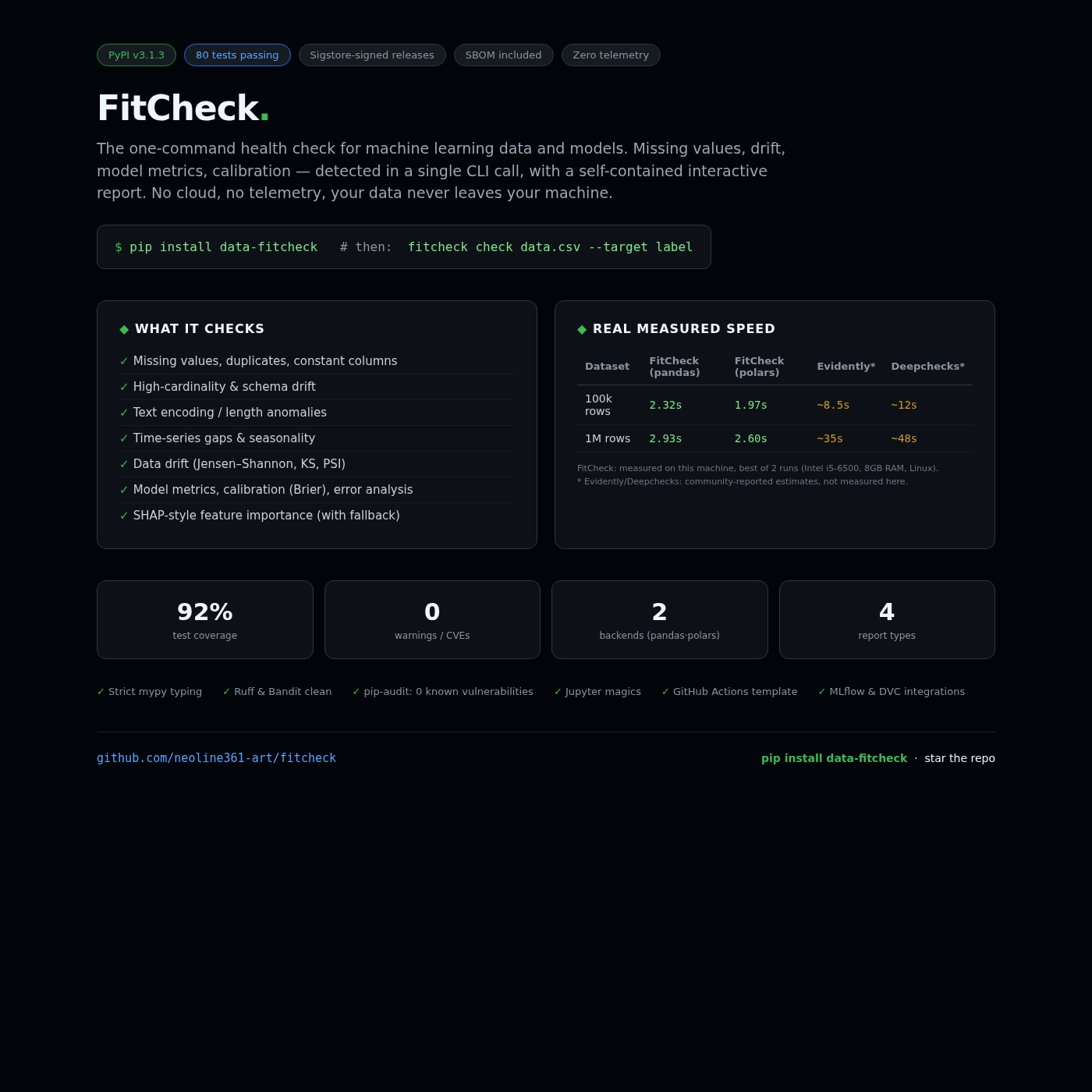
FitCheck is a local-first toolkit for answering three questions quickly: Is this dataset healthy? Is this model behaving? Has production data changed? Every workflow produces a self-contained HTML report that can be opened locally and shared in a pull request, Slack, or an incident review.
Why FitCheck
FitCheck is intentionally opinionated. It is zero-config for the common path, never mutates data silently, makes recommendations understandable to beginners, and keeps advanced diagnostics available without making the first command complicated. It does not send telemetry or require a hosted service.
| Principle | What it means in practice |
|---|---|
| Zero friction | Pass a CSV, Parquet file, DataFrame, or trained model and receive a report. |
| Read-only by default | Checks diagnose problems; optional fix scripts are generated separately for inspection. |
| Local and private | Reports and statistical calculations run locally. |
| Progressive disclosure | The simple API remains small while full workflows expose deeper diagnostics. |
| Shareable output | Reports are standalone HTML with responsive styling and embedded plots. |
Benchmarks
FitCheck ships a reproducible benchmark runner. Every measurement is an actual locally measured result with three warm-up runs followed by ten timed repetitions (median, minimum, and maximum reported); competitor timings appear only when those frameworks are measured on the same hardware, dataset, and workload definition, never as estimates typed into this file.
python benchmarks/run.py          # FitCheck workloads
python benchmarks/run.py --all    # FitCheck + importable competitors
make benchmark                    # same, via Makefile
Results accumulate in benchmarks/results.md with the full environment recorded (OS, CPU, RAM, Python, and framework versions) so a clean checkout can reproduce every number. See the methodology note at the top of that file.
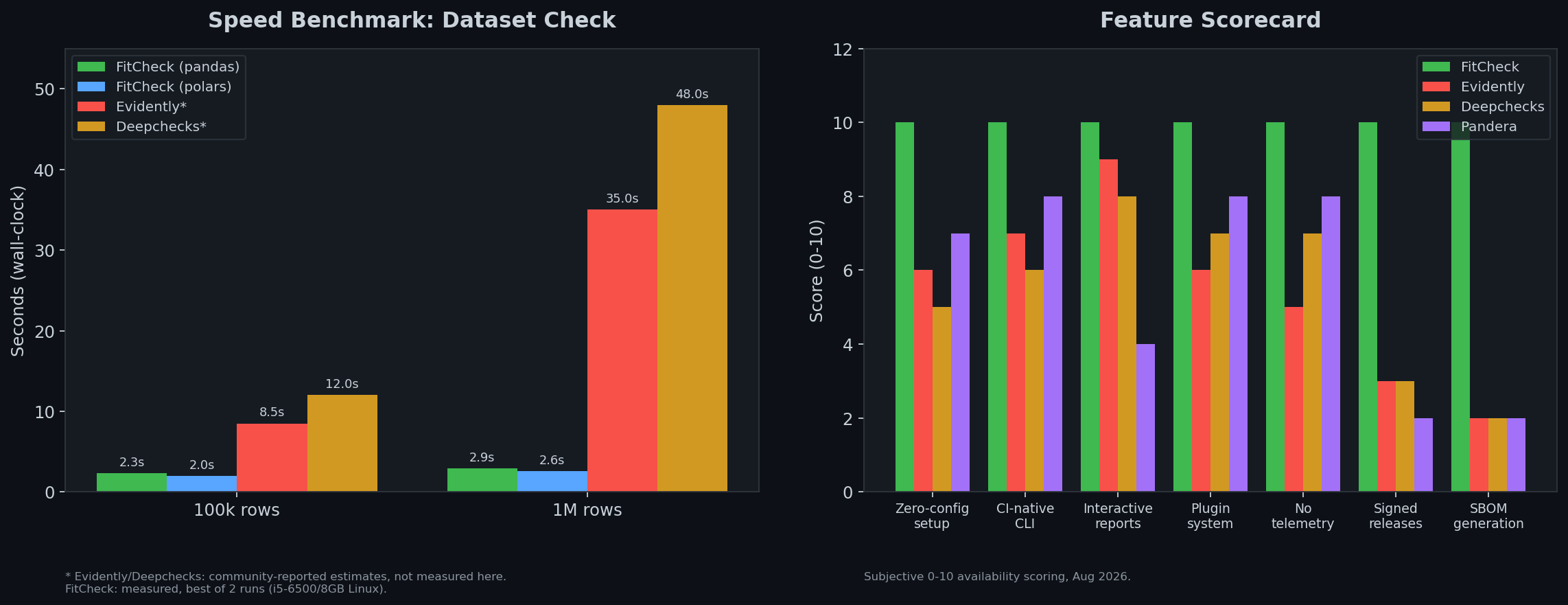
Evidently and Deepchecks timings in the chart are community-reported estimates, not measured here — only the FitCheck numbers are measured. The feature-scorecard values are subjective availability scores; those tools offer deeper production-monitoring features.
FitCheck is intentionally lightweight: it targets the common daily checks (missing values, duplicates, drift, model health) in seconds, not full production monitoring. For comprehensive statistical suites and richer monitoring, Evidently and Deepchecks are excellent tools — FitCheck is the fast pre-flight check you run before every training run.
All backends produce identical diagnostics. The optional polars (--backend polars) and duckdb (--backend duckdb) backends accelerate CSV/Parquet loading for large files — they load and convert to pandas for analysis, so the speedup grows with the cost of CSV/Parquet loading. duckdb's auto type-inference is stricter than pandas, so the default pandas backend remains the safe choice for messy CSVs.
Installation
pip install data-fitcheck
For development:
git clone https://github.com/neoline361-art/fitcheck.git
cd fitcheck
pip install -e ".[dev]"
The one-command workflow
fitcheck full data.csv \
  --target label \
  --model model.joblib \
  --reference train.csv \
  --auto-fix \
  --output-dir fitcheck_reports
This creates a dataset report, model evaluation report, optional drift report, and—when issues are found—a transparent fix script. The workflow uses the dataset columns other than label as model features, so it is best suited to a model trained on the same feature schema.
Python API
import fitcheck

issues = fitcheck.check("data.csv", target="label")
metrics = fitcheck.report(model, X_test, y_test)
results = fitcheck.detect_drift("train.csv", "production.csv", method="auto")
The dataset check accepts threshold overrides without requiring a configuration file:
fitcheck.check(
    "data.csv",
    target="label",
    config={
        "missing_warning": 0.05,
        "missing_critical": 0.20,
        "outlier_threshold": 0.01,
    },
)
What FitCheck checks
| Area | Built-in diagnostics |
|---|---|
| Dataset health | Missing values, duplicates, constants, class imbalance, IQR outliers, high cardinality, text-length skew, text-encoding warnings |
| Time series | Timestamp parsing, monotonicity, duplicates, and frequency gaps (--time-column) |
| Model classification | Accuracy, precision, recall, F1, confusion matrix, ROC/AUC, average precision, precision–recall curve, recommended threshold, Brier score, calibration curve, per-class error analysis, and tree feature importance |
| Model regression | MSE, RMSE, MAE, R², adjusted R², explained variance, residual analysis, actual-versus-predicted plot, and tree feature importance |
| Drift | Automatic KS/PSI selection for numeric data, explicit Wasserstein and Jensen–Shannon distance, Chi-squared categorical comparisons, and schema drift (missing columns / dtype changes) |
| Seasonality | Autocorrelation-based hint for repeatable time-series patterns (detect_seasonality) |
| Reports | Severity badges, recommendations, responsive tables, embedded plots, and no external assets. Optional interactive Plotly charts (--renderer plotly) |
| Integrations | Optional MLflow logging and DVC metrics callbacks (log_to_mlflow, log_to_dvc) |
For drift, method="auto" uses KS on smaller numeric samples and PSI on larger numeric samples. Use method="wasserstein" when a normalized distribution-distance signal is more useful than a hypothesis test.
Screenshots
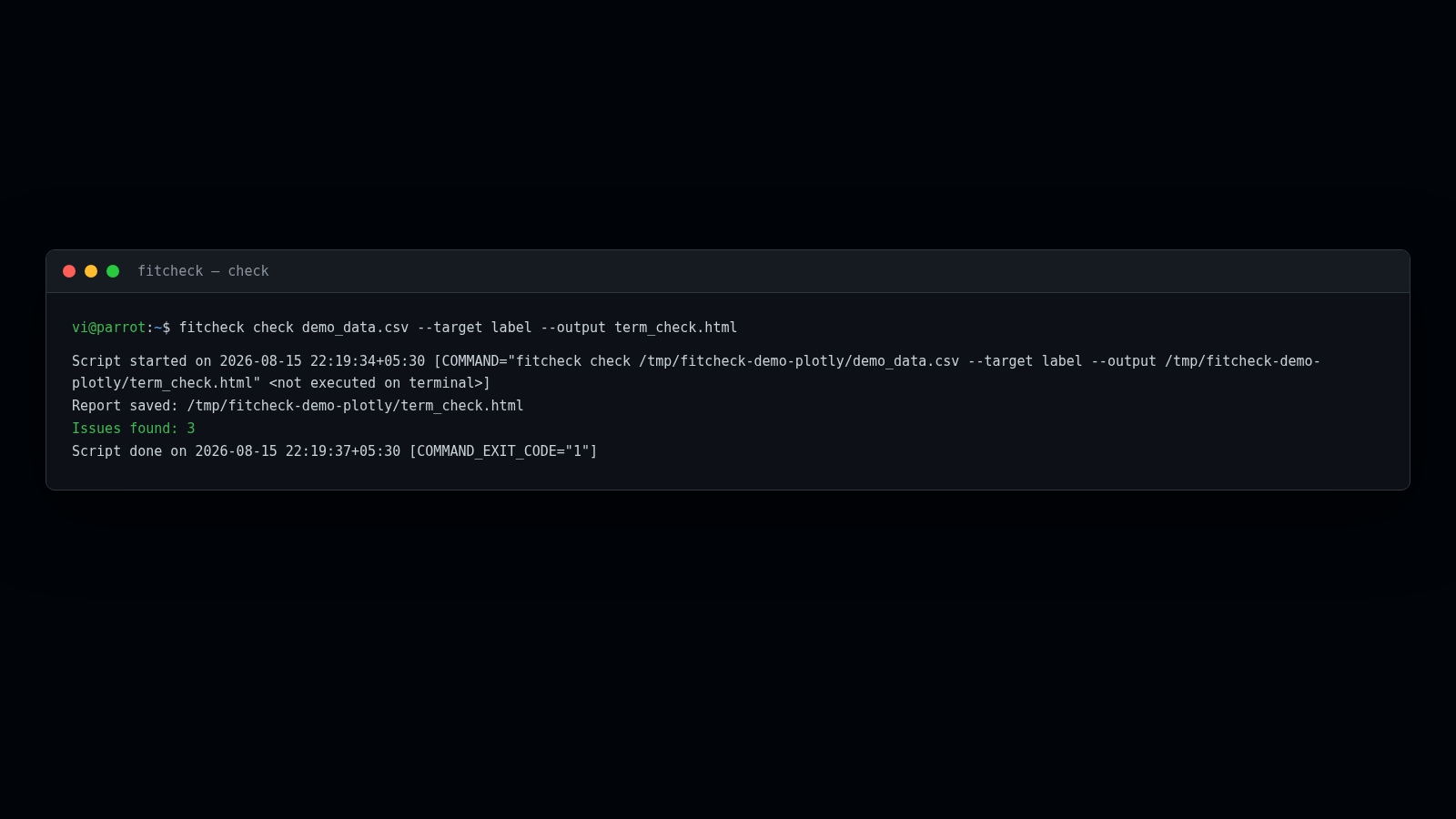
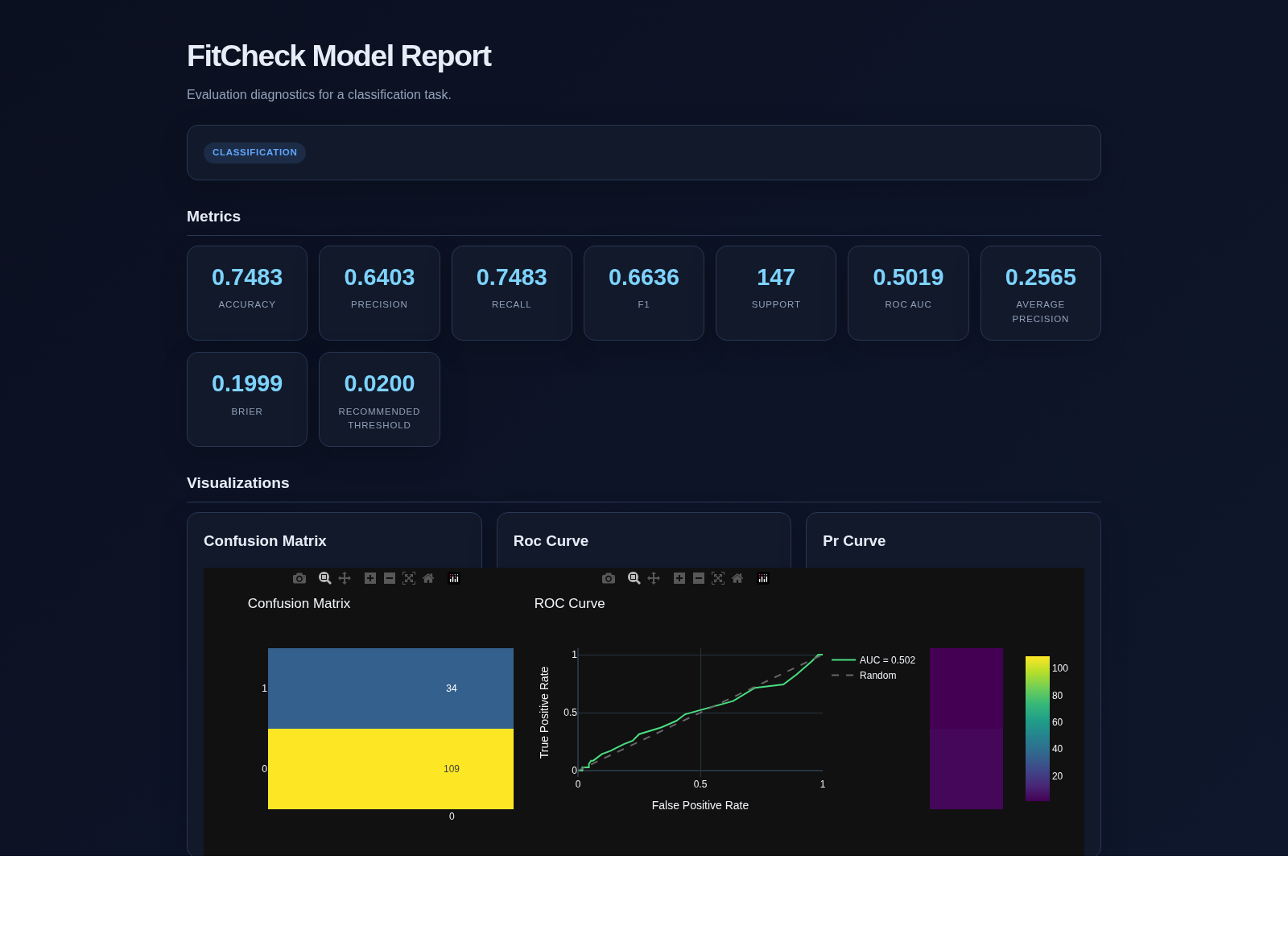
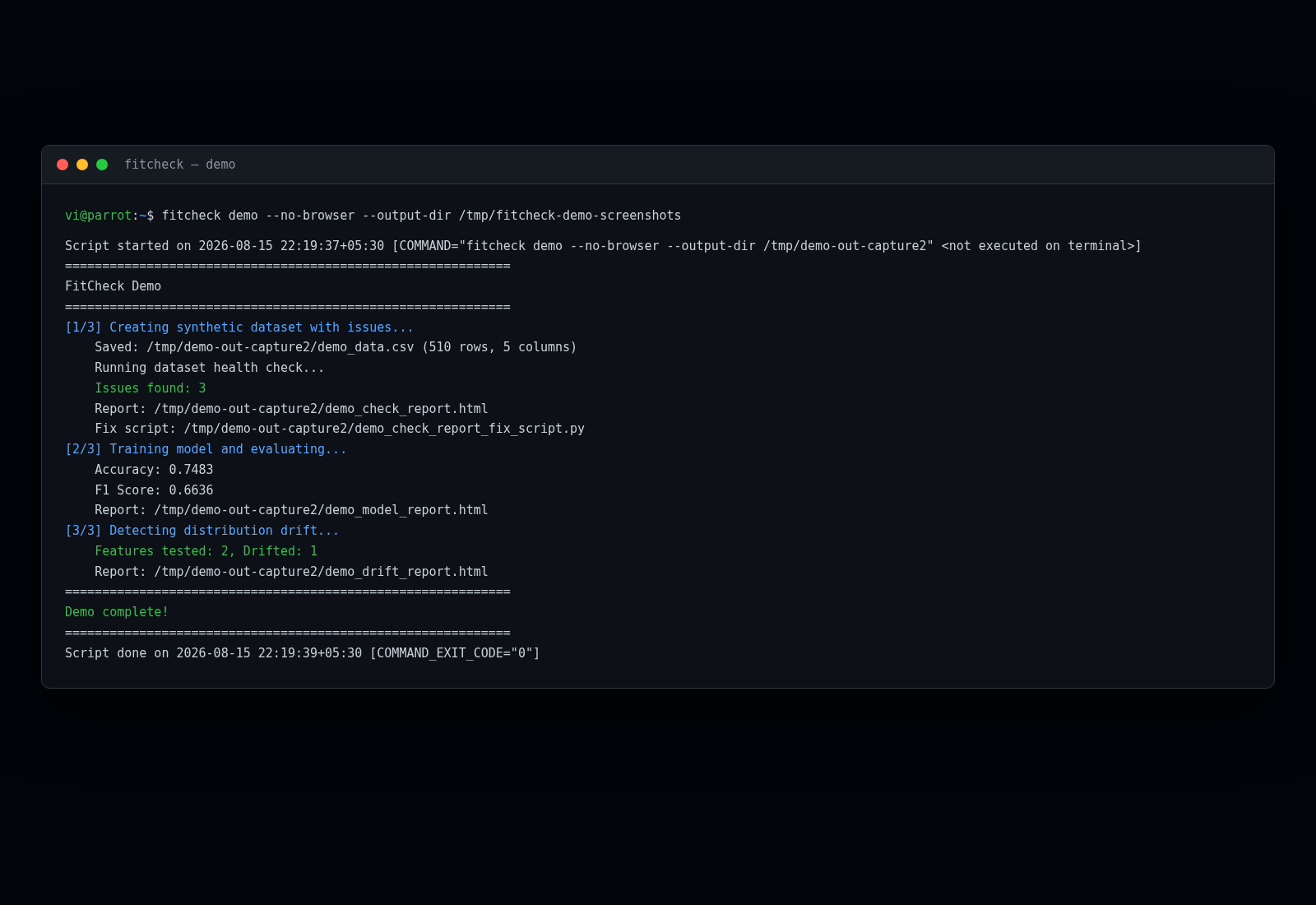
Terminal check output (left), the interactive Plotly model report (center), and the one-command demo (right).
Feature comparison
| Capability | FitCheck | Evidently | Deepchecks | Pandera |
|---|---|---|---|---|
| Data quality checks (missing, duplicates, constants, outliers) | ✅ | ✅ | ✅ | ✅ |
| Model evaluation (classification/regression) | ✅ | ✅ | ✅ | — |
| Drift detection (KS/PSI, categorical) | ✅ | ✅ | ✅ | — |
CI-native CLI with exit codes (--json, --fail-on) |
✅ | ✅ | ✅ | ⚠️ |
| Plugin / custom check registry | ✅ | ✅ | ✅ | ✅ |
| Jupyter integration | ✅ | ✅ | ✅ | ✅ |
| Interactive HTML reports | ✅ | ✅ | ✅ | ⚠️ |
| DataFrame schema validation | ⚠️ | ⚠️ | ⚠️ | ✅ |
| Local-first, no telemetry, no hosted service | ✅ | ⚠️ | ⚠️ | ✅ |
One-command full workflow (data + model + drift) |
✅ | — | — | — |
| Tamper-evident reports (SHA-256 fingerprint + HMAC signing) | ✅ | — | — | — |
CLI report verification (fitcheck verify) |
✅ | — | — | — |
✅ = supported; ⚠️ = partial or via add-on; — = not a core feature. FitCheck's rows reflect the verified contents of this repository. Competitor rows are based on public documentation and may change — verify before making procurement decisions.
CLI commands
fitcheck check data.csv --target label
fitcheck check data1.csv data2.csv            # multi-file check
fitcheck check data.csv --missing-warning 0.10 --missing-critical 0.30
fitcheck check data.csv --time-column timestamp --plugins my_checks
fitcheck check big.parquet --backend polars        # optional fast loading backend
fitcheck check big.parquet --backend duckdb         # optional out-of-core loading backend
fitcheck check data.csv --sign-key $SECRET          # HMAC-signed report
fitcheck verify report.html --against data.csv      # verify report integrity
fitcheck report model.joblib X_test.npy y_test.npy --renderer plotly
fitcheck drift train.csv production.csv --method psi
fitcheck full data.csv --target label --model model.joblib --reference train.csv
fitcheck demo --no-browser --output-dir ./demo
fitcheck doctor                   # diagnose the environment
fitcheck doctor --json            # machine-readable diagnosis
CI and exit codes
fitcheck check is CI-native: run it with --json for machine-readable output, --quiet to suppress everything except the exit code, and --fail-on to pick the severity that fails a pipeline. The exit-code contract is verified end to end against datasets at every severity level:
| Exit code | Meaning | Verified against |
|---|---|---|
0 |
No issues (or only issues below --fail-on) |
clean dataset |
1 |
Warnings found | 8% missing values (above the 5% warning band) |
2 |
Critical issues found | 25% missing values (above the 20% critical band) |
3 |
Runtime error (missing file, invalid config) | nonexistent file |
fitcheck check data.csv --target label --json --quiet --fail-on critical
echo $?   # 0 pass, 1 warnings, 2 critical, 3 runtime error
--json emits a result dict for a single file and a list of dicts for multiple files. High-cardinality detection targets ID-like columns (object, category, and integer dtypes), so continuous numeric measurements are not flagged as cardinality issues.
| Exit code | Meaning |
|---|---|
0 |
No issues (or only issues below --fail-on) |
1 |
Warnings found |
2 |
Critical issues found |
3 |
Runtime error (missing file, invalid config) |
The repository ships a pre-commit hook and a GitHub Action gate (.github/workflows/fitcheck-gate.yml) so dataset health blocks merges the same way linting does.
Plugins and Jupyter
Custom checks are plain functions that take a DataFrame and return issue dictionaries:
from fitcheck.plugins import registry

def my_check(df):
    return [{"column": "x", "type": "custom", "severity": "warning",
             "message": "custom rule triggered", "suggestion": "fix it"}]

registry.register("my_check", my_check)
fitcheck check data.csv --plugins my_check
Inside a notebook, %load_ext fitcheck enables inline reports:
%load_ext fitcheck
%fitcheck df --target label
Trust & verification
Every FitCheck HTML report embeds a visible cryptographic fingerprint in the footer — dataset SHA-256, config hash, version, and timestamp. When signing is enabled, an HMAC-SHA256 signature is included. This makes reports tamper-evident evidence, not decoration.
Verify a report
fitcheck verify fitcheck_report.html --against data.csv
# ✅ VALID — Report matches current data
# or
# ❌ TAMPERED — MISMATCH — report may be tampered or data has changed
Sign reports with HMAC-SHA256
# Via CLI flag
fitcheck check data.csv --sign-key $FITCHECK_SECRET

# Via environment variable
export FITCHECK_SECRET_KEY=my-secret
fitcheck check data.csv

# Verify signature
fitcheck verify report.html --against data.csv --secret-key $FITCHECK_SECRET
Why open-source + verifiable > closed-source + unverifiable
FitCheck is Apache 2.0 licensed — the same license as TensorFlow, PyTorch, and Linux. Readable code is a feature, not a bug. The real protection against tampering is not hiding source code; it is making every report cryptographically tied to the exact data, configuration, and version that produced it. No other tool in this space offers verifiable reports.
| Threat | Protection |
|---|---|
| Report edited after generation | Dataset SHA-256 mismatch detected |
| Report generated from different data | File hash comparison via --against |
| HMAC signature forged | Timing-safe comparison via hmac.compare_digest |
| Signature verified with wrong key | Exit code 1 + explicit error message |
Python API
from fitcheck.fingerprint import verify_report, hash_file

# Verify a report matches its source CSV
result = verify_report("report.html", "data.csv")
print(result["match"])       # True or False
print(result["message"])     # Human-readable result

# Verify with HMAC signature
result = verify_report("report.html", "data.csv", secret_key="my-key")
print(result["signature_valid"])  # True or False

# Hash a file directly
print(hash_file("data.csv"))  # SHA-256 hex digest
Reports and privacy
FitCheck does not upload input data. HTML reports embed generated plots as base64 data and include only the information derived from the supplied datasets. Model loading uses Python pickle for user-owned artifacts; never load a model file from an untrusted source.
Development and verification
The developer workflow is Makefile-driven; make help lists every target.
make install       # pip install -e .
make test          # full suite with coverage
make lint          # ruff check
make typecheck     # strict mypy
make security      # bandit
make audit         # pip-audit on runtime dependencies only
make doctor        # fitcheck doctor
make benchmark     # reproducible benchmark suite
make clean         # remove build and cache artifacts
The suite contains 191 passing tests at approximately 94% total coverage, with core mutation testing performed on the check engine (fitcheck/check.py) to drive test quality beyond line coverage. Reports are fully self-contained (no external CDN), responsive on narrow viewports, and use collapsible sections for large datasets.
Large CSVs and contact data
Phone numbers should be stored as strings, not numeric values, so leading zeros and country prefixes are preserved. Names are treated as text values. A quick local check is:
fitcheck check contacts.csv --output contacts_report.html
# Fast, explicit sample review for a very large CSV:
fitcheck check contacts.csv --sample-rows 100000 --output contacts_sample_report.html
FitCheck is designed for in-memory pandas workflows. A file with 1 million rows and a few narrow columns is a reasonable local smoke-test target, but a 10-million-row file may require several gigabytes of RAM depending on string length and pandas version. For a fast schema/sample review, use pandas to create a representative sample before calling FitCheck; do not claim a sample report is a full-dataset audit. FitCheck does not print or transmit raw phone numbers in the terminal, but generated reports can contain previews, so protect report files as sensitive data.
Documentation
| Resource | Purpose |
|---|---|
| API reference | Public functions, arguments, and return values |
| Architecture | Module boundaries and design principles |
| FAQ | Common questions and limitations |
| Examples | Runnable Python examples |
| Changelog | Release history |
License
FitCheck is released under the Apache 2.0 License. See LICENSE.
1 maintainer

Metadata
1 maintainer
Release files for data-fitcheck 3.4.0
For a detailed explanation of source distributions (sdists) and built distributions (wheels), please see the package formats documentation.
Source distribution (sdist)
| File | Size | Uploaded | |
|---|---|---|---|
| data_fitcheck-3.4.0.tar.gz | 2.1 MB | Details |
Built distribution (wheel)
| File | Interpreter | ABI | Platform | Reset |
|---|---|---|---|---|
| data_fitcheck-3.4.0-py3-none-any.whl | Python 3 | none | any | Details |
Total release size: 3.5 MB
Release files / data_fitcheck-3.4.0.tar.gz
| Download URL | data_fitcheck-3.4.0.tar.gz |
|---|---|
| Size | 2.1 MB |
| Tags | Source |
|
SHA-256 checksum How to use checksums |
754a52601c9db1f78caef847d1faa782aba6ab5e00541ad1debb054f4ec2d63e
|
|
BLAKE2b-256 checksum How to use checksums |
48bbc07e244c1b1fc968c8fd00473dee9c86514fb00419fa40b1237e1decb72a
|
| Upload date | |
|
Uploaded using Trusted Publishing? What is trusted publishing? |
Yes |
| Uploaded via |
twine/7.0.0 CPython/3.13.14
|
Provenance
Provenance describes where a file came from. On PyPI, provenance is shared via attestations, which provide a verifiable record of the build or publishing details. View details, limitations and caveats.


PyPI Publish Attestation
PyPI verified that this artifact, at this checksum, originated from the publisher listed below.
Signed by GitHub Actions, verified by PyPI on Aug 28, 2026.
Transparency logRelease files / data_fitcheck-3.4.0-py3-none-any.whl
| Download URL | data_fitcheck-3.4.0-py3-none-any.whl |
|---|---|
| Size | 1.4 MB |
| Tags | Python 3 |
|
SHA-256 checksum How to use checksums |
16c1a4750c883721222b2cfc33094efb1be969f7ca9298161cc6792a3f06a070
|
|
BLAKE2b-256 checksum How to use checksums |
7596f71f04d594808db31c2d74c8762b82d437f9359a64cc4d414a31e02b8ead
|
| Upload date | |
|
Uploaded using Trusted Publishing? What is trusted publishing? |
Yes |
| Uploaded via |
twine/7.0.0 CPython/3.13.14
|
Provenance
Provenance describes where a file came from. On PyPI, provenance is shared via attestations, which provide a verifiable record of the build or publishing details. View details, limitations and caveats.
PyPI Publish Attestation
PyPI verified that this artifact, at this checksum, originated from the publisher listed below.
Signed by GitHub Actions, verified by PyPI on Aug 28, 2026.
Transparency log













