

Datakeel
A local-first workbench for auditable AI datasets, traceable business metrics, and human-approved agents
Proofread multimodal training samples, freeze verifiable SHA-256 releases, trace every metric answer back to registered SQL and lineage, and gate Agent/MCP writes behind human sign-off.






简体中文 · Website · Quick start · Dataset delivery · Guided tour · Documentation · Changelog
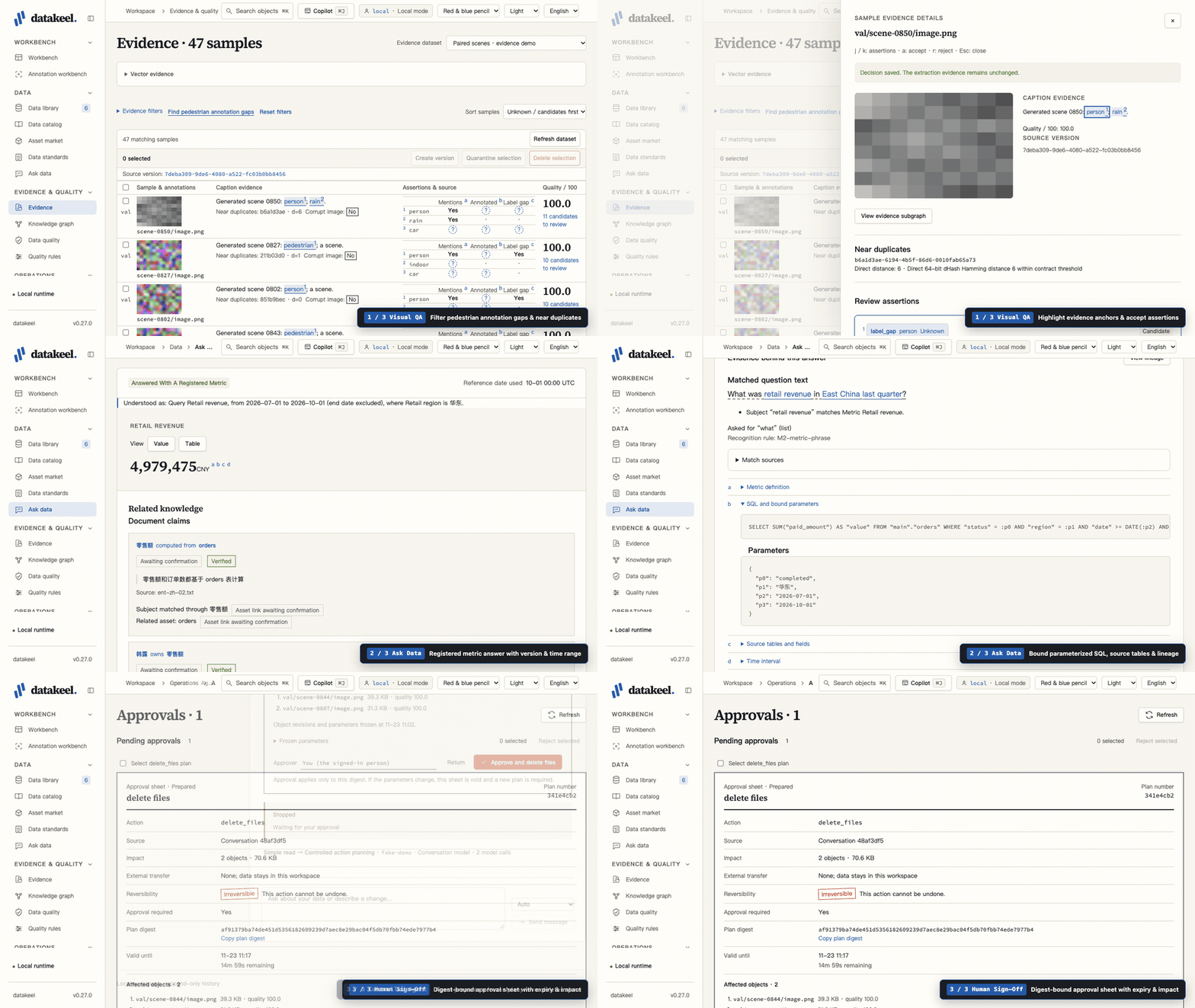
18-second live demo walkthrough: visual QA & evidence anchors, traceable metric SQL, and digest-bound human approval. See also dataset delivery review.
Quick start
Install uv and launch the offline demo in one command (or run uv sync --locked && uv run datakeel demo from a source checkout). The demo starts the API and worker, serves the bundled web UI, and seeds generated samples in local SQLite. Model calls use the bundled offline provider.
uvx datakeel demo
# Web UI:   http://127.0.0.1:8765
# API docs: http://127.0.0.1:8765/api/docs
# Ctrl+C stops both processes.
Start with Evidence to inspect an image alongside its caption and annotations. In Ask data, try “What was retail revenue in East China last quarter?” with the demo reference date 2026-10-01. The guided tour uses the same generated samples. Guided tour
Run the demo and queries from the command line
uv run datakeel demo --once
uv run datakeel ask '上个季度华东区零售额是多少' --reference-instant 2026-10-01T00:00:00Z
uv run datakeel ask '退货率为什么上升' --reference-instant 2026-10-01T00:00:00Z
uv run datakeel ask '上个季度营业额是多少' --reference-instant 2026-10-01T00:00:00Z
uv run datakeel export --format openlineage --output events.json
uv run datakeel export --format croissant --output croissant.json
The demo includes four generated collections for file processing, paired image evidence, enterprise metrics, and knowledge graphs. The evidence collection has 1,000 sample images with known annotation conflicts, missing sidecars, and corrupted files.
What you can do
| Workflow | What you can verify | Guide |
|---|---|---|
| Import and review an image folder | Preview sample and sidecar pairing, inspect images that match across partitions, and exclude a confirmed sample in a corrected version. | Dataset delivery review |
| Review samples | Follow a candidate issue to a caption, annotation, image, or source event. Evidence distinguishes present, absent, and unknown. | Evidence review |
| Prepare training data | Compare immutable versions, inspect split leakage, and export training sets in COCO, YOLO, Hugging Face, or JSONL formats as applicable. | Training sets |
| Deliver a dataset | Sign a frozen release plan, download a reproducible package, and verify its manifest with datakeel reconcile. |
Dataset releases |
| Explain a business metric | Inspect its definition version, source fields, parameterized SQL, and time range. Ask for a breakdown or follow the metric to its lineage. | Ask data |
| Review an Agent proposal | Inspect the affected objects, outbound scope, and cost. The Web UI and CLI handle approval and execution. | Controlled actions · MCP |
The bilingual UI includes a keyboard-driven evidence review panel, global search with ⌘K / Ctrl+K, and a contextual Copilot with ⌘J / Ctrl+J. UI design
For labeling production, audio and video processing, LLM dataset checks, knowledge graphs, and semantic catalog imports, use the documentation hub or browse the documentation site.
Where Datakeel fits
Datakeel complements data warehouses and training frameworks by uniting three workflows that are usually stitched across separate tools:
| Dimension | Datakeel | Typical point-tool stack |
|---|---|---|
| Deployment footprint | Local-first SQLite + loopback Web UI in two commands; scales to PostgreSQL + S3. | Separate clusters for data catalogs or hosted SaaS accounts for QA and labeling. |
| Visual QA & split leakage | Three-state evidence (present / absent / unknown), visual review, and cross-split dHash / SimHash / exact leakage checks. |
Split across separate inspection tools (FiftyOne), labeling UIs (Label Studio), and ad-hoc scripts. |
| Reproducible dataset delivery | Digest-signed release plans, immutable SHA-256 manifests, and offline datakeel reconcile verification. |
File version trackers (DVC) hash blobs without review sign-off or leakage proofs. |
| Traceable metric Q&A | Registered metric definitions, parameterized SQL, lineage links, and explicit clarification/refusal on ambiguity. | Free-form Text-to-SQL assistants generate unreviewed queries with no metric version binding. |
| Agent & MCP write safety | Read and plan-preparation tools over stdio/SSE; destructive or outbound writes pause for human sign-off. | Generic database MCP connectors execute writes directly or lack digest-bound approval sheets. |
Frequently asked questions
- Do I need cloud API keys or a database server to try Datakeel? No.
uv run datakeel demoruns locally on SQLite with an offline deterministic provider and 1,000 generated image, metric, and knowledge-graph samples. - How does Datakeel catch train/test split leakage? It computes exact hashes, 64-bit perceptual dHash, SimHash text fingerprints, and group keys across partitions, shows side-by-side matches for review, and records the checked proof inside the signed release manifest.
- Can an MCP client delete data or change metrics autonomously? No. Datakeel's MCP server never exposes approval or execution tools; humans review and sign the frozen plan digest in the Web UI or CLI.
- Can a small team share one installation? Yes. Switch to PostgreSQL and S3-compatible object storage behind Caddy or nginx + oauth2-proxy using the deployment guide.
How it fits together
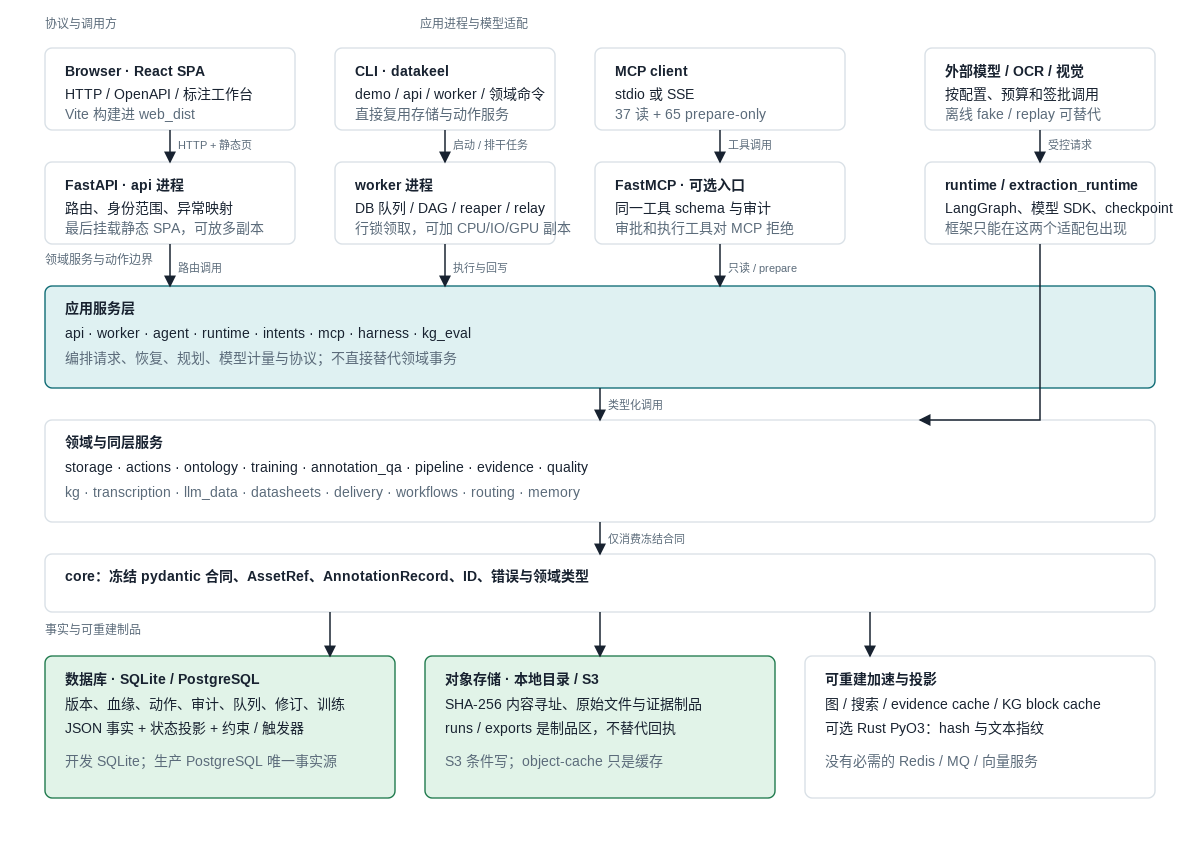
Datakeel runs an API and a fenced worker over SQLite or PostgreSQL and local or S3-compatible storage. File versions have immutable SHA-256 manifests. Lineage rebuilds from append-only events, and external or irreversible actions require a person to approve the exact prepared plan. Architecture · Persistence schema · API reference
MCP and models
The MCP server exposes audited reads and plan preparation. It can run over local stdio or loopback SSE. Use the same DATAKEEL_HOME as the Web UI to work on the same datasets. Controlled actions
MCP client configurations
For a local stdio client such as Claude Desktop (claude_desktop_config.json) or Cursor (.cursor/mcp.json), replace the absolute paths:
{
  "mcpServers": {
    "datakeel": {
      "command": "/absolute/path/to/uv",
      "args": [
        "--directory",
        "/absolute/path/to/datakeel",
        "run",
        "datakeel",
        "mcp"
      ],
      "env": {
        "DATAKEEL_HOME": "/absolute/path/to/datakeel/.datakeel"
      }
    }
  }
}
For an isolated loopback SSE server, run uv run datakeel mcp --transport sse --host 127.0.0.1 --port 8766:
{
  "mcpServers": {
    "datakeel": {
      "url": "http://127.0.0.1:8766/sse"
    }
  }
}
Optional real providers use DATAKEEL_OPENAI_API_KEY or DATAKEEL_ANTHROPIC_API_KEY, with optional DATAKEEL_OPENAI_BASE_URL or DATAKEEL_ANTHROPIC_BASE_URL. Keep secrets outside the repository and register provider model prices in the price catalog.
Export sanitized OTLP/HTTP spans to a collector, Phoenix, or Langfuse with uv run datakeel export-traces [--conversation-id <id>]. Trace export reference
Deploy and contribute
GitHub Releases carry the wheel, locked requirements, license notices, and SHA-256 checksums. For a shared installation, use the small-team deployment guide for the authenticated reverse proxy and PostgreSQL options. Release files · Deployment guide · SQLite maintenance
Run separate processes or build local artifacts
uv run datakeel db upgrade
uv run datakeel api --port 8765
# In a second terminal with the same storage and database environment:
uv run datakeel worker
A source build uses Python 3.12, uv, Node.js 22, and Rust 1.96. The build commands produce local artifacts.
make build-wheel
make build-image
docker run --rm -p 127.0.0.1:8765:8765 -v datakeel-data:/data datakeel:local
After building the image, Docker Compose can run the API, worker, migration job, and PostgreSQL on a loopback-only binding.
docker compose up -d
docker compose run --rm api demo --once
Run the repository quality gates
uv sync --locked
(cd web && npm ci)
uv run pre-commit install
make check
uv run python scripts/check_readme.py
bash scripts/ci-check.sh
CI runs gates, tests, and mutation checks on SQLite and PostgreSQL. For test inputs and guardrails, see Verification and Code standards.
Contributing · Support · Private security reports · Code of conduct · Citation
Datakeel is licensed under Apache-2.0. Dependency and bundled font terms are recorded in Third-party notices and Frontend notices.
1 maintainer

Metadata
1 maintainer
Release files for datakeel 0.27.1
For a detailed explanation of source distributions (sdists) and built distributions (wheels), please see the package formats documentation.
Built distribution (wheel)
| File | Interpreter | ABI | Platform | Actions Reset |
|---|---|---|---|---|
| datakeel-0.27.1-py3-none-any.whl | Python 3 | none | any | Details for datakeel-0.27.1-py3-none-any.whl |
Release files / datakeel-0.27.1-py3-none-any.whl
| Download URL | datakeel-0.27.1-py3-none-any.whl |
|---|---|
| Size | 4.4 MB |
| Tags | Python 3 |
|
SHA-256 checksum How to use checksums |
494962f2b4b4ec87a600ce37a28b3120b167bf44e788fdb9e4f48d2788b47534
|
|
BLAKE2b-256 checksum How to use checksums |
41c211c3c98e7b85a7d63489fe70a04bf39a6a74d35c2b3c2fa4228e22ccd7d4
|
| Upload date | |
|
Uploaded using Trusted Publishing? What is trusted publishing? |
Yes |
| Uploaded via |
twine/7.0.0 CPython/3.13.16
|
Provenance
Provenance describes where a file came from. On PyPI, provenance is shared via attestations, which provide a verifiable record of the build or publishing details. View details, limitations and caveats.


PyPI Publish Attestation
PyPI verified that this artifact, at this checksum, originated from the publisher listed below.
Signed by GitHub Actions, verified by PyPI on Nov 23, 2026.
Transparency logSecurity for datakeel 0.27.1
Provenance
Provenance describes where a file came from. On PyPI, provenance is shared via attestations, which provide a verifiable record of the build or publishing details. View details, limitations and caveats.
Full provenance
1 file in this release has been uploaded with provenance metadata.
Attestation for datakeel-0.27.1-py3-none-any.whl
PyPI Publish Attestation
PyPI verified that this artifact, at this checksum, originated from the publisher listed below.
Signed by GitHub Actions, verified by PyPI on Nov 23, 2026.
Transparency logA note on package security
PyPI is a repository for distributing packages, not a service for auditing them. While third-party security researchers and our staff do their best to detect and remove malicious packages, PyPI cannot guarantee the quality, security or suitability of any given package.
To learn more about protecting yourself from malicious actors, visit our package security documentation.














