


⚛️ Reactor
Application builders hit a wall when a feature spans the browser and the server: frontend and backend plugin systems usually disagree about discovery, dependencies, lifecycle, compatibility, and enablement. Teams duplicate those contracts, hard-wire optional features into the host, and must coordinate rebuilds and deployments just to add, remove, or replace one capability.
Reactor gives JavaScript frontends and Python backends one extensibility model, inspired by VS Code, Eclipse (OSGi), and other proven plugin systems.
Reactor provides two sibling packages:
@datalayer/reactor(TypeScript): Plugin runtime with a framework-agnostic core and separate React integration.datalayer_reactor(PyPI distribution, imported asreactor): FastAPI + pluggy plugin reactor for modular extensibility.
Both tiers implement the same architecture. That is the point of writing it down once: a host that lists, describes, groups or draws plugins should never have to ask which side of the wire one came from.
📖 Documentation
reactor.datalayer.tech — everything is
there, and only there. Source in docs/.
| Why Reactor | what this targets that a hook callback does not |
| Architecture | the seven constructs, and the two distinctions the model rests on |
| Get started in TypeScript · in Python | install, and a plugin running |
| TypeScript runtime | plugins, lifecycle, contribution points, extensions, activation, lazy loading, remote plugins, allowed origins, React bindings, signals |
| Python runtime | manifests, contribution points, extensions, tenants, the HTTP API |
| Across the tiers | what a plugin may declare about its counterpart, and why it is not enforced |
| Federation | plugins that arrive from a URL, containers, and where one is allowed to come from |
| Python-packaged extensions | one pip install shipping both tiers, the frontend built into the wheel |
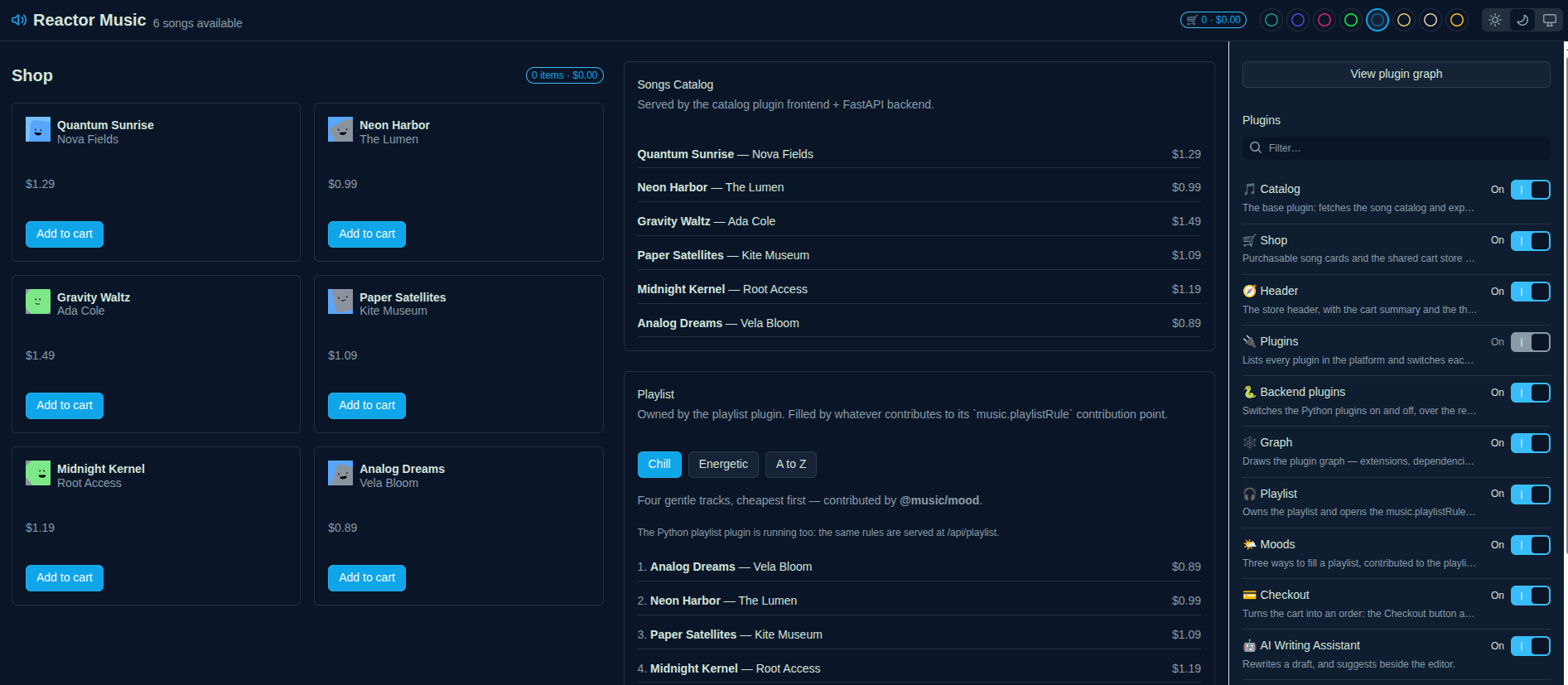
🎵 The music store, running in the page
reactor.datalayer.tech/examples/music/demo — a store assembled entirely from plugins, with a switch per plugin on both tiers. Untick one and watch what it contributed leave.
Repository layout
| Path | What is in it |
|---|---|
src/ |
TypeScript package source for @datalayer/reactor |
reactor/ |
Python package source for datalayer_reactor |
plugins/ |
reusable plugins shipped alongside the runtime — the manager and the graph |
examples/ |
the demos, including the music store |
docs/ |
the documentation site |
Develop
# TypeScript: the runtime and the bundled plugins.
npm install
npm run build
npm test
npm run typecheck

# Python.
python -m venv .venv
source .venv/bin/activate
pip install -e .
python -m reactor

# The music example, both tiers.
make music

# The documentation site.
cd docs && make install && make start
Release
See RELEASE.md.
1 maintainer

Metadata
1 maintainer
Release files for datalayer-reactor 1.0.5
For a detailed explanation of source distributions (sdists) and built distributions (wheels), please see the package formats documentation.
Source distribution (sdist)
| File | Size | Uploaded | |
|---|---|---|---|
| datalayer_reactor-1.0.5.tar.gz | 1.3 MB | Details |
Built distribution (wheel)
| File | Interpreter | ABI | Platform | Reset |
|---|---|---|---|---|
| datalayer_reactor-1.0.5-py3-none-any.whl | Python 3 | none | any | Details |
Total release size: 1.4 MB
Release files / datalayer_reactor-1.0.5.tar.gz
| Download URL | datalayer_reactor-1.0.5.tar.gz |
|---|---|
| Size | 1.3 MB |
| Tags | Source |
|
SHA-256 checksum How to use checksums |
c25534ab0269ff146e1ea607e2bb465499a984503d1121a0b5f7c59fd20aac6a
|
|
BLAKE2b-256 checksum How to use checksums |
359ad20d4efd61965a1d00d40ab30e434cc43fa5ea403da05c985d7e5ce1d143
|
| Upload date | |
|
Uploaded using Trusted Publishing? What is trusted publishing? |
Yes |
| Uploaded via |
twine/7.0.0 CPython/3.13.14
|
Provenance
Provenance describes where a file came from. On PyPI, provenance is shared via attestations, which provide a verifiable record of the build or publishing details. View details, limitations and caveats.


PyPI Publish Attestation
PyPI verified that this artifact, at this checksum, originated from the publisher listed below.
Signed by GitHub Actions, verified by PyPI on Oct 10, 2026.
Transparency logRelease files / datalayer_reactor-1.0.5-py3-none-any.whl
| Download URL | datalayer_reactor-1.0.5-py3-none-any.whl |
|---|---|
| Size | 57.7 kB |
| Tags | Python 3 |
|
SHA-256 checksum How to use checksums |
0cfa07c4dd3a814bd56c904047c347cd8039e104a905b61d97f10c8c58e1167e
|
|
BLAKE2b-256 checksum How to use checksums |
97770be01ce67a40e90c80752e60704b1f18c5a5a733a98c71aa0e43903b6267
|
| Upload date | |
|
Uploaded using Trusted Publishing? What is trusted publishing? |
Yes |
| Uploaded via |
twine/7.0.0 CPython/3.13.14
|
Provenance
Provenance describes where a file came from. On PyPI, provenance is shared via attestations, which provide a verifiable record of the build or publishing details. View details, limitations and caveats.
PyPI Publish Attestation
PyPI verified that this artifact, at this checksum, originated from the publisher listed below.
Signed by GitHub Actions, verified by PyPI on Oct 10, 2026.
Transparency log













