

🌌 DataNova
DataNova — a toolkit for data exploration in Python with a few lines of code!
🚀 Features
- Instant profiling: Summarize your data with
profile(df) - Bar Graph: Shows the top 5 most common values
bar(df, 'Column_Name') - Histogram: Plots the distribution of numerical data
hist(df, 'Column_Name') - Exploratory Data Analysis:
EDA(df) - Simple Linear Regression:
lm(df, x_var, y_var)
what's next?
- Logistic Regression (coming soon!)
🧭 Examples
Examples below use a dataset provided in the package called WINE_DF
from datanova import *
profile( WINE_DF )
- Most of our data is not blank, expect for 'price' (only 5% blank).
| Variable Name | Variable Type | Missing Count | % Blank | Unique Values | Most Frequent Value | Mean | Standard Deviation | Min | 25% | Median | 75% | Max | |
|---|---|---|---|---|---|---|---|---|---|---|---|---|---|
| 0 | country | object | 0 | 0 | 24 | US | |||||||
| 1 | province | object | 0 | 0 | 120 | California | |||||||
| 2 | points | int64 | 0 | 0 | 13 | 90 | 89.55 | 2.32 | 84.0 | 88.0 | 90.0 | 91.0 | 96.0 |
| 3 | price | float64 | 88 | 5 | 110 | 20.0 | 38.71 | 29.39 | 7.0 | 20.0 | 30.0 | 48.0 | 500.0 |
| 4 | variety | object | 0 | 0 | 161 | Pinot Noir |
$$\:$$ $$\:$$
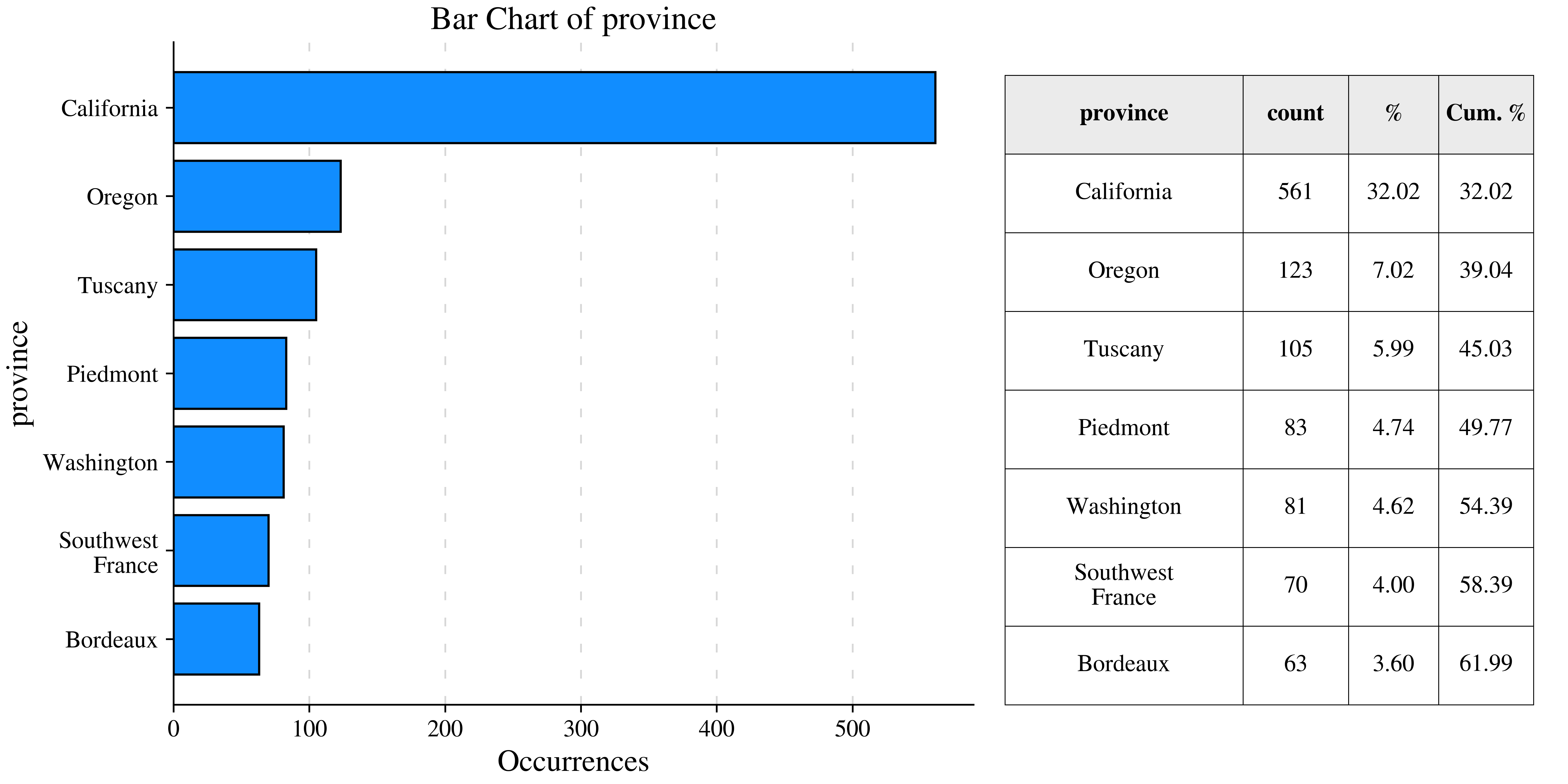
bar( WINE_DF , 'province', top_n=7)
- California accounts for 32% of total wine sales, and the top five regions collectively contribute over half of all sales.
$$\:$$ $$\:$$
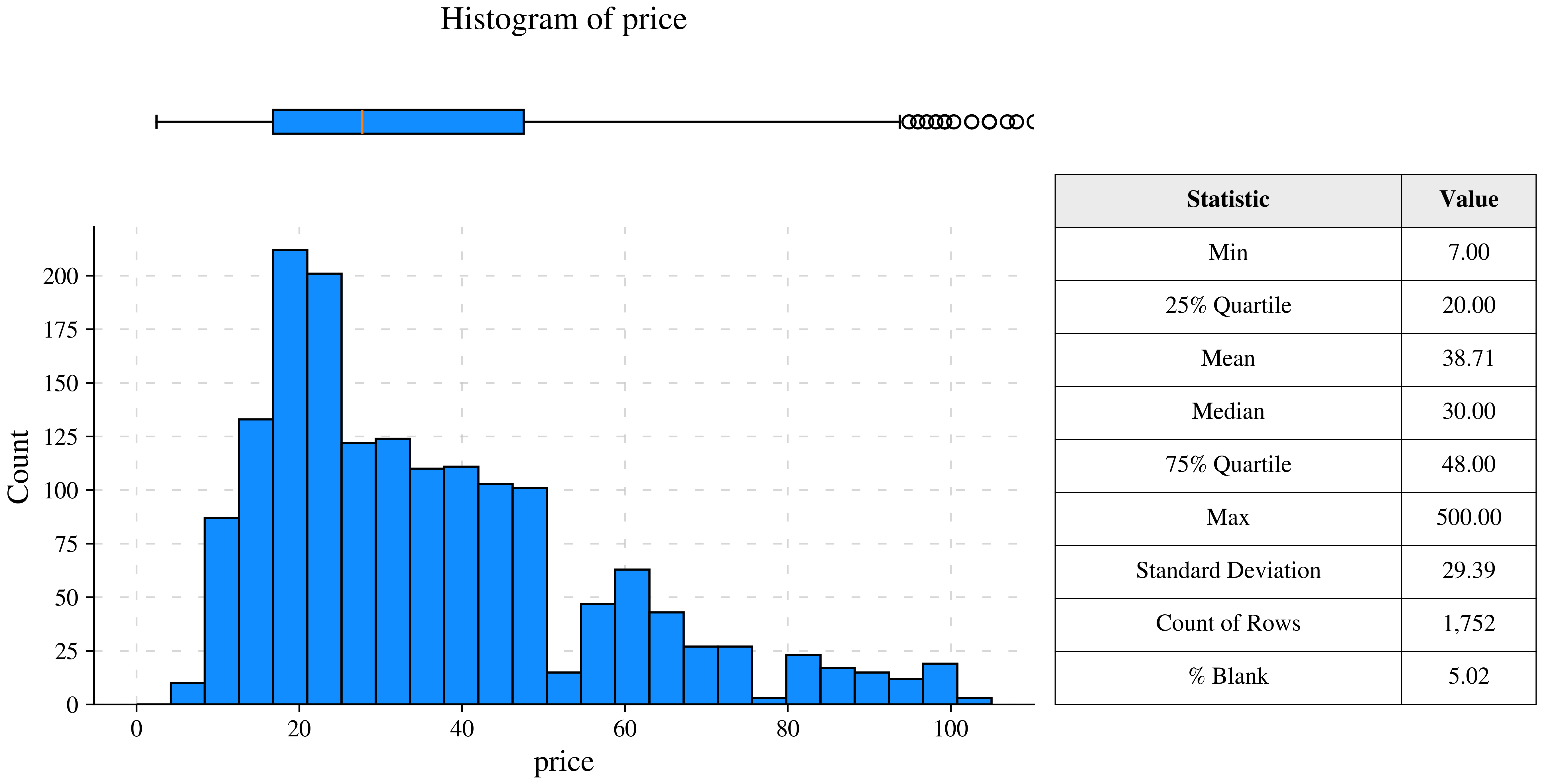
hist( WINE_DF , 'price' , xlim = [0,105], n_bins = 25)
- On average, a bottle of wine costs $38. The price ranges from: $20-$48
$$\:$$ $$\:$$
eda( WINE_DF )
- Creates bar graphs and histograms for all columns in the dataset.
$$\:$$
Regression Modeling
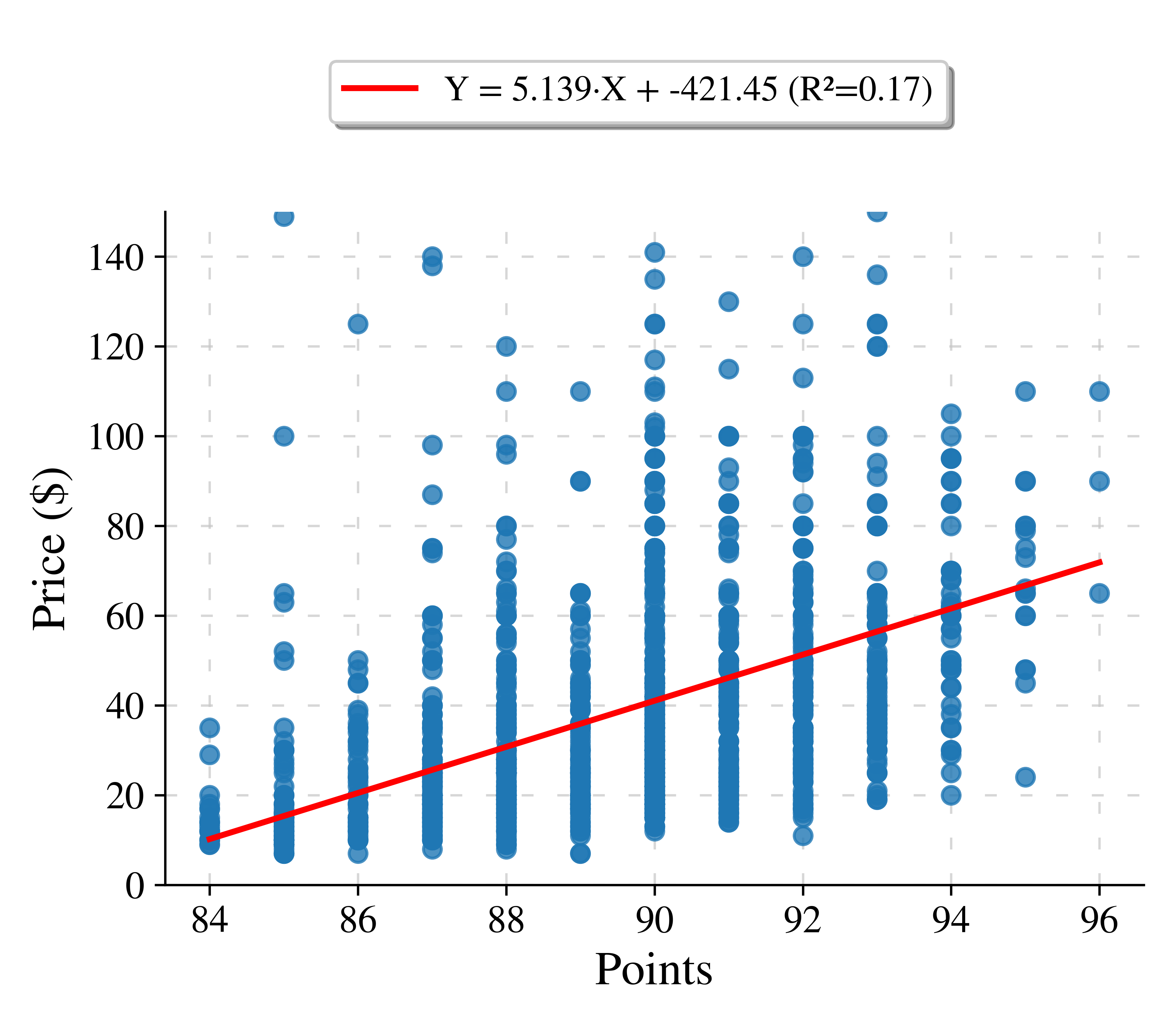
figure, model = lm(WINE_DF, 'points' , 'price' ,  ylimit = [0,150] ,
                   xtitle = 'Points' , ytitle = 'Price ($)' ,
                   show_summary=False , alpha = 0.8 )

display( figure )
- Creates a simple linear regression
- As the quality of wine increases (points), the price also increases.
🛠️ Installation
pip install DataNova
1 maintainer

Metadata
1 maintainer
Release files for DataNova 0.1.3
For a detailed explanation of source distributions (sdists) and built distributions (wheels), please see the package formats documentation.
Source distribution (sdist)
| File | Size | Uploaded | Provenance | Actions |
|---|---|---|---|---|
| datanova-0.1.3.tar.gz | 21.3 kB | Without provenance | Details for datanova-0.1.3.tar.gz |
Built distribution (wheel)
| File | Interpreter | ABI | Platform | Actions Reset |
|---|---|---|---|---|
| datanova-0.1.3-py3-none-any.whl | Python 3 | none | any | Details for datanova-0.1.3-py3-none-any.whl |
Total release size: 42.9 kB
Release files / datanova-0.1.3.tar.gz
| Download URL | datanova-0.1.3.tar.gz |
|---|---|
| Size | 21.3 kB |
| Tags | Source |
|
SHA-256 checksum How to use checksums |
8ae85b00d227f9e66ea70734fe2bc0eb7dac6b91a452cfa5c097affd0728f7b2
|
|
BLAKE2b-256 checksum How to use checksums |
1b291de310bebbc3235aa850e467c75d0275bc36937256b91602481ade949239
|
| Upload date | |
|
Uploaded using Trusted Publishing? What is trusted publishing? |
No |
| Uploaded via |
twine/6.2.0 CPython/3.12.0
|
Release files / datanova-0.1.3-py3-none-any.whl
| Download URL | datanova-0.1.3-py3-none-any.whl |
|---|---|
| Size | 21.6 kB |
| Tags | Python 3 |
|
SHA-256 checksum How to use checksums |
6b86657e9bb62f2e964cd11bfdb0fd26a362daf54ac945c55c715f85acd0b78d
|
|
BLAKE2b-256 checksum How to use checksums |
b9a3744ab199cfa4afcb5194b503ddb9bcc1e94f986fc74a7e30bb42b23b0930
|
| Upload date | |
|
Uploaded using Trusted Publishing? What is trusted publishing? |
No |
| Uploaded via |
twine/6.2.0 CPython/3.12.0
|
Security for DataNova 0.1.3
Provenance
Provenance describes where a file came from. On PyPI, provenance is shared via attestations, which provide a verifiable record of the build or publishing details. View details, limitations and caveats.
No provenance found
None of the files in this release were uploaded with provenance metadata.
A note on package security
PyPI is a repository for distributing packages, not a service for auditing them. While third-party security researchers and our staff do their best to detect and remove malicious packages, PyPI cannot guarantee the quality, security or suitability of any given package.
To learn more about protecting yourself from malicious actors, visit our package security documentation.














