

DataRanger patrols your data, fixes what it can prove, and calls you for the rest.
A park ranger walks the trails, fixes what is safe to fix on the spot, radios in anything dangerous, and files a report. DataRanger does the same for your tables. It finds data-quality incidents, tests every candidate fix on a copy against the source's control totals, applies only the fixes it can prove, and keeps wrong fixes under a rate you choose. Everything else goes to a person, with the evidence attached.




The dotted line under the name is a patrol trail: one marker per daily partition, the same marks the patrol console uses.
Most data-quality tools stop at an alert. Letting an AI agent fix data is the obvious next step, and a risky one: a wrong fix can pass every monitor you have. In the DQ-Repair benchmark, a rules engine left wrong data behind in 31% of incidents and an agent checked only by monitors in 24%. DataRanger's calibrated gate kept it under 1% while handling 59% of incidents without a person.
The patrol loop
- Detect. Rules and statistics find nulls, duplicates, schema drift, late partitions, broken references, unit errors and silent shifts. No LLM.
- Diagnose. A language model answers one narrow question: what is the likely cause?
- Propose fix. A templated fix (dedupe, backfill, quarantine, patch). The model fills in parameters only.
- Verify. pipeverify checks the fix against source data, on a copy.
- Gate. Proven and low risk: applied as a new version, never an overwrite. Anything else: escalated.
- Report. Every detection, fix and decision lands on a live dashboard and an audit log.
The patrol console
Every patrol writes one self-contained page that answers a data team's morning question: what broke, what DataRanger fixed, and what needs a person.
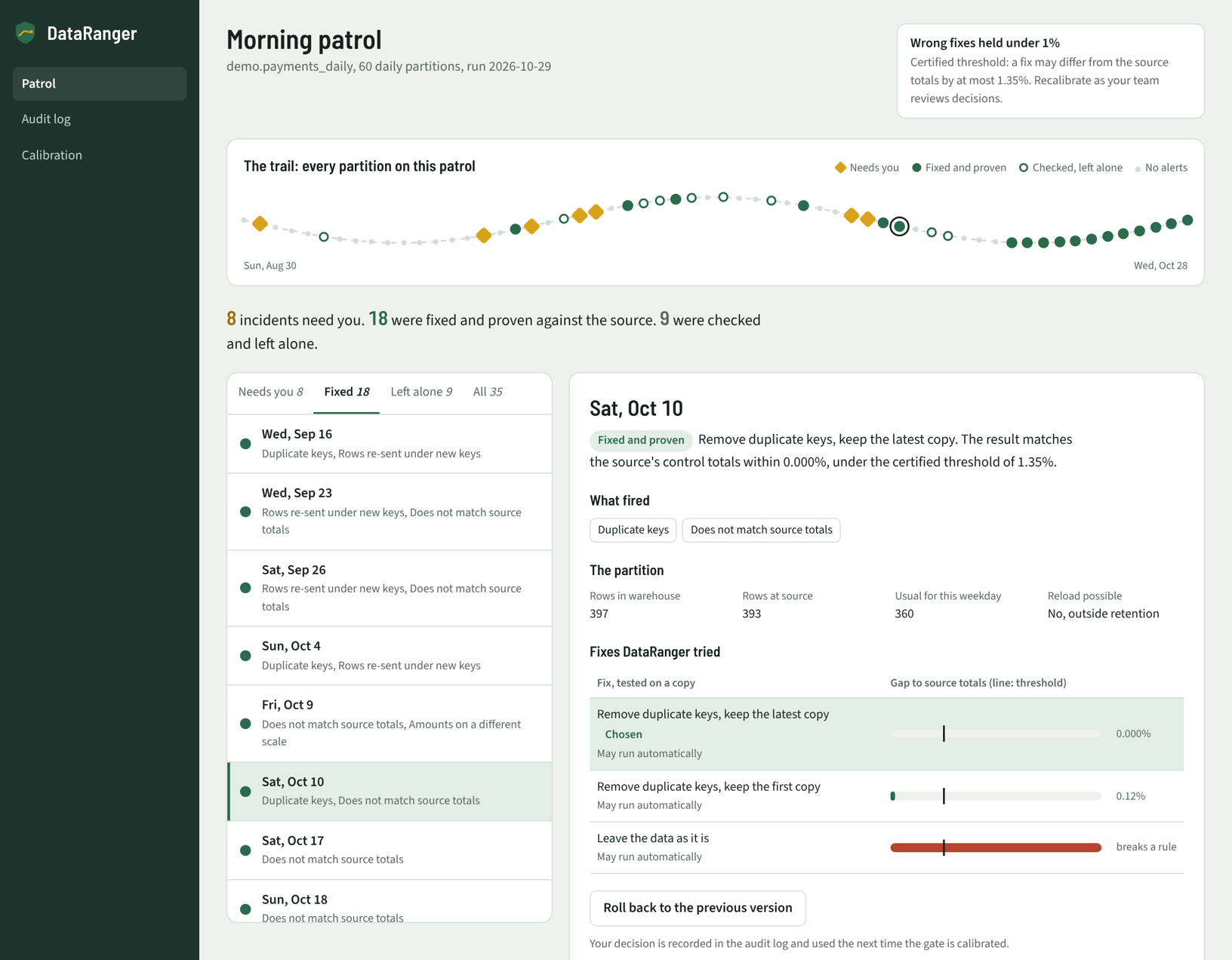
- The trail across the top shows every daily partition on the patrol. Yellow diamonds need you, solid green markers were fixed and proven against the source, hollow ones were checked and left alone.
- The queue lists incidents by what they need from you.
- The evidence view shows what fired, the partition next to its source totals, and every fix DataRanger tested on a copy, with its gap to the source against the certified threshold. Above, two copies of re-sent rows disagree: keeping the first copy would leave a 0.12% gap, so DataRanger kept the latest copy, which matches exactly.
- Decisions (approve, reject, roll back, reopen) are recorded in the audit log and feed the next calibration.
Try it
pip install dataranger
dataranger demo                 # patrol a sample table with planted problems; opens as dataranger-demo/dashboard.html
On your own DuckDB tables (a fact table partitioned by date, a reference table, and the source's control totals):
dataranger patrol --db warehouse.duckdb --table payments --ref-table customers \
    --manifest-table control_totals --key payment_id --reference customer_id \
    --date booking_date --segment channel --amount amount
The control-totals table has one row per date and segment, plus a row with segment * for the whole day, with columns n (rows) and amount (sum). DataRanger never modifies your tables: fixed partitions go to fixed_version.csv, every decision and its evidence to audit.jsonl, and the morning report to dashboard.html.
The default threshold was calibrated on the DQ-Repair benchmark for a 1% target. Once people have reviewed some of DataRanger's decisions, calibrate on your own data:
dataranger calibrate --audit report/audit.jsonl --labels reviewed.csv --alpha 0.01
reviewed.csv has columns partition and verdict (right or wrong). About 300 reviewed incidents certify a 1% target and about 60 certify 5%.
DQ-Repair benchmark
DQ-Repair measures how many data-quality issues an agent can fix safely. This branch adds the benchmark data and the detection stage.
Synthetic cases. A transactions table and a customer dimension, generated per seed in three sizes (about 24k, 120k and 480k rows over 60 days). Each case keeps the source of record and a dirty warehouse copy with known issues and the correct fix for each:
| Type | What happens | Correct response |
|---|---|---|
| Duplicates | A retried load appends 1 to 8% of a partition again | Dedupe on txn_id |
| Late partition | A day's file arrives after the job ran | Reload the partition |
| Schema drift | Upstream renames channel to payment_channel |
Remap, after review |
| Broken references | A bad key mapping points rows at missing customers | Quarantine, escalate |
| Unit or scale | One channel starts sending cents | Rescale by 0.01 |
| Silent drop | A join change quietly drops one slice of a day | Reload the partition |
| Decoys | A promotion day or a big-ticket travel day, real in the source | Do nothing |
Real datasets. Hospital, Flights and Beers, the standard cell-level cleaning datasets with known clean versions, downloaded on first use from the Raha repository at a pinned commit.
Detection so far (deterministic, no LLM, results/detection.json):
- Synthetic, 5 seeds per size: the statistical monitors find every structural error, 60 to 100% of silent drops, and none of the partial-late partitions. Every decoy is flagged too, which is the point: detection cannot tell a real spike from an error, so the later stages must.
- Hospital: F1 0.83. Beers: F1 0.98. Flights: F1 0.10 with no configuration, 0.50 when told the entity key (
flight).
pip install -e .
dataranger bench --size small --seed 1        # one synthetic case
python benchmarks/run_detection.py            # all sizes and the real datasets
Repair with a calibrated gate
The loop proposes template fixes for each incident, checks every candidate against the source's control totals and the declared invariants (unique keys, valid references), and applies the best-supported fix only if its residual clears a threshold chosen by Learn-then-Test. Fixes that delete data or change meaning always escalate. The source publishes control totals per partition and channel; 15% of them are stale by up to 1%, so even a correct fix can leave a small residual.
250 instances (150 small, 100 medium), 6,600 incidents, 100 random calibration and test splits by instance, delta = 0.05. Silent harm is the share of incidents that end with a wrong fix applied. All numbers are in results/repair_summary.json.
| Policy | Auto-applied | Silent harm | Real errors fixed |
|---|---|---|---|
| Rules: default fix for every alert | 66.6% | 31.1% | 49.3% |
| Agent checked by the monitors | 58.2% | 23.8% | 49.7% |
| Verified, calibrated for alpha = 1% | 58.6% | 0.56% | 56.4% |
| Verified, calibrated for alpha = 2% | 69.4% | 1.42% | 59.0% |
| Verified, calibrated for alpha = 5% | 79.3% | 3.91% | 61.1% |
- The bound holds. Test harm exceeded alpha in 1 to 5% of splits, within delta = 5%, for both evidence granularities.
- Versioned duplicates. Rules and the monitor-checked agent kept the pre-settlement copy in 500 and 498 of 500 such incidents; the gate picked the settled copy by its match to the control totals.
- Hand-picked thresholds do not travel. A threshold of 0.01 is safe with per-channel totals but breaks a 1% target in every split when only partition totals exist; calibration moves the threshold to 0.003 on its own.
- Exchangeability matters. Calibrated without any partial-late incidents, the gate then wrongly applies "no action" to 67% of them. New incident types need recalibration, which is what epoch recalibration with repair memory is for.
- Source-aware detection. The statistical monitors miss every partial-late partition; a reconciliation check against the control totals catches all of them.
python benchmarks/run_repair.py 150 100       # about 6 minutes on two cores
python benchmarks/analyze_repair.py
Language models as proposers
Qwen2.5 7B and 14B, served by Ollama on free GitHub Actions runners (.github/workflows/llm.yml, triggered by pushing to the llm-run branch; responses are committed to llm-results), proposed one fix per incident. At a 5% target:
| Model | Policy | Automated | Harm | Real errors fixed |
|---|---|---|---|---|
| 7B | Apply the model's fix | 93.4% | 42.4% | 23.6% |
| 7B | Apply it if the monitors go quiet | 66.5% | 29.4% | 23.3% |
| 7B | Apply it if its own gap to the totals is under 0.5% | 33.6% | 5.58% | 20.8% |
| 7B | Through the gate | 27.2% | 3.19% | 20.4% |
| 7B | Gate over model + templates | 79.3% | 3.17% | 63.4% |
| 14B | Apply the model's fix | 92.8% | 35.5% | 40.1% |
| 14B | Apply it if its own gap to the totals is under 0.5% | 39.5% | 5.22% | 33.8% |
| 14B | Through the gate | 32.3% | 2.43% | 31.9% |
The models' fixes were right for 51% (7B) and 57% (14B) of incidents. An agent that checks its own fix against the control totals is not enough: with a 0.5% tolerance it still breaks a 5% target, while the same tolerance is safe for the pooled candidates. The safe tolerance depends on the proposer, which is what calibration measures. python benchmarks/eval_llm.py <runs/<id>/llm> reproduces the table.
TPC-DS
The same loop on a benchmark we did not design: TPC-DS store_sales at scale factor 1 (DuckDB's dsdgen), store as the segment for control totals, item category as the category, net paid as the amount. Thirty 60-day windows, three injections each: 4,299 incidents, 58% of them false alarms from TPC-DS's seasonal volume. Splits are by window.
| Policy | Automated | Silent harm | Real errors fixed |
|---|---|---|---|
| Rules: default fix per alert | 82.8% | 63.4% | 44.0% |
| Fix must quiet the monitors | 40.1% | 31.6% | 22.2% |
| Calibrated on TPC-DS, alpha = 1% | 77.6% | 0.59% | 55.8% |
| Calibrated on TPC-DS, alpha = 5% | 90.7% | 3.74% | 61.6% |
| Calibrated on DQ-Repair, applied to TPC-DS, alpha = 1% | 75.8% | 0.47% | 54.9% |
pip install -e ".[bench]"                      # includes the DuckDB tpcds extension
python benchmarks/run_tpcds.py 1 3             # about 6 minutes on two cores
python benchmarks/analyze_tpcds.py
How strong is the guarantee?
Learn-then-Test assumes independent incidents, and incidents of one table share its manifest. benchmarks/analyze_guarantee.py measures it: the intraclass correlation of the loss within an instance is about 0.005 (design effect at most 1.16). calibrate_clusters makes the table the unit instead, which needs no independence inside a table; it certifies 5% and 10% targets from 125 tables, and needs about 300 tables for 1%.
Larger tables
On 40 large instances (about 480k rows each, 1,069 incidents), a threshold calibrated on small and medium tables gave 0.75%, 1.87% and 5.24% harm at targets of 1, 2 and 5%: close to target and just above it at 5%, since relative gaps shrink as partitions grow. Calibrating separately for "no action" decisions and for repairs (calibrate_groups) transferred with margin: 0.28%, 1.59% and 4.40%.
Repair memory under drift
benchmarks/run_stream.py simulates a year: five data estates of ten tables each, a new incident type (partial-late partitions) from month 5, and staler control totals from month 9. At a 2% target:
| Policy | Silent harm | Automated | Months over target |
|---|---|---|---|
| Calibrated once | 3.05% | 75.4% | 60% |
| Recalibrated monthly | 1.30% | 62.4% | 18% |
| Monthly + repair memory | 0.39% | 55.0% | 7% (all in month 5) |
Memory (dataranger.repair.memory) escalates unfamiliar incident signatures, blocks signatures whose fixes went wrong, and recalibrates on what it would have done. It recovered from the new incident type within a month (harm on partial-late incidents 32% in month 5, 5% in month 6). The price is automation: when the world changes, staying inside the promise means asking people more often.
Sensitivity and cost
benchmarks/ablations.py (results in results/ablations.json):
- Labels needed. A 5% target is certifiable from about 130 labeled incidents (66% automated); a 1% target needs about 300 before anything is automated, then reaches 50% at about 530 and 59% at 3,300.
- Stale control totals. At a 1% target, automation falls from 71% with exact totals to 29% when half of them are stale; harm stays under target.
- Without invariant checks the calibration refuses to certify any threshold and automation collapses to about 0%: the gate fails safe.
- Cost. A full patrol takes 2.7 s, 4.1 s and 10.1 s on one CPU core for 23k, 117k and 470k-row tables.
Real datasets: Hospital, Flights, Beers
No source of record here, so the evidence comes from the table itself (agreeing dependencies, normalization rules). Half the rows are labels: a quarter fits an evidence score and a quarter certifies the threshold. Compared on held-out rows with Baran (20 labeled tuples, Raha detection) and conformal data cleaning (reimplemented, trained on clean rows):
| Data | Method | Errors fixed | Precision | Wrong per 1k cells |
|---|---|---|---|---|
| Hospital | Baran | 55.0% | 93.5% | 0.96 |
| Hospital | Conformal cleaning | 85.0% | 64.7% | 11.80 |
| Hospital | DataRanger, alpha 5% | 62.8% | 98.2% | 0.37 |
| Flights | Baran | 51.2% | 81.7% | 34.37 |
| Flights | Conformal cleaning | 51.6% | 94.6% | 8.83 |
| Flights | DataRanger, alpha 5% | 25.0% | 95.3% | 3.67 |
| Beers | Baran | 89.2% | 94.0% | 9.46 |
| Beers | Conformal cleaning | 64.9% | 60.2% | 70.40 |
| Beers | DataRanger, alpha 1% | 85.0% | 100.0% | 0.02 |
The target held in every split. Baran's corrections are in results/baran/; benchmarks/run_baran.py reproduces them (it needs pip install raha).
Reproducing the paper
pip install -e ".[bench]"
./reproduce.sh          # every analysis from the committed incident records
./reproduce.sh full     # regenerate the records too
Seeds are fixed, so the numbers come out the same. The LLM proposals (from the Actions workflow) and Baran's corrections (needs raha) are scored from their saved outputs.
Citing
See CITATION.cff. Archived on Zenodo: 10.5281/zenodo.23769536.
License
MIT
1 maintainer

Metadata
1 maintainer
Release files for dataranger 0.2.0
For a detailed explanation of source distributions (sdists) and built distributions (wheels), please see the package formats documentation.
Source distribution (sdist)
| File | Size | Uploaded | Provenance | Actions |
|---|---|---|---|---|
| dataranger-0.2.0.tar.gz | 4.6 MB | With provenance | Details for dataranger-0.2.0.tar.gz |
Built distribution (wheel)
| File | Interpreter | ABI | Platform | Actions Reset |
|---|---|---|---|---|
| dataranger-0.2.0-py3-none-any.whl | Python 3 | none | any | Details for dataranger-0.2.0-py3-none-any.whl |
Total release size: 4.6 MB
Release files / dataranger-0.2.0.tar.gz
| Download URL | dataranger-0.2.0.tar.gz |
|---|---|
| Size | 4.6 MB |
| Tags | Source |
|
SHA-256 checksum How to use checksums |
b7a3d56e9dccaf67a97099533eba5613d6aac6e34f287b905f7c0cc82f4d298e
|
|
BLAKE2b-256 checksum How to use checksums |
ad5591170ca6c267ff15297dfe2193b14e5b3eb2b969a8ae6773019c4d8e0012
|
| Upload date | |
|
Uploaded using Trusted Publishing? What is trusted publishing? |
Yes |
| Uploaded via |
twine/7.0.0 CPython/3.13.16
|
Provenance
Provenance describes where a file came from. On PyPI, provenance is shared via attestations, which provide a verifiable record of the build or publishing details. View details, limitations and caveats.


PyPI Publish Attestation
PyPI verified that this artifact, at this checksum, originated from the publisher listed below.
Signed by GitHub Actions, verified by PyPI on Oct 29, 2026.
Transparency logRelease files / dataranger-0.2.0-py3-none-any.whl
| Download URL | dataranger-0.2.0-py3-none-any.whl |
|---|---|
| Size | 51.0 kB |
| Tags | Python 3 |
|
SHA-256 checksum How to use checksums |
577244203c851ef1672c3b89956977ec6129e9fa9186c760caa30502d744e819
|
|
BLAKE2b-256 checksum How to use checksums |
90c201736291a5200d99fd2453fa1502c990e611094b07884a1af022f4479089
|
| Upload date | |
|
Uploaded using Trusted Publishing? What is trusted publishing? |
Yes |
| Uploaded via |
twine/7.0.0 CPython/3.13.16
|
Provenance
Provenance describes where a file came from. On PyPI, provenance is shared via attestations, which provide a verifiable record of the build or publishing details. View details, limitations and caveats.
PyPI Publish Attestation
PyPI verified that this artifact, at this checksum, originated from the publisher listed below.
Signed by GitHub Actions, verified by PyPI on Oct 29, 2026.
Transparency logSecurity for dataranger 0.2.0
Provenance
Provenance describes where a file came from. On PyPI, provenance is shared via attestations, which provide a verifiable record of the build or publishing details. View details, limitations and caveats.
Full provenance
All 2 files in this release have been uploaded with provenance metadata.
Attestation for dataranger-0.2.0.tar.gz
PyPI Publish Attestation
PyPI verified that this artifact, at this checksum, originated from the publisher listed below.
Signed by GitHub Actions, verified by PyPI on Oct 29, 2026.
Transparency logA note on package security
PyPI is a repository for distributing packages, not a service for auditing them. While third-party security researchers and our staff do their best to detect and remove malicious packages, PyPI cannot guarantee the quality, security or suitability of any given package.
To learn more about protecting yourself from malicious actors, visit our package security documentation.














