
dattri-LLM: A Unified and Efficient Library for Training Data Attribution at LLM Scale





Quick Start | Algorithms, Models and Frameworks | Architecture | API Reference
What is dattri-LLM?
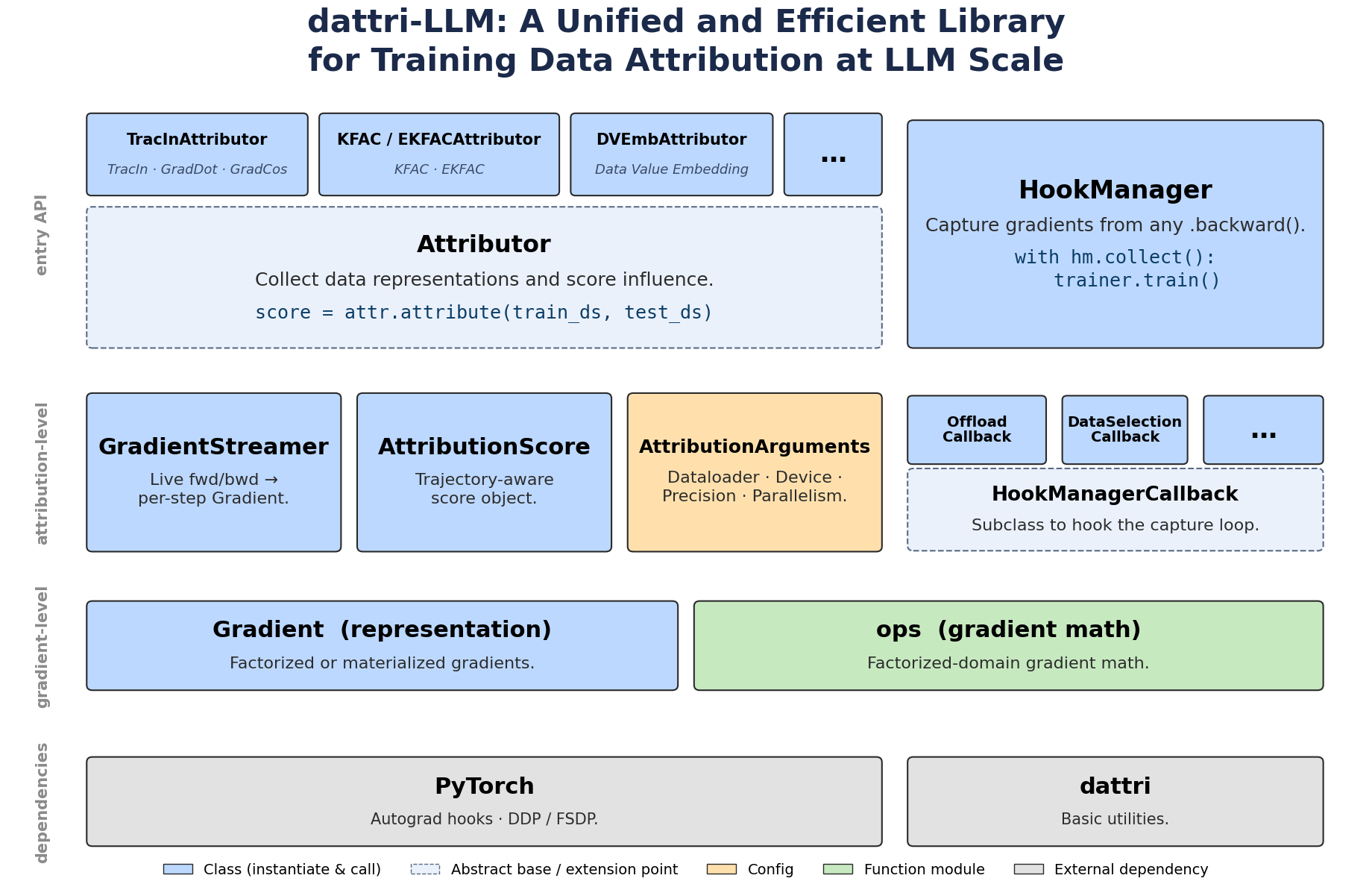
dattri-LLM is a PyTorch library for efficient training data attribution (TDA) at LLM scale. It captures per-example gradients from existing training loops and scores them with gradient-based attribution methods, built around one unified gradient interface:
- Efficiency — gradients are kept in exact factorized or materialized form, and a FLOP-aware cost model routes each operation to the cheaper one.
- Compatibility — autograd hooks capture gradients from any loop that calls
backward(), with no change to the loop, optimizer or trainer. This covers DDP and FSDP, and pipelines built on Hugging Face Transformers, TRL and OLMo. - Extensibility — the
Attributorinterface adds attribution methods over one shared gradient stream, and theHookManagerCallbackinterface adds applications that act during training, such as online data selection.
Key Features
- 🪝 Non-invasive capture — wrap
trainer.train()inHookManager(...).collect()and per-sample gradients are assembled from hooks after every step. - 👻 Factorized per-sample gradients — one batched backward pass yields every sample's gradient as a (activation, output-gradient) pair; "ghost" inner products score them without ever forming the weight gradient when that is cheaper.
- ⚡ On-the-fly or from disk — attribute in one
attribute(...)call with nothing persisted, or offload gradients during training and re-run any attributor over the same cache afterwards, without the model. - 🧩 Pluggable callbacks —
OffloadCallback,KroneckerCovarianceCallback,OptimizerStateCallbackandDataSelectionCallbackextend one capture path. - 🌐 Distributed by default — gradients captured under DDP and FSDP match the single-device reference; each rank writes its own shard and the store merges them.
- 📚 Broad layer coverage — linear, convolution (incl. transposed), embedding
and normalization layers (
LayerNorm,RMSNorm,GroupNorm,InstanceNorm), with optional capture-time random projection.
dattri-LLM is the LLM-scale companion of dattri
and is validated on its benchmark suite for attribution quality (LDS, LOO) and
runtime. See examples/ for runnable scripts.
Contents
- dattri-LLM: A Unified and Efficient Library for Training Data Attribution at LLM Scale
Quick Start
Installation
git clone https://github.com/TRAIS-Lab/dattri-llm
cd dattri-llm
pip install -e .                  # core: torch + tqdm
pip install -e ".[transformers]"  # live attribution (attribute / GradientStreamer), HF Trainer
Python 3.10 or newer. The core install covers gradient capture (HookManager
and its callbacks), the on-disk store, and attribution from a cache
(attribute_from_cache). The live path — every attributor's one-call
attribute(...) and the GradientStreamer behind it — imports
transformers, so install the transformers extra for it. Optional extras:
| extra | installs | needed for |
|---|---|---|
transformers |
transformers, accelerate |
live attribute(...) / GradientStreamer; the Hugging Face Trainer examples |
attribution |
dattri |
dattri's random projectors (capture-time logra / dense projection) and dattri tasks |
trl |
trl |
the TRL SFTTrainer / GRPOTrainer examples |
olmo |
ai2-olmo |
the OLMo Trainer example (examples/trainers/olmo_trainer.py) |
olmo-core |
ai2-olmo-core==2.6.0 |
the OLMo-core runs of experiments/fidelity |
test |
pytest |
running the test suite |
dev |
all of the above except olmo-core, plus the pinned lint tools (ruff, pre-commit) |
development (see CONTRIBUTING.md) |
Extras combine, e.g. pip install -e ".[transformers,attribution]".
1. Attribution from disk offloading
Wrap any training loop to offload per-sample gradients to disk — the loop itself is untouched:
from dattri_llm import (
    REGISTER_ALL, GradientStorageManager, HookManager, HookManagerConfig, OffloadCallback,
)

fm = GradientStorageManager("./train_grads")
hm = HookManager(
    model,
    config=HookManagerConfig(linear_io=REGISTER_ALL),  # factorized hooks on all eligible layers
    callbacks=[OffloadCallback(offload_interval=1, file_manager=fm,
                               recording_type="per_sample")],
)
with hm.collect():
    trainer.train()          # any loop that calls .backward()
hm.remove()
Then attribute from the cache — no model or backward pass needed, and different attributors or settings re-run over the same cache for free:
from dattri_llm import AttributionArguments, TracInAttributor

args = AttributionArguments(output_dir="./scores")
score = TracInAttributor(args).attribute_from_cache("./train_grads", "./test_grads")
train_ids, matrix = score.agnostic_matrix()   # (num_train, num_test)
2. Attribution on-the-fly
Describe the target with an AttributionTask — a (model, batch) -> loss
function evaluated on the live model, plus the checkpoints to score at; the
attributor streams gradients live and scores them, nothing is written to disk
(needs the transformers extra):
from dattri_llm import AttributionArguments, AttributionTask, TracInAttributor

def loss_fn(model, batch):
    return model(**batch).loss

task = AttributionTask(loss_func=loss_fn, model=model)  # or checkpoints=[ckpt_a, ckpt_b]
attributor = TracInAttributor(AttributionArguments(output_dir="./out"), task=task)
score = attributor.attribute(train_dataset, test_dataset)
Scores are keyed by content hash, so a sample can also be looked up by identity:
score.query(train_hashes, test_hashes).
Because the loss calls the model itself, the same task runs through a DDP or
FSDP wrapper; pass the wrapped model as model.
See examples/ for complete runnable scripts, including multi-GPU
collection, online data selection, and one script per attribution method
(examples/attribution/method_tour.py).
3. Hugging Face norm layers (Llama / Qwen RMSNorm)
Layer hyperparameters (a norm's eps, a convolution's stride, ...) are read
straight off each hooked module. Hugging Face's LlamaRMSNorm (also used by
Qwen and other families) is its own class and stores its epsilon as
variance_epsilon, so declare what the layer is and pass its hyperparameters
with the builders in dattri_llm.utils.module:
from dattri_llm import HookManager, HookManagerConfig
from dattri_llm.utils.module import rms_norm_module_kwargs

norm = model.model.norm                               # a LlamaRMSNorm
config = HookManagerConfig(
    hook_types={"model.norm": "linear_io"},
    layer_types={"model.norm": "nn.RMSNorm"},         # what the layer is
    module_kwargs={"model.norm": rms_norm_module_kwargs(
        normalized_shape=norm.weight.shape[0], eps=norm.variance_epsilon,
    )},
)
hm = HookManager(model, config=config, callbacks=[...])
layer_types only relabels a layer; it does not select it for hooking.
Norm layers take the "dense" or "mask" projection styles, not "logra".
The full recipe, including a check against autograd, is in
examples/projection/.
4. Factorized versus materialized routing
A captured per-sample gradient is kept either factorized (a layer's input
activations and output gradients) or materialized (the dense per-sample
weight gradient). For a layer with input width D, output width K and S
tokens per sample, inner products route by flop count:
- Scoring.
dattri_llm.gradient.ops.maybe_use_materialized_gram(B1, B2, S, K, D)picks materialize-then-GEMM whenB1·B2·S²·(D+K) ≥ (B1+B2)·S·D·K + B1·B2·D·K, andmaybe_use_materialized_norm(S, K, D)materializes per-sample norms whenS ≥ DK/(D+K). The inner-product ops (ops.dot,ops.pairwise_dot,ops.cross_dot,Gradient.similarity, ...) takemode="auto"(the rule),"factorized"or"materialized"; every mode is exact, only the cost differs. - Capture.
HookManagerConfig(capture_style=...)chooses what the backward hook buffers:"factorized"(default) keeps the factors,"materialized"contracts them at once, and"auto"applies the rule ofops.should_materializeper layer and micro-batch.
experiments/benchmark/routing.py compares
the cost model with each route pinned for every layer (pin_route in
experiments/benchmark/utils/adapters/run_ours.py).
Algorithms, Models and Frameworks
Algorithms
| Family | Attributor | Notes | Paper |
|---|---|---|---|
| Grad-Dot / Grad-Cos | TracInAttributor |
single checkpoint; cosine via normalized_grad=True |
Charpiat et al., 2019 |
| TracIn | TracInAttributor |
checkpoint ensemble along the training trajectory | Pruthi et al., 2020 |
| K-FAC influence | KFACAttributor |
Kronecker-factored inverse-Fisher preconditioning, fit from the training gradients | Martens & Grosse, 2015 |
| EK-FAC influence | EKFACAttributor |
Kronecker eigenbasis with empirical eigenvalues | George et al., 2018; Grosse et al., 2023 |
| DVEmb | DVEmbAttributor |
trajectory-aware data value embeddings with GGN/Fisher propagation | Wang et al., 2024 |
| LESS | LESSAttributor |
cosine between a query's gradient and a sample's Adam update direction, summed over checkpoints with the learning rate as weight | Xia et al., 2024 |
| AdamW-influence | AdamWInfluenceAttributor |
first-order influence unrolled through the AdamW trajectory from the recorded optimizer moments; every coordinate or a random mask per layer | Deng et al., 2026 |
| Online data selection | DataSelectionCallback |
gradient-alignment scoring + sample dropping inside the training step | — |
All attributors consume the same GradientSource contract (per-step
(step, Gradient, hashes) blocks), read either from disk or computed live, so new
methods plug into the same capture/storage/streaming infrastructure.
Capture requirements
Each method's live attribute(...) sets up this capture itself. When you capture
from your own training loop and score with attribute_from_cache(...), record what
the method reads. All callbacks below are importable from dattri_llm.
| Attributor | Train-side gradients | Also recorded |
|---|---|---|
TracInAttributor |
raw | — |
KFACAttributor, EKFACAttributor |
raw | Kronecker covariances: a fit pass over the store, or KroneckerCovarianceCallback at capture, passed as fit(covariances=...) |
LESSAttributor |
preconditioned, captured with HookManager(optimizer=...); queries are raw |
the learning rate per step (trajectory form), or the optimizer state per checkpoint (frozen form, optimizers=) |
AdamWInfluenceAttributor |
raw, per step; or parameter snapshots (ParameterSnapshotCallback) to recompute them |
the moments before and after every update: OptimizerStateCallback, with record_post(step) called after each optimizer.step(); pass callback.dynamics() as dynamics= |
DVEmbAttributor |
raw, per step; or parameter snapshots | the learning-rate schedule, passed as learning_rate= |
Preconditioned capture needs exact gradient entries: it takes no projection, a
"mask" or a "dense" projection (applied after the map), but not the "logra"
factor projection, and it rejects param_grad layers. Without a mask, each
hooked layer's per-sample gradient is materialized before the map.
Models and Frameworks
Models — Our hook-based implementation is compatible with any nn.Module, enabling support for a broad range of LLM architectures, including the GPT-2, Llama, Qwen, and Gemma families.
Frameworks — Our library integrates directly with a variety of training frameworks, including but not limited to
Transformers,
TRL, and
OLMo.
See examples/trainers for detailed examples.
Efficiency
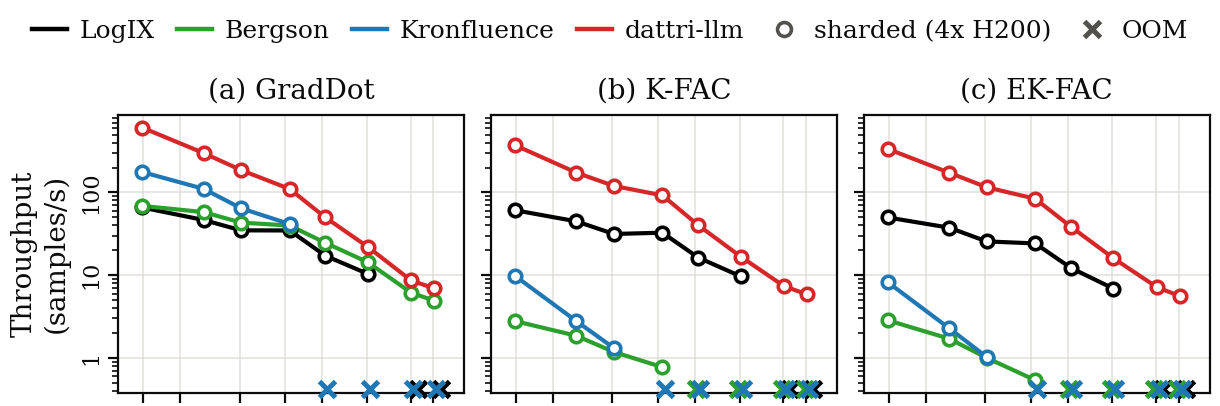
Efficiency benchmark results of dattri-LLM against Bergson, Kronfluence and LogIX on 0.5B to 110B models under an equal workload. See the paper and experiments/benchmark for the full results.
Architecture
The library is organized in three layers:
dattri_llm/
├── utils/         # content hashing (sample identity), distributed helpers
├── gradient/      # Gradient data model, factorized ops, hooks, callbacks,
│                  # on-disk store, streaming sources
└── attribution/   # attributor interface, arguments, scores, algorithms
utils/— generic helpers: content hashing that gives every sample a position- and shuffling-independent identity, and guardedtorch.distributedutilities.gradient/— the gradient system: theGradientdata model (factorized or materialized), the math on factorized gradients, theHookManagerand its callbacks for capture, the on-disk gradient store, and the streaming sources attributors read from.attribution/— the TDA methods: the attributor interface,AttributionArguments, theAttributionScoreresult container, and one module per algorithm.
API Reference
docs/API.md indexes the public API: what dattri_llm exports
at the top level and what each subpackage (dattri_llm.gradient,
dattri_llm.gradient.ops, dattri_llm.attribution, dattri_llm.utils)
provides, and the Literal option types in dattri_llm.options. The package
ships a py.typed marker, so type checkers read its inline annotations.
Extension bases are exported too: TrajectoryAttributor (the trajectory
methods' base), ReplayGradientSource and TrajectorySnapshots. Every public class and function carries a docstring; use
help(dattri_llm.TracInAttributor) and the like for signatures.
Citation
If you use dattri-LLM in your research, please cite the paper:
@article{liu2026dattrillm,
  title   = {dattri-LLM: A Unified and Efficient Library for Training Data Attribution at LLM Scale},
  author  = {Liu, Shixuan and Zhou, Tongli and Deng, Junwei and Hu, Pingbang and Ma, Jiaqi W.},
  journal = {arXiv preprint arXiv:2609.38767},
  year    = {2026}
}
Contributing
See CONTRIBUTING.md for the development setup, the lint and test commands CI runs, and the pull-request conventions.
Related Projects
dattri— general-purpose data attribution library and benchmark suite from the same group;dattri-llmtargets LLM-scale models and training-framework integration.
License
dattri-llm is released under the MIT License.
1 maintainer

Metadata
1 maintainer
Release files for dattri-llm 0.1.0
For a detailed explanation of source distributions (sdists) and built distributions (wheels), please see the package formats documentation.
Source distribution (sdist)
| File | Size | Uploaded | |
|---|---|---|---|
| dattri_llm-0.1.0.tar.gz | 274.7 kB | Details |
Built distribution (wheel)
| File | Interpreter | ABI | Platform | Reset |
|---|---|---|---|---|
| dattri_llm-0.1.0-py3-none-any.whl | Python 3 | none | any | Details |
Total release size: 568.8 kB
Release files / dattri_llm-0.1.0.tar.gz
| Download URL | dattri_llm-0.1.0.tar.gz |
|---|---|
| Size | 274.7 kB |
| Tags | Source |
|
SHA-256 checksum How to use checksums |
0c47abafeb1eeebb957183dc5cc312ed37d64a5d7e64e7d1dfff7a6f787a9ebc
|
|
BLAKE2b-256 checksum How to use checksums |
4a5e37cdeb9324d331cd712728cb1eff2b8483988e1da0d2e9ddb3f32dd9a61f
|
| Upload date | |
|
Uploaded using Trusted Publishing? What is trusted publishing? |
No |
| Uploaded via |
twine/7.0.0 CPython/3.10.9
|
Release files / dattri_llm-0.1.0-py3-none-any.whl
| Download URL | dattri_llm-0.1.0-py3-none-any.whl |
|---|---|
| Size | 294.2 kB |
| Tags | Python 3 |
|
SHA-256 checksum How to use checksums |
a0f0936f36f23322ef15388738de0cfa27f83279a14374732a894930f6d9da6b
|
|
BLAKE2b-256 checksum How to use checksums |
7ee6f507ef75965533ad633c0176a1d2a73635b42896f59eb7b62550b8aad4f0
|
| Upload date | |
|
Uploaded using Trusted Publishing? What is trusted publishing? |
No |
| Uploaded via |
twine/7.0.0 CPython/3.10.9
|













