

Build and maintain all of your metric logic in code.






Welcome to MetricFlow
See our latest updates in the Metricflow Changelog!
MetricFlow is a semantic layer that makes it easy to organize metric definitions. It takes those definitions and generates legible and reusable SQL. This makes it easy to get consistent metrics output broken down by attributes (dimensions) of interest.
The name comes from the approach taken to generate metrics. A query is compiled into a query plan (represented below) called a dataflow that constructs metrics. The plan is then optimized and rendered to engine-specific SQL.
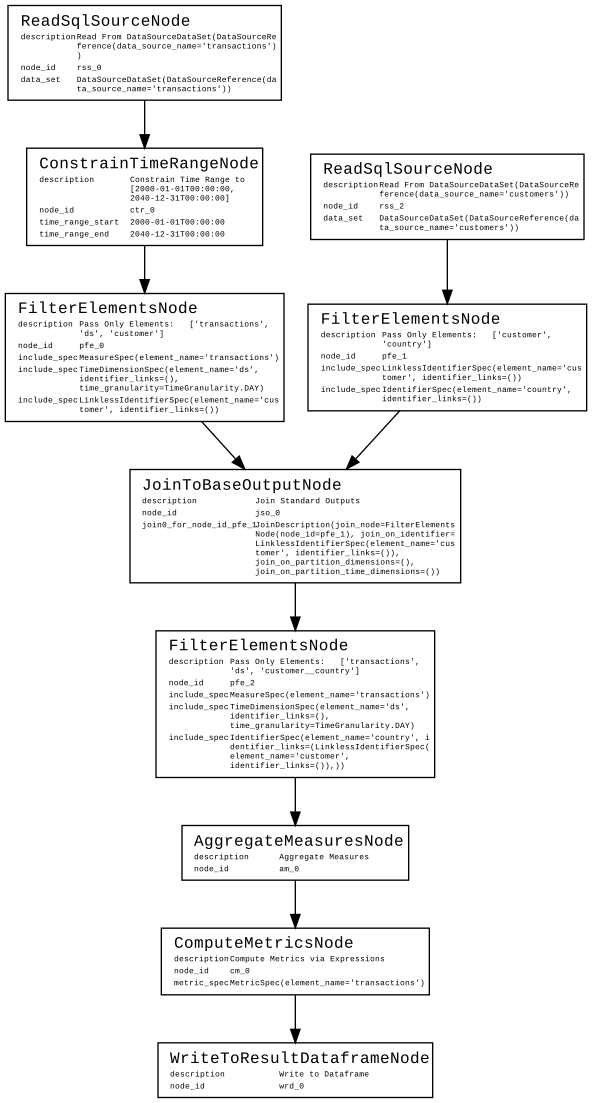
MetricFlow provides a set of abstractions that help you construct complicated logic and dynamically generate queries to handle:
- Multi-hop joins between fact and dimension sources
- Complex metric types such as ratio, expression, and cumulative
- Metric aggregation to different time granularities
- And so much more
As a developer, you can also use MetricFlow's interfaces to construct APIs for integrations to bring metrics into downstream tools in your data stack.
To get up and running with your own metrics, you should rely on MetricFlow’s documentation available at MetricFlow docs.
Getting Started
Install MetricFlow
MetricFlow can be installed from PyPi for use as a Python library with the following command:
pip install metricflow
Once installed, MetricFlow can be setup and connected to a data warehouse by following the instructions after issuing the command:
mf setup
In case you don't have a connection to a data warehouse available and want a self-contained demo, DuckDB can be selected.
You may need to install Postgres or Graphviz. You can do so by following the install instructions for Postgres or Graphviz. Mac users may prefer to use brew: brew install postgresql or brew install graphviz.
Tutorial
The best way to get started is to follow the tutorial steps:
mf tutorial
There are several examples of MetricFlow configs on common data sets in the config-templates folder. The tutorial will rely on a small set of sample configs.
Resources
Contributing and Code of Conduct
This project will be a place where people can easily contribute high-quality updates in a supportive environment.
You might wish to read our code of conduct and engineering practices before diving in.
To get started on direct contributions, head on over to our contributor guide.
License
MetricFlow is open source software. The project relies on several licenses including AGPL-3.0-or-later and Apache (specified at folder level).
MetricFlow is built by Transform.
1 maintainer

Metadata
1 maintainer
Release files for datus-metricflow 0.2.8
For a detailed explanation of source distributions (sdists) and built distributions (wheels), please see the package formats documentation.
Source distribution (sdist)
| File | Size | Uploaded | Provenance | Actions |
|---|---|---|---|---|
| datus_metricflow-0.2.8.tar.gz | 870.4 kB | Without provenance | Details for datus_metricflow-0.2.8.tar.gz |
Built distribution (wheel)
| File | Interpreter | ABI | Platform | Actions Reset |
|---|---|---|---|---|
| datus_metricflow-0.2.8-py3-none-any.whl | Python 3 | none | any | Details for datus_metricflow-0.2.8-py3-none-any.whl |
Total release size: 2.7 MB
Release files / datus_metricflow-0.2.8.tar.gz
| Download URL | datus_metricflow-0.2.8.tar.gz |
|---|---|
| Size | 870.4 kB |
| Tags | Source |
|
SHA-256 checksum How to use checksums |
3dbbfe49a2110c8aa04a27ce7b2a93e88127f1e6e04664f8dfa2420244e72867
|
|
BLAKE2b-256 checksum How to use checksums |
739fd62804c613565381fb6134d0bb1983bf5a112b79f2def20220955f9853ce
|
| Upload date | |
|
Uploaded using Trusted Publishing? What is trusted publishing? |
No |
| Uploaded via |
twine/7.0.0 CPython/3.12.13
|
Release files / datus_metricflow-0.2.8-py3-none-any.whl
| Download URL | datus_metricflow-0.2.8-py3-none-any.whl |
|---|---|
| Size | 1.8 MB |
| Tags | Python 3 |
|
SHA-256 checksum How to use checksums |
6e14627e4e41bd0a7076cbcdb5327f654bd2c146483d594ea545e42e7e319dcb
|
|
BLAKE2b-256 checksum How to use checksums |
9215cd1ef778879b744ee0dc93edb0d186a72270b1188a47505185de2e9f7c97
|
| Upload date | |
|
Uploaded using Trusted Publishing? What is trusted publishing? |
No |
| Uploaded via |
twine/7.0.0 CPython/3.12.13
|
Security for datus-metricflow 0.2.8
Provenance
Provenance describes where a file came from. On PyPI, provenance is shared via attestations, which provide a verifiable record of the build or publishing details. View details, limitations and caveats.
No provenance found
None of the files in this release were uploaded with provenance metadata.
A note on package security
PyPI is a repository for distributing packages, not a service for auditing them. While third-party security researchers and our staff do their best to detect and remove malicious packages, PyPI cannot guarantee the quality, security or suitability of any given package.
To learn more about protecting yourself from malicious actors, visit our package security documentation.














