
dbckit





dbckit is a Python library for working with DBC (CAN database) files.
Use it to:
- load and inspect DBC files
- decode CAN payloads into physical signal values — integers, floats, and doubles
- encode signal values back into CAN payloads
- validate DBC content
- apply deterministic edits and write the result back out
- diff, merge, extract, and search databases
- decode CAN log files (
.ascbuilt in, extensible readers) and in-memory frame streams
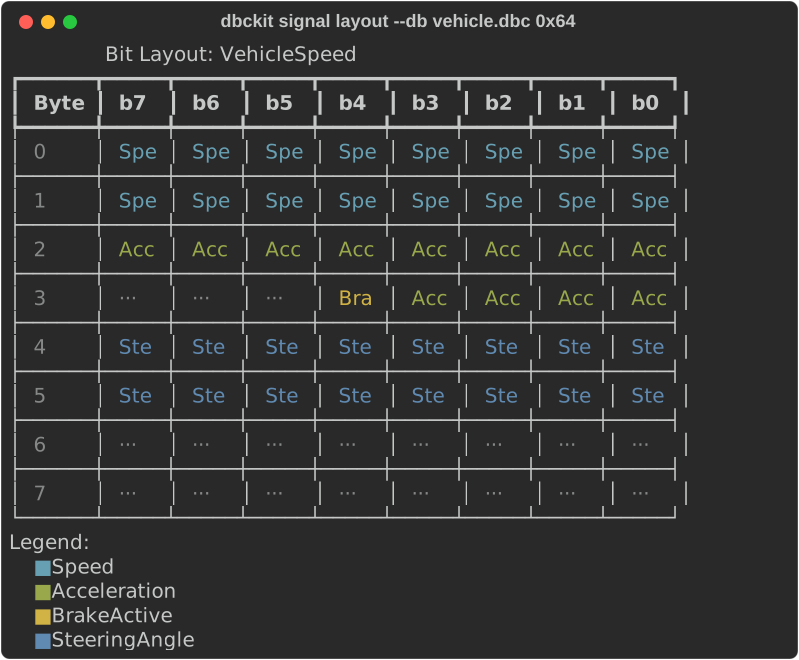
Output of dbckit signal layout — per-signal colored bit grid of a message.
Install
pip install dbckit
pip install "dbckit[cli]"   # adds the dbckit command-line tool
Requires Python >=3.11.
Design
dbckit is built around typed data models with database-bound Views:
Databaseis for navigation, top-level creation, cross-database operations, and persistence.MessageView,SignalView, andNodeView(returned bydb.message(),msg.signal(),db.node()) are the normal way to modify or delete existing entities.- Edit operations are copy-on-write: they return a new
Databaseand never mutate the original.
Quick Start
import dbckit

db = dbckit.load("vehicle.dbc")

# inspect
print(db.version, len(db.messages))

msg = db.message(0x1F4)
sig = msg.signal("EngineSpeed")
print(sig.start_bit, sig.length, sig.factor, sig.unit)

# decode / encode a frame payload
values = msg.decode(bytes([0xE8, 0x03, 0, 0, 0, 0, 0, 0]))
raw = msg.encode({"EngineSpeed": 825.0, "EngineTemp": 90.0})

# validate
for issue in dbckit.validate(db):
    print(issue.severity, issue.code, issue.location)

# edits return a new Database
db2 = sig.update(factor=0.5)
db3 = db2.message(0x1F4).rename("MotorData")
db4 = db3.node("ECU1").rename("EngineECU")

db4.save("vehicle.updated.dbc")
Features
Parse and I/O
dbckit.load() / dbckit.save() for files, dbckit.parse() / dbckit.dump()
for strings. Loading tries strict UTF-8 first and falls back to cp1252 (common
in Vector-exported files); pass encoding= to either function to force one:
db = dbckit.load("vehicle.dbc", encoding="latin-1")
dbckit.save(db, "copy.dbc", encoding="utf-8")
For bounded unsupported constructs, on_unsupported="skip" returns the
parseable model with structured diagnostics and decode-safety rollups; see the
API reference.
Codec
Message-level decode_frame() / encode_frame() and signal-level
decode_signal() / encode_signal(). Both integer signals and IEEE-754
float/double signals (SIG_VALTYPE_) are supported, in Intel and Motorola
byte order. Encoding clamps out-of-range values by default; pass strict=True
to raise ValueError instead. Unspecified signals are zero-filled.
Simple DBC multiplexing (one M selector, mX variants) is fully supported
for decode, encode, and validation. Extended/nested multiplexing (m0M) is
unsupported and rejected during parsing with a clear error.
Editing
Views cover renames, field updates, signal add/delete, sender and receiver
edits, arbitration-ID changes, value-table choices, and attribute values.
Database covers top-level creation and signal groups:
from dbckit import Message, Signal, Node, SignalGroup

db2 = db.add_node(Node(name="Gateway"))
db3 = db2.add_message(Message(arbitration_id=0x400, name="BrakeData", length=8))
db4 = db3.message(0x400).add_signal(Signal(name="BrakePressure", start_bit=0, length=16))
db5 = db4.message(0x400).set_attribute("GenMsgCycleTime", 20)
db6 = db5.add_signal_group(SignalGroup(name="BrakeGroup", message_id=0x400, repetitions=1))
db7 = db6.add_signal_to_group(0x400, "BrakeGroup", "BrakePressure")
db7.save("vehicle.updated.dbc")
Validation
dbckit.validate(db) returns structured issues (severity, code, location,
message) covering duplicate/invalid IDs, signal overlap and overflow,
multiplexing problems, missing senders/receivers, and attribute violations.
The full issue-code list is in the API reference.
Operations
result = dbckit.diff(db_a, db_b)
merged = dbckit.merge(db_a, db_b, strategy="ours")   # raise | ours | theirs

sub = dbckit.extract(db, [0x100, 0x200])
sub = dbckit.extract(db, message_names=["EngineData"], node_names=["Gateway"])

messages = dbckit.search_messages(db, "engine")
pairs = dbckit.search_signals(db, "speed")
J1939 lookup helpers continue to use explicit PGN/SPN attribute values.
For frame resolution, pgn_from_arbitration_id() derives the PGN directly from
a 29-bit ID with PDU1/PDU2 handling:
matches = dbckit.find_messages_by_pgn(db, 61444)
owner, sig = db.signal_by_spn(177)
pgn = dbckit.pgn_from_arbitration_id(0x18F00401)  # 61444
Log and frame decoding
decode_log() streams decoded frames from a log file. Vector CANalyzer .asc
is built in (including extended 29-bit IDs); other formats plug in through
register_reader() or the dbckit.readers entry-point group, and
format= overrides extension-based detection for oddly named files:
for frame in dbckit.decode_log(db, "trace.asc"):
    print(frame.timestamp, hex(frame.arbitration_id), frame.signals)

frames = dbckit.decode_log(db, "capture.txt", format="asc")
decode_frames() does the same for any iterable of frame objects — no file
I/O required. Anything with timestamp, arbitration_id, and data
attributes satisfies the FrameLike protocol, so frames from python-can or
your own tooling decode directly:
decoded = dbckit.decode_frames(db, my_frames)   # Iterator[DecodedFrame]

# Resolve J1939 frames by derived PGN; ambiguous matches are returned explicitly.
decoded = dbckit.decode_frames(db, my_frames, match="j1939")

# Prefer exact IDs, then allow PGN fallback only for a J1939-marked DBC.
decoded = dbckit.decode_frames(db, my_frames, match="auto")
Code generation
header = dbckit.codegen(db, "c")          # experimental
module = dbckit.codegen(db, "python")     # dataclasses with decode()/encode()
doc = dbckit.codegen(db, "markdown")
schema = dbckit.codegen(db, "json-schema")
CLI
The cli extra installs a dbckit command with db, message, signal,
node, attribute, decode, encode, and codegen groups. Output formats
are table, json, and csv.
dbckit db info --db vehicle.dbc
dbckit db validate --db vehicle.dbc
dbckit db diff base.dbc changed.dbc
dbckit message list --db vehicle.dbc
dbckit signal layout --db vehicle.dbc 0x1F4
dbckit decode frame --db vehicle.dbc 0x1F4 "E8 03 00 00 00 00 00 00"
dbckit decode log --db vehicle.dbc trace.asc --match auto
dbckit codegen markdown --db vehicle.dbc --out docs.md
See the CLI reference for every command and option.
Scope and Caveats
- Classic CAN DBC workflows are the supported surface; CAN FD is untested and
FD-specific flags such as
VFrameFormatare not interpreted. .sym,.kcd, and ARXML database formats are out of scope.- J1939 lookup helpers use explicit
PGN/SPNattribute values. Frame-stream matching can derive PGNs from 29-bit IDs withmatch="j1939";match="auto"requires a valid messagePGNor J1939ProtocolTypeattribute marker. - Frame encoding zero-fills unspecified signals and ignores
GenSigStartValue. - Mutation helpers are pure at the
Databaselevel, but the underlying Pydantic models are not frozen objects.
Documentation
- Recipes — short, runnable patterns for common dbckit tasks
- API reference — the detailed public API contract, including codec overflow/error behavior and validation issue codes
- DBC support matrix — which DBC sections and constructs are fully, partially, or not supported
- CLI reference — every command and option
Development
python -m venv .venv
source .venv/bin/activate
pip install -e ".[dev]"
pytest
License
MIT
1 maintainer

Metadata
1 maintainer
Release files for dbckit 1.1.1
For a detailed explanation of source distributions (sdists) and built distributions (wheels), please see the package formats documentation.
Source distribution (sdist)
| File | Size | Uploaded | Provenance | |
|---|---|---|---|---|
| dbckit-1.1.1.tar.gz | 146.0 kB | With provenance | Details |
Built distribution (wheel)
| File | Interpreter | ABI | Platform | Reset |
|---|---|---|---|---|
| dbckit-1.1.1-py3-none-any.whl | Python 3 | none | any | Details |
Total release size: 214.4 kB
Release files / dbckit-1.1.1.tar.gz
| Download URL | dbckit-1.1.1.tar.gz |
|---|---|
| Size | 146.0 kB |
| Tags | Source |
|
SHA-256 checksum How to use checksums |
954172bbd68ca43bc892d89abc0c3db38580f81d3e26e24abbee8443dc7302e5
|
|
BLAKE2b-256 checksum How to use checksums |
87c2e19eded4547168cbc13fe72c83c528587a29ef6ad2ccd23eb87f1e054eb1
|
| Upload date | |
|
Uploaded using Trusted Publishing? What is trusted publishing? |
Yes |
| Uploaded via |
twine/6.1.0 CPython/3.13.14
|
Provenance
Provenance describes where a file came from. On PyPI, provenance is shared via attestations, which provide a verifiable record of the build or publishing details. View details, limitations and caveats.


PyPI Publish Attestation
PyPI verified that this artifact, at this checksum, originated from the publisher listed below.
Signed by GitHub Actions, verified by PyPI on Jul 20, 2026.
Transparency logRelease files / dbckit-1.1.1-py3-none-any.whl
| Download URL | dbckit-1.1.1-py3-none-any.whl |
|---|---|
| Size | 68.4 kB |
| Tags | Python 3 |
|
SHA-256 checksum How to use checksums |
05f8f6f7f5d68f9f9f6d8ae0897cf05b72fc89433c1949eecb68763a9ac27c19
|
|
BLAKE2b-256 checksum How to use checksums |
e99fe58a0f30b7039c16391276af4a398b83fa3ea92ba3189e74f092142a8ae5
|
| Upload date | |
|
Uploaded using Trusted Publishing? What is trusted publishing? |
Yes |
| Uploaded via |
twine/6.1.0 CPython/3.13.14
|
Provenance
Provenance describes where a file came from. On PyPI, provenance is shared via attestations, which provide a verifiable record of the build or publishing details. View details, limitations and caveats.
PyPI Publish Attestation
PyPI verified that this artifact, at this checksum, originated from the publisher listed below.
Signed by GitHub Actions, verified by PyPI on Jul 20, 2026.
Transparency logSecurity for dbckit 1.1.1
Provenance
Provenance describes where a file came from. On PyPI, provenance is shared via attestations, which provide a verifiable record of the build or publishing details. View details, limitations and caveats.
Full provenance
All 2 files in this release have been uploaded with provenance metadata.
Attestation for dbckit-1.1.1.tar.gz
PyPI Publish Attestation
PyPI verified that this artifact, at this checksum, originated from the publisher listed below.
Signed by GitHub Actions, verified by PyPI on Jul 20, 2026.
Transparency logA note on package security
PyPI is a repository for distributing packages, not a service for auditing them. While third-party security researchers and our staff do their best to detect and remove malicious packages, PyPI cannot guarantee the quality, security or suitability of any given package.
To learn more about protecting yourself from malicious actors, visit our package security documentation.














