
dbt-preflight





Built and maintained by JB Analytica — data platform architecture and analytics engineering.
CI for dbt pull requests that needs no warehouse.
On every pull request, preflight generates synthetic source data from your schema, builds
the models the change reaches on DuckDB, once from main and once from the pull request, on
that same data, compares them, and leaves one comment: what broke, which numbers moved, and
what it could not check. No warehouse credentials anywhere. Free and open source (MIT), and
measured on every release against five public dbt projects.
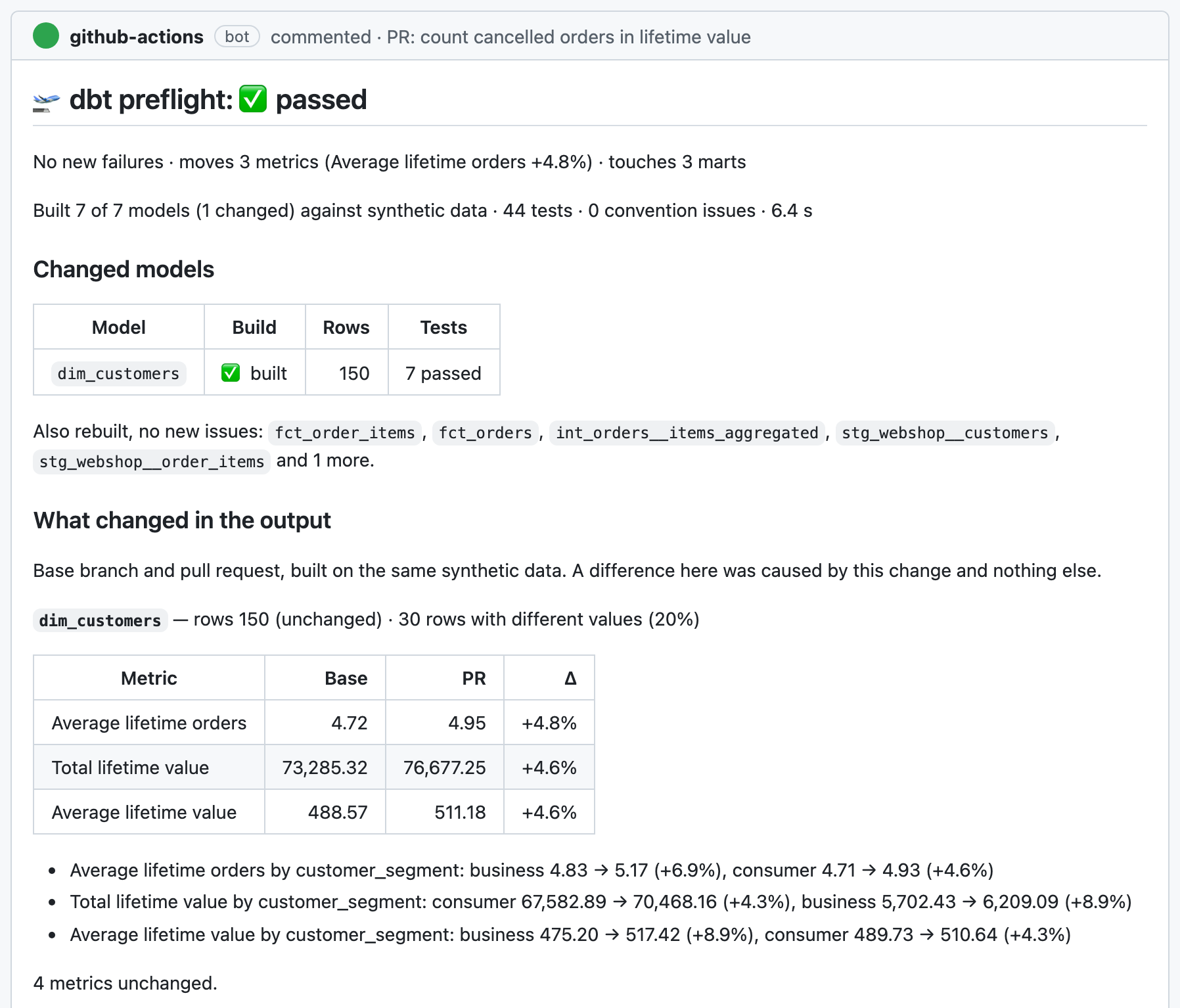
A pull request that counts cancelled orders in customer lifetime value. Every test passes. The comment shows what the tests did not: lifetime value up 4.6%, and by how much per segment.
# .github/workflows/preflight.yml
name: dbt preflight
on:
  pull_request:

permissions:
  contents: read
  pull-requests: write

jobs:
  preflight:
    runs-on: ubuntu-latest
    steps:
      - uses: actions/checkout@v4
      - uses: JB-Analytica/dbt-preflight@v0
Or try it locally first, on a branch: uvx dbt-preflight run --base-ref origin/main.
Want it set up for your team? The Action is free and stays open source. Getting the most from it on a real project is mostly about the parts around it: a source schema that behaves like your business, the conventions your team actually follows, metrics worth comparing, and instructions that keep coding agents inside them. JB Analytica sets that up with your team and hands it over, so your engineers run it without us afterwards. Book a 30-minute call or write to jarich@jbanalytica.com.
What you get
What broke, and what it breaks. Renamed columns, dropped ref()s and broken joins, with
the unchanged models the change breaks named, and DuckDB's error read into plain English
(the input no longer has a column called email). Each failing test folds the compiled
SQL that failed under it. Schema tests and dbt unit tests both run.
→ Recorded scenarios
The numbers that moved. A change no test covers still shows up: rows whose values
differ, columns added, removed or retyped, row counts, and every metric the project defines,
before and after, overall and per segment. Metrics are read from dbt's semantic layer,
Lightdash meta.metrics, or a metrics: list in the config.
→ Metrics
Judged against main. Both branches run the same tests on the same data, and only new
or worse failures count: ⚠️ Broken on main too does not fail the pull request, ❓ Could
not be checked does. When in doubt, the pull request answers for it.
→ How it works
Works on a project as it is. With no schema file, the source schema is derived from
sources.yml, the staging SQL and dbt's compiled SQL, so sources read through Fivetran's
macros are found. A column no SQL types is guessed from its name and flagged, never silently.
→ Where the schema comes from
The same data, every run. Fixtures come from
model2data: relationship-preserving, cast to
the declared types, and seeded. Same schema, same seed, same data.
→ .dbt-preflight.yml
Your warehouse's SQL, on DuckDB. A model DuckDB rejects as written is transpiled from the project's dialect (BigQuery, Snowflake, ...) with sqlglot. One that still fails because DuckDB lacks something is reported as not verified, not as broken. → Warehouse SQL on DuckDB
A schema you can keep. dbt-preflight schema writes what a run derived as a DBML file
to commit, with a note on every column whose type was guessed.
→ Keeping the schema
House conventions, opt-in. Naming, layering, a tested primary key, descriptions and column names, checked on the changed models: warnings by default, errors once opted in. → Conventions
A feedback loop for coding agents. An agent that runs preflight before opening a pull request gets every finding with a file path, the downstream models a rename touches, and the metrics its "no behaviour change" refactor moved. → Using preflight from a coding agent
One comment, and JSON for a hook. The comment opens with a verdict (passed, passed
with warnings or failed) and one line that sums up the change, and is updated in place
on every push. --summary-file writes the same findings as JSON.
→ Integrating preflight
Before and after
In: a pull request that drops one line from dim_customers, so cancelled orders count
towards customer lifetime value. No test covers it.
 orders as (

     select * from {{ ref('stg_webshop__orders') }}
-    where order_status != 'cancelled'

 ),
Out: the comment. Every test passes, so the verdict is passed, and the numbers say what changed:
No new failures · moves 3 metrics (Average lifetime orders +4.8%) · touches 3 marts
dim_customers— rows 150 (unchanged) · 30 rows with different values (20%)
Metric Base PR Δ Average lifetime orders 4.72 4.95 +4.8% Total lifetime value 73,285.32 76,677.25 +4.6% Average lifetime value 488.57 511.18 +4.6%
In: a pull request that renames email to email_address in the source schema and leaves
the staging model alone. Out: a failed check, naming the model that broke and the mart it
takes with it.
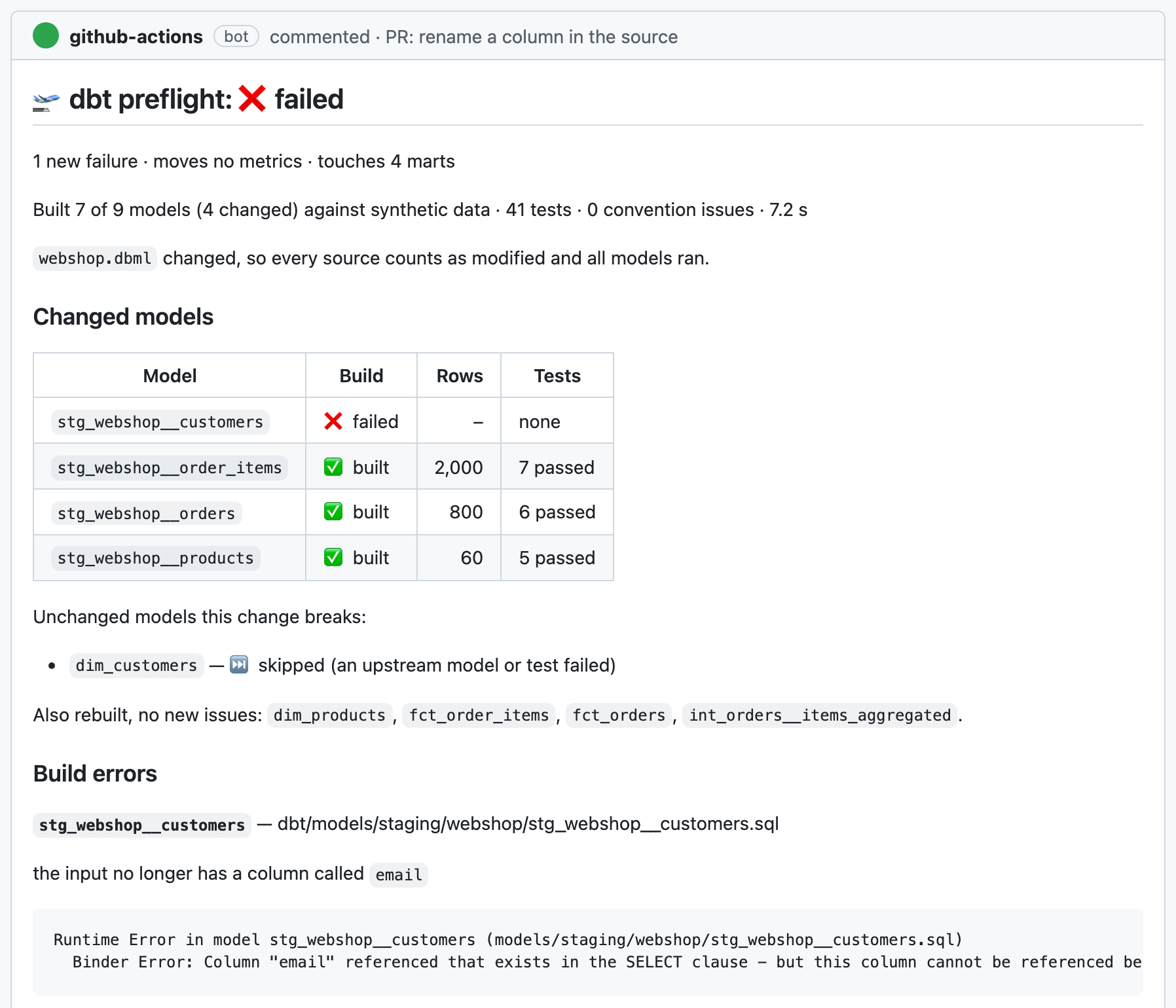
Six pull-request shapes, four that must fail and two that must pass, are recorded with the full comments they produced in docs/scenarios.
Who it's for
A staging model renames a column, every test passes, and the first sign of trouble is a dashboard that is wrong three days later, and more of those changes are now written by coding agents. The honest check is to run the change on data, but the data lives in a warehouse whose credentials most teams will not put in CI. dbt Cloud's CI jobs and data-diff tools run against that warehouse, so they need access to it. Preflight needs none: the data is synthetic, and the warehouse is a DuckDB file that lives for the length of the job.
- A team that will not put warehouse credentials in CI. Preflight writes its own
profiles.yml, so the project's real profile is never used to connect and its credentials are never read. - A reviewer of a refactor that should change nothing. The comment shows whether any row, column or metric moved, before anyone has to reason about the SQL.
- A team letting coding agents change the dbt project. The agent runs preflight before it opens the pull request and fixes what the comment reports.
- A project built on Fivetran's or other packages. Sources that only appear in compiled SQL are still found; Fivetran's Shopify package runs without a hand-written schema.
- A consultant who gets the client's code but never their data. Every check runs on synthetic data generated from the schema.
How it works
flowchart LR
    A["pull request<br>dbt project + base branch"]

    subgraph pf ["dbt-preflight"]
        direction LR
        B["Derive schema<br>sources.yml, staging SQL,<br>compiled SQL, or your DBML"] --> C["Generate fixtures<br>model2data, seeded"]
        C --> D["Build on DuckDB<br>main and PR,<br>same data"]
        D --> E["Compare<br>tests, builds, rows,<br>metrics"]
    end

    subgraph output ["Output"]
        direction TB
        F["One comment<br>updated in place"]
        G["Summary JSON<br>for hooks and bots"]
    end

    A --> B
    E --> F & G
    F --> H["passed · passed with warnings · failed"]

    classDef m2dStyle fill:#0A3866,stroke:#2196F0,color:#F6F8FB
    classDef outStyle fill:#182333,stroke:#A8C9EE,color:#F6F8FB
    classDef endStyle fill:#FA9306,stroke:#FA9306,color:#182333
    class B,C,D,E m2dStyle
    class F,G outStyle
    class H endStyle
- Parse.
dbt parseon the pull request, and on the base branch in a temporary worktree;dbt ls --select state:modifiedfinds what changed. - Generate. model2data generates data for every source table from the schema (your DBML file, or the one derived from the project), cast to the declared types and loaded into a DuckDB file.
- Transpile. Each compiled model DuckDB does not accept as written is transpiled from the project's dialect with sqlglot.
- Build. The selection is closed over downstream models, models whose tests read a
changed model, and all their ancestors, and
dbt buildruns on it. Conventions are checked on the changed models. - Compare. The changed models and everything downstream are built on the base branch too, into their own schemas on the same fixtures, and compared: test results, builds, columns, row counts, differing rows and metric values.
- Comment. One Markdown comment, posted or updated through the GitHub API.
What counts against the pull request
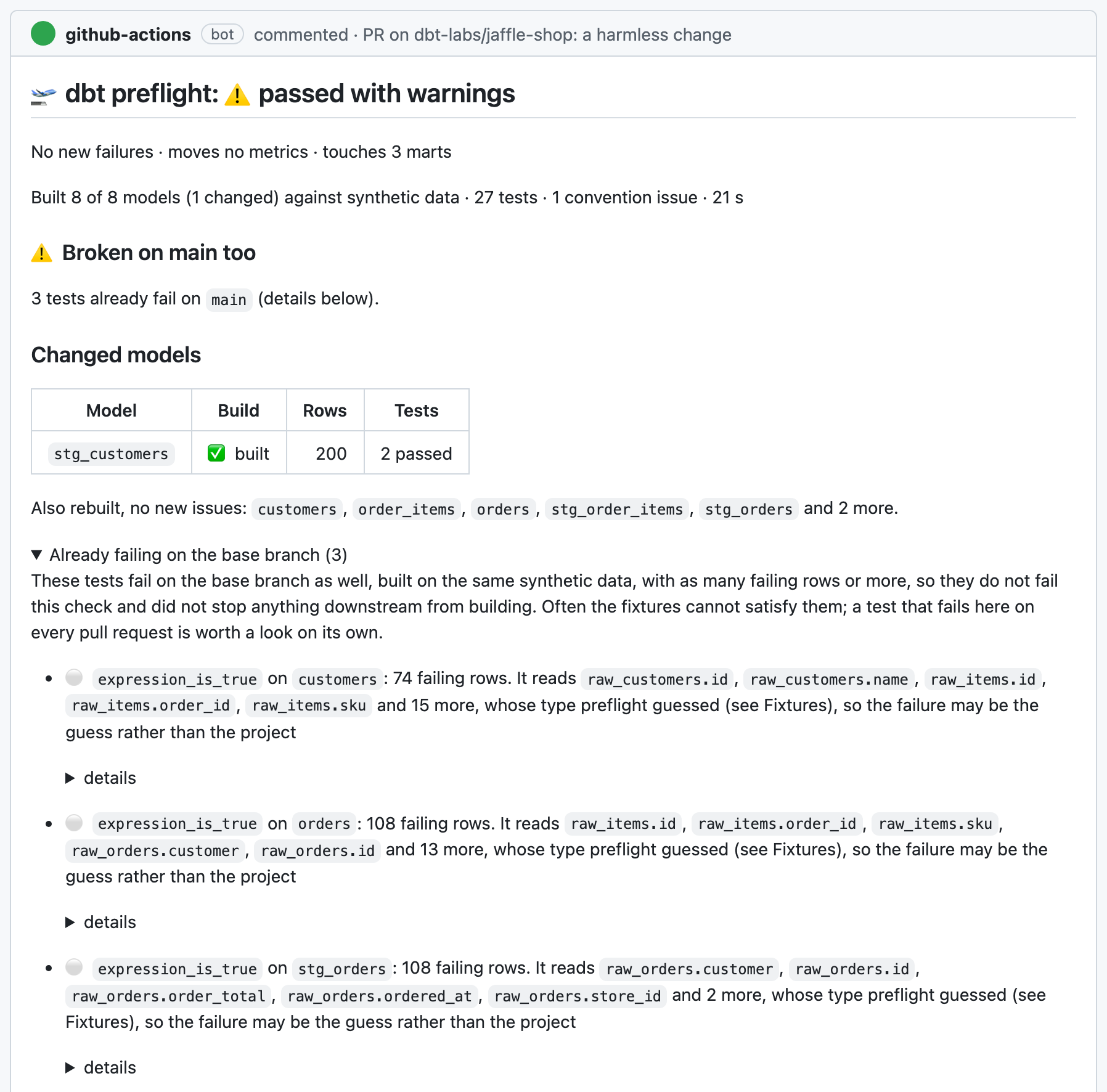
A model that fails the same way on main leads the comment under ⚠️ Broken on main too
and does not fail the pull request. Tests synthetic data can never satisfy fail on both
branches, so they are folded under Already failing on the base branch.
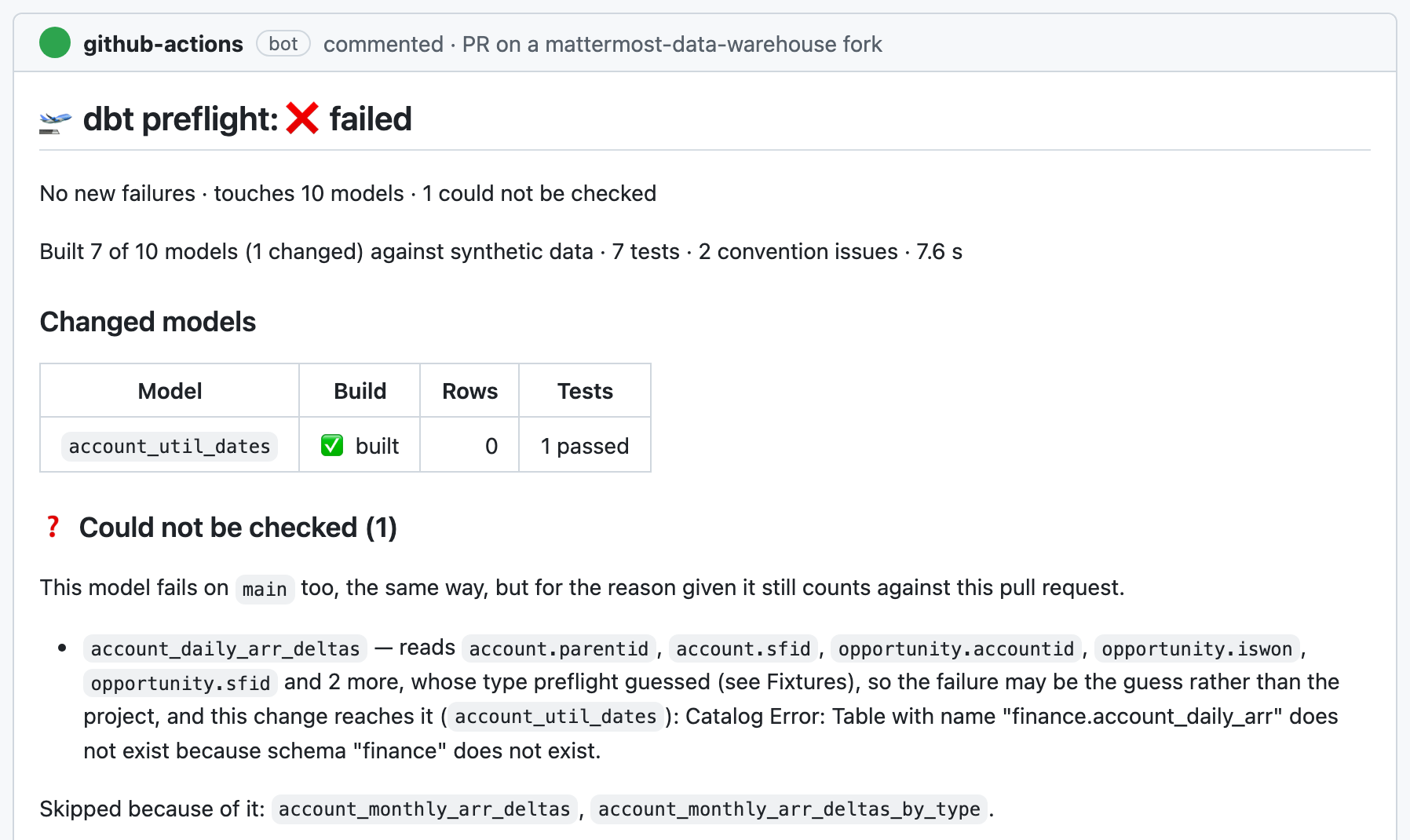
When preflight cannot tell whether the change broke a model, it says so and counts it
against the pull request: ❓ Could not be checked. That happens when a model the change
reaches is already broken on main (DuckDB reports only the first error, so a new one can
hide behind it), or fails on data preflight had to guess. A model the change does not reach
builds from identical SQL on identical data on both sides, so a failure there is only a
warning. The full rules are in
docs/how-it-works.md.
Works on projects we didn't write
Five public dbt projects, in six setups, are pinned to a commit and run through a harmless change and a column rename. Every release is measured against them, and a weekly workflow runs them again. The results as of 0.5.0:
| Project | Setup | Harmless change | Column rename |
|---|---|---|---|
| dbt-labs/jaffle_shop (classic) | Seeds only, no config file | Passes with warnings, 5 of 5 models built | Caught |
| dbt-labs/jaffle-shop | Sources without declared columns, no config file | Passes with warnings, 8 of 8 built | Caught |
| fivetran/dbt_shopify | No schema file: derived through Fivetran's macros | Passes with warnings, 52 of 52 built | Caught |
| mattermost-data-warehouse (fork) | Snowflake, in a subfolder, env: set |
Fails: 1 model could not be checked, 7 of 10 built | Caught |
| fivetran/dbt_shopify | BigQuery, hand-written DBML schema | Fails: 45 of 49 built; 4 models the change reaches sit behind 2 that preflight's data cannot build | Caught |
| Velir/dbt-ga4 | BigQuery, GA4 nested records | Fails: nothing builds yet (BigQuery partition_by) |
Not caught |
The failures stay in the table, because they say where the edges are. The mattermost
failure is the Could not be checked comment above. The hand-written Shopify schema types
parent_id as text, so two models cannot be built on its data; preflight says so, and
counts the four models behind them that the change reaches instead of excusing them.
dbt-ga4 is a known gap. No model in the suite has been reported not verified for SQL
DuckDB could not run.
Shopify without a schema file is the hard case: Fivetran's staging models select their
columns through macros such as fill_staging_columns, so the source columns are not in the
raw SQL at all. Since 0.5.0 preflight reads them from dbt's compiled SQL. A column no SQL
types is guessed from its name and flagged in the comment, and a column the SQL reads as
JSON gets valid JSON in its fixture. On these projects a run takes 7 to 48 seconds, the
Shopify package included.
The suite, its pinned commits and its baseline are in scripts/realworld.
Installation
As a GitHub Action, in the workflow at the top of this page:
- uses: JB-Analytica/dbt-preflight@v0        # follows the latest 0.x release
- uses: JB-Analytica/dbt-preflight@v0.5.0    # or pin an exact version
As a CLI, to run locally or in another CI:
uvx dbt-preflight run --base-ref origin/main    # or: uv tool install / pipx install / pip install dbt-preflight
uvx dbt-preflight schema                        # write the derived schema as DBML
Python 3.10 to 3.13. Preflight brings its own dbt-core (1.11 or newer, below 2) and dbt-duckdb, so the project must parse on dbt-core 1.11 or newer; its own warehouse adapter is not needed.
Without --base-ref, every model counts as changed and the whole project is built.
--comment-file preflight.md writes the comment to a file instead of stdout,
--summary-file writes the JSON, and --keep-workdir leaves .preflight/ (fixtures,
DuckDB file, dbt artefacts) behind for inspection. Every flag and the exit code are in
docs/integration.md.
Configuration
A project at the repository root often needs no config file at all. Add a
.dbt-preflight.yml when the project sits in a subfolder, when its SQL is written for a
warehouse and no profiles.yml is checked in, or when its sources.yml reads environment
variables:
project_dir: transform/dbt   # folder holding dbt_project.yml
dialect: snowflake           # transpile Snowflake SQL to DuckDB
env:
  SNOWFLAKE_DATABASE: preflight
Every key is optional:
| Key | Default | What it sets |
|---|---|---|
project_dir |
. |
Folder holding dbt_project.yml |
schema |
derived from the project | DBML file describing the source tables |
rows / rows_for |
200 / none |
Rows per source table, and per-table overrides |
seed |
42 |
Same seed, same data, every run |
locale |
model2data's default | Faker locale for names and addresses |
env |
none | Environment variables profiles.yml or sources.yml expect |
vars |
none | dbt vars, passed to every dbt command as --vars |
dialect |
read from a checked-in profiles.yml |
SQL dialect to transpile from (bigquery, snowflake, ...) |
dialect_failures |
warn |
Whether a model DuckDB cannot run fails the check (error) |
metrics |
none | Extra metrics to compare: name, model, aggregate sql |
conventions |
jba rules as warnings |
Opt in to the convention rules as errors, or adjust them |
check_all |
false |
Check conventions on every built model, not only changed ones |
loader_columns |
dlt's _dlt_load_id, _dlt_id |
Columns a loader adds to every table |
The full reference, with the action's inputs and examples, is in docs/configuration.md.
model2data studio, for the source schema
A derived schema is a starting point that preflight rebuilds on every run. When it had to guess a type, the comment says so in one line. To make the data behave like your business, keep the schema and refine it in model2data studio, JB Analytica's browser editor for the engine that generates preflight's fixtures:
- Start from what preflight derived.
dbt-preflight schemawritessource_system/<project name>.dbml; pointschema:at it and commit it. Paste it into the studio's editor, or open the repository as a repository project. - See the guesses. Every column
sources.ymldid not type carries a note saying where its type came from. Check the column, then delete the note. - Shape the data. Weighted statuses, null rates and skewed keys set in the studio carry through to the fixtures preflight builds on.
Free to start, nothing to install. The Action and the CLI stay where the check runs; the studio is where the schema gets designed.
Documentation
- Configuring preflight — the Action's inputs,
.dbt-preflight.yml, where the schema comes from, warehouse SQL, metrics, conventions - How preflight works — a run step by step, and what counts against a pull request
- Integrating preflight — flags, exit code, the summary JSON, a pre-pull-request hook
- Using preflight from a coding agent — the instruction block for
CLAUDE.mdorAGENTS.md - Recorded scenarios — six pull requests and the comments they produced
- The real-world suite and the changelog
Design decisions / non-goals
- Synthetic data, never production. Fixtures come from the schema alone. Preflight
writes its own
profiles.ymland runs on it, so no credentials are needed, and~/.dbtis never read. - DuckDB. A file that lives for the length of the job, built fresh on every run. DuckDB gets the first word: only a model it rejects is transpiled.
- Base and pull request on the same data. The comparison is
mainagainst the pull request, not production against the pull request, so a difference was caused by the change and nothing else. - When in doubt, the pull request answers for it. A failure preflight cannot put down to
maincounts against the change. - One comment, updated in place, not a stack of them.
- Conventions are opt-in. Without a
conventions:block they are warnings: a project never signs up for anyone's conventions just by writing a config file. - Non-goal: a diff against production. Preflight never touches production data.
Limitations
- Production numbers are not proven unchanged. Synthetic data shows that the logic changed and how, not the size of the effect on real data. A metric that does not move on the fixtures can still move on production.
- SQL DuckDB cannot run. Warehouse SQL is transpiled to DuckDB with sqlglot; a model that still fails because DuckDB lacks something is reported per model as not verified, not as broken.
- Some warehouse-only configs. dbt-ga4's BigQuery
partition_bycurrently stops the run. - Incremental behaviour across runs. Every run is a full build on a fresh file.
- Invariants across columns. The generated data respects the types, keys, foreign keys and accepted values it knows about, not rules such as "shipped after ordered". Tests that rely on one fail on both branches and are folded as already failing.
Project status
dbt-preflight is at 0.x and actively developed. The real-world suite above runs weekly and before every release, and the changelog says what each release changed in the comment and the summary JSON.
Ideas still open:
- Incremental models checked across days, with model2data's day-by-day batches.
- Metrics checked against known values, and GitLab merge requests.
Contributing
Bugs and feature requests belong in the issue tracker. A pull request is welcome:
uv sync --extra dev
uv run poe check          # ruff, ty, pytest
poe check has to be green and, if you change what the comment says,
uv run python scripts/scenarios.py re-records the six scenarios so the change shows up in
docs/scenarios/. uv run poe realworld --compare runs the real-world suite (it needs
network).
Licence
MIT. See LICENSE.

Built and maintained by JB Analytica —
Data & Analytics Engineering · Data Platform Architecture · Modern BI.
Synthetic data from model2data; design the schema behind it in model2data studio.
1 maintainer

Metadata
1 maintainer
Release files for dbt-preflight 0.5.0
For a detailed explanation of source distributions (sdists) and built distributions (wheels), please see the package formats documentation.
Source distribution (sdist)
| File | Size | Uploaded | |
|---|---|---|---|
| dbt_preflight-0.5.0.tar.gz | 202.0 kB | Details |
Built distribution (wheel)
| File | Interpreter | ABI | Platform | Reset |
|---|---|---|---|---|
| dbt_preflight-0.5.0-py3-none-any.whl | Python 3 | none | any | Details |
Total release size: 332.7 kB
Release files / dbt_preflight-0.5.0.tar.gz
| Download URL | dbt_preflight-0.5.0.tar.gz |
|---|---|
| Size | 202.0 kB |
| Tags | Source |
|
SHA-256 checksum How to use checksums |
b88745f5bd038c01f602b4a6907ad6e62c21c226b81c7f4156c59b0f423b1ac6
|
|
BLAKE2b-256 checksum How to use checksums |
cf4a0bc89662f39b1dccfe6787e9f51b692d40f1efa9f5ad9685c268522b3909
|
| Upload date | |
|
Uploaded using Trusted Publishing? What is trusted publishing? |
Yes |
| Uploaded via |
twine/7.0.0 CPython/3.13.14
|
Provenance
Provenance describes where a file came from. On PyPI, provenance is shared via attestations, which provide a verifiable record of the build or publishing details. View details, limitations and caveats.


PyPI Publish Attestation
PyPI verified that this artifact, at this checksum, originated from the publisher listed below.
Signed by GitHub Actions, verified by PyPI on Oct 6, 2026.
Transparency logRelease files / dbt_preflight-0.5.0-py3-none-any.whl
| Download URL | dbt_preflight-0.5.0-py3-none-any.whl |
|---|---|
| Size | 130.7 kB |
| Tags | Python 3 |
|
SHA-256 checksum How to use checksums |
640c81f1f66e19c051240432aab959c2e61d236321e6a889997c7ae4ddba855f
|
|
BLAKE2b-256 checksum How to use checksums |
bf98f077c95ee68f10c8ffd3d64f703701ff35751d6de4c01bc29e125d0efdf8
|
| Upload date | |
|
Uploaded using Trusted Publishing? What is trusted publishing? |
Yes |
| Uploaded via |
twine/7.0.0 CPython/3.13.14
|
Provenance
Provenance describes where a file came from. On PyPI, provenance is shared via attestations, which provide a verifiable record of the build or publishing details. View details, limitations and caveats.
PyPI Publish Attestation
PyPI verified that this artifact, at this checksum, originated from the publisher listed below.
Signed by GitHub Actions, verified by PyPI on Oct 6, 2026.
Transparency log













