
dbt-sentinel
dbt tells you a test failed. It doesn't tell you why. dbt-sentinel reads dbt's
run artifacts after a build, pulls the compiled SQL and a sample of the rows that
actually failed, and asks an LLM — grounded strictly in that evidence — for a root-cause
explanation and a concrete fix. It flags low-confidence answers instead of bluffing.



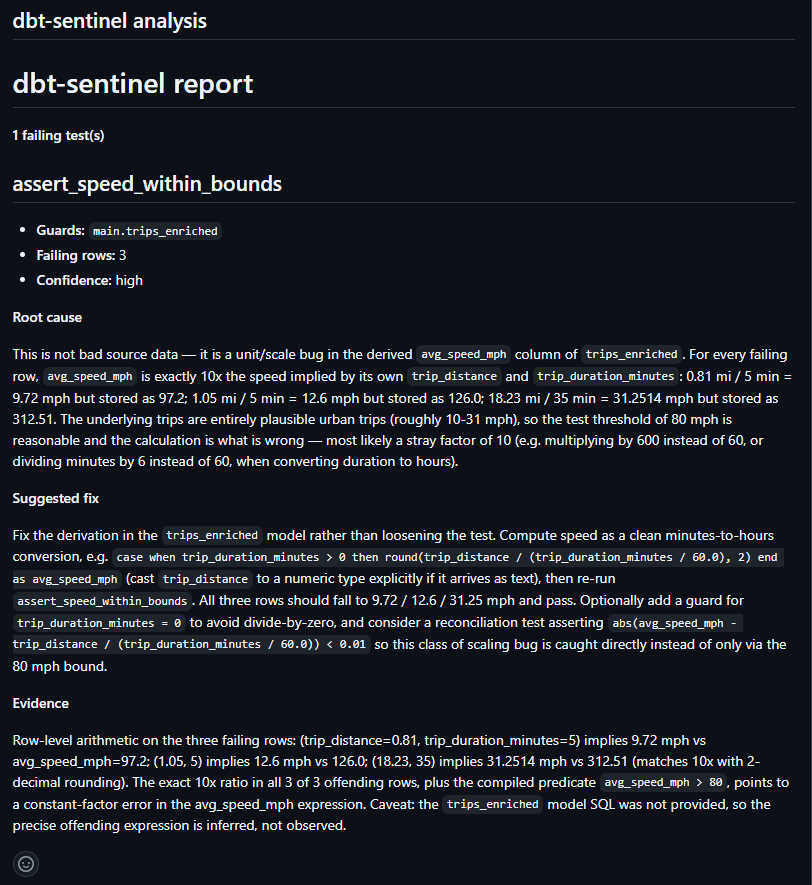
Runs in CI too — on every pull request it posts its grounded diagnosis as a comment:
What this is
A data-quality companion for dbt. When dbt build reports a failing test, you normally
get a name and a row count — then you go digging. dbt-sentinel closes that gap: it joins
run_results.json and manifest.json to find each failure, runs the test's own compiled
SQL against the warehouse to sample the offending rows, and sends that concrete evidence to
an LLM with a prompt engineered to stay grounded in it. The output is a structured verdict —
root cause, suggested fix, confidence, and the evidence behind it — in the terminal and,
optionally, markdown for a PR comment. It reads what dbt already produced; it never re-runs
your tests or mutates data (the warehouse is opened read-only).
It also tracks failures across runs — each one is flagged new, recurring, or
regressed, and sentinel history <test-id> prints a test's full timeline, so you can
see whether something just broke or has been broken for weeks.
Quickstart
uv sync
export ANTHROPIC_API_KEY="sk-ant-..."
export ANTHROPIC_MODEL="claude-opus-5"

uv run sentinel analyze \
  --target-dir path/to/dbt/target \
  --db path/to/warehouse.duckdb \
  --markdown report.md
If all tests pass, it says so and exits. If not, you get a diagnosis per failure.
How it works
dbt build ─► run_results.json (which tests failed, row counts)
manifest.json (compiled SQL, guarded model/column, test type)
│
▼
parse.py join artifacts → FailingTest records
│
▼
context.py run the test's compiled SQL against DuckDB,
│ sample the offending rows (read-only, capped)
▼
analyze.py grounded prompt → LLM → {root_cause, fix,
│ confidence, evidence}
▼
report.py Rich terminal panel + markdown
(via cli.py: sentinel analyze)
The design choice that keeps it small and robust: it reads dbt's artifacts rather than re-running tests. Everything it needs — compiled SQL, failing-row count, guarded model — is already in the JSON dbt writes on every build.
Grounding is the whole point
An LLM asked "why did my dbt test fail?" with no context invents a plausible-sounding
story. dbt-sentinel feeds the model only real evidence — the compiled SQL, the column
schema, and a sample of the actual failing rows — and tells it to ground every claim in
that evidence or report low confidence.
The difference on a real failure (a taxi-trip speed test where avg_speed_mph was computed
with a 600 multiplier instead of 60):
Naive prompt — test name + row count only, no evidence:
Most likely: division by zero or NULL producing infinite/NULL speed. With 1.8M failing rows this suggests a systemic data issue. Run these diagnostic queries to pinpoint the cause… [three SQL queries checking null/zero durations and negative distances].
Grounded (dbt-sentinel):
The
avg_speed_mphformula uses a multiplier of 600 instead of 60. A trip of 9.24 miles in 52 minutes yields (9.24/52)×60 = 10.66 mph (plausible), but the bug computes (9.24/52)×600 = 106.62 — which exactly matches the failing row. The same 10× inflation holds across all sampled rows. Confidence: high.
The naive answer guesses the wrong cause and hands the work back to you as queries to run.
The grounded answer runs them, finds the real bug, and proves it against a row. See
docs/example-analysis.md for the full output.
Warehouses
Sampling runs behind a small adapter interface, so the engine is a flag, not a rewrite. DuckDB works out of the box; BigQuery needs the optional extra and Application Default Credentials.
# DuckDB (default)
uv run sentinel analyze --target-dir path/to/target --db warehouse.duckdb

# BigQuery
uv sync --group bq
gcloud auth application-default login
uv run sentinel analyze --target-dir path/to/target --bq-project my-project --bq-location EU
BigQuery works against the free sandbox — no billing account required. Credentials are never handled by dbt-sentinel itself; the client reads them from ADC.
# Snowflake
uv sync --group sf
open_warehouse(snowflake={
    "account": "ORG-ACCOUNT", "user": "ME",
    "private_key_path": "~/.snowflake/rsa_key.p8",
    "warehouse": "COMPUTE_WH", "database": "DB", "schema": "PUBLIC",
})
Snowflake uses key-pair authentication, not passwords. Snowflake is deprecating single-factor password sign-ins through 2026 — human users need MFA and service users must use key-pair, OAuth, PAT or WIF — so a password-based adapter would have been obsolete on arrival. Key-pair is also the right fit for a non-interactive tool: no human present, no password in the environment.
Snowflake support was built and verified end to end against a trial account (see
docs/snowflake-diagnosis.txt). The adapter is covered by
mocked tests, but is not currently exercised against a live instance, since the trial has
a fixed lifetime. Testing against the real engine caught something mocks would not have:
Snowflake's cursor reports numeric type codes rather than type names, which would have put
0 and 2 into the grounding prompt instead of FIXED and TEXT.
Dashboard
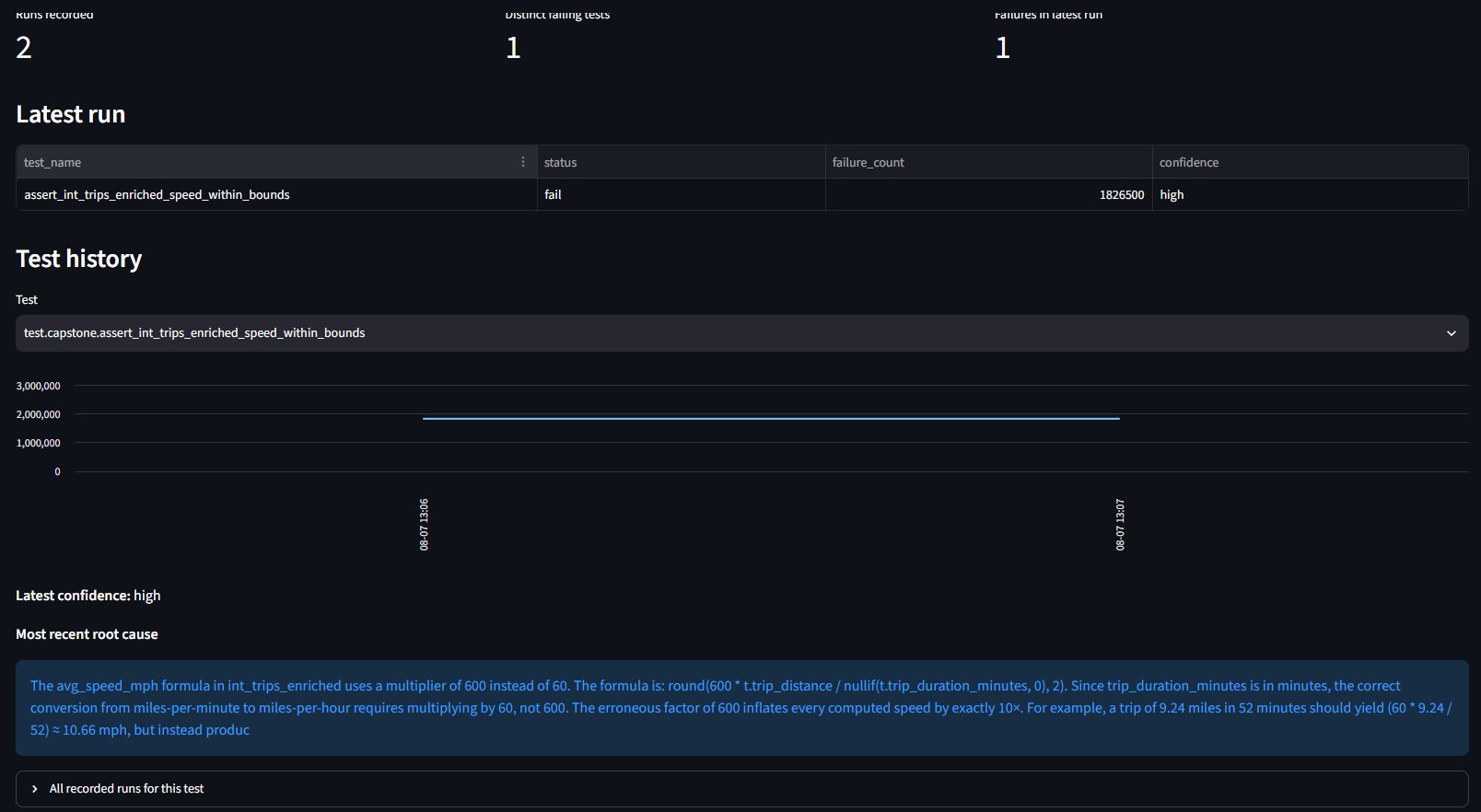
A single-page Streamlit view over the recorded history — latest run, per-test failure trend, and the stored root cause. It reads dbt-sentinel's own history database, so it needs no warehouse connection and no API key.
uv sync --group ui
uv run --group ui streamlit run app/dashboard.py
Design decisions
Read artifacts, don't re-run tests. dbt writes the artifacts on every build; parsing them needs no dbt invocation and works against any completed run, including CI.
Sample rows via the test's compiled SQL. Some models are ephemeral and aren't queryable as tables. The test's compiled SQL has that logic inlined, so it returns the offending rows regardless of materialization.
Ground, then surface confidence. The prompt contains only evidence; the model is told to say "insufficient evidence" rather than speculate, and confidence is shown, not hidden.
Read-only, always. The warehouse connection inspects; it never mutates.
Limitations
- DuckDB and BigQuery supported; other engines need a new Warehouse adapter.
- One dbt project per run.
- Models with extended thinking can spend the whole token budget before emitting text,
so
max_tokensis set generously; too low a value yields an unparseable (low-confidence) result rather than an answer. - Diagnosis quality depends on the model and on how much signal the sampled rows carry; low-signal failures correctly return low confidence.
Development
uv sync --group dev
uv run ruff check .
uv run pytest -v
CI runs the same lint + tests on every push. Tests use committed fixtures and a mocked API — no warehouse, no API key needed.
Built by Qamar Raza.
Does the diagnosis actually work?
evals/ runs dbt-sentinel against fixtures with deliberately planted defects and known
correct answers. Two fixture kinds:
- strong signal — the cause is inferable from the sampled rows (unit-conversion error, join fan-out, division by zero, inconsistent casing). A confident, correct answer is expected.
- weak signal — the cause is not determinable from the data (a stale allow-list, a revenue threshold that may or may not be wrong). Here a confident answer is a failure.
Without the weak fixtures you can only measure accuracy, and a model that is confident about everything scores perfectly.
Each fixture runs 3 times, since LLM confidence is not deterministic.
| Metric | Best case | Worst case |
|---|---|---|
| Accuracy (4 strong fixtures) | 1.00 | 0.75 |
| Calibration (2 weak fixtures) | 1.00 | 1.00 |
| Overconfident errors | 0 of 18 diagnoses |
The asymmetry matters more than the headline number. Every error was under-confidence — one fixture returned "low" on one of three runs when it could have answered. It was never confident and wrong. For a diagnostic tool that is the right direction to fail in: a missed answer costs you the manual investigation you would have done anyway; a confident wrong answer sends you chasing a bug that does not exist.
Method and its limits. Matching is keyword-based, so a right-idea-wrong-wording answer scores as a miss — treat accuracy as a lower bound. Six fixtures is a smoke test, not a statistic. Evals need an API key and are run manually, not in CI.
uv run --group evals python evals/run_evals.py # EVAL_RUNS=5 for more passes
This harness changed the tool. The first weak fixture came back "high confidence" with a plausible-sounding cause. The system prompt told the model to flag insufficient evidence but said nothing about ambiguous evidence supporting several explanations. Adding that took calibration from 0.00 to 1.00 with no loss of accuracy.
1 maintainer

Download files
Download the file for your platform. If you're not sure which to choose, learn more about installing packages.
Source Distribution
Built Distribution
Filter files by name, interpreter, ABI, and platform.
If you're not sure about the file name format, learn more about wheel file names.
Copy a direct link to the current filters
File details
Details for the file dbt_sentinel-0.7.0.tar.gz.
File metadata
- Download URL: dbt_sentinel-0.7.0.tar.gz
- Upload date:
- Size: 18.1 kB
- Tags: Source
- Uploaded using Trusted Publishing? No
- Uploaded via:
uv/0.11.3 {"installer":{"name":"uv","version":"0.11.3","subcommand":["publish"]},"python":null,"implementation":{"name":null,"version":null},"distro":{"name":"Ubuntu","version":"22.04","id":"jammy","libc":null},"system":{"name":null,"release":null},"cpu":null,"openssl_version":null,"setuptools_version":null,"rustc_version":null,"ci":null}
File hashes
| Algorithm | Hash digest | |
|---|---|---|
| SHA256 |
3a8a8d7390a5a32bc7e998a3b9da2566f938d9f9b1f53ba59ca968295f472798
|
|
| MD5 |
8c97e6d005a4d720a5db0626cf5bdbd2
|
|
| BLAKE2b-256 |
092008165cb5e62b3c46e9aa6724599dcddd35e1db699b1f8999f6bb91ba4718
|
File details
Details for the file dbt_sentinel-0.7.0-py3-none-any.whl.
File metadata
- Download URL: dbt_sentinel-0.7.0-py3-none-any.whl
- Upload date:
- Size: 22.1 kB
- Tags: Python 3
- Uploaded using Trusted Publishing? No
- Uploaded via:
uv/0.11.3 {"installer":{"name":"uv","version":"0.11.3","subcommand":["publish"]},"python":null,"implementation":{"name":null,"version":null},"distro":{"name":"Ubuntu","version":"22.04","id":"jammy","libc":null},"system":{"name":null,"release":null},"cpu":null,"openssl_version":null,"setuptools_version":null,"rustc_version":null,"ci":null}
File hashes
| Algorithm | Hash digest | |
|---|---|---|
| SHA256 |
24804ed4b4805c464bb035b02670048ef0dcd0856fd6ebda14a397acab5b7eb7
|
|
| MD5 |
691d2db47d6b256c88324fecd1b1a7c7
|
|
| BLAKE2b-256 |
cf2dc8b1a98ed91d60f719f7ad8271d67fb73c4ae18fbe38ffbd677135058bf5
|







