
Domain Driven Design Library
Verified details
These details have been verified by PyPIProject links
GitHub Statistics
Maintainers

Project description
DDDesign





DDDesign is a Python library designed to implement Domain-Driven Design (DDD) principles in software projects. It provides a set of tools and structures to help developers apply DDD architecture. This library is built on top of Pydantic, ensuring data validation and settings management using Python type annotations.
Installation
Install the library using pip:
pip install dddesign
DDD Components
Application
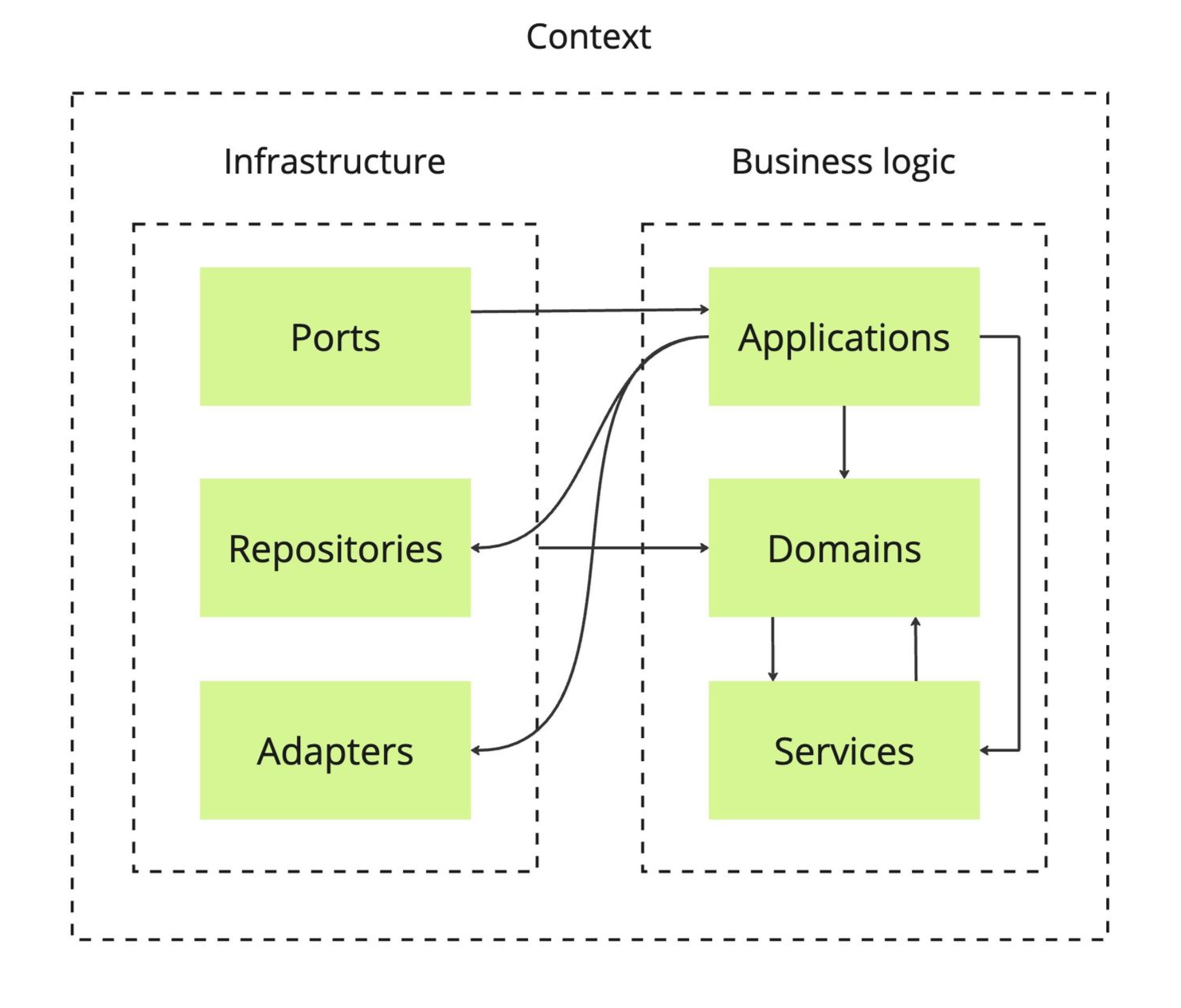
Application is a programmatic interface for accessing business logic. It serves as the primary entry point for all domain operations.
Entry points:
- Ports: HTTP interfaces, background tasks, CLI commands, and other interaction points.
- Other Applications: Within the same Context, leading and subordinate Applications may coexist, creating a layered structure. Leading Applications manage core business logic, while subordinate Applications handle narrower delegated tasks.
This approach ensures clear separation of responsibilities and helps maintain a well-organized architecture.
Adapter
Adapter is a component designed to retrieve data from external sources. Based on the Adapter Pattern described in "Gang of Four" (GoF), it bridges the interface of a system with the one expected by another.
Characteristics:
- Belongs to the infrastructure layer and isolates interactions with external interfaces.
- Divided into integration with internal (
InternalAdapter) and third-party (ExternalAdapter) services.
By encapsulating external dependencies, Adapter keeps the core application logic decoupled and modular.
Repository
Repository, a subtype of Adapter, is a specialized infrastructure layer component introduced in "Domain-Driven Design" by Eric Evans. It isolates interactions with data storage systems (e.g., PostgreSQL, ClickHouse, Redis, and others) and provides an abstraction for managing persistence.
Characteristics:
- Single Responsibility: Each Repository is typically designed to work with a single table (Entity).
- Separation of Concerns: Keeps domain logic independent of storage implementations.
- Application Usage: If an Application uses more than one Repository, this indicates a design issue. In such cases, consider creating another Application.
This abstraction ensures that persistence logic is modular and aligns with DDD principles.
Service
Service is used to handle business logic not tied to a specific domain object.
Characteristics:
- Purpose: Used when a method spans multiple domain objects.
- Clear Naming: The name should clearly describe its purpose, as it always implements a single
handlemethod. - Input / Output: Can return a new object or modify an input object in place.
- Dependency Management: Relies only on provided inputs, avoiding direct infrastructure dependencies, ensuring easy unit testing.
Data Transfer Object (DTO)
Data Transfer Object is a simple, immutable data structure used for transferring data between application layers. Introduced by Martin Fowler in "Patterns of Enterprise Application Architecture", it acts as a data contract.
Characteristics:
- Data Contracts: Defines clear structures for exchanging data between layers.
- Immutability: DTOs cannot be modified after creation.
- Application Access: Any additional data fetching required to fulfill a contract should be handled by the Application, as it has access to Repositories or subordinate Applications.
Value Object
Value Object is an object defined solely by its properties and has no unique identifier. Originating in object-oriented programming, it was refined by Eric Evans in "Domain-Driven Design" to reduce domain model complexity.
Characteristics:
- No Identity: Identified by attributes, not a unique identifier.
- Immutability: Cannot be modified after creation, ensuring consistency.
- Equality: Two Value Objects are equal if all their properties match.
Examples:
- Address: street, city, postal code, country.
- Money: amount, currency.
Entity
Entity is a domain object identified by a unique property (typically a primary key in the database). It represents a single record in a table and encapsulates related data and behavior.
Characteristics:
- Unique Identity: Ensures one-to-one correspondence with a database record.
- Field Consistency: Fields in the Entity should align with the database schema.
Notes:
- Fields such as
created_atandupdated_at, often managed by ORMs, can be omitted from the Entity if they are not required in the business logic. - Ideally, each Entity should have a dedicated Repository and possibly its own Application.
Aggregate
Aggregate is a collection of related Entity objects that work together within a single bounded context.
By exposing controlled methods for interaction, it ensures consistency and atomicity of operations under shared rules.
Characteristics:
- Consistency: Ensures domain rules are followed by exposing public methods for interaction, ensuring all internal Entities remain in valid states.
- Atomicity: Treats operations on the aggregate as a single unit, ensuring consistent changes across all entities.
Usage:
- Ports create a DTO, which is passed to the Application. The Application builds Entities and groups them into an Aggregate, validating rules and contracts.
- Aggregates can also act as simple containers for related Entities within a single HTTP request, avoiding the need for multiple REST calls, thereby reducing network overhead.
Component Interaction Flowchart
Factories
ApplicationFactory
Facilitates creating application instances with specific dependencies. Useful when multiple interfaces with different dependencies share the same application logic.
Example:
from dddesign.structure.applications import Application, ApplicationDependencyMapper, ApplicationFactory

from app.account_context.applications.account import AccountApp, account_app_impl
from app.account_context.applications.social_account import SocialAccountApp, social_account_app_impl
from app.account_context.domains.constants import SocialDriver
from app.account_context.infrastructure.adapters.external import social


class AuthSocialApp(Application):
    account_app: AccountApp = account_app_impl
    social_account_app: SocialAccountApp = social_account_app_impl
    social_adapter: social.SocialAdapterInterface

    ...


auth_social_app_factory = ApplicationFactory[AuthSocialApp](
    application_class=AuthSocialApp,
    dependency_mappers=(
        ApplicationDependencyMapper(
            application_attribute_name='social_adapter',
            request_attribute_value_map={
                SocialDriver.APPLE: social.apple_id_adapter_impl,
                SocialDriver.GOOGLE: social.google_adapter_impl,
                SocialDriver.FACEBOOK: social.facebook_adapter_impl,
            },
        ),
    ),
)

# note: the argument name must match the lowercase version of the Enum class name
auth_apple_app_impl = auth_social_app_factory.get(social_driver=SocialDriver.APPLE)
AggregateListFactory
Converts a list of Entity into Aggregate objects.
from dddesign.structure.infrastructure.adapters.internal import InternalAdapter

from app.account_context.domains.dto.media import Media, MediaId
from app.media_context.applications.media import MediaApp, media_app_impl


class MediaAdapter(InternalAdapter):
    media_app: MediaApp = media_app_impl

    def get(self, media_id: MediaId | None) -> Media | None:
        if media_id is None:
            return None

        medias = self.get_map((media_id,))
        return next(iter(medias.values()), None)

    def get_map(self, media_ids: tuple[str, ...]) -> dict[str, Media]:
        if not media_ids:
            return {}

        medias = self.media_app.get_list(media_ids=media_ids)
        return {MediaId(media.media_id): Media(**media.model_dump()) for media in medias}


media_adapter_impl = MediaAdapter()
from dddesign.structure.domains.aggregates import Aggregate
from pydantic import model_validator

from app.account_context.domains.dto.media import Media
from app.account_context.domains.entities.profile import Profile


class ProfileAggregate(Aggregate):
    profile: Profile
    icon: Media | None = None

    @model_validator(mode='after')
    def validate_consistency(self):
        if self.profile.icon_id:
            if self.icon is None:
                raise ValueError('`icon` field is required when `profile` has `icon_id`')
            if self.profile.icon_id != self.icon.media_id:
                raise ValueError('`profile.icon_id` is not equal to `icon.media_id`')
        elif self.icon is not None:
            raise ValueError('`icon` field is not allowed when `profile` has no `icon_id`')

        return self
Example 1: Retrieving multiple related objects
from dddesign.structure.domains.aggregates import AggregateDependencyMapper, AggregateListFactory

from app.account_context.domains.aggregates.profile import ProfileAggregate
from app.account_context.infrastructure.adapters.internal.media import media_adapter_impl


aggregate_list_factory = AggregateListFactory[ProfileAggregate](
    aggregate_class=ProfileAggregate,
    aggregate_entity_attribute_name='profile',
    dependency_mappers=(
        AggregateDependencyMapper(
            method_getter=media_adapter_impl.get_map,
            entity_attribute_name='icon_id',
            aggregate_attribute_name='icon',
        ),
    ),
)

aggregates: list[ProfileAggregate] = aggregate_list_factory.create_list([...])  # list of Profile Entity
Example 2: Retrieving a single related object
from dddesign.structure.domains.aggregates import AggregateDependencyMapper, AggregateListFactory

from app.account_context.domains.aggregates.profile import ProfileAggregate
from app.account_context.infrastructure.adapters.internal.media import media_adapter_impl


aggregate_list_factory = AggregateListFactory[ProfileAggregate](
    aggregate_class=ProfileAggregate,
    aggregate_entity_attribute_name='profile',
    dependency_mappers=(
        AggregateDependencyMapper(
            method_getter=media_adapter_impl.get,
            entity_attribute_name='icon_id',
            aggregate_attribute_name='icon',
        ),
    ),
)

aggregates: list[ProfileAggregate] = aggregate_list_factory.create_list([...])  # list of Profile Entity
Enums
BaseEnum
BaseEnum is a foundational enum class that should be used across the application.
It extends the standard Python Enum and provides additional functionality:
__str__method: Converts the enum’s value to a string representation, making it more readable in logs, responses, or debugging output.has_valueclass method: Allows you to check whether a specific value is defined in the enum. This is particularly useful for validation purposes.
ChoiceEnum
ChoiceEnum is an extension of BaseEnum designed for scenarios where enumerations need both a machine-readable value
and a human-readable title. It adds utility methods for creating user-friendly choices.
Error Handling
BaseError
BaseError is a foundational exception class that standardizes error handling by providing structured information for errors.
It simplifies the creation of domain-specific exceptions and ensures consistency across the application.
CollectionError
CollectionError is an exception class designed to aggregate multiple instances of BaseError.
It simplifies error handling in scenarios where multiple errors need to be captured and processed together.
Errors
Errors is a Data Transfer Object that transforms a CollectionError into a structured format for 4XX HTTP responses.
It ensures domain-level errors are serialized and returned to the client in a meaningful way, avoiding 500 responses.
wrap_error
wrap_error is a utility function designed to convert a Pydantic ValidationError into a CollectionError,
enabling a standardized way of handling and aggregating validation errors.
It ensures that detailed error information is preserved while providing a structured format for further processing.
create_pydantic_error_instance
create_pydantic_error_instance is a utility function for dynamically creating custom PydanticErrorMixin instances,
allowing to define detailed and context-aware Pydantic validation errors.
Testing and State Management
MagicMock
MagicMock is an enhanced version of unittest.mock.MagicMock that adds compatibility with BaseModel.
It streamlines testing by handling Pydantic models more effectively in mocked environments.
TrackChangesMixin
TrackChangesMixin is a mixin for BaseModel that tracks changes made to model fields.
It allows to monitor field modifications, compare current and initial values, and manage the state of the model.
Project details
Verified details
These details have been verified by PyPIProject links
GitHub Statistics
Maintainers
Release history Release notifications | RSS feed


Download files
Download the file for your platform. If you're not sure which to choose, learn more about installing packages.
Source Distribution
Built Distribution
Filter files by name, interpreter, ABI, and platform.
If you're not sure about the file name format, learn more about wheel file names.
Copy a direct link to the current filters
File details
Details for the file dddesign-1.1.10.tar.gz.
File metadata
- Download URL: dddesign-1.1.10.tar.gz
- Upload date:
- Size: 19.6 kB
- Tags: Source
- Uploaded using Trusted Publishing? Yes
- Uploaded via: twine/6.1.0 CPython/3.13.7
File hashes
| Algorithm | Hash digest | |
|---|---|---|
| SHA256 |
07e5fa994cfc94313c88b1a51dc4c80f8b08d43545cebf4139debb85dd9c4c51
|
|
| MD5 |
93c8328ffd9c628aa4b7c36ba3ce3f44
|
|
| BLAKE2b-256 |
625fd05830c8d226b3850e15d09e8bdca979e3a5f6f1cae9b884e1031ce68607
|
Provenance
The following attestation bundles were made for dddesign-1.1.10.tar.gz:
Publisher:
publish_python_package.yml on davyddd/dddesign
-
Statement:
-
Statement type:
https://in-toto.io/Statement/v1 -
Predicate type:
https://docs.pypi.org/attestations/publish/v1 -
Subject name:
dddesign-1.1.10.tar.gz -
Subject digest:
07e5fa994cfc94313c88b1a51dc4c80f8b08d43545cebf4139debb85dd9c4c51 - Sigstore transparency entry: 953508982
- Sigstore integration time:
-
Permalink:
davyddd/dddesign@a5a0a0cc504094a3c83cb4f348fd693012c9929d -
Branch / Tag:
refs/tags/v1.1.10 - Owner: https://github.com/davyddd
-
Access:
public
-
Token Issuer:
https://token.actions.githubusercontent.com -
Runner Environment:
github-hosted -
Publication workflow:
publish_python_package.yml@a5a0a0cc504094a3c83cb4f348fd693012c9929d -
Trigger Event:
push
-
Statement type:
File details
Details for the file dddesign-1.1.10-py3-none-any.whl.
File metadata
- Download URL: dddesign-1.1.10-py3-none-any.whl
- Upload date:
- Size: 28.3 kB
- Tags: Python 3
- Uploaded using Trusted Publishing? Yes
- Uploaded via: twine/6.1.0 CPython/3.13.7
File hashes
| Algorithm | Hash digest | |
|---|---|---|
| SHA256 |
12ee861dfaa3adf19f75a8ac7bddc160a94a88b3a095b4bda9d09740dcc41309
|
|
| MD5 |
2b0dc05d2a97e563436b565aa079951f
|
|
| BLAKE2b-256 |
e3b04eda1323b0e6adad903f1d4656cc1b965499c05817f761f4ec361f4619fc
|
Provenance
The following attestation bundles were made for dddesign-1.1.10-py3-none-any.whl:
Publisher:
publish_python_package.yml on davyddd/dddesign
-
Statement:
-
Statement type:
https://in-toto.io/Statement/v1 -
Predicate type:
https://docs.pypi.org/attestations/publish/v1 -
Subject name:
dddesign-1.1.10-py3-none-any.whl -
Subject digest:
12ee861dfaa3adf19f75a8ac7bddc160a94a88b3a095b4bda9d09740dcc41309 - Sigstore transparency entry: 953508984
- Sigstore integration time:
-
Permalink:
davyddd/dddesign@a5a0a0cc504094a3c83cb4f348fd693012c9929d -
Branch / Tag:
refs/tags/v1.1.10 - Owner: https://github.com/davyddd
-
Access:
public
-
Token Issuer:
https://token.actions.githubusercontent.com -
Runner Environment:
github-hosted -
Publication workflow:
publish_python_package.yml@a5a0a0cc504094a3c83cb4f348fd693012c9929d -
Trigger Event:
push
-
Statement type:






