
🦆 Duckduckgo


duckduckgois a multi-language toolkit for searching DuckDuckGo from code or the command line. The core is written entirely in Rust and compiled to a native extension, so Python and Node.js callers enjoy the same performance and correctness guarantees as the Rust library, with no runtime dependencies beyond the native extension itself 🗿.
🐧 Linux (Recommended) |
🪟 Windows | 🐳 Docker | 📦 Linux Distros |
|---|---|---|---|
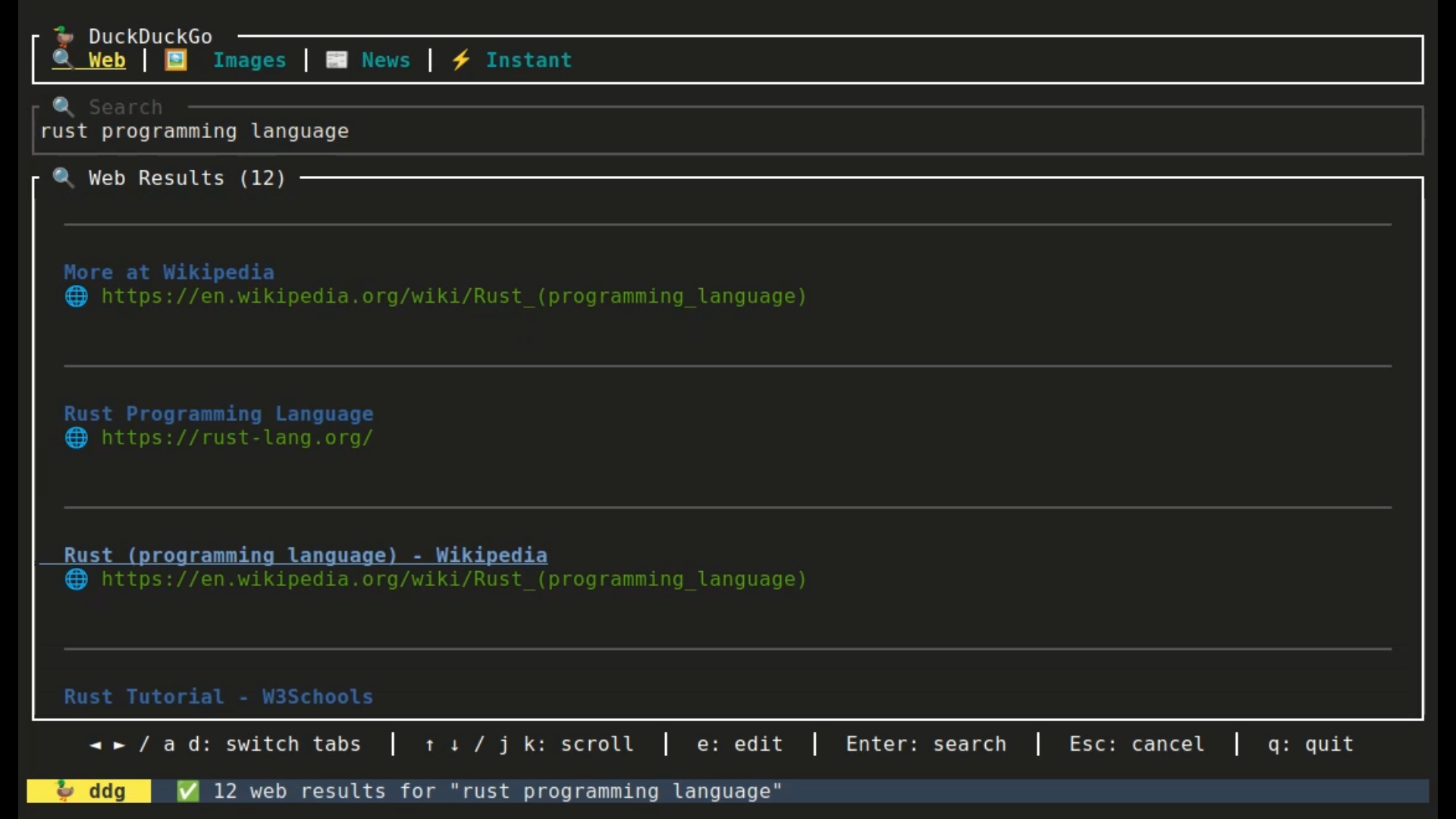 |
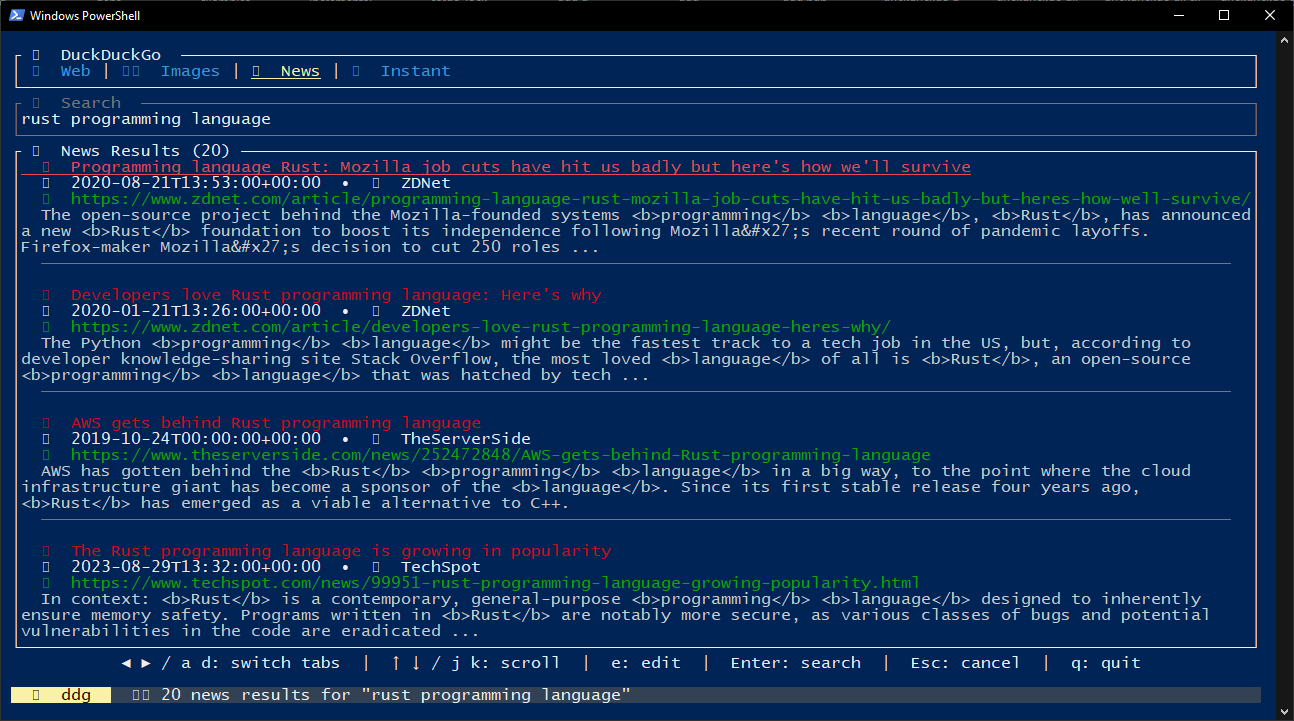 |
|
|
Download ddg binary |
Download ddg.exe binary |
docker pull wiseaidev/ddg |
apt install ddg-rs (TODO: Publish) |
cargo install duckduckgo --features rust-binary |
cargo install duckduckgo --features rust-binary |
docker run -it wiseaidev/ddg |
dnf install ddg-rs (TODO: Publish) |
ddg ← launches TUI |
ddg ← launches TUI |
Read DOCKER.md | Read PACKAGING.md |
🤔 What does this crate provide?
The library exposes 4 search backends:
- Instant Answer: the official
api.duckduckgo.comJSON endpoint, which returns structured data including abstracts, definitions, direct answers, and related topics. - Lite: the minimal
lite.duckduckgo.comHTML interface, which returns plain text results without JavaScript. - Images: paginated image results via
duckduckgo.com/i.js. - News: paginated news articles via
duckduckgo.com/news.js.
A comprehensive SearchParams
builder covers every documented DuckDuckGo URL parameter: region, safe-search,
theme, colours, fonts, header behaviour, and more.
🦀 Rust
The Rust crate is available on crates.io. For a complete API reference, installation guide, and worked examples, visit the Rust Usage Guide.
The crate ships the following Cargo features:
| Feature | Description |
|---|---|
rust-binary |
Enables the standalone ddg terminal CLI executable |
python |
Python extension module via pyo3 |
node |
Node.js native add-on via napi-derive |
🌐 WebAssembly (WASM)
duckduckgo natively supports the wasm32-unknown-unknown target! Because it uses reqwest under the hood, it seamlessly switches to the fetch API when deployed in the browser.
To resolve CORS issues, the library uses a 4-tier strategy: direct DDG calls, optional self-hosted or public proxies, and a guaranteed Wikipedia fallback. This ensures your search always returns a result, even without a proxy.
This makes it perfect for client-side search inside Rust frontend frameworks like Yew, Dioxus, and Leptos. We actively use this technique in the llm/examples/chat application.
For CORS considerations, code examples, and usage details, read the WASM usage guide.
🐍 Python
The Python bindings are published to PyPI as ddg-rs and can be installed
with pip install ddg-rs. The package is built with
maturin and ships pre-compiled wheels for the major
CPython versions.
The Python module exposes the Browser, SearchParams, LiteSearchResult,
ImageResult, and NewsResult types. All network methods are synchronous -
they drive an embedded Tokio runtime so callers do not need an event loop.
For installation instructions, configuration options, and full method signatures, read the Python usage guide.
🟩 Node.js
The Node.js bindings are published to npm as ddg-rs and can be installed
with npm install ddg-rs. The package is built with
napi-rs and ships a pre-compiled .node add-on.
The module exposes the Browser class, SearchParams builder, and plain
object result types (LiteSearchResult, ImageResult, NewsResult,
InstantAnswerResponse). Like the Python API, all network calls are
synchronous within the binding.
For installation instructions, type definitions, and examples, read the Node.js usage guide.
💻 Command-line interface
The ddg binary supports full-text, image, news, and Instant Answer searches
directly from the terminal. It accepts a rich set of options including
user-agent selection, cookie storage, HTTP proxy support, safe-search, and a
choice of result backends.
For the full option reference and usage examples, see the
CLI documentation or run ddg --help after installing with
cargo install duckduckgo --features rust-binary.
🐳 Docker Deployment
duckduckgo is completely containerized and includes the CLI and TUI pre-installed.
For instructions on pulling the container and usage, refer to the Docker usage guide.
📦 Linux Distros Packaging (TODO)
For system-wide installations that rely on native package managers, the project includes .deb and .rpm packaging pipelines. This enables installation via apt (Debian/Ubuntu/Kali) and dnf (RedHat/Fedora).
For packaging instructions and build flows, refer to the Linux Packaging guide.
🔒 Privacy
DuckDuckGo does not track users or personalise results. This library makes direct HTTPS requests to the same public endpoints that the browser does. No API key, account, or authentication token is required.
For more information about DuckDuckGo's privacy practices, visit duckduckgo.com/privacy.
📚 Further reading
- DuckDuckGo Instant Answer API
- DuckDuckGo URL Parameters reference
- DuckDuckGo Search Syntax
- DuckDuckGo Help Pages
- Instant Answer API playground
📄 License
Licensed under the MIT License.
⭐ Star us
If you use or enjoy this toolkit, please leave us a star on GitHub! It helps others discover the project and keeps the momentum going and the coffee flowing ☕.

1 maintainer

Metadata
1 maintainer
Release files for ddg-rs 0.3.5
For a detailed explanation of source distributions (sdists) and built distributions (wheels), please see the package formats documentation.
Built distribution (wheel)
| File | Interpreter | ABI | Platform | Actions Reset |
|---|---|---|---|---|
| ddg_rs-0.3.5-cp314-cp314-manylinux_2_38_x86_64.whl | CPython 3.14 | CPython 3.14 | Linux glibc 2.38+ x86-64 | Details for ddg_rs-0.3.5-cp314-cp314-manylinux_2_38_x86_64.whl |
Release files / ddg_rs-0.3.5-cp314-cp314-manylinux_2_38_x86_64.whl
| Download URL | ddg_rs-0.3.5-cp314-cp314-manylinux_2_38_x86_64.whl |
|---|---|
| Size | 3.4 MB |
| Tags | CPython 3.14 Linux glibc 2.38+ x86-64 |
|
SHA-256 checksum How to use checksums |
718dad67db1c6539be114380c3157ebeac721955bc0e430961e5bc73b54b0831
|
|
BLAKE2b-256 checksum How to use checksums |
ad046f9c59fed4e9b6e9d3c1b1e98298ae1f4c66e19efd542d016ab69fae42b9
|
| Upload date | |
|
Uploaded using Trusted Publishing? What is trusted publishing? |
No |
| Uploaded via |
twine/7.0.0 CPython/3.13.16
|
Security for ddg-rs 0.3.5
Provenance
Provenance describes where a file came from. On PyPI, provenance is shared via attestations, which provide a verifiable record of the build or publishing details. View details, limitations and caveats.
No provenance found
None of the files in this release were uploaded with provenance metadata.
A note on package security
PyPI is a repository for distributing packages, not a service for auditing them. While third-party security researchers and our staff do their best to detect and remove malicious packages, PyPI cannot guarantee the quality, security or suitability of any given package.
To learn more about protecting yourself from malicious actors, visit our package security documentation.














