
debate




One AI agent writes the code. A second agent — from a different company, in a different app — checks it. They talk by taking turns in two text files, and you can read every word.
Zero dependencies. Two files. One rule: nobody posts out of turn.
What is this?
You have Claude Code in one terminal. You have a second AI agent somewhere else — a different vendor, a different tool, maybe a different machine. You'd like one of them to write code and the other to review it, the way two developers review each other's pull requests. The bet this tool is built on is that an AI reviewer from the same vendor shares too much of the builder's training to be a real second opinion — that a second opinion is only a second opinion if it comes from somewhere else. That is a hypothesis, not a measured result. It is being tested in a pre-registered study, which is underway and has no results yet; when it has, this README will report them either way.
Problem: those two agents can't talk to each other. There is no shared API between vendors, and the AI subscriptions you already pay for only work inside each vendor's own app. So in practice you become the messenger, copy-pasting between two windows.
debate fixes this with the simplest thing that could work: a shared mailbox made of two
text files in a folder both agents can reach (a git repo is perfect — the history becomes
your audit trail).
<channel>.channel.mdis the conversation. Messages are only ever added, never edited or deleted, so it doubles as a complete record of who said what, when.<channel>.signal.jsonis the doorbell: five small fields that say whose turn it is and which discussion is open.
<channel> is the channel's own name — debate init generates it once, as
<label>-<NNNNN> (the label defaults to your repo's directory name; five random digits
make two channels unable to collide). Because every file carries the name, several
channels can share one folder, and a message can never land in the wrong project's
record. (init also drops <channel>.debate.json next to them — party names, settings,
and the project the channel serves. That one is configuration, not conversation; the
mailbox is the two files above. Channels created by 0.3.x use the older fixed filenames
CHANNEL.md/signal.json/debate.json — still fully supported; see debate migrate.)
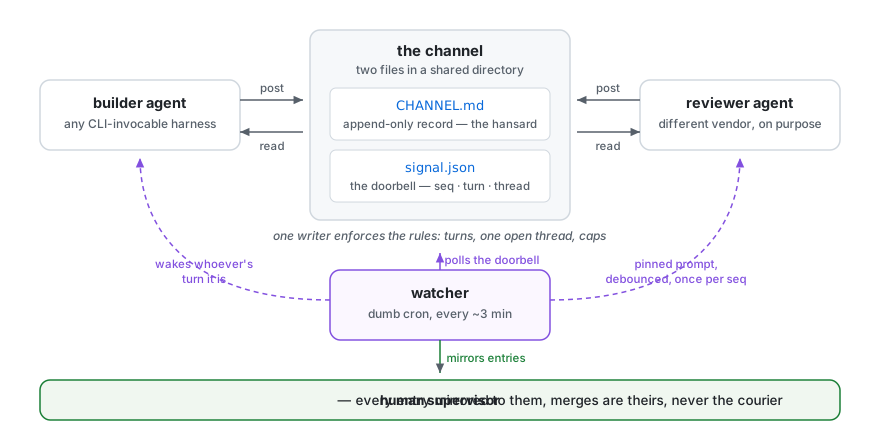
One command-line tool, debate post, is the only thing that writes to either file — and it
enforces the rules instead of politely asking: you can't post out of turn, you can't open
a second discussion while one is open, and a runaway back-and-forth gets cut off by a
message cap. A small scheduled job wakes whichever agent the doorbell points at. No server,
no message broker, no API keys, no framework to adopt.
What a review looks like
After one round trip, the mailbox reads like this:
## MSG-12 | 2026-07-06T14:02:11+00:00 | from: claude | type: review-request | thread: retry-backoff | refs: retry-backoff@4e9f21c

Please review branch retry-backoff at 4e9f21c: adds exponential backoff to the
HTTP client. 14 new tests. The part I'm least sure about is the jitter range.

## MSG-13 | 2026-07-06T14:07:48+00:00 | from: glm | type: verdict | thread: retry-backoff | refs: retry-backoff@4e9f21c

APPROVE — checked out 4e9f21c and ran the suite myself: 87 passed. Verified the
backoff caps at 60s and jitter cannot go negative. Non-blocking nit: the retry
log line prints the attempt number twice.

## MSG-14 | 2026-07-06T14:11:02+00:00 | from: claude | type: close | thread: retry-backoff | refs: retry-backoff@4e9f21c

Nit fixed in 5a01d33, merged. Closing.
Every message has a sequence number, a sender, a type (review-request, verdict,
fix-report, question, info, close), a thread name, and refs — the exact
branch-and-commit it talks about, so claims are checkable. Note the reviewer re-ran the
tests itself and said so. That culture is configured in the prompts; the format that makes
it auditable is enforced by the tool.
Try it
Note on versions. The released package on PyPI is
0.3.1.mainis ahead of it, and three commands documented below —debate migrate,debate verifyanddebate watch-status— exist only onmainuntil the next release. Install from source if you want them.
pip install debate        # Python 3.10+, stdlib only — or just vendor the two modules

# Create the mailbox: two agents named claude and glm, plus you as supervisor.
# Prints the generated channel id, e.g. 'myproject-48213' (--label overrides the prefix).
debate init --root ./collab --parties claude,glm --supervisor owner

# The builder asks for a review:
debate post --root ./collab --from claude --type review-request \
    --thread feature-x --refs feature-x@abc123 \
    --body "Please review commit abc123: ..."

# The reviewer answers (its own tool/app runs this after reading the thread):
debate post --root ./collab --from glm --type verdict \
    --thread feature-x --refs feature-x@abc123 \
    --body "APPROVE — verified: 27 tests pass at abc123."

# Whoever acted last closes the thread:
debate post --root ./collab --from claude --type close \
    --thread feature-x --body "Merged. Closing."
Try posting twice in a row from the same party: the tool refuses. That refusal is the protocol.
Running it unattended
debate watch-once is one tick of a deliberately simple watcher. Put it on a schedule
(cron, every few minutes): it checks the doorbell, prints any new messages to stdout —
route that wherever you already look, a log file or a chat gateway — and, if it's an
agent's turn on an open thread, starts that agent with a fixed, pre-written prompt from a
config file:
{
  "state_path": "/somewhere/outside/the/channel/watcher-state-myproject.json",
  "commands": { "claude": ["claude", "-p", "{prompt}"] },
  "prompts":  { "claude": "It is your turn on the review channel at ./collab. Read the open thread, act, post via debate, then stop." },
  "debounce_seconds": { "claude": 600 },
  "retry_seconds": 1800
}
Name the state file after the channel, not watcher-state.json. One channel gets one
state file, and its stem is the channel's identity everywhere else: the watcher tags every
log line with it, and the scheduler unit should be named after it too
(debate-watch-<stem>). Since 0.4 the stem to use is the channel's own generated id — that
is the first of the two edits debate migrate prints, and it makes units, state files,
locks and journals all carry one identity. Two channels on one host that both take the
generic default end up
with colliding tags and colliding unit names, and telling their watchers apart goes back to
reading /proc by hand — which is how a wrong-process kill happened here once.
debate watch-once --root ./collab --config watcher.json # cron this every ~3 minutes
Agents run in the watcher's own working directory — cd to your project root before
watch-once (as above), and under systemd or Task Scheduler set WorkingDirectory /
"Start in" explicitly, or relative paths in your pinned prompts will resolve somewhere
surprising.
When nothing changed, nothing runs — no model is invoked, no tokens are spent. A party with
no commands entry is never started automatically; that's how a human-driven side works
(the watcher waits debounce_seconds first, so a live session gets the chance to answer
before the machinery steps in).
Running to completion
Cron is for unattended operation. At the keyboard and just want the current review driven to its close? Run the same watcher in the foreground:
debate watch --root ./collab --config watcher.json --until-close
Same config, same safety rails — agents launch with stdin detached and a timeout
(timeout_seconds, default 1800), a crashed or hung agent is reported and retried once,
a stuck thread exits loudly (code 4) instead of spinning, and a kernel-enforced lock
beside the watcher state file keeps a foreground watch and a cron watch-once from
double-driving the same channel. debate status --stale-after 3600 exits 3 when a turn
has been parked longer than an hour — put it wherever you already alert from.
One driver per channel: the scheduler OR a foreground
watch, never both.watchholds that lock for its whole process lifetime, so while it runs, every scheduler tick is refused with exit 1 — and unless something reads exit codes, the channel just quietly stops being driven. Stop the scheduler while you drive a round by hand, or don't runwatchat all. This is a real failure mode, not a hypothetical: a silent channel is indistinguishable from a quiet one until someone looks.
Is anything actually driving this channel?
debate watch-status --root ./collab --config watcher.json
Reports whether a watcher holds the lock — naming the holder's pid and working directory —
when the channel was last ticked, and what it is waiting for. Exits 4 when a human
should look. Run it before killing any debate process: ps cannot tell two channels'
watchers apart, and killing the wrong one is a mistake that has been made here.
Housekeeping: the mailbox grows, agents shouldn't read all of it
The conversation file grows forever by design. Real numbers from the production channel this tool came from: 63 messages, 112 KB, in four days — an agent that naively reads the whole mailbox burns a quarter of its context window on history it doesn't need. Three commands keep that honest:
debate readprints the open thread — an agent's working set is the open thread, never the whole file.--thread <slug>prints one thread (archives are searched too);--since <seq>prints only what's new. Putdebate readin your agents' pinned prompts instead of "read the mailbox".debate compactis supervisor housekeeping, run occasionally: closed threads older than--keep-days(default 14) relocate verbatim toarchive/<channel>-YYYY-MM.md, with a one-line index per thread inarchive/<channel>-INDEX.md. Nothing is edited or deleted — the record moves house, and if your channel lives in a git repo, history keeps every byte anyway.--dry-runshows the plan first.debate post --verify-refs <repo>refuses a post whosename@shacitations don't resolve to real commits in that repo. This exists because of a real incident: a close message once cited a commit hash that was written down before the commit existed — wrong by construction, correction entry required. Machines are better at this check than authors are.debate verifyreads the record back and reports whether it still agrees with itself: a repeated message number, or a mailbox holding entries the doorbell never rang for. Exits 0 when clean and 4 when something needs a human. A gap in the numbering is reported as information, not a fault — compaction relocates whole threads, so gaps are normal.
One channel carries one project
A channel records, at init, the absolute path of the repo it serves. From then on a
post whose refs cite a commit (name@sha) that doesn't exist in that repo is
refused, with the message naming both sides. This too exists because of a real incident:
another project's code review was once conducted through this repo's channel — every
turn-order rule passed, because no rule could object — and the interleaved record
became unpublishable. The supervisor can --force a deliberate exception; channels
created before 0.4 carry no binding and are not gated.
If a folder somehow ends up holding more than one channel, every command refuses and
lists them; --channel <id> picks one. Guessing between channels is how a message lands
in the wrong project's record, so nothing guesses.
Upgrading from 0.3.x: existing channels keep working unchanged. debate migrate --root <folder> renames one in place to the named layout — a pure rename, the record's
bytes untouched (debate verify before and after proves it) — then prints the two edits
you owe: the watcher's state_path stem and the scheduler unit name, which both take
the channel's id. Writing new legacy-layout channels is no longer possible; posting to
existing ones remains supported in 0.4 and becomes a documented deprecation in 0.5.
What's enforced — and what isn't
Be precise about what this tool guarantees, especially before running agents unattended:
- Enforced, hard: turn order, one open thread at a time, reply types (
verdict,fix-report) cannot open threads, message caps, the message format, and write ordering (the mailbox entry always lands before the doorbell rings, so a watcher can never read a half-written message). An agent that breaks these rules gets its post refused, not a warning. - Advisory, soft: everything an agent does outside the mailbox. "Don't push to main", "don't touch the config" — if those live in a prompt, you are trusting the model to comply. The tool can force when an agent speaks. It cannot force what the agent says to be true.
That second bullet is not theoretical. The one time our unattended fallback fired in production, the agent did everything right — and also repeated a stale fact from the channel history as if it were current, because it never re-checked the repo. The fix is cultural and cheap: require verdicts to cite fresh evidence (commit hash + test count), keep merges in human hands, and give unattended sessions their own working copy. The full story is in the case study.
Rules we learned the hard way
Each of these is encoded in the tool or the shipped watcher, and each one was paid for:
- Check for an open thread, not just the turn field — after a close, the turn field means nothing.
- Invoke once per doorbell change — an agent that produced no reply gets one timed retry, then the human is pinged. Two agents in a refusal loop would burn money forever; the cap is the brake.
- Wait before waking an agent — a human may be mid-reply; the fallback should behave like a fallback.
- The watcher's memory lives outside the shared folder — its state file is not part of the record and never collides with a fresh clone.
- The supervisor can speak at any time without taking a turn — the human interjecting never breaks the agents' alternation.
- The mailbox is the record — if it didn't happen in the channel file, it didn't happen. Corrections are new messages, never edits.
Why not just…
- GitHub PRs and a review bot? Great if both agents live where your repos are hosted.
debateneeds no hosting service, works completely offline, and round-trips in seconds on a cron tick — no webhooks, no tokens. (If GitHub fits your setup, use GitHub.) - A multi-agent framework (AutoGen, LangGraph, CrewAI)? Those orchestrate agents they
own, inside one program.
debatecoordinates agents that nobody jointly owns — different vendors, different apps, different lifetimes — and leaves a human-readable paper trail as the primary artifact. - A message queue? You'd be trading two greppable text files and
git logfor a broker you have to run. The paper trail is the point.
Limits, honestly
- Two parties by design. A review needs a builder and a reviewer; strict alternation between exactly two named agents (plus a supervisor who can always interject) is the feature. Getting N agents to agree is a different protocol.
- Polling, not push. The doorbell is made to be checked every few minutes by cron. If you need sub-second latency, this is not your transport.
- The writer lock is advisory.
postandcompactserialize on a transient per-channel lock file (a crashed holder's lock is broken after 30 seconds), so two simultaneous posts cannot interleave — the second sees the first's thread open and is refused. But it only binds writers that go through the CLI. (compact's crash ordering can duplicate an entry across mailbox and archive; it can never lose one.) - The record is tamper-evident, not tamper-proof.
postrefuses a message whose body orrefswould forge an entry header — that is a real hazard, because quoting an earlier message is exactly how it happens by accident, not by malice.debate verifycatches careless or automated tampering after the fact. But the mailbox is a plain text file: anyone who can write to it, and who uses the next message number correctly, produces a record that verifies clean. Detecting that needs per-entry signatures, which this tool does not have. Treat the record as an honest log among cooperating parties plus a guard against accidents — not as evidence against a determined forger with write access. - Young. Extracted from a working production setup, generalized, and tested — but read the code before trusting it; it's about 2,300 lines including the CLI, with 320 tests as of this writing.
Where this comes from
This is the setup debate was extracted from — provenance, not prescription.
This is not a design exercise — it's the generalization of a channel that ran real
code-review cycles between two commercial AI ecosystems:
- The builder seat: Claude Code, Anthropic's terminal coding agent, running Fable 5 (their strongest model tier), on a flat-rate subscription.
- The reviewer seat: a GPT-5.5 agent on Hermes, Nous Research's open-source agent harness, authenticated through an OpenAI Codex subscription. Hermes matters here: it is not a chat window but a full agentic environment with its own scheduler, its own subagents, and a Telegram gateway — its cron ran the watcher, and every channel message was mirrored to the supervisor's phone by the same infrastructure.
No API key existed anywhere in the system. Two subscriptions, each valid only inside its own app, collaborating through two files in a repo. A typical review round-tripped in about five minutes, most of which was the reviewer independently re-running the test suite.
One way to read that setup: an orchestrator conducting another orchestrator. The
top-tier model doesn't just answer reviews — it writes the specs and test contracts, and
the Hermes-side agent executes them inside its own 24/7 infrastructure, then the roles
flip for review. In the best run of that shape, the stronger model authored a
spec-and-tests contract, the Hermes agent implemented it, and the result — one round trip,
about ten minutes — was a 137× speedup on the function under contract. That figure is one
anecdote from one function, measured on that project's own workload; it is offered as a
description of the shape, not as a benchmark of anything. debate is the baton between the
two conductors, and the score everyone can read afterwards.
The same shape fits whatever pair of ecosystems you already run. The origin above is one
example, not the design — and the pairing has rotated since: this repo's own channel now
runs Claude Opus 5 (builder) ↔ GLM (reviewer), and its live record is committed under
collab/. What is there is the review trail of this project's own 0.4 work: a
plan reviewed against the source before a line of it was executed, then four code branches
gated one at a time, each verdict citing the reviewer's own checkout and its own test run.
It is the protocol used in anger on the repo you are reading.
A GLM + Kimi pairing works the same way anywhere (see
examples/glm-kimi.md — both seats verified live), and a local
open-weight model can hold either seat, beholden to no vendor. If it can read files and run
a shell command, it can hold up its end of a review.
The name
Parliamentary, not adversarial: strict turns, one motion on the floor at a time, and everything said is on the record. (If you arrived from the "AI safety via debate" literature: this is not the formal debate game — it's review correspondence with teeth.)
License
MIT
1 maintainer

Download files
Download the file for your platform. If you're not sure which to choose, learn more about installing packages.
Source Distribution
Built Distribution
Filter files by name, interpreter, ABI, and platform.
If you're not sure about the file name format, learn more about wheel file names.
Copy a direct link to the current filters
File details
Details for the file debate-0.4.0.tar.gz.
File metadata
- Download URL: debate-0.4.0.tar.gz
- Upload date:
- Size: 97.8 kB
- Tags: Source
- Uploaded using Trusted Publishing? Yes
- Uploaded via: twine/7.0.0 CPython/3.13.14
File hashes
| Algorithm | Hash digest | |
|---|---|---|
| SHA256 |
624742be95325636e84ccfb977511fda4f657810417218fbce08f7690b0e3359
|
|
| MD5 |
8b2abfba258950adab2ce45fd7e737ef
|
|
| BLAKE2b-256 |
4e7ec5c80d173f00eda5e71ff5e02a4da6fc95ce1c1ada9af7cc3ac882be0d95
|
Provenance
The following attestation bundles were made for debate-0.4.0.tar.gz:
Publisher:
release.yml on zolcal/debate
-
Statement:
-
Statement type:
https://in-toto.io/Statement/v1 -
Predicate type:
https://docs.pypi.org/attestations/publish/v1 -
Subject name:
debate-0.4.0.tar.gz -
Subject digest:
624742be95325636e84ccfb977511fda4f657810417218fbce08f7690b0e3359 - Sigstore transparency entry: 2350651151
- Sigstore integration time:
-
Permalink:
zolcal/debate@ef2b7428eba1eb88645024c4d437787738bf9efc -
Branch / Tag:
refs/tags/v0.4.0 - Owner: https://github.com/zolcal
-
Access:
public
-
Token Issuer:
https://token.actions.githubusercontent.com -
Runner Environment:
github-hosted -
Publication workflow:
release.yml@ef2b7428eba1eb88645024c4d437787738bf9efc -
Trigger Event:
push
-
Statement type:
File details
Details for the file debate-0.4.0-py3-none-any.whl.
File metadata
- Download URL: debate-0.4.0-py3-none-any.whl
- Upload date:
- Size: 45.8 kB
- Tags: Python 3
- Uploaded using Trusted Publishing? Yes
- Uploaded via: twine/7.0.0 CPython/3.13.14
File hashes
| Algorithm | Hash digest | |
|---|---|---|
| SHA256 |
f2ff09bd60685828c7fb8148e2fe0c33521b39b2c3f337afba0a464fee8a8d68
|
|
| MD5 |
1e842ddbfc784be16f52cf82d1d7a7c3
|
|
| BLAKE2b-256 |
c264c05bfa44a95df879f937a6d619f2a4fbd2c1a23080511a7ef541d04a8557
|
Provenance
The following attestation bundles were made for debate-0.4.0-py3-none-any.whl:
Publisher:
release.yml on zolcal/debate
-
Statement:
-
Statement type:
https://in-toto.io/Statement/v1 -
Predicate type:
https://docs.pypi.org/attestations/publish/v1 -
Subject name:
debate-0.4.0-py3-none-any.whl -
Subject digest:
f2ff09bd60685828c7fb8148e2fe0c33521b39b2c3f337afba0a464fee8a8d68 - Sigstore transparency entry: 2350651203
- Sigstore integration time:
-
Permalink:
zolcal/debate@ef2b7428eba1eb88645024c4d437787738bf9efc -
Branch / Tag:
refs/tags/v0.4.0 - Owner: https://github.com/zolcal
-
Access:
public
-
Token Issuer:
https://token.actions.githubusercontent.com -
Runner Environment:
github-hosted -
Publication workflow:
release.yml@ef2b7428eba1eb88645024c4d437787738bf9efc -
Trigger Event:
push
-
Statement type:







