
decider: one-pass typed decisions with calibrated probabilities



A language model that does not generate text. It reads a state and a set of typed questions and returns, from one forward pass, a probability distribution for every question.
A typed decision is a question with a fixed answer set: Choice over 2 to 255 options, Score over 2 to 10 described levels, or Noul, the probability of yes. There is no decoding, no parsing, and no output outside the options you defined.
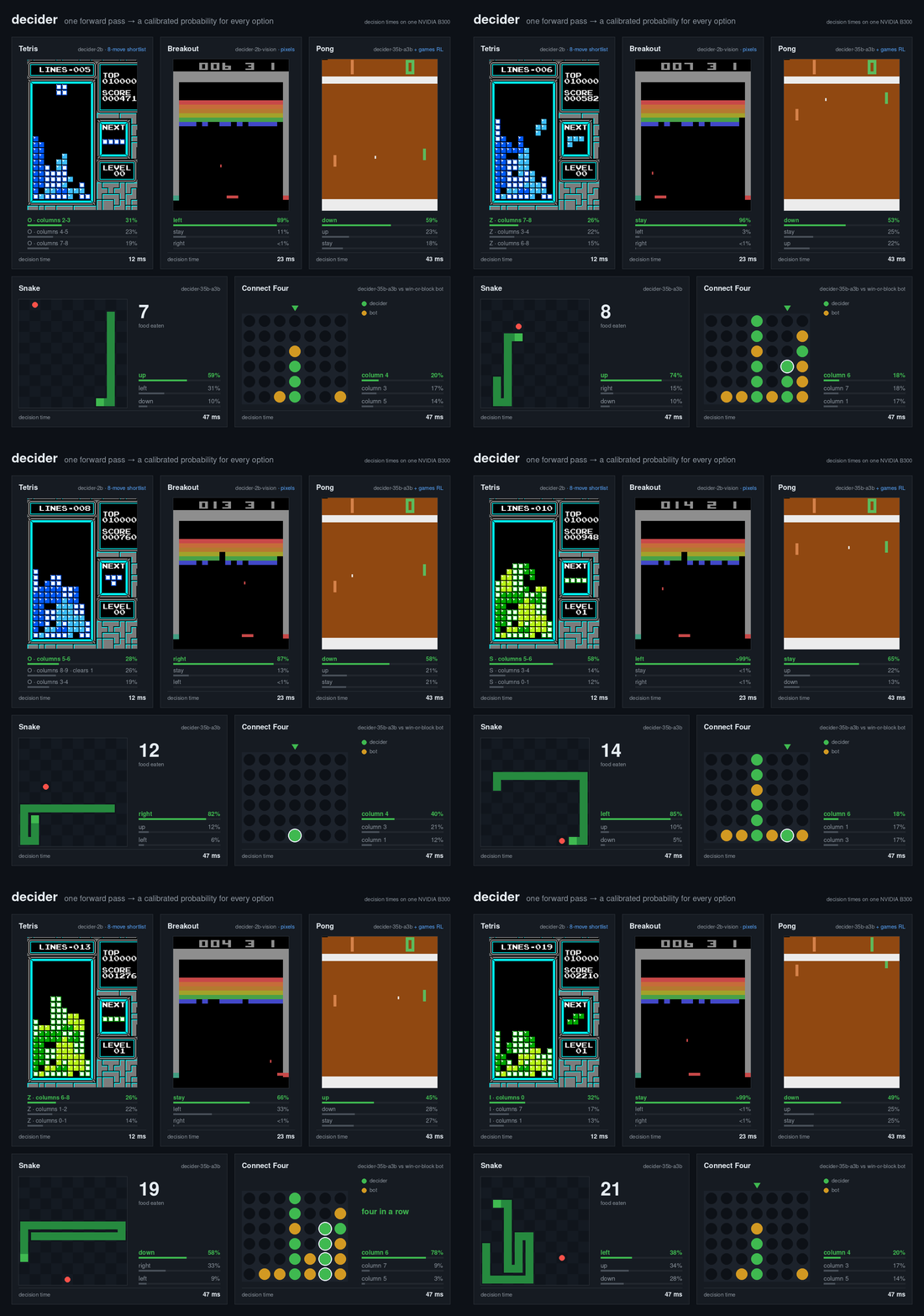
Recorded episodes; every move is one forward pass, and the bars are the served probabilities. Tetris: the harness shortlists 8 placements with a hand-tuned heuristic and states their consequences, and the model picks one (20 lines per game, against 0.6 for a random pick from the same 8). Pong uses an unreleased games-RL overlay. Sources, seeds and windows: docs/DEMOS.md.
Independence. This is an independent project. It is not affiliated with or endorsed by TypeSafe AI. It is an open
reproduction of the "System One" model class (TypeSafe AI's Jev): a 2B model built on Qwen/Qwen3.5-2B-Base, a 4B model built on
Qwen/Qwen3.5-4B-Base and a 35B mixture-of-experts model built on Qwen/Qwen3.5-35B-A3B-Base. The training mixture is public datasets plus data labelled by a
local Qwen3.5-27B teacher (teacher_data/, decider/data/mixture.py). Nothing was distilled from Jev.
Contents: What's new · Standing · Models · Runs on · Quick start · Train your own · How it works · Limits · Results
What's new
- 2026-09-25 — decider-ai 1.5.0:
decider.serve_vllm. The/v1/systemonereadout served by vLLM 0.29.0, for large stock checkpoints read in the chat layout, such as Qwen/Qwen3.6-27B at temperature 1.943 (the Decision Index entry "Decider chat · Qwen3.6-27B"). Same prompt rows, same answer slot, softmax of the option-letter logits over T. On one idle B300, one request at a time over the Decision Index 0.2 sample: median 32.3 ms and p95 430 ms, against 40.1 / 712 ms fordecider.serve1.4.0; 99.6% argmax agreement with the submitted run. vLLM needs numpy 2, so it is installed in its own environment (Serving on vLLM).DECIDER_LAYOUT=chatalso letsdecider.serveread a stock checkpoint in the chat layout. - 2026-09-24 — decider-4b v2.1, decider-2b v11 and decider-ai 1.4.0. Both models are their parent plus a LoRA stage on
harder decisions whose replay rows are trained toward the parent's own answers, and both configs set one temperature per
answer type (
temperature_by_type, read by decider-ai 1.4.0; older versions use the singletemperature). decider-4b v2.1 gets back most of the sampled play v2 lost (bag-draw games 52% against 38% wins, live browser 93% against 88%) at v2's level on hard sets (JevBench public hard tier 0.649 against 0.676), and is less well calibrated on hard items than v2. decider-2b v11 is 10 to 11 points above v10 on our held-out hard sets and at 0.577 against 0.459 on the JevBench public hard tier, and 2.2 points lower on human-labelled public sets. Neither passed its pre-registered release rules; the model cards list every failure. v2 and v10 stay under the Hub tagsv2andv10. 1.4.0 also addspython -m decider.calibrate, which fits the per-type map from your own labelled answers. - 2026-09-24 — decider-4b v2. v1 plus a LoRA stage on harder decisions (generated decision families, document questions
written by Qwen3.6-27B and kept when two independent answers agreed, human-labelled sets, replay of v1's data). JevBench
public hard tier 0.676 against v1's 0.550 with hard-tier ECE 0.071 against 0.288 (recomputed at the release temperature from stored probabilities; 6 Score items kept at the candidate temperature), OpenJev +2.8 points, Bespoke's suite 0.773;
about 1 point lower on the regression set (0.824 / 0.779) and worse in sampled play (bag-draw games 38% against 57% wins).
v1 stays under the Hub tag
v1; the model card says who should keep it. Same size and prompt layout, so no package change. - 2026-09-22 — decider-4b v1. Qwen3.5-4B-Base, one pass over mixture v2 (the public mixture plus 26 further public datasets and ten programmatic families), AdamW on bf16 parameters, no RL stage. Above decider-2b v10 on 87 of 95 regression tasks (0.834 / 0.788 against 0.805 / 0.755), JevBench hard tier 0.541, Bespoke's suite 0.757; level with the 2B on TypeSafe and OpenJev and 17 points below it on the held-out browser tasks. 8.4 GB bf16.
- 2026-09-22 — 1.1.0: the HTTP server captures its CUDA graphs at start-up. On the default path no request compiles or
captures a graph (the opt-in schema cache still captures one graph set per schema the first time it is used); request-size
and queue limits;
DECIDER_COMPILEandDECIDER_FP8default off. Details in docs/CHANGELOG.md. - 2026-09-22 — 1.0.2 fixes wrong answers from the cached shared-state path on Blackwell (a cuDNN attention backend fault; the engine now turns that backend off). Upgrade if you serve long shared-state requests; details in docs/CHANGELOG.md.
- 2026-09-22 — On PyPI as
decider-ai(the import name staysdecider). - 2026-09-22 — Apple Silicon. MPS acceleration for the dense models (0.8B, 2B, 2B vision), merged from pull request #2 by @simply-sunny. See Runs on.
- 2026-09-20 — decider-35b-a3b v1, and its NVFP4 build. The supervised recipe on Qwen3.5-35B-A3B-Base, routed experts frozen, Muon on the block matrices; above decider-2b v10 on 93 of 95 regression tasks; no RL stage.
- 2026-09-19 — decider-2b v10. The v8 weights plus 384 steps of calibration-aware RL on live browser tasks and exact games: sampled browser play 83% to 93%, belief 0.47 to 0.22 nats above the exact laws, everything else unchanged.
Earlier versions, v1 to v9, are in docs/CHANGELOG.md, with the per-stage measurements in docs/HISTORY.md.
Standing
Two third-party leaderboards rank this model class. Both were read on the dates given; we did not run them.
JevBench, read 2026-09-21 (Benchmark Heaven, harness at fstandhartinger/jevbench). 36 entries; the total score combines four axes, and speed and cost are measured from the operator's server.
| system | score | intelligence | calibration | speed | cost |
|---|---|---|---|---|---|
| Jev 1.13.0 (TypeSafe AI, #1) | 75.4 | 90.4 | 82.7 | 83.3 | 52.0 |
| SemIf (Qwen3.5-4B, #2) | 74.7 | 85.9 | 72.6 | 83.7 | 59.5 |
| decider-35b-a3b (#10 of 36) | 68.9 | 86.3 | 71.5 | 80.8 | 45.3 |
| decider-2b (#21 of 36) | 64.6 | 73.8 | 46.6 | 83.2 | 61.0 |
Our 35B is pulled down by cost (45.3, priced as a 35B), the 2B by calibration (46.6).
Decision Index, edition v0.1 dated 2026-09-22 (leaderboard, kit at apolinario/decision-index). 32 entries, 132,422 requests, 37 benchmarks, scored on a 19-benchmark panel.
| system | score | rank |
|---|---|---|
| Jev | 59.5 | 1 |
| jevfire (zero-training wrapper on a stock 27B-class model) | 55.7 | 2 |
| joshua-diffusion (zero-training wrapper on a stock 27B-class model) | 55.6 | 3 |
| decider-35b-a3b (NVFP4) | 54.3 | 4 |
| decider-2b | 44.0 | 14 |
decider-35b-a3b is fourth of 32 and the highest-scoring trained model on this edition; the two entries above it are zero-training wrappers.
Where Jev leads
The gap to Jev is the knowledge area. Per-area scores on the Decision Index panel, decider-35b-a3b against Jev:
| area | decider-35b-a3b | Jev |
|---|---|---|
| knowledge (GPQA, GSM8K, CRUXEval, MMLU) | 0.51 | 0.69 |
| language | 0.61 | 0.62 |
| retrieval | 0.34 | 0.37 |
| tools | 0.72 | 0.73 |
| arts | 0.53 | 0.56 |
Language, retrieval, tools and arts are within 0.03. Knowledge is 0.18 behind, on GPQA, GSM8K, CRUXEval and MMLU. The same weakness shows on JevBench's 111 public hard items, which are long policy texts, multi-hop and temporal-numeric reasoning: decider-35b-a3b 0.676, decider-4b v2.1 0.649 and decider-2b v11 0.577 against Jev's 0.730 (our runner and the harness's own per-task file, same items). The other axis we lose there is calibration on hard items; see Limits.
Models
Held-out means no example of that dataset was trained on. The regression set has 28 held-out tasks, the 94-task set 24; the two are not comparable to each other, and the NVFP4 row is measured against the bf16 build rather than on a held-out set. docs/RESULTS.md has all of them in full.
| model | base | parameters | context | held-out accuracy | weights |
|---|---|---|---|---|---|
| decider-2b v11 | Qwen3.5-2B-Base | 1.9B | 32k tokens | 0.752 (regression set) | Mapika/decider-2b |
| decider-4b v2.1 | Qwen3.5-4B-Base | 4.2B | 32k tokens | 0.784 (regression set) | Mapika/decider-4b |
| decider-35b-a3b v1 | Qwen3.5-35B-A3B-Base | 34.7B total, 3B active | 32k tokens | 0.810 (regression set) | Mapika/decider-35b-a3b |
| decider-35b-a3b-nvfp4 | the 35B in NVFP4, 19.6 GB | 34.7B total, 3B active | 32k tokens | 1.0 to 1.5 points under bf16 in vLLM | Mapika/decider-35b-a3b-nvfp4 |
| decider-0.8b | Qwen3.5-0.8B-Base | 0.8B | 32k tokens | 0.71 (94-task set) | Mapika/decider-0.8b |
| decider-2b-vision | Qwen3.5-2B vision-language, v5 text weights | 1.9B | 32k tokens | Visual7W 0.89 (see MODEL_CARD_VISION.md) | Mapika/decider-2b-vision |
decider-2b v10 and v8 stay available under the Hub tags v10 and v8 of Mapika/decider-2b, and decider-4b v2 and v1 under the
tags v2 and v1 of Mapika/decider-4b. decider-4b is the first model trained on mixture v2 (the public mixture
plus 26 further public decision datasets and ten programmatic families with verifiable gold); the mixture-v2 builders are not
yet in this package, scripts/train.sh full reproduces the public 60% of its data. decider-2b-vision has a
browser demo, a Space built by the Hugging Face team.
Runs on
- CUDA. bf16,
torch.compile, shape-bucketed CUDA graphs, optional FP8 (e4m3) linears. The 2B needs about 4 GB, the 4B 8.4 GB, the 35B 65 GB in bf16 or 19.6 GB in NVFP4. - Apple Silicon, MPS. Merged 2026-09-22 from pull request #2 by @simply-sunny. On an M1 Pro in float16, across the
three 2B smoke-test workloads, the median request is 133 ms with the patch and 171 ms without it; on the held-out MASSIVE
Scenario set (1,500 examples, temperature 1.30) the MPS path scores accuracy 0.7553 and ECE 0.0438 against the published
bf16 row's 0.756 and 0.041. Conditions:
docs/benchmarks/mps-full-model.md,docs/benchmarks/mps-heldout.md. - CPU. The library and the HTTP server run on CPU in bfloat16, eager; the unit tests run without a GPU:
python -m pytest tests.
Quick start
pip install decider-ai # or: git clone https://github.com/Mapika/decider && pip install -e ".[serve]"
On Apple Silicon, pip install "decider-ai[metal]" adds the optional MLX/Metal kernel. Without it, MPS inference uses the PyTorch implementation.
from decider.infer import Decider
d = Decider("Mapika/decider-2b")                             # one CUDA GPU, bf16, about 4 GB; downloads the weights on first use
d.system_one(
    {"ticket": {"messages": [{"from": "customer", "text": "I was charged twice for order A-104. Please refund the duplicate."}]},
     "refund_policy": "Duplicate charges are eligible for a refund."},
    {"department": {"type": "choice", "instructions": "Which team should handle this?",
                    "criteria": {"returns": "Exchanges, refunds, wrong or damaged items", "billing": {"what": "Charges, invoices", "not_for": "delivery"}, "other": None}},
     "refund_requested": {"type": "noul", "instructions": "Does `ticket.messages[0].text` request a refund?"},
     "frustration": {"type": "score", "instructions": "How frustrated is the customer?", "criteria": ["calm", "frustrated", "very frustrated"]}})
# {"answers": {"department": {"choice": "billing", "confidence": 0.34, "x_p_max": 0.56, "certainty": 0.37, "probabilities": {"returns": 0.44, "billing": 0.56, "other": 0.00}},
#              "refund_requested": {"noul": 0.99},
#              "frustration": {"score": 0.76, "probabilities": {"0": 0.34, "1": 0.55, "2": 0.10}, "level_fit": {"0": 0.34, "1": 0.55, "2": 0.10}, "fit_mass": 0.99}}}
#                                                             (v10 weights; "returns" also mentions refunds, so the mass is split)

d.decide("My card was charged twice.", [{"question": "Which team?", "options": ["billing", "technical", "sales"]}])
# [{"choice": "billing", "confidence": 0.77, "probs": {"billing": 0.77, "technical": 0.19, "sales": 0.04}}]      the plain form
confidence on a Choice or Score answer follows TypeSafe's definition since decider-ai 1.3.0. For a Choice with n options it is
(n·p_max − 1)/(n − 1), where p_max is the largest probability: 0 when the probabilities are uniform, 1 when one option has all
of them. For a Score it is max(0, 1 − Σ pᵢ·|i − k| / D), where k is the most likely level and
D = (1/n)·Σ |i − (n − 1)/2| is the mean distance of the n levels from the middle of the scale. Before 1.3.0, confidence was p_max. x_p_max reports p_max on every Choice and Score answer; if
you tuned thresholds on confidence before 1.3.0, compare them with x_p_max instead. A Noul answer has no confidence; its
noul value is the probability of yes. A Noul question may omit instructions if its criteria describe true or false.
examples/ has three complete programs: confidence-gated routing, composite scoring, and a hierarchical beam over Choice
probabilities.
HTTP server
scripts/serve.sh Mapika/decider-2b 8000
POST /v1/systemone is TypeSafe's wire format, so their SDKs work unchanged with TYPESAFE_BASE_URL=http://localhost:8000;
POST /decide is the plain form. The server picks its device as Decider does (CUDA, else MPS, else CPU; DECIDER_DEVICE
overrides it). On CUDA it captures a CUDA graph for every (batch, length) shape at start-up, so on the default path no
request compiles or captures a graph; on MPS and CPU every request runs eager; requests over its size limits get HTTP 413 and an overloaded server
answers 503 (limits, defaults and measurements in docs/SERVING.md). The schema cache (a schema seen twice gets a cached prefix
and its own graphs, captured the first time that schema is used) is on only for a model whose decider_config.json sets
schema_first, or with DECIDER_SCHEMA_CACHE=1.
Serving a large stock model on vLLM
decider.serve_vllm (1.5.0) serves the same /v1/systemone readout on vLLM 0.29.0, for large checkpoints such as a stock
instruct model read in the chat layout. vLLM 0.29.0 needs numpy 2 and its own torch, and decider-ai pins numpy < 2, so it goes
in its own environment:
python -m venv decider-vllm && . decider-vllm/bin/activate
pip install vllm==0.29.0 fastapi "uvicorn[standard]" jinja2 huggingface_hub
pip install --no-deps decider-ai
DECIDER_MODEL=Qwen/Qwen3.6-27B DECIDER_LAYOUT=chat DECIDER_TEMPERATURE=1.943 DECIDER_VLLM_GPU_MEMORY_UTILIZATION=0.90 \
    uvicorn decider.serve_vllm:app --host 127.0.0.1 --port 8000
It answers independent /v1/systemone questions only (/decide and the schema cache stay decider.serve features). Design,
limits and measurements: docs/SERVING.md section 8.
Temperatures in decider_config.json
Every answer is a softmax over its option letters divided by a temperature from the model's decider_config.json:
| key | meaning |
|---|---|
temperature |
one value for every answer (default 1.0) |
temperature_by_type |
optional, decider-ai 1.4.0 and later: {"choice": T, "noul": T, "score": T}; a missing type uses temperature |
temperature_schema_first |
optional: the schema cache (questions-first layout); without it the cache uses the two keys above |
temperature_schema_first_by_type |
optional, 1.4.0 and later: per type on the schema cache; a missing type uses temperature_schema_first |
The keys of the maps are the /v1/systemone question types. A /decide field of type bool is a noul, scale is a
score, choice is a choice; Decider.decide() questions are choice. A Score question read with isolated levels (one
yes/no row per level) uses the score temperature on each of its level rows, because the rows form one Score answer.
Every value must be a finite number > 0, and any other key in a map is refused when the model is loaded.
Decider(path, temperature=T) and DECIDER_TEMPERATURE replace temperature and switch temperature_by_type off.
decider-4b v2.1 and decider-2b v11 have a map; the other released models have one temperature. decider-ai 1.3.0 and earlier
ignore the map and use temperature for every answer. python -m decider.calibrate records.jsonl fits the map by NLL
from answers read at temperature 1 (record format in decider/calibrate.py). /health reports the temperature each type gets.
Train your own
uv venv --python 3.12 .venv312 && uv pip install -p .venv312/bin/python -e ".[serve,train]"
scripts/train.sh full                       # datasets -> data/tasks.pkl -> data/mixture_full.pkl -> one epoch from Qwen3.5-2B-Base -> scripts/evaluate.sh
scripts/train.sh delta runs/some/model      # or: continue an existing decider checkpoint on the new formats + a replay sample
The full recipe and the data builders are in this repository: decider/data/ downloads and converts about 95 public datasets
and assembles the mixture (decider/data/mixture.py lists every component with its size), decider/train.py is the
fine-tune, scripts/evaluate.sh scores it. One epoch is 1.47M examples and 455M tokens, 5.3 h on a GH200 plus 45 min of
evaluation, and it reproduces the released supervised weights: it matches v9 on the 94-task set (in-task 0.809 against 0.812,
held-out 0.739 against 0.741) and every probe family within noise, with a fitted temperature of 1.03 instead of 1.36.
The RL stage that turns v8 into v10 (docs/RL.md) needs a live Chrome with MiniWoB++, the exact game environments and the training loop of a separate research repository; it is not in this package yet.
How it works
flowchart LR
  S["state<br/>text or JSON"] --> P["one prompt with<br/>one answer slot<br/>per question"]
  Q["typed questions<br/>Choice / Score / Noul"] --> P
  P --> F["one forward pass"]
  F --> L["letter logits at<br/>each answer slot"]
  L --> T["softmax over the valid<br/>options at a fitted<br/>temperature"]
  T --> O["one probability distribution<br/>per question"]
decider/prompt.py renders a request as text with one answer slot per question. decider/model.py reads the hidden state at
each slot, projects it onto one label token per option (A-J, then K-Z and two-letter tokens up to 255) and softmaxes over the
valid ones. Letters are never generated, so all slots come out of one pass. The temperature is fitted once on in-task data and
checked on held-out tasks. Every question can also be scored in its own row, and then adding, removing or reordering questions
cannot change another answer; every Score level is judged alone, without its number or its neighbours.
Two prompt layouts are trained, 50/50. State-first (Context ... Question ... Options ... Answer: () is the default.
Schema-first puts the question and option blocks before the state, so they form a prefix that does not depend on the
state: decider/schema_engine.py runs that prefix once per schema, keeps its cache read-only, and a request then runs only
Context: <state> plus the slots, as a CUDA graph per (batch, length) bucket. Schema-first trades accuracy for speed, so the
cache is opt-in; the cost is measured in docs/RESULTS.md.
Calibration
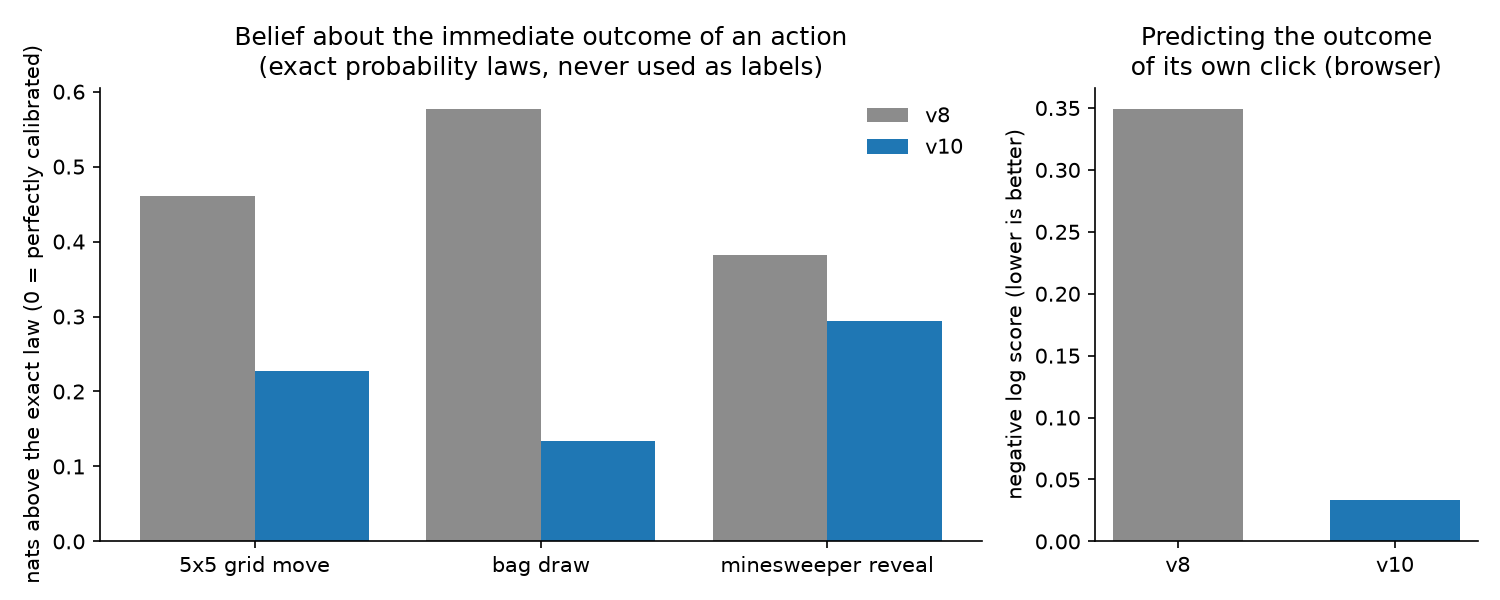
Calibration is what the v10 RL objective trains directly. For every action in a game with a known probability law the model is asked what will happen next, and its answer is scored against the exact law with a log score: v10 is 0.22 nats above the law where v8 was 0.47. In the browser it predicts the outcome of its own click at a log score of −0.03 against −0.35.
Limits, stated plainly
- One pass cannot do multi-step arithmetic. There is no chain of thought and no intermediate state, so GSM8K-type items, temporal arithmetic and multi-hop chains are out of reach. Split such a judgment into several questions.
- Calibration on hard items is the weak axis. decider-2b v10's top-label ECE on JevBench's public hard items is 0.31: it is confident where it is wrong there, and its calibration score on the JevBench leaderboard is 46.6. decider-2b v11 is at 0.18 there, decider-4b v2.1 at 0.18, the 35B at 0.15 and decider-4b v2 at 0.10 (0.07 at its release temperature). On our own held-out generated families v2.1 and v11 are at 0.15 and 0.16 against a limit of 0.08 that we set for release.
- Knowledge-heavy multiple choice. decider-2b improves little over its base model on MMLU and MedQA. decider-4b is higher (v2: MMLU +11, MedQA +13 points over decider-2b v10) and decider-35b-a3b more (MMLU +19 points) at 3 to 4 times the cost per decision; decider-4b v2.1 is at 0.649 and the 35B at 0.676 on JevBench's public hard tier, and neither has the RL stage.
- Optimizer setting on the 35B. decider-35b-a3b was trained with FP32 master weights (Muon on the block matrices, AdamW elsewhere). In later controlled runs that setting moved small models further from their base than the same schedule without a master copy, and cost accuracy on knowledge tasks. The 2B and the 4B were trained without a master copy and are not affected. A 35B retrain without it is planned.
- English only. Calibration is measured on public datasets and teacher-labelled probes, not on your traffic.
- The schema cache costs accuracy. Use it for fixed classification-style schemas with short states; see docs/RESULTS.md.
- Generic options need to look like buckets. v10 and v11 continue the v8 weights, so the v9 terse-bucket result (generic
0.86) does not apply to them; v8's 0.59 does. A plain
supportnext toothersends an in-scope complaint toother. - Rules written into the question are not followed at this size. On the form-filling probe a one-sentence question scores 0.67 and a paragraph of rules 0.24. A fixed convention has to be in the training data, not in the question.
- Picking a record out of a long JSON array by position is the least accurate input shape (0.51 with 64 records against
0.70 with one). Address records by key, or let
render_statewrite the index into the array (0.62). - Known regressions. TREC-fine with all 50 labels fell from 0.76 (v6) to 0.72 (v8). Held-out Freeway play fell to 0 and did not come back when the game data was replayed. OpenJev is 0.8 points lower on v10 than on v8. decider-2b v11 against v10: human-labelled public sets −2.2 points, knowledge guard −1.6, greedy bag-draw play −10.9, sampled browser play −2.8 (interval includes zero). decider-4b v2.1 against v1: BabyAI-GoTo 0.19 against 0.54, greedy bag-draw play −9.4, and issue #9's form case c_1 is answered wrongly.
- Teacher bias. The custom-question data is labelled by a 27B teacher that shares some of the biases it is meant to fix;
it agreed with only 72% of its own generic-option labels.
decider/data/mixture.pyshows how they are filtered. - Browser results are narrow. They are on the 22 click-only MiniWoB++ tasks: small synthetic pages, elements listed as text. Typing, scrolling and real websites were not tested.
- The vision variant (
decider/vision) is still on v5 text weights and is retraining. - Reproduction is not byte-identical. The released weights were produced by staged continuation runs;
scripts/train.sh fullreproduces the supervised stages in one run, and the 16-to-60-case hand-written probes move by a few cases either way.
Repository layout
decider/prompt.py        the two prompt layouts, label table, answer slots
decider/model.py         DecisionModel: backbone -> slot hidden states -> option logits
decider/systemone.py     Choice / Score / Noul with criteria -> prompt rows; typed answers; isolated levels
decider/infer.py         Decider: system_one(), schema() (compiled, cached question sets), decide()
decider/engine.py        CUDA graphs, torch.compile, shared-prefix scoring;  fp8.py, schema_engine.py, mps_ops.py
decider/serve.py         HTTP server: /v1/systemone, /decide, continuous batching
decider/serve_vllm.py    HTTP server on vLLM 0.29.0: /v1/systemone for large stock or chat-layout models;  vllm_worker.py
decider/data/            ~95 public datasets, input-shape augmentations, the mixture, the 27B teacher data
decider/train.py         cross-entropy fine-tune;  evaluate.py  accuracy / NLL / Brier / ECE / AURC per task
decider/probes/          hand-written batteries, question independence, isolated levels
decider/bench/           engine, schema-cache and MPS benchmarks, HTTP load test, Bespoke's public suite
decider/games/           ten text games + Super Mario Bros behind the same interface, imitation and PPO
decider/vision/          the vision-language variant (decisions from pixels)
moe/                     frozen-expert Muon training, evaluation and NVFP4 quantization for decider-35b-a3b
scripts/  examples/  tests/  teacher_data/  media/
docs/                    RESULTS.md (every measurement), CHANGELOG.md, HISTORY.md, RL.md, benchmarks/ (MPS)
Citation
@software{marosi2026decider,
  author = {Marosi, Mark},
  title  = {decider: one-pass typed decisions with calibrated probabilities},
  year   = {2026},
  url    = {https://github.com/Mapika/decider}
}
License
Apache 2.0. See LICENSE.
1 maintainer

Release files for decider-ai 1.5.0
For a detailed explanation of source distributions (sdists) and built distributions (wheels), please see the package formats documentation.
Source distribution (sdist)
| File | Size | Uploaded | |
|---|---|---|---|
| decider_ai-1.5.0.tar.gz | 252.0 kB | Details |
Built distribution (wheel)
| File | Interpreter | ABI | Platform | Reset |
|---|---|---|---|---|
| decider_ai-1.5.0-py3-none-any.whl | Python 3 | none | any | Details |
Total release size: 489.9 kB
Release files / decider_ai-1.5.0.tar.gz
| Download URL | decider_ai-1.5.0.tar.gz |
|---|---|
| Size | 252.0 kB |
| Tags | Source |
|
SHA-256 checksum How to use checksums |
53abf5dfd2ef219452799e642c21c98d3d6b42410a11bc83c5450c290334ab95
|
|
BLAKE2b-256 checksum How to use checksums |
1b44d253bbbf8a0ccde4e6d39a3d95d46d3ca44538fa1636d400980a9c8e090c
|
| Upload date | |
|
Uploaded using Trusted Publishing? What is trusted publishing? |
Yes |
| Uploaded via |
twine/7.0.0 CPython/3.13.14
|
Provenance
Provenance describes where a file came from. On PyPI, provenance is shared via attestations, which provide a verifiable record of the build or publishing details. View details, limitations and caveats.


PyPI Publish Attestation
PyPI verified that this artifact, at this checksum, originated from the publisher listed below.
Signed by GitHub Actions, verified by PyPI on Sep 25, 2026.
Transparency logRelease files / decider_ai-1.5.0-py3-none-any.whl
| Download URL | decider_ai-1.5.0-py3-none-any.whl |
|---|---|
| Size | 237.9 kB |
| Tags | Python 3 |
|
SHA-256 checksum How to use checksums |
f72af210ba442a40f7e80339419ea9aa811bec2d1bf4eafe63b392c3cb22d7cb
|
|
BLAKE2b-256 checksum How to use checksums |
834749053077330001b9e2e99a31459c45916f0e08a86b19fb93d53f73d2cfa9
|
| Upload date | |
|
Uploaded using Trusted Publishing? What is trusted publishing? |
Yes |
| Uploaded via |
twine/7.0.0 CPython/3.13.14
|
Provenance
Provenance describes where a file came from. On PyPI, provenance is shared via attestations, which provide a verifiable record of the build or publishing details. View details, limitations and caveats.
PyPI Publish Attestation
PyPI verified that this artifact, at this checksum, originated from the publisher listed below.
Signed by GitHub Actions, verified by PyPI on Sep 25, 2026.
Transparency log













