
DecisionFormer
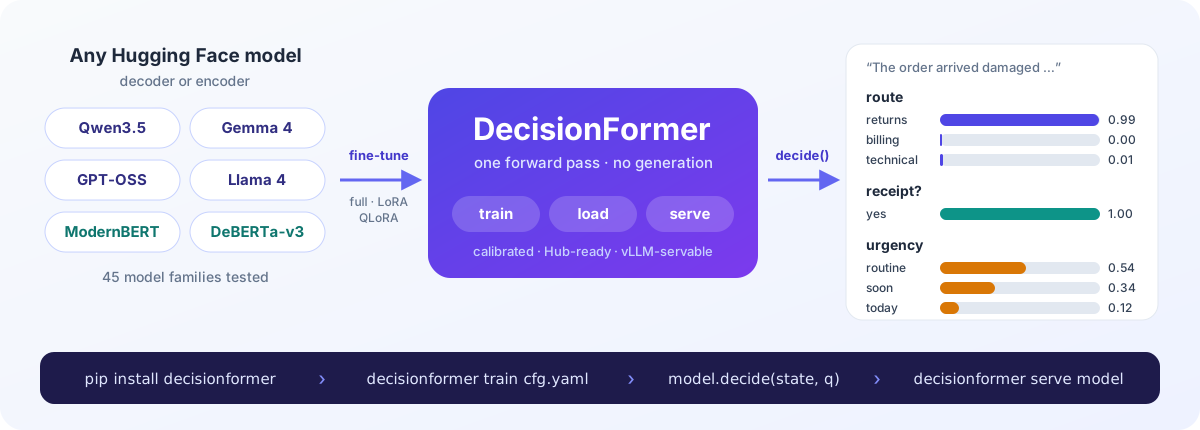
The simplest way to fine-tune and serve decision models on any Hugging Face model. Give it a state and typed questions; it returns a calibrated probability for every option in a single forward pass, with no text generation. Three lines to decide, one command to train, one command to serve.
Installation
Python 3.10 or newer, with PyTorch 2.6+ and transformers 5.20+.
pip install decisionformer                 # the library and CLI
pip install "decisionformer[serve]"        # with the API server
The latest code, or a development install:
pip install "decisionformer[serve] @ git+https://github.com/FrontiersMindAI/decisionformer.git"

git clone https://github.com/FrontiersMindAI/decisionformer.git
cd decisionformer
pip install -e ".[dev]"
Optional extras, combined as pip install "decisionformer[serve,qlora]":
| extra | adds |
|---|---|
serve |
the /v1/systemone API server (FastAPI, uvicorn) |
qlora |
bitsandbytes, for QLoRA |
vllm |
the vLLM serving backend (a vLLM build from 2026-10-15 or later) |
fla |
fast Gated DeltaNet kernels for Qwen3.5 backbones |
data |
datasets, for Hub datasets (hf: inputs) and the example converters |
Quick start
Inference in Python
from decisionformer import AutoDecisionModel

model = AutoDecisionModel.from_pretrained("vllm-sr/d3-edge")   # or your own fine-tune, local or on the Hub

response = model.decide(
    state="The order arrived damaged yesterday. The customer has a receipt and asks for a replacement today.",
    questions={
        "route": {
            "type": "choice",
            "instructions": "Which team should handle this request?",
            "criteria": {
                "returns": "Refunds, replacements and damaged deliveries",
                "billing": "Payments, invoices and charges",
                "technical": "Product setup and faults",
            },
        },
        "receipt": {
            "type": "noul",
            "instructions": "Does the customer have a receipt?",
        },
        "urgency": {
            "type": "score",
            "instructions": "How urgent is this request?",
            "criteria": ["Routine", "Soon", "Today"],
        },
    },
)
# {
#   "model": "vllm-sr/d3-edge",
#   "answers": {
#     "route": {
#       "type": "choice",
#       "choice": "returns",
#       "probabilities": {"returns": 0.9927, "billing": 0.0001, "technical": 0.0073},
#       "confidence": 0.9602
#     },
#     "receipt": {
#       "type": "noul",
#       "noul": 0.9995
#     },
#     "urgency": {
#       "type": "score",
#       "score": 0.5777,
#       "probabilities": {"0": 0.5393, "1": 0.3438, "2": 0.1169},
#       "confidence": 0.1343,
#       "legend": {"0": "Routine", "1": "Soon", "2": "Today"}
#     }
#   },
#   "usage": {"input_tokens": 345, "output_tokens": 0}
# }
choice picks one of the criteria, noul answers yes/no with the probability of yes, and score picks one of
2 to 10 ordered levels; every question needs a type. confidence is not the top probability: it is 1 minus the
normalized entropy of the probabilities, from 0 (all options equally likely) to 1 (certain), so a 0.51/0.49 choice
has a confidence near 0. Checkpoints in the AutoJev format report the top probability's margin over chance instead.
model.decide_many([...]) answers several requests in shared batches.
A model refuses requests longer than the length it was trained on (data.max_length, 1,024 tokens by default) with
a ContextLengthError (HTTP 422 from the server) instead of truncating them; pass max_length= to
from_pretrained, or --max-length to serve, to allow longer ones. On a CPU, vllm-sr/d3-edge (0.6B parameters)
answers a request in several seconds; the Decision Index's latency rule (a median of at most 1,000 ms per request)
needs a GPU.
Serve as an API
decisionformer serve vllm-sr/d3-edge --port 8000
curl localhost:8000/v1/systemone -H 'content-type: application/json' -d '{
  "state": "I was charged twice for my subscription this month.",
  "questions": {
    "angry": {"type": "noul", "instructions": "Is the customer angry?"}
  }
}'
The server takes the same state (required, may be empty) and questions and returns the same JSON as decide, with id, object and
created added. It is the System One API used by Jev, vLLM and the Decision Index; the request and response
schemas are at /docs. Over-long requests are refused with HTTP 422, never truncated, and
--api-key-env MY_KEY_VAR requires Authorization: Bearer <key>. A request that arrives while the model is idle
runs at once; requests that arrive while it is busy are answered together, up to --max-batch (16) at a time.
For code-readout checkpoints on Qwen3.5 (the Decision 3.0 layout), vLLM can run the model behind the same API. Other checkpoints fail with a clear error that points to the default backend:
pip install "decisionformer[vllm]"
decisionformer serve vllm-sr/d3-edge --backend vllm
Supported backbones
Every family below is fine-tuned, exported, reloaded and checked against the Decision Index's response rules in
tests/test_zoo.py, using tiny randomly initialized models of each architecture, newest first within each group.
Real checkpoints fine-tuned, exported and reloaded so far: Qwen3-0.6B, Qwen3.5-0.8B, SmolLM2-135M and 360M,
ModernBERT-base and T5-small; vllm-sr/d3-edge is loaded and served (docs/benchmarks.md).
| families | |
|---|---|
| Decoders, dense | Gemma 4, Gemma 3, Qwen3, SmolLM3, Seed-OSS, EXAONE 4, GLM-4, Ministral, Cohere 2, Hunyuan, OLMo 2, Granite, Phi-3, Qwen2, Gemma 2, Gemma, Mistral, Llama, Phi, StableLM, Falcon, GPT-NeoX, GPT-2 |
| Decoders, mixture of experts | GPT-OSS, Llama 4, DeepSeek-V3, Qwen3-MoE, Granite-MoE, OLMoE, Phi-MoE, Mixtral |
| Decoders, hybrid linear attention | Qwen3.5 (saved whole, with its vision tower), Qwen3-Next |
| Encoders | ModernBERT, EuroBERT, DeBERTa-v3 (and v1/v2), XLM-RoBERTa, RoBERTa, ELECTRA, ALBERT, DistilBERT, BERT, T5 and mT5 (the encoder) |
Backbones are the architectures built into Hugging Face transformers, loaded with its Auto classes and saved with
save_pretrained; decisionformer has no model code of its own. Hub models that need their own modeling code
(trust_remote_code) are not supported. Decoders read the answer as a code token (A, B, ...) at the end of
the prompt, which works from step 0; encoders score each option. Encoder-decoder models without a standalone text
encoder in transformers (BART) are refused with a clear error. Fine-tuning Qwen3.5 with the answer-code readout
has not learned reliably in our runs yet (docs/benchmarks.md); loading and serving Qwen3.5 checkpoints such as
vllm-sr/d3-edge works.
Fine-tune
decisionformer data split hf:FrontiersMind/deciformer-15k:train --out data/deciformer-15k
decisionformer train deciformer15k_qwen3                  # Qwen3-0.6B + LoRA, one epoch
torchrun --nproc-per-node 8 -m decisionformer train deciformer15k_qwen3                     # multi-GPU
deciformer15k_qwen3 is a bundled recipe: decisionformer recipes lists them all, and
decisionformer init deciformer15k_qwen3 copies one to a YAML file you can edit. Every setting lives in that YAML,
and any value can be overridden on the command line with dotted keys (train.lr=1e-4).
decisionformer config FILE prints the resolved configuration. A minimal config:
model:
  backbone: Qwen/Qwen3-0.6B          # any Hub id or local path
  attention: causal                  # causal | bidirectional | prefix_bidirectional
  head: {type: code_readout}
finetune:
  mode: lora                         # full | lora | qlora | head_only
  lora: {r: 16, lora_alpha: 32, target_modules: all-linear}
data:
  train: data/train.jsonl
  calibration: data/calibration.jsonl
  eval: {dev: data/dev.jsonl}
train:
  output_dir: runs/my-decider
  push_to_hub: my-org/my-decider     # optional: uploads best/ when training ends (private by default)
Everything else has a default. The learning rate follows the fine-tuning mode (2e-5 full, 2e-4 LoRA and QLoRA,
1e-3 head only). Training evaluates and saves resumable state every 500 steps, and rerunning the same command
resumes where it stopped; the resumable state is removed once the run finishes. A run writes runs/<name>/best and last: finished checkpoints in the standard Hugging
Face layout, ready for from_pretrained, serve and push. It also writes metrics.jsonl, per-example
predictions at every evaluation and summary.json. Training warns when the training data shares ids, families or
identical states with the evaluation or calibration data.
The same from Python, with a recipe name, a YAML file or a dict:
import decisionformer

summary = decisionformer.train("deciformer15k_qwen3", {"train.max_steps": 200})
model = decisionformer.AutoDecisionModel.from_pretrained("runs/deciformer15k-qwen3-0.6b/best")
On a laptop (Mac or Linux)
A small model trains on a laptop. This recipe fully fine-tunes SmolLM2-135M-Instruct on deciformer-15k for 300 steps:
pip install "decisionformer[data]"
decisionformer data split hf:FrontiersMind/deciformer-15k:train --out data/deciformer-15k
decisionformer train local_smollm2
decisionformer serve runs/local-smollm2-135m/best        # try it on /v1/systemone
The device is picked automatically: a CUDA GPU, then Apple silicon (MPS), then the CPU. Set
DECISIONFORMER_DEVICE=cpu to force the CPU. On MPS and CPU, training runs in float32. The recipe keeps memory
low with micro-batches of 4, at most 4,096 tokens per micro-batch and gradient checkpointing: on a 6-core CPU it
peaked at 3.7 GB of memory and took about 15 s per step. If memory is still tight, lower them:
train.micro_batch_size=2 train.token_budget=2048. Resumable state is saved every 100 steps, and rerunning the
same command resumes from it.
Training data
Training data is the request with the gold answers, one JSON object per line. One record, spread out here for reading:
{
  "id": "t-17",
  "family": "ticket-17",
  "state": {"ticket": 17, "text": "I was charged twice this month."},
  "questions": {
    "route": {
      "type": "choice",
      "criteria": {"billing": "Payments and invoices", "returns": null}
    },
    "angry": {
      "type": "noul",
      "instructions": "Is the customer angry?"
    }
  },
  "gold": {"route": "billing", "angry": false},
  "targets": {"route": {"billing": 0.9, "returns": 0.1}}
}
gold may also be called expected or answers. targets (soft labels, such as vote shares) and teachers
(probabilities to distill from) are optional, per question. A record with a single question and a label also
works, and so do flat rows with one question each, as the deciformer pipeline writes them: state, question
(the instructions), question_type, options, option_descriptions, label and soft_target. family keeps
related records together in splits, data checks and bootstrap intervals. Files can be .jsonl, .jsonl.gz, or a
Hub dataset written as hf:<name>[:<config>]:<split>.
decisionformer data split holds out 10% for calibration and 10% for dev by default (--holdout NAME=FRACTION),
keeping whole families together and each task's share equal in every split; the source is not modified.
decisionformer data check dev=dev.jsonl calibration=calibration.jsonl train=train.jsonl finds leakage between
splits.
Fine-tuning modes
finetune:
  mode: qlora
  gradient_checkpointing: true
  quantization: {bits: 4, quant_type: nf4, double_quant: true, compute_dtype: bfloat16}
  lora:                          # passed to peft.LoraConfig with peft's own field names
    r: 16
    lora_alpha: 32
    lora_dropout: 0.05
    target_modules: all-linear   # list | regex | all-linear | attention | mlp | attention_mlp
    use_dora: false
    use_rslora: false
    init_lora_weights: true      # true | gaussian | pissa | olora | loftq | ...
    rank_pattern: {q_proj: 32}
  export: merged                 # merged (default: plain weights, no peft needed) | adapter
The LoRA block is checked against peft when the config loads. all-linear leaves mixture-of-experts routers
out. The decision head always trains fully, with its own train.head_lr. Full fine-tuning also supports
freeze_embeddings, freeze_layers: "0-7" and layerwise_lr_decay.
Precision
Training runs in bf16 by default. Every part is configurable:
train:
  mixed_precision: bf16      # bf16 (default) | fp16 (with loss scaling) | no (float32)
finetune:
  model_dtype: auto          # weights while training: float32 | bfloat16 | float16
  export_dtype: auto         # saved checkpoints: auto = the base checkpoint's dtype | float32 | bfloat16 | float16
  quantization:
    compute_dtype: auto      # QLoRA compute: auto = follows mixed_precision
With model_dtype: auto, LoRA keeps the frozen base in bf16 and QLoRA in 4-bit, and full fine-tuning keeps
float32 master weights while the compute runs in bf16, as PyTorch AMP does: pure bf16 weights lose small optimizer
updates. Set model_dtype: bfloat16 for pure bf16 training. GPUs without bf16 (Turing, V100) fall back to fp16
with loss scaling and log a warning; CPU runs use float32. Exports are saved in the base checkpoint's dtype (bf16
for most current models), so a fine-tuned model is the same size as the one it started from.
Heads
| head | what it does | good for |
|---|---|---|
code_readout |
Scores the answer codes (A, B, ... ZZ) at the last prompt token, initialized from the LM head |
Decoders; up to 255 options; strong from step 0; the standard, servable layout |
lm_verbalizer |
The frozen LM head restricted to the codes, with no new parameters | Zero-shot baselines |
option_scoring |
Pools each option's own tokens and scores it with a shared MLP | Encoders; any number of options; order-invariant |
fixed_softmax |
A classifier over a fixed labels list |
A fixed label set |
binary |
One logit for yes | noul questions |
ordinal |
A cumulative-link model with increasing thresholds | score questions |
Use model.head for one task or model.heads: {task_name: {...}, default: {...}} for several. A head can set
its own pooler (decision_token, last_token, cls, mean, attention, option_spans).
Prompts
data.prompt.style picks the prompt: d3 (the default: Decision 3.0's byte-exact prompt, servable by vLLM) or
autojev (AutoJev's). Decoders use the tokenizer's own chat template, and chat_template_kwargs defaults to
{enable_thinking: false}. Register your own format with decisionformer.register_format. Training examples
longer than data.max_length have the end of their state cut (data.overflow); loaded and served models never
truncate and refuse what does not fit instead.
Decoder attention
model.attention |
behaviour | saved as |
|---|---|---|
causal (default) |
Standard left-to-right attention | causal |
bidirectional |
Full-attention layers see the whole prompt; recurrent and linear-attention layers (Qwen3.5's Gated DeltaNet) stay causal | noncausal_full_attention |
prefix_bidirectional |
The prompt is bidirectional and the answer suffix causal | prefix_bidirectional |
Bidirectional mode uses transformers' own switches (is_causal=False on the text decoder only), so SDPA,
flash and sliding-window kernels all respect it, and a vision tower keeps its own attention. Conformance tests
check every family in tests/test_attention.py. Compare against a causal baseline before adopting it: a causally
pretrained decoder made bidirectional loses most of what it knows. On deciformer-15k, Qwen3-0.6B reached 0.45 after
50 steps with bidirectional attention against 0.67 with causal attention, and on MNLI SmolLM2-360M stayed near
chance where causal reached 0.80 (docs/benchmarks.md).
Multi-GPU (DDP)
Launch with torchrun. NCCL is used on GPUs and gloo on CPU. Every rank computes the same step plan with
balanced token counts. Ranks with fewer micro-batches run zero-weight padding batches, so synchronization never
deadlocks, and the loss is scaled so that DDP averaging yields the global-batch mean (tested against one
process for 1, 2 and 3 ranks). train.shard_optimizer_states: true adds ZeRO-1, and train.save_every with
train.resume: auto resumes exactly, data order and RNG included.
| mode (per 80 GB GPU, approximate) | fits about |
|---|---|
| full, mixed precision | ≤ 3B |
full + shard_optimizer_states on 8 GPUs |
5–7B |
| LoRA (bf16 base) | 14B comfortably, 30B tight |
| QLoRA (4-bit base) | 30B comfortably, 70B tight |
Evaluate, upload and benchmark
decisionformer eval runs/my-decider/best data/dev.jsonl --predictions dev.predictions.jsonl
decisionformer predict runs/my-decider/best requests.jsonl --output responses.jsonl
decisionformer compare a.predictions.jsonl b.predictions.jsonl       # paired bootstrap over families
decisionformer push runs/my-decider/best my-org/my-decider            # private unless --public
Checkpoints are plain Hugging Face model repos: the backbone's config.json and safetensors, the tokenizer,
decision_config.json, readout.safetensors (or heads.safetensors for the other heads) and a model card. In
Python, model.push_to_hub("my-org/my-decider") does the same.
from_pretrained also loads the other checkpoints of this standard, such as Decision 3.0 (vllm-sr/d3*) and
AutoJev exports, with each one's own prompt, attention mode and temperatures. On vllm-sr/d3-edge it reproduces
the checkpoint's reference runtime exactly (identical probabilities in BF16, one question per pass).
Run any checkpoint through the Decision Index
kit in-process, or serve it and use the kit's http engine:
pip install "decision-index @ git+https://github.com/apolinario/decision-index"
python -m decision_index pipeline --engine decisionformer.integrations.decision_index:DecisionFormerEngine \
    --option model=my-org/my-decider --out runs/index-my-decider
Measured results
On one 8 GB RTX 2060 SUPER in FP16, the starting recipe deciformer15k_qwen3 (Qwen3-0.6B with LoRA, one epoch of
deciformer-15k, 30 minutes) reaches 0.824 dev accuracy across its 9 tasks, from 0.75 (VitaminC) to 0.90 (Civil
Comments), with calibrated ECE 0.023. On MNLI: Qwen3-0.6B with LoRA and code_readout went from 0.36 zero-shot to
0.83 dev accuracy in 250 steps (calibrated ECE 0.042), and Qwen3.5-0.8B with QLoRA and bidirectional attention
reached 0.84 in 150 steps. The vLLM backend matched the transformers backend to within 0.001 per probability, with identical choices,
at a median of 30 ms per 3-question request. Configs and full tables are in docs/benchmarks.md.
Development
pip install -e ".[dev,data]"
pytest -q                 # offline, tiny random models: about 2 minutes on a laptop CPU
pytest -q -m "not slow"   # unit and attention-conformance tests only
ruff check src tests
Experimental: decisionformer adapt runs masked next-token prediction (as in LLM2Vec) before bidirectional
training (the adapt_mntp recipe). A short stage did not help in our tests.
Roadmap
FSDP2 for full fine-tuning beyond the DDP limits, encoding a request's state once for all of its questions,
image and video inputs, and more heads (multi_label, regression).
License and acknowledgements
Apache-2.0. The option-code readout, prompt layouts, calibration metrics and near-duplicate checks are adapted
from AutoJev (MIT; see NOTICE). The d3 prompt and checkpoint
contract follow Decision 3.0 (vllm-sr/d3).
Citation
If you use DecisionFormer in your work, please cite it:
@software{decisionformer2026,
  title  = {{DecisionFormer}: Fine-tune, load and serve one-pass decision models on Hugging Face transformers},
  author = {{FrontiersMind AI}},
  year   = {2026},
  url    = {https://github.com/FrontiersMindAI/decisionformer},
  note   = {Version 0.2}
}
1 maintainer

Metadata
1 maintainer
Release files for decisionformer 0.2.0
For a detailed explanation of source distributions (sdists) and built distributions (wheels), please see the package formats documentation.
Source distribution (sdist)
| File | Size | Uploaded | Provenance | |
|---|---|---|---|---|
| decisionformer-0.2.0.tar.gz | 118.3 kB | With provenance | Details |
Built distribution (wheel)
| File | Interpreter | ABI | Platform | Reset |
|---|---|---|---|---|
| decisionformer-0.2.0-py3-none-any.whl | Python 3 | none | any | Details |
Total release size: 217.6 kB
Release files / decisionformer-0.2.0.tar.gz
| Download URL | decisionformer-0.2.0.tar.gz |
|---|---|
| Size | 118.3 kB |
| Tags | Source |
|
SHA-256 checksum How to use checksums |
82979014203501964f3364b25b06fad3279cd7487c3b1a38940cb36937ac182e
|
|
BLAKE2b-256 checksum How to use checksums |
b3cb43af779ceba590c173fd1d5dadb8205fa2f934c39886fa6853b15bed9e65
|
| Upload date | |
|
Uploaded using Trusted Publishing? What is trusted publishing? |
Yes |
| Uploaded via |
twine/7.0.0 CPython/3.13.16
|
Provenance
Provenance describes where a file came from. On PyPI, provenance is shared via attestations, which provide a verifiable record of the build or publishing details. View details, limitations and caveats.


PyPI Publish Attestation
PyPI verified that this artifact, at this checksum, originated from the publisher listed below.
Signed by GitHub Actions, verified by PyPI on Oct 23, 2026.
Transparency logRelease files / decisionformer-0.2.0-py3-none-any.whl
| Download URL | decisionformer-0.2.0-py3-none-any.whl |
|---|---|
| Size | 99.3 kB |
| Tags | Python 3 |
|
SHA-256 checksum How to use checksums |
d53eeca104ce87d8fd9cff17b5da4830f12f57b468f8cdc4ddbc8b8f6499b05e
|
|
BLAKE2b-256 checksum How to use checksums |
0f6872d72b753d2f937d9d32157526b9594d23a121e5db6d6c0dc82b6023f88f
|
| Upload date | |
|
Uploaded using Trusted Publishing? What is trusted publishing? |
Yes |
| Uploaded via |
twine/7.0.0 CPython/3.13.16
|
Provenance
Provenance describes where a file came from. On PyPI, provenance is shared via attestations, which provide a verifiable record of the build or publishing details. View details, limitations and caveats.
PyPI Publish Attestation
PyPI verified that this artifact, at this checksum, originated from the publisher listed below.
Signed by GitHub Actions, verified by PyPI on Oct 23, 2026.
Transparency logSecurity for decisionformer 0.2.0
Provenance
Provenance describes where a file came from. On PyPI, provenance is shared via attestations, which provide a verifiable record of the build or publishing details. View details, limitations and caveats.
Full provenance
All 2 files in this release have been uploaded with provenance metadata.
Attestation for decisionformer-0.2.0.tar.gz
PyPI Publish Attestation
PyPI verified that this artifact, at this checksum, originated from the publisher listed below.
Signed by GitHub Actions, verified by PyPI on Oct 23, 2026.
Transparency logA note on package security
PyPI is a repository for distributing packages, not a service for auditing them. While third-party security researchers and our staff do their best to detect and remove malicious packages, PyPI cannot guarantee the quality, security or suitability of any given package.
To learn more about protecting yourself from malicious actors, visit our package security documentation.














