
⚠️ Alert: If you are using this code with Keras v3, make sure you are using Keras ≥ 3.6.0. Earlier versions of Keras v3 do not honor
trainable=False, which will result in training hand-crafted filters in LITEMV and H-Inception unexpectedly.
| Overview | |
|---|---|
| CI/CD |   |
| Code |     |
| Community |   |
A Standardized Benchmark for Skeleton-Based Rehabilitation Assessment Using Deep Learning
Authors: Ali Ismail-Fawaz1,†, Maxime Devanne1,†, Stefano Berreti2, Jonathan Weber1 and Germain Forestier1,3
† These authors contributed equally to this work
1 IRIMAS, Universite de Haute-Alsace, France
2 MICC, University of Florence, Italy
3 DSAI, Monash University, Australia
This repository is the source code of the article titled "A Standardized Benchmark for Skeleton-Based Rehabilitation Assessment Using Deep Learning", accepted at the 2026 IEEE International Conference on Face and Gestures, we also have a more detailed arXiv version here. In this article, we present a benchmark comparison between nine different deep learning architectures on for Skeleton Based Human Rehabilitation Assessment. This archive contains 39 classification datasets and 21 extrinsic regression datasets. More details about the dataset information is available on the article webpage.
Abstract
Automated assessment of human motion plays a vital role in rehabilitation, enabling objective evaluation of patient performance and progress. Unlike general human activity recognition, rehabilitation motion assessment focuses on analyzing the quality of movement within the same action class, requiring the detection of subtle deviations from ideal motion. Recent advances in deep learning and video-based skeleton extraction have opened new possibilities for accessible, scalable motion assessment using affordable devices such as smartphones or webcams. However, the field lacks standardized benchmarks, consistent evaluation protocols, and reproducible methodologies, limiting progress and comparability across studies. In this work, we address these gaps by first aggregating existing rehabilitation repositories into a unified archive called Rehab-Pile. Second, we propose a general benchmarking framework for robustly and fairly evaluating deep learning methods in this domain. Experimental results show that some approaches offer a good trade-off between performance and efficiency. All datasets and implementations are publicly released to the community to support transparency, reproducibility and evolution: https://msd-irimas.github.io/pages/DeepRehabPile/
Data
In order to download the 60 datasets of our archive simply use the two following commands when in the root directory of this repository:
cd datasets
chmod +x get_datasets.sh
./get_datasets.sh
This will create two sub-folders under the datasets folder: datasets/classification/ and datasets/regression/ where the datasets are stored inside.
For each dataset sub-folder, there exists a single json file containing the informaiton of the datasets alongside k folders for each fold (train-test split) on this specific dataset, where k is the number of folds which varries from dataset to another.
Docker
This repository supports the usage of docker. In order to create the docker image using the dockerfile, simply run the following command (assuming you have docker installed and nvidia cuda container as well):
docker build --build-arg USER_ID=$(id -u) --build-arg GROUP_ID=$(id -g) -t deep-rehab-pile-image .
After the image has been successfully built, you can create the docker container using the following command:
docker run --gpus all -it --name deep-rehab-pile-container -v "$(pwd):/home/myuser/code" --user $(id -u):$(id -g) deep-rehab-pile-image bash
The code will be stored under the directory /home/myuser/code/ inside the docker container. This will allow you to use GPU acceleration.
Requirements
If you do not want to use docker, simply install the project using the following command:
python3 -m venv ./deep-rehab-pile-venv
source ./deep-rehab-pile-venv/bin/activate
pip install --upgrade pip
pip install -e .[dev]
Make sure you have jq installed on your system. This project supports python>=3.11 only.
numpy==1.26.4
scikit-learn==1.4.2
aeon==1.2.0
keras==3.6.0
tensorflow==2.16.1
hydra-core==1.3.2
omegaconf==2.3.0
pandas==2.0.3
matplotlib==3.9.0
Running the code on a single experiment
For each experiment, our code runs multiple initialization (default 5) of a model on a single fold of a single dataset, reports the evaluation metrics on each initialization, as well as the ensemble performance of all initialization. The results reported in our article are of the ensemble performance.
If you wish to run a single experiment on a single dataset, on a single fold of this dataset, using a single model then first you have to execute your docker container to open a terminal inside if you're not inside the container:
docker exec -it deep-rehab-pile-container bash
Then you can run the following command for example top run LITEMV on the IRDS_clf_bn_EFL classification dataset on fold number 0:
python3 main.py task=classification dataset_name=IRDS_clf_bn_EFL fold_number=0 estimator=LITEMV
The code uses hydra for the parameter configuration, simply see the hydra configuration file for a detailed view on the parameters of our experiments.
Running the whole benchmark
If you wish to run all the experiments to reproduce the results of our article simply run the following for classification experiments:
chmod +x run_classification_experiments.sh
nohup ./run_classification_experiments.sh &
and the following for regression:
chmod +x run_regression_experiments.sh
nohup ./run_regression_experiments.sh &
Results
All the results are available in csv format in the results folder
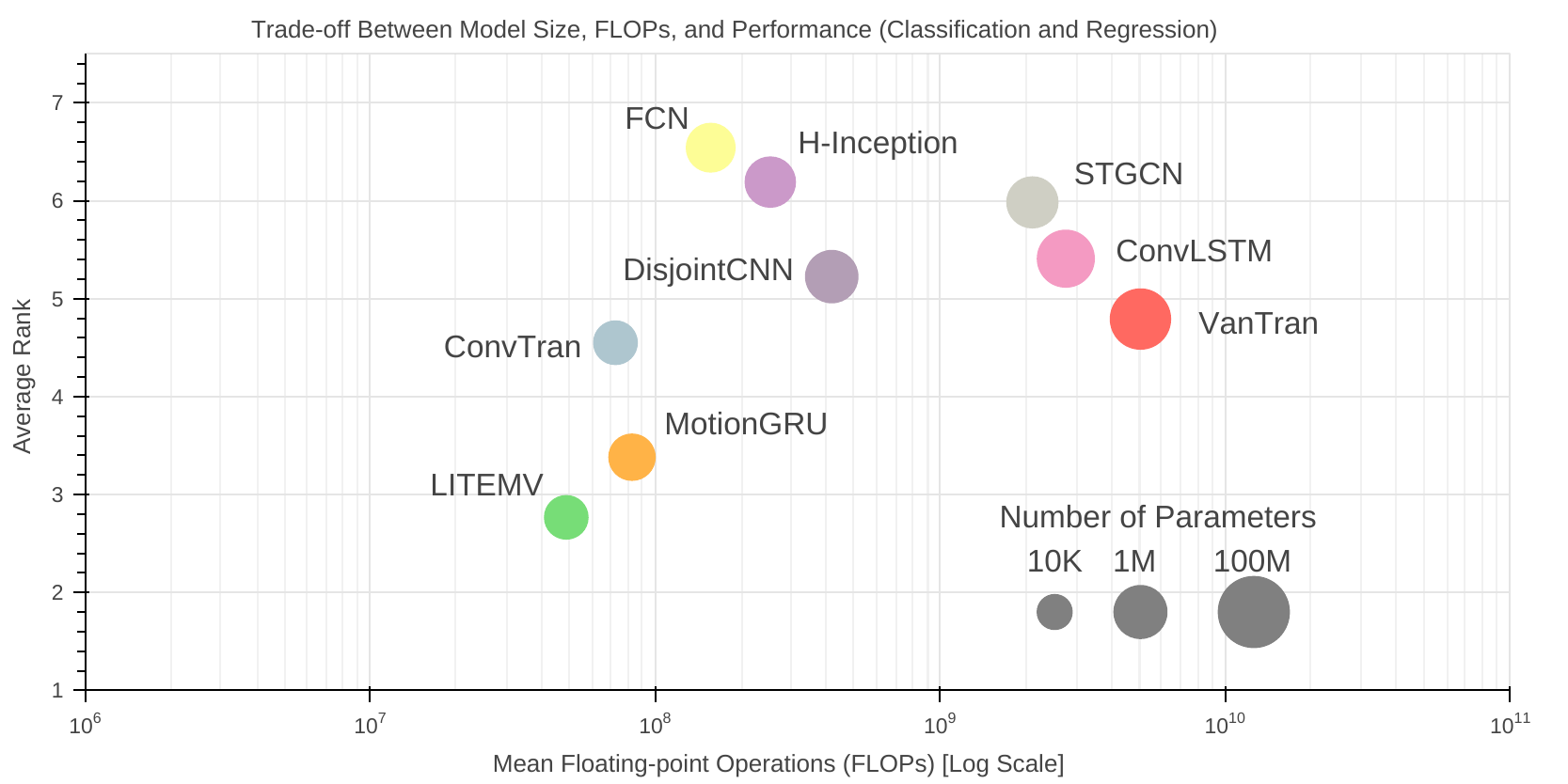
Cite this work
If you use this work please cite the following:
@inproceedings{ismail2026deeprehab-pile-fg,
  author = {Ismail-Fawaz, Ali and Devanne, Maxime and Berretti, Stefano and Weber, Jonathan and Forestier, Germain},
  title = {A Standardized Benchmark for Skeleton-Based Rehabilitation Assessment Using Deep Learning},
  booktitle = {IEEE international conference series on Automatic Face and Gesture Recognition (FG)},
  city = {Kyoto},
  country = {Japan},
  pages = {1--9},
  year = {2026}
}
@article{ismail-fawaz2025DeepRehabPile,
  author = {Ismail-Fawaz, Ali and Devanne, Maxime and Berretti, Sefano and Weber, Jonathan and Forestier, Germain},
  title = {Deep Learning for Skeleton Based Human Motion Rehabilitation Assessment: A Benchmark},
  journal={arxiv preprint	arXiv:2507.21018},
  year = {2025}
}
Acknowledgments
This work was supported by the ANR DELEGATION project (grant ANR-21-CE23-0014) of the French Agence Nationale de la Recherche. The authors would like to acknowledge the High Performance Computing Center of the University of Strasbourg for supporting this work by providing scientific support and access to computing resources. Part of the computing resources were funded by the Equipex Equip@Meso project (Programme Investissements d'Avenir) and the CPER Alsacalcul/Big Data. The authors would also like to thank the creators and providers of the original datasets in our archive.
1 maintainer

Metadata
1 maintainer
Release files for deep-rehab-pile 0.1.3
For a detailed explanation of source distributions (sdists) and built distributions (wheels), please see the package formats documentation.
Source distribution (sdist)
| File | Size | Uploaded | |
|---|---|---|---|
| deep_rehab_pile-0.1.3.tar.gz | 19.1 kB | Details |
Built distribution (wheel)
| File | Interpreter | ABI | Platform | Reset |
|---|---|---|---|---|
| deep_rehab_pile-0.1.3-py3-none-any.whl | Python 3 | none | any | Details |
Total release size: 37.1 kB
Release files / deep_rehab_pile-0.1.3.tar.gz
| Download URL | deep_rehab_pile-0.1.3.tar.gz |
|---|---|
| Size | 19.1 kB |
| Tags | Source |
|
SHA-256 checksum How to use checksums |
c8d2b4c2d239765ee6a73b3464ce9cbb1198215156ffd2a59d54218946bea57a
|
|
BLAKE2b-256 checksum How to use checksums |
243b1125a8a27b98af0eee84d98bf2f4f2fefacd1f126e84486e3021c071d7e6
|
| Upload date | |
|
Uploaded using Trusted Publishing? What is trusted publishing? |
Yes |
| Uploaded via |
twine/6.1.0 CPython/3.13.12
|
Provenance
Provenance describes where a file came from. On PyPI, provenance is shared via attestations, which provide a verifiable record of the build or publishing details. View details, limitations and caveats.


PyPI Publish Attestation
PyPI verified that this artifact, at this checksum, originated from the publisher listed below.
Signed by GitHub Actions, verified by PyPI on Jun 7, 2026.
Transparency logRelease files / deep_rehab_pile-0.1.3-py3-none-any.whl
| Download URL | deep_rehab_pile-0.1.3-py3-none-any.whl |
|---|---|
| Size | 18.0 kB |
| Tags | Python 3 |
|
SHA-256 checksum How to use checksums |
ca7cdee23c7a689738b1ef25947472d2b728807e0fa6be0db47e27df07d26687
|
|
BLAKE2b-256 checksum How to use checksums |
d58e6d735f16cf4d69e7478f7e271abc46b0eacbd67b0ecff6dba61610500b51
|
| Upload date | |
|
Uploaded using Trusted Publishing? What is trusted publishing? |
Yes |
| Uploaded via |
twine/6.1.0 CPython/3.13.12
|
Provenance
Provenance describes where a file came from. On PyPI, provenance is shared via attestations, which provide a verifiable record of the build or publishing details. View details, limitations and caveats.
PyPI Publish Attestation
PyPI verified that this artifact, at this checksum, originated from the publisher listed below.
Signed by GitHub Actions, verified by PyPI on Jun 7, 2026.
Transparency log













