
Introduction to my developed deepctools toolbox for data-enabled predictive control.
Github project: link
Introduction: link
DeePCtools
A wrapped package for Data-enabled predictive control (DeePC) implementation. Including DeePC and Robust DeePC design with multiple objective functions.
If you have questions, remarks, technical issues etc. feel free to use the issues page of this repository. I am looking forward to your feedback and the discussion.
I. How to use
This package operates within the Python framework.
1. Required packages
- Numpy
- Matplotlib
- CasADi <-- 3 <= version <= 4
2. Usage
-
Download the deepctools file and save it to your project directory.
-
Or install using pip
pip install deepctools
Then you can use the deepctools in your python project.
II. deepctools toolbox organization
.
└── deeptools
    ├── hankel
    ├── deepctools
    │   ├── initialize_DeePCsolver
    │   ├── initialize_RDeePCsolver
    │   └── solver_step
    ├── getCasadiFunc
    └── DiscreteSimulator
Under this file and function, there is detailed explanation of the usage, inputs, outputs of the functions.
1. hankel
Construct Hankel matrix of order L based on data x
- The data x: $x \in \mathbb{R}^{T, n_x}$
- The Hankel matrix: $H_L(x) \in \mathbb{R}^{n_x L \times T - L + 1}$
2. deepctools
Formulate and solve the DeePC problem, including DeePC and Robust DeePC design.
Construct the nlp solver for DeePC using CasADi IPOPT sovler, only formulate the solver once at the first beginning.
In the online loop, no need to reformulate the NLP problem which saves lots of computational time.
Each iteration, only need provide updated parameters: $u_{ini}$, $y_{ini}$ (, $u_{ref}$, $y_{ref}$ if set-point changes during control).
Objective function: $J = \Vert y - y^r \Vert_Q^2 + \Vert u_{loss} \Vert_R^2 + \mathcal{o}(\sigma_y, g)$
$u_{loss}$ can be:
        'u': u

        'uus': u - u_ref

        'du': delta u
There is a tutorial file in tutorial.py.
a. initialize_DeePCsolver(uloss, opts)
Formulate the DeePC design with different loss on control inputs.
The optmization problem can be formulated as:
        Standard DeePC design:                        |            Equivalent expression
     min J  =  || y - yref ||_Q^2 + || uloss ||_R^2   |   min J  =  || Uf*g - yref ||_Q^2 + || uloss ||_R^2
         s.t.   [Up]       [uini]                     |      s.t.   Up * g = uini
                [Yp] * g = [yini]                     |             Yp * g = yini
                [Uf]       [ u  ]                     |             ulb <= u <= uub
                [Yf]       [ y  ]                     |             ylb <= y <= yub
                ulb <= u <= uub                       |
                ylb <= y <= yub                       |  uloss = (u)   or    (u - uref)    or    (du)
b. initialize_RDeePCsolver
Formulate the Robust DeePC design with slack variables and different loss on control inputs.
The optmization problem can be formulated as:
              Robust DeePC design:                    |            Equivalent expression
     min J  =  || y - yref ||_Q^2 + || uloss ||_R^2   |   min J  =  || Uf*g - ys ||_Q^2 + || uloss ||_R^2
                 + lambda_y||sigma_y||_2^2            |             + lambda_y||Yp*g-yini||_2^2
                 + lambda_g||g||_2^2                  |             + lambda_g||g||_2^2
         s.t.   [Up]       [uini]     [   0   ]       |      s.t.   Up * g = uini
                [Yp] * g = [yini]  +  [sigma_y]       |             ulb <= u <= uub
                [Uf]       [ u  ]     [   0   ]       |             ylb <= y <= yub
                [Yf]       [ y  ]     [   0   ]       |
                ulb <= u <= uub                       |
                ylb <= y <= yub                       |  uloss = (u)   or    (u - uref)    or    (du)
c. solver_step
Solve the optimization problem for one step, and output the optimized control inputs, operator g, and solving time.
3. getCasadiFunc
Construct the Function using CasADi
4. DiscreteSimulator
Construct the discrete system simulator for predicting next step
III. Tutorial
This is a tutorial example to illustrate how to use the deepctools to develop and implement DeePC design to different processes.
1. Plant
A simple discrete-time nonlinear model of polynomial single-input-single-output system is used:
y(t) = 4 * y(t-1) * u(t-1) - 0.5 * y(t-1) + 2 * u(t-1) * u(t) + u(t)
The model has been crafted as a Plant class to facilitate its utilization.
Notice:
- This system is adopted from the paper.
- Note this plant is a nonlinear model which do not satisfy the assumption of Fundamental Lemma, the control performance can be bad.
- For your own project, you can replace this plant to your own system.
2. DeePC designs
Within the sample code, you have the option to specify either DeePC or Robust DeePC design, along with various objective functions. This segment is implemented within the main function.
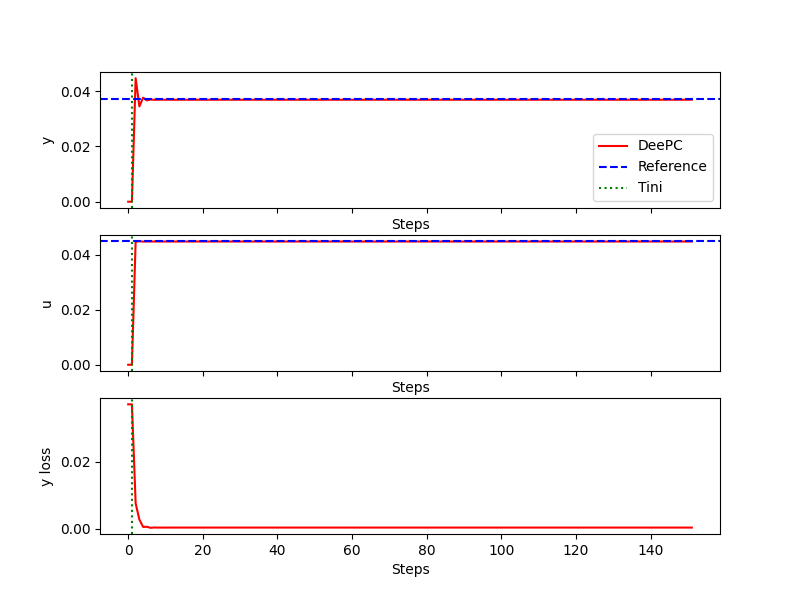
3. Tutorial results
Feasible DeePC config:
     DeePC        |  {Tini:1, Np:5, T:5, uloss:uus}    | T merely influence the performance as long as T>=5
     Robust DeePC |  {Tini:1, Np:1, T:600, uloss:du}   | T will influence the steady-state loss
     Robust DeePC |  {Tini:1, Np:1, T:600, uloss:uus}  | T will influence the steady-state loss
     Robust DeePC |  {Tini:1, Np:1, T:600, uloss:u}    | T will influence the steady-state loss
Figure of control peformance under first config:
Application
This project has been applied and used in the following papers:
- Deep DeePC: Data-enabled predictive control with low or no online optimization using deep learning: paper & source code
    @article{zhang2024deepdeepc,
    title={Deep DeePC: Data-enabled predictive control with low or no online optimization using deep learnin},
    author={Zhang, Xuewen and Zhang, Kaixiang and Li, Zhaojian and Yin, Xunyuan},
    journal={arXiv:2408.16338},
    year={2024}
    }
License
The project is released under the APACHE license. See LICENSE for details.
Copyright 2024 Xuewen Zhang
Licensed under the Apache License, Version 2.0 (the "License"); you may not use this file except in compliance with the License. You may obtain a copy of the License at
http://www.apache.org/licenses/LICENSE-2.0
Unless required by applicable law or agreed to in writing, software distributed under the License is distributed on an "AS IS" BASIS, WITHOUT WARRANTIES OR CONDITIONS OF ANY KIND, either express or implied. See the License for the specific language governing permissions and limitations under the License.
1 maintainer

Release files for deepctools 1.1.5
For a detailed explanation of source distributions (sdists) and built distributions (wheels), please see the package formats documentation.
Source distribution (sdist)
| File | Size | Uploaded | |
|---|---|---|---|
| deepctools-1.1.5.tar.gz | 22.0 kB | Details |
Built distribution (wheel)
| File | Interpreter | ABI | Platform | Reset |
|---|---|---|---|---|
| deepctools-1.1.5-py3-none-any.whl | Python 3 | none | any | Details |
Total release size: 45.4 kB
Release files / deepctools-1.1.5.tar.gz
| Download URL | deepctools-1.1.5.tar.gz |
|---|---|
| Size | 22.0 kB |
| Tags | Source |
|
SHA-256 checksum How to use checksums |
ce1d0fd80fb20686322acf316b347a54a7fbf6ed6fe38d625e90c82004153bdd
|
|
BLAKE2b-256 checksum How to use checksums |
a93641b44276ab5cd133d0e65c7c7a7b867cb0f7e3d63496d6c22403c76cda3a
|
| Upload date | |
|
Uploaded using Trusted Publishing? What is trusted publishing? |
No |
| Uploaded via |
twine/5.0.0 CPython/3.9.12
|
Release files / deepctools-1.1.5-py3-none-any.whl
| Download URL | deepctools-1.1.5-py3-none-any.whl |
|---|---|
| Size | 23.4 kB |
| Tags | Python 3 |
|
SHA-256 checksum How to use checksums |
198486f0e2c00150adbb224e749c16959ead5efba88a65cf2de75e24cc63cea0
|
|
BLAKE2b-256 checksum How to use checksums |
4cbaf225a37604cf01a579e29b5212dc1ffc56417044dd984915151de3b13c59
|
| Upload date | |
|
Uploaded using Trusted Publishing? What is trusted publishing? |
No |
| Uploaded via |
twine/5.0.0 CPython/3.9.12
|














