

Lightweight, production-hardened Python utilities for data engineering pipelines.






What It Does
- 🌐 Resilient HTTP client for ETL pipelines with bounded retries and exponential backoff.
- 🗄️ PostgreSQL helper with safe pooling, sessions, and auto-rollback.
- 📝 Structured JSON logging with automatic deep secret redaction.
~60 tests · ~94% coverage · CI on Python 3.10–3.13 · Linted with ruff · Type-checked with mypy
Quickstart
pip install "dehelpers[all]"
A complete pipeline in under 15 lines:
from dehelpers import ResilientClient, DatabaseManager, get_logger

log = get_logger("my_pipeline", job_id="daily-sync")
client = ResilientClient()

# Connects automatically via DATABASE_URL env var
with DatabaseManager() as db, client:
    users = client.get("https://jsonplaceholder.typicode.com/users").json()
    log.info("Fetched users", extra={"count": len(users)})

    with db.session() as session:
        for user in users:
            session.execute(
                "INSERT INTO users (id, name) VALUES (:id, :name) ON CONFLICT DO NOTHING",
                {"id": user["id"], "name": user["name"]}
            )
    log.info("Ingestion complete")
Documentation & Links
- 📚 Documentation: Installation, Getting Started, and FAQ
- 📖 API Reference: Full details on every class and function
- 💡 Examples: Runnable scripts for HTTP, DB, and Logging
- 🗺️ Roadmap: Planned features for v0.2 and beyond
- 📝 Medium Article: The story behind building this library
Architecture & Flow
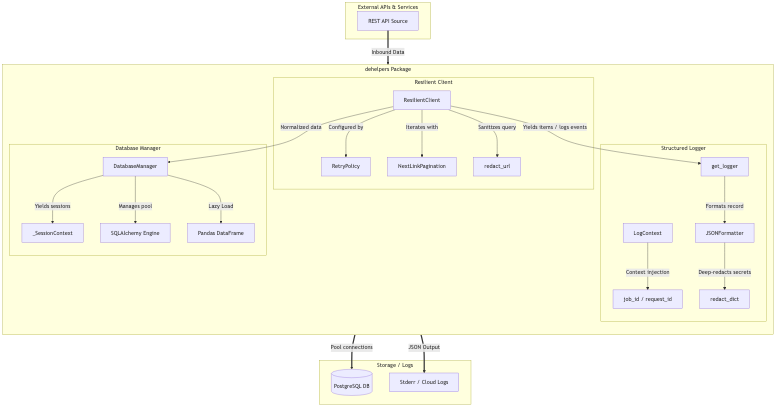
(For an interactive version of this diagram, see the Architecture Docs)
Boundaries & Capabilities
Here is exactly what this package is and what it is not:
| Category / Layer | What this IS | What this IS NOT |
|---|---|---|
| API / HTTP | A retry-protected wrapper around requests.Session with exponential backoff, jitter, and simple pagination. |
An asynchronous network library (like aiohttp or httpx), fully-fledged HTTP client replacement, or GraphQL API wrapper. |
| Database | A thread-safe connection manager for PostgreSQL with pooling configuration, automated transaction commits/rollbacks, and lazy DataFrame output. | An Object-Relational Mapper (ORM) (like SQLModel/SQLAlchemy ORM), schema migration engine (like Alembic), or database administration tool. |
| Logging | A zero-dependency structured JSON formatter on top of standard logging with automatic deep secrets redaction. |
A log routing system (like Fluentd/Logstash), file logger, metrics exporter, or complex log management server. |
| Execution Context | Designed for batch execution environments like Airflow tasks, ETL scripts, and containerized Docker runtimes. | Suitable for high-throughput, low-latency, real-time web servers or async microservices. |
Comparison with Standard Setup
How this package compares to a standard DIY setup:
| Feature / Criteria | Standard Setup (requests + logging + psycopg) |
dehelpers |
|---|---|---|
| Secret Leakage Protection | Manual / None. Secrets easily print to stdout or appear in exception tracebacks. | Automatic & Deep Recursive: Redacts predefined secrets from nested metadata, logs, and query parameters. |
| Retry & Jitter Strategy | Manual loops or boilerplate urllib3 retry configurations. |
Out-of-the-box resilience: Exponential backoff with random jitter and clock-based total_timeout limit. |
| Pagination Handling | Custom pagination loop logic required for every API endpoint. | Next-link strategy Protocol: Yields individual items transparently and safely with validation. |
| Connection Safety | Connection leaks or transaction rollback failures if block managers are missed. | Context-managed Session: Engine-pooled with pre-ping checks, pool timeout, and auto-rollback. |
| Dependency Footprint | Heavy setup if installing frameworks like Loguru, Structlog, or heavy database utilities. | Ultra-lightweight: Base dependencies are minimal. Pandas is entirely optional and lazy-loaded. |
Configuration
| Parameter | Default | Description |
|---|---|---|
DATABASE_URL (env var) |
— | PostgreSQL connection string (fallback when dsn is not passed) |
pool_size |
5 | Persistent connections in the pool |
max_overflow |
2 | Extra connections beyond pool_size |
pool_recycle |
1800 | Seconds before connection recycling |
pool_pre_ping |
True | Health-check connections before use |
pool_timeout |
30 | Seconds to wait for a pool connection |
Security
Automatic Redaction
The logger and API client automatically redact values for these keys in log output:
password, secret, token, api_key, authorization, dsn, connection_string, credential, passphrase, private_key, client_secret
Matching is case-insensitive substring — e.g. db_password matches password.
You can extend the redaction list:
from dehelpers._redact import redact_dict

result = redact_dict(
    {"my_custom_secret": "value"},
    extra_sensitive_keys=frozenset({"my_custom_secret"}),
)
⚠️ Never Embed Secrets in URLs
URL query parameter values are redacted, but path segments are not. Never construct URLs like:
https://api.example.com/v1/token/abc123/data # BAD — token in path
Instead, pass secrets via headers or request body.
Fork Safety (Airflow / Multiprocessing)
If you use DatabaseManager in a forked environment (e.g. Airflow workers, multiprocessing), you must either:
- Create the
DatabaseManagerinside each worker process, or - Call
db.dispose()before forking.
SQLAlchemy connection pools are not safe to share across forked processes.
Testing
Unit tests (no PostgreSQL required)
pip install -e ".[dev,dataframe]"
pytest -v --tb=short -m "not postgres"
PostgreSQL integration tests
# Start a local PostgreSQL
docker run -d --name pg-test -e POSTGRES_PASSWORD=test -p 5432:5432 postgres:16

# Run integration tests
DATABASE_URL="postgresql+psycopg://postgres:test@localhost:5432/postgres" \
    pytest -m postgres -v
Coverage
pytest --cov=dehelpers --cov-report=term-missing -m "not postgres"
Code Style & Tools
We use automated tooling to enforce consistent code quality:
| Tool | Purpose |
|---|---|
| ruff | Linting & formatting |
| mypy | Static type checking |
| pre-commit | Runs all checks on git commit |
# Set up after cloning
pip install -e ".[dev,dataframe]"
pre-commit install
Developer Resources & Standards
To ensure the library remains production-grade, reliable, and easily maintainable, we enforce the following open-source standards:
- CONTRIBUTING.md: Guidelines for cloning the fork, setting up local editable environments, running unit tests, and opening PRs.
- CODE_OF_CONDUCT.md: Our pledge to foster an inclusive, welcoming, and harassment-free community.
- SECURITY.md: Responsible disclosure policy for reporting vulnerabilities.
- ROADMAP.md: Planned features and design direction.
- CHANGELOG.md: Structured history of features, bugfixes, and breaking changes.
- LICENSE: Permissive MIT License.
Maintenance & Support
This library is actively maintained by the author for personal and internal data engineering workflows. It is built with production-minded practices — comprehensive tests, CI, type checking, and structured documentation — but it is not a certified enterprise product.
Release policy: Semantic-ish versioning (v0.x.y) for incremental features and fixes.
Issues, bug reports, and pull requests are welcome. See CONTRIBUTING.md to get started.
License
Distributed under the MIT License. See LICENSE for more information.
1 maintainer

Metadata
1 maintainer
Release files for dehelpers 0.2.0
For a detailed explanation of source distributions (sdists) and built distributions (wheels), please see the package formats documentation.
Source distribution (sdist)
| File | Size | Uploaded | |
|---|---|---|---|
| dehelpers-0.2.0.tar.gz | 394.0 kB | Details |
Built distribution (wheel)
| File | Interpreter | ABI | Platform | Reset |
|---|---|---|---|---|
| dehelpers-0.2.0-py3-none-any.whl | Python 3 | none | any | Details |
Total release size: 412.0 kB
Release files / dehelpers-0.2.0.tar.gz
| Download URL | dehelpers-0.2.0.tar.gz |
|---|---|
| Size | 394.0 kB |
| Tags | Source |
|
SHA-256 checksum How to use checksums |
af7f98bf4b89839879fbcf35d8be9214c63d9124924cf1593100a7ca70225bc2
|
|
BLAKE2b-256 checksum How to use checksums |
744e45be53273a79a2a4c96c27413888f4520d29e315046846c67274d18badab
|
| Upload date | |
|
Uploaded using Trusted Publishing? What is trusted publishing? |
Yes |
| Uploaded via |
twine/6.1.0 CPython/3.13.12
|
Provenance
Provenance describes where a file came from. On PyPI, provenance is shared via attestations, which provide a verifiable record of the build or publishing details. View details, limitations and caveats.


PyPI Publish Attestation
PyPI verified that this artifact, at this checksum, originated from the publisher listed below.
Signed by GitHub Actions, verified by PyPI on Jul 4, 2026.
Transparency logRelease files / dehelpers-0.2.0-py3-none-any.whl
| Download URL | dehelpers-0.2.0-py3-none-any.whl |
|---|---|
| Size | 18.0 kB |
| Tags | Python 3 |
|
SHA-256 checksum How to use checksums |
314756861454e98a5a938624166452b75aff36f4a449d540c471f48c7dd62c1f
|
|
BLAKE2b-256 checksum How to use checksums |
6321d0a6c7e45eff55675017173f09fba8c1aa90c2a6e2bf60c7f0fe29598f87
|
| Upload date | |
|
Uploaded using Trusted Publishing? What is trusted publishing? |
Yes |
| Uploaded via |
twine/6.1.0 CPython/3.13.12
|
Provenance
Provenance describes where a file came from. On PyPI, provenance is shared via attestations, which provide a verifiable record of the build or publishing details. View details, limitations and caveats.
PyPI Publish Attestation
PyPI verified that this artifact, at this checksum, originated from the publisher listed below.
Signed by GitHub Actions, verified by PyPI on Jul 4, 2026.
Transparency log













