





Déjà Queue
A fast alternative to multiprocessing.Queue. Faster, because it takes advantage of a shared memory ring buffer (rather than slow pipes) and pickle protocol 5 out-of-band data to minimize copies. dejaq.DejaQueue supports any type of picklable Python object, including numpy arrays or nested dictionaries with mixed content.
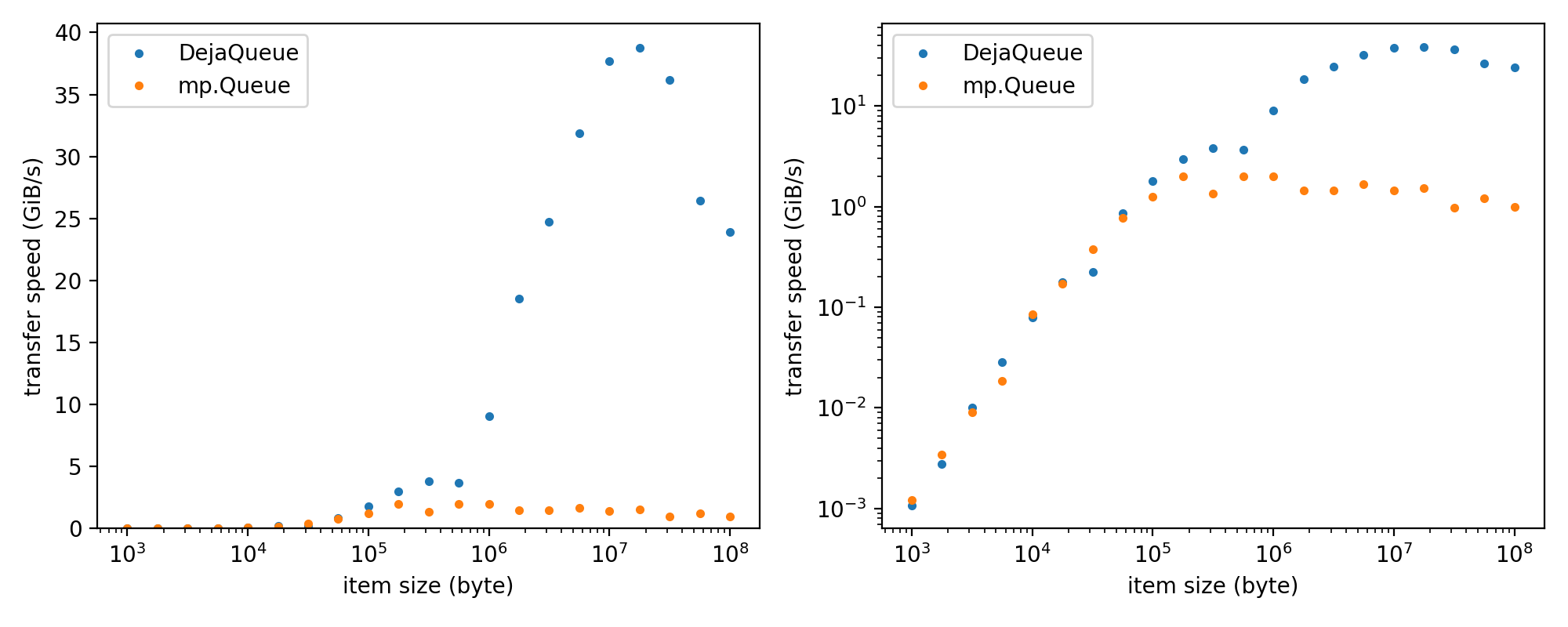
The speed advantage of DejaQueue becomes substantial for items of > 1 MB size. It enables efficient inter-job communication in big-data processing pipelines using dejaq.Actor or dejaq.stream.
Features:
- Fast, low-latency, high-throughput inter-process communication
- Supports any picklable Python object, including numpy arrays and nested dictionaries
- Zero-copy data transfer with pickle protocol 5 out-of-band data
- Picklable queue instances (queue object itself can be passed between processes)
- Peekable (non-destructive read)
- Actor class for remote method calls and attribute access in a separate process (see dejaq.Actor)
Auto-generated (minimal) API documentation: https://danionella.github.io/dejaq
Installation
-
conda install conda-forge::dejaq -
or, if you prefer pip:
pip install dejaq -
for development, clone this repository, navigate to the root directory and type
pip install -e .
Examples
dejaq.DejaQueue
import numpy as np
from multiprocessing import Process
from dejaq import DejaQueue

def produce(queue):
    for i in range(10):
        arr = np.random.randn(100,200,300)
        data = dict(array=arr, i=i)
        queue.put(data)
        print(f'produced {type(arr)} {arr.shape} {arr.dtype}; meta: {i}; hash: {hash(arr.tobytes())}\n', flush=True)

def consume(queue, pid):
    while True:
        data = queue.get()
        array, i = data['array'], data['i']
        print(f'consumer {pid} consumed {type(array)} {array.shape} {array.dtype}; index: {i}; hash: {hash(array.tobytes())}\n', flush=True)

queue = DejaQueue(buffer_bytes=100e6)
producer = Process(target=produce, args=(queue,))
consumers = [Process(target=consume, args=(queue, pid)) for pid in range(3)]
for c in consumers:
    c.start()
producer.start()
dejaq.Actor and ActorDecorator
dejaq.Actor allows you to run a class instance in a separate process and call its methods or access its attributes remotely, as if it were local. This is useful for isolating heavy computations, stateful services, or legacy code in a separate process, while keeping a simple Pythonic interface.
Example: Using Actor directly
from dejaq import Actor

class Counter:
    def __init__(self, start=0):
        self.value = start
    def increment(self, n=1):
        self.value += n
        return self.value
    def get(self):
        return self.value

# Start the actor in a separate process
counter = Actor(Counter, start=10)

print(counter.get())         # 10
print(counter.increment())   # 11
print(counter.increment(5))  # 16
print(counter.get())         # 16

counter.close()  # Clean up the process
Example: Using ActorDecorator
from dejaq import ActorDecorator

@ActorDecorator
class Greeter:
    def __init__(self, name):
        self.name = name
    def greet(self):
        return f"Hello, {self.name}!"

greeter = Greeter("Alice")
print(greeter.greet())  # "Hello, Alice!"
greeter.close()
Features
- Remote method calls: Call methods as if the object was local.
- Remote attribute access: Get/set attributes of the remote object.
- Async support: Call
method_async()to get aFuturefor non-blocking calls. - Tab completion: Works in Jupyter and most IDEs.
dejaq.Parallel
The following examples show how to use dejaq.Parallel to parallelize a function or a class, and how to create job pipelines.
Here we execute a function and map iterable inputs across 10 workers. To enable pipelining, the results of each stage are provided as iterable generator. Use .run() (or .compute() for backwards compatibility) to get the final result. Results are always ordered.
from time import sleep
from dejaq import Parallel

def slow_function(arg):
    sleep(1.0)
    return arg + 5

input_iterable = range(100)
slow_function = Parallel(n_workers=10)(slow_function)
stage = slow_function(input_iterable)
result = stage.run() # or list(stage)
# or shorter:
result = Parallel(n_workers=10)(slow_function)(input_iterable).compute()
You can also use Parallel as a function decorator:
@Parallel(n_workers=10)
def slow_function_decorated(arg):
    sleep(1.0)
    return arg + 5

result = slow_function_decorated(input_iterable).run()
Similarly, you can decorate a class. It will be instantiated within a worker. Iterable items will be fed to the __call__ method. Note how the additional init arguments are provided:
@Parallel(n_workers=1)
class Reader:
    def __init__(self, arg1):
        self.arg1 = arg1
    def __call__(self, item):
        return item + self.arg1

result = Reader(arg1=0.5)(input_iterable).compute()
Finally, you can create pipelines of chained jobs. In this example, we have a single threaded reader and consumer, but a parallel processing stage (an example use case is sequentially reading a file, compressing chunks in parallel and then sequentially writing to an output file):
@Parallel(n_workers=1)
class Producer:
    def __init__(self, arg1):
        self.arg1 = arg1
    def __call__(self, item):
        return item + self.arg1

@Parallel(n_workers=10)
class Processor:
    def __init__(self, arg1):
        self.arg1 = arg1
    def __call__(self, arg):
        sleep(1.0) #simulating a slow function
        return arg * self.arg1

@Parallel(n_workers=1)
class Consumer:
    def __init__(self, arg1):
        self.arg1 = arg1
    def __call__(self, arg):
        return arg - self.arg1

input_iterable = range(100)
stage1 = Producer(0.5)(input_iterable)
stage2 = Processor(10.0)(stage1)
stage3 = Consumer(1000)(stage2)
result = stage3.run()

# or:
result = Consumer(1000)(Processor(10.0)(Producer(0.5)(input_iterable))).run()
See also
1 maintainer

Metadata
1 maintainer
Release files for dejaq 0.7.0
For a detailed explanation of source distributions (sdists) and built distributions (wheels), please see the package formats documentation.
Source distribution (sdist)
| File | Size | Uploaded | |
|---|---|---|---|
| dejaq-0.7.0.tar.gz | 41.4 kB | Details |
Built distribution (wheel)
| File | Interpreter | ABI | Platform | Reset |
|---|---|---|---|---|
| dejaq-0.7.0-py3-none-any.whl | Python 3 | none | any | Details |
Total release size: 74.2 kB
Release files / dejaq-0.7.0.tar.gz
| Download URL | dejaq-0.7.0.tar.gz |
|---|---|
| Size | 41.4 kB |
| Tags | Source |
|
SHA-256 checksum How to use checksums |
faa71e5abf3d6cbbe94954bc6c99456f046284083f0c2ad43fb40bee7e6c77a3
|
|
BLAKE2b-256 checksum How to use checksums |
a4dc692ab33df519d12bbb69c743b39f389941e5d6a70458fd4b754cf150b6c2
|
| Upload date | |
|
Uploaded using Trusted Publishing? What is trusted publishing? |
No |
| Uploaded via |
twine/6.1.0 CPython/3.13.7
|
Release files / dejaq-0.7.0-py3-none-any.whl
| Download URL | dejaq-0.7.0-py3-none-any.whl |
|---|---|
| Size | 32.8 kB |
| Tags | Python 3 |
|
SHA-256 checksum How to use checksums |
1b5396b3f46786abca3bd946f8952a21859eb32b9aff3186aae9fe7f4c46b272
|
|
BLAKE2b-256 checksum How to use checksums |
9235dbcf38509ce91c0475a5ef5d38cc4bff0b2993a5dba575a458ca96a69a7c
|
| Upload date | |
|
Uploaded using Trusted Publishing? What is trusted publishing? |
No |
| Uploaded via |
twine/6.1.0 CPython/3.13.7
|














