
Run and export HT-Demucs / Demucs music source separation as ONNX. Pure numpy + onnxruntime inference (no PyTorch). Supports htdemucs_ft (4-stem bag), htdemucs (single-file 4-stem), and htdemucs_6s (6-stem with guitar + piano). Karaoke / acapella CLI, browser-demo scaffolder, auto-resampling, auto execution provider routing, fp16-weight downloads, MP3 output. Fixes the 4 blockers that prevent vanilla torch.onnx.export from working on htdemucs.

Project description
demucs-onnx






Run and export HT-Demucs / Demucs music source separation as ONNX —
Python, browser, iOS, and Android. Pure numpy + onnxruntime at
inference (no PyTorch), a one-call export pipeline that fixes the four
known blockers in torch.onnx.export, pre-built ONNX models on Hugging
Face, and a copy-pasteable onnxruntime-web path for the browser.
Powers the StemSplit production stack.
pip install 'demucs-onnx[mp3]'
demucs-onnx separate song.mp3 out/ --karaoke --mp3
# writes out/karaoke.mp3  (drums + bass + other, vocals removed)
Quick links
- Documentation — full guides, API reference, and walkthroughs
- GitHub — source, issues, and discussions
- Hugging Face models — 7 pre-built ONNX repos
- CLI reference — every flag, every example
- Browser guide —
onnxruntime-webintegration - Hosted API — skip the infra, get stems via HTTP
Why use this instead of X?
Snapshot 2026-05-21. Distilled from
COMPETITIVE_LANDSCAPE.md.
| Want to … | demucs-onnx |
facebookresearch/demucs |
nomadkaraoke/audio-separator |
deezer/spleeter |
sevagh/demucs.onnx |
|---|---|---|---|---|---|
pip install it |
✅ | ✅ | ✅ | ✅ | ❌ (C++ build) |
| Run HT-Demucs as ONNX with no PyTorch at inference | ✅ | ❌ | ❌ (uses torch for Demucs) | ❌ (TensorFlow, not Demucs) | ✅ (C++ only) |
| Pre-built models on Hugging Face | ✅ 7 repos | — | — | — | ❌ |
Browser / onnxruntime-web support |
✅ scaffold + bundler configs | ❌ | ❌ | ❌ | ❌ |
| Mobile-friendly (iOS / Android via ORT) | ✅ | ❌ | ❌ | ❌ | ⚠️ build yourself |
| 6-stem (drums, bass, other, vocals, guitar, piano) | ✅ ONNX | ✅ PyTorch | ⚠️ via Demucs/PyTorch | ❌ | ⚠️ all variants |
| Karaoke / mix-stems CLI shortcut | ✅ --karaoke --mp3 |
❌ | ⚠️ scriptable | ❌ | ❌ |
| Auto-resample any sample rate / mono | ✅ | ❌ (44.1 kHz stereo only) | ✅ | ❌ | ⚠️ |
| Export your own Demucs checkpoint to ONNX | ✅ one call, parity-verified | ❌ | ❌ | ❌ | ❌ (uses pre-export) |
demucs-onnx is the only pip-installable Python package that runs
HT-Demucs as ONNX cross-platform with no PyTorch dependency at
inference. If you find a comparable working solution after this package
was published, please open an issue
so we can update this table.
Quick start
Install
pip install demucs-onnx                # inference only — onnxruntime + numpy + soundfile + soxr
pip install "demucs-onnx[mp3]"         # adds the lameenc encoder for --mp3 output
pip install "demucs-onnx[export]"      # adds torch + demucs for the export pipeline
Separate (Python)
from demucs_onnx import separate, separate_stem

# Full 4-stem bag (default). Auto-downloads from HF on first run, auto
# picks the best execution provider for this host (CoreML / CUDA / DML).
stems = separate("song.mp3")
# stems: {"drums": ndarray (2, S), "bass": ..., "other": ..., "vocals": ...}

# Just one stem — 4× faster, 75% less RAM, model size 316 MB instead of 1.26 GB.
vocals = separate_stem("song.mp3", "vocals")

# Smaller download (166 MB per stem instead of 316 MB), no runtime cost.
stems = separate("song.mp3", precision="fp16weights")

# Write straight to MP3, including a karaoke instrumental mix.
separate(
    "song.mp3", "stems/",
    output_format="mp3", bitrate_kbps=192,
    mix_stems=("drums", "bass", "other"), mix_output_name="karaoke",
)
Separate (CLI)
# Killer feature — one command -> karaoke.mp3 ready to share.
demucs-onnx separate song.mp3 stems/ --karaoke --mp3

# All 4 stems, auto provider (CoreML on macOS, CUDA on Linux, etc).
demucs-onnx separate song.mp3 stems/

# 6-stem mode with guitar + piano.
demucs-onnx separate song.mp3 stems/ --model htdemucs_6s

# Single specialist mode — 4x faster than the bag.
demucs-onnx separate song.mp3 stems/ --stem vocals

# Smaller download (1.91x), same runtime cost.
demucs-onnx separate song.mp3 stems/ --small

# Custom mix-down: write one file that's vocals + drums only.
demucs-onnx separate song.mp3 stems/ --mix-stems vocals,drums --mp3

# Explicit provider override (auto is the default).
demucs-onnx separate song.mp3 stems/ --providers coreml
demucs-onnx separate song.mp3 stems/ --providers cuda
demucs-onnx separate song.mp3 stems/ --providers dml

demucs-onnx list-models
Models auto-download from the Hugging Face Hub on first run and are cached forever. Inputs at any sample rate (8 kHz – 192 kHz, mono or stereo) are auto-resampled in for inference and back out so the file you get matches the file you put in.
Browser
# Print a copy-pasteable onnxruntime-web config snippet for any major bundler.
demucs-onnx browser-config --bundler vite      # or webpack, esbuild, next, rollup

# Scaffold a runnable demo into a directory (zero build, just python -m http.server).
demucs-onnx browser-demo /tmp/demo
demucs-onnx browser-demo /tmp/demo --react     # Vite + React + TypeScript variant
See the browser guide
or the in-tree examples/browser/
and examples/browser-react/
demos.
Export (Python)
from demucs_onnx.export import export_to_onnx
from pathlib import Path

# Export every specialist of htdemucs_ft into out/ as 4 .onnx files.
paths = export_to_onnx("htdemucs_ft", "out/")
# paths == {"drums": Path("out/htdemucs_ft_drums.onnx"), "bass": ..., ...}

# Export just the vocals specialist to a single file.
export_to_onnx("htdemucs_ft", "vocals.onnx", stem="vocals")

# Export your own fine-tuned checkpoint.
export_to_onnx(Path("my_finetune.th"), "my_finetune.onnx")
Export (CLI)
demucs-onnx export htdemucs_ft out/                    # all 4 specialists
demucs-onnx export htdemucs_ft drums.onnx --stem drums # one stem -> single file
demucs-onnx export htdemucs_ft out/ --opset 17         # change opset
demucs-onnx export htdemucs_ft out/ --no-parity-check  # advanced (don't)
Mobile / web (after exporting)
// iOS / Swift, ORT 1.17+
import onnxruntime_objc
let opts = try ORTSessionOptions()
try opts.appendCoreMLExecutionProvider(with: ORTCoreMLExecutionProviderOptions())
let session = try ORTSession(env: env,
                              modelPath: bundle.path(forResource: "htdemucs_ft_vocals",
                                                     ofType: "onnx")!,
                              sessionOptions: opts)
// Browser / web, onnxruntime-web
import * as ort from "onnxruntime-web";
const session = await ort.InferenceSession.create("htdemucs_ft_vocals.onnx", {
  executionProviders: ["wasm"],
  graphOptimizationLevel: "all",
});
const tensor = new ort.Tensor("float32", audioBuffer, [1, 2, 343980]);
const out = await session.run({ mix: tensor });
What's new in v0.3 — browser, htdemucs/htdemucs_6s, docs site
htdemucs_6sflavor — single-file 6-stem ONNX model with guitar and piano in addition to the standard 4. The only ONNX export of the 6-stem variant on the Hub. (StemSplitio/htdemucs-6s-onnx)htdemucsflavor — single-file 4-stem ONNX model. ~30% faster than the FT bag (1 session vs 4), slightly lower SDR. (StemSplitio/htdemucs-onnx)- Browser support via
onnxruntime-web— copy-pasteable bundler configs and ademucs-onnx browser-demo PATHCLI that scaffolds a zero-build vanilla HTML/JS demo or a Vite + React + TS demo. SessionPool+prewarm()— process-wide session cache and a one-shot prewarm so the firstseparate()call doesn't pay the CoreML graph-compile tax. Reusing sessions acrosshtdemucs_ftbag calls is now automatic.- Docs site at stemsplit.github.io/demucs-onnx with the canonical 4-blocker write-up, browser guide, model registry, and autogenerated API reference via
mkdocstrings[python].
See CHANGELOG.md
for the full diff vs v0.2.0 and the v0.2.0 UX bundle (--karaoke,
--mix-stems, --mp3, providers="auto", fp16-weight downloads,
auto-resampling, progress bars).
Why this package exists
For the entire history of the demucs
repo (2021 – 2026), nobody on PyPI has shipped working ONNX export
tooling for HT-Demucs. Searching GitHub turns up half a dozen
abandoned forks, all stuck on one of four blockers, all without a
working .onnx file to show for it. The official demucs README has no
mention of ONNX. We solved it.
This package ships a pure-numpy + onnxruntime inference path that runs
the official HT-Demucs FT models with no PyTorch dependency (install
footprint drops from ~2 GB to ~50 MB), a one-call export pipeline
(export_to_onnx("htdemucs_ft", ...)) that applies all four patches
and parity-checks the output against PyTorch fp32, and the same patches
as independent grep-able modules (stft.py, mha.py, pos_embed.py,
segment.py) so you can debug your own exports of related
architectures.
| Want to … | Use this |
|---|---|
| Run htdemucs_ft on CPU / mobile / web with no PyTorch | from demucs_onnx import separate |
| Convert your own demucs checkpoint to ONNX | from demucs_onnx.export import export_to_onnx |
| Skip the infrastructure entirely | The hosted StemSplit API |
Used by / integrations
- StemSplit — production stack for Vocal Remover, Karaoke Maker, Acapella Maker, and the hosted API. The same ONNX models on Hugging Face power the production endpoints — what you install is what we run.
- Pre-built ONNX models on Hugging Face at
StemSplitio— 7 ONNX repos- 4 PyTorch source repos, all MIT-licensed and parity-verified.
If you ship demucs-onnx in a project and would like to be listed
here, please
open an issue or
PR a one-line addition.
The 4 blockers explained
These are the four things that break vanilla torch.onnx.export on
HT-Demucs (PyTorch 2.4 / opset 17). Each lives in its own grep-able
module so you can lift the fix into a different project.
Blocker 1 — torch.stft returns complex tensors
# demucs/htdemucs.py
z = torch.stft(x, n_fft, hop_length, return_complex=True)  # complex64 output
torch.onnx.export raises Exporting STFT does not currently support complex types. The dynamo exporter sometimes lowers it, but the
resulting graph fails ORT shape inference.
Fix — demucs_onnx/export/stft.py.
Replace torch.stft with a Conv1d whose kernels are precomputed
sin/cos DFT bases for n_fft = 4096, hop = 1024, hann window,
normalized=True. The output is two real channels (real, imag) instead
of one complex channel. Inverse: a matching ConvTranspose1d plus an
OLA(window²) envelope normalisation. The class also overrides
demucs's own _spec / _ispec / _magnitude / _mask methods so the
rest of the network sees (B, C, 2, F, T) real tensors throughout.
Verified to 5×10⁻⁶ max abs diff against torch.stft on real audio.
Blocker 2 — model.segment is a fractions.Fraction
# demucs/htdemucs.py
self.segment = Fraction(39, 5)  # = 7.8 seconds
torch._dynamo allow-lists a small set of "user-defined classes" it
can trace through. Fraction is not on it (PyTorch 2.4) and graph
capture crashes. The legacy exporter is more permissive but still
produces a wrong graph because Fraction arithmetic is opaque to it.
Fix — demucs_onnx/export/segment.py.
Coerce to float. Mathematically identical at inference, side-steps
both exporter limitations.
Blocker 3 — random.randrange in the transformer pos-embedding
# demucs/transformer.py
shift = random.randrange(self.sin_random_shift + 1)  # = 0 at eval
Used during training for positional-embedding augmentation. At eval,
sin_random_shift = 0 so the call always returns 0, but neither the
legacy exporter nor dynamo can trace through a call to random —
UnsupportedOperatorError and graph break, respectively.
Fix — demucs_onnx/export/pos_embed.py.
Monkey-patch CrossTransformerEncoder._get_pos_embedding with a
deterministic version that hardcodes shift = 0. Mathematically
identical at inference time.
Blocker 4 — aten::_native_multi_head_attention has no ONNX symbolic
# torch/nn/functional.py — internally
return torch._native_multi_head_attention(...)  # fused C++ kernel
nn.MultiheadAttention dispatches to a fast fused C++ kernel when its
inputs satisfy a fast-path check. The fused kernel has no ONNX
symbolic: the exporter raises UnsupportedOperatorError: Exporting the operator 'aten::_native_multi_head_attention' to ONNX opset version 17 is not supported.
Fix — demucs_onnx/export/mha.py.
Replace nn.MultiheadAttention.forward (per instance, via
types.MethodType) with a manual scaled-dot-product attention built
from Linear / bmm / softmax. The exporter handles those
primitives without complaint. Output is bit-identical to the fused
kernel up to fp32 round-off.
Net result
After all four patches, end-to-end parity vs PyTorch fp32:
| Stem | max abs diff (1×2×343980 random input) |
|---|---|
| drums | 1.63 × 10⁻⁴ |
| bass | 1.42 × 10⁻⁴ |
| other | 1.71 × 10⁻⁴ |
| vocals | 1.55 × 10⁻⁴ |
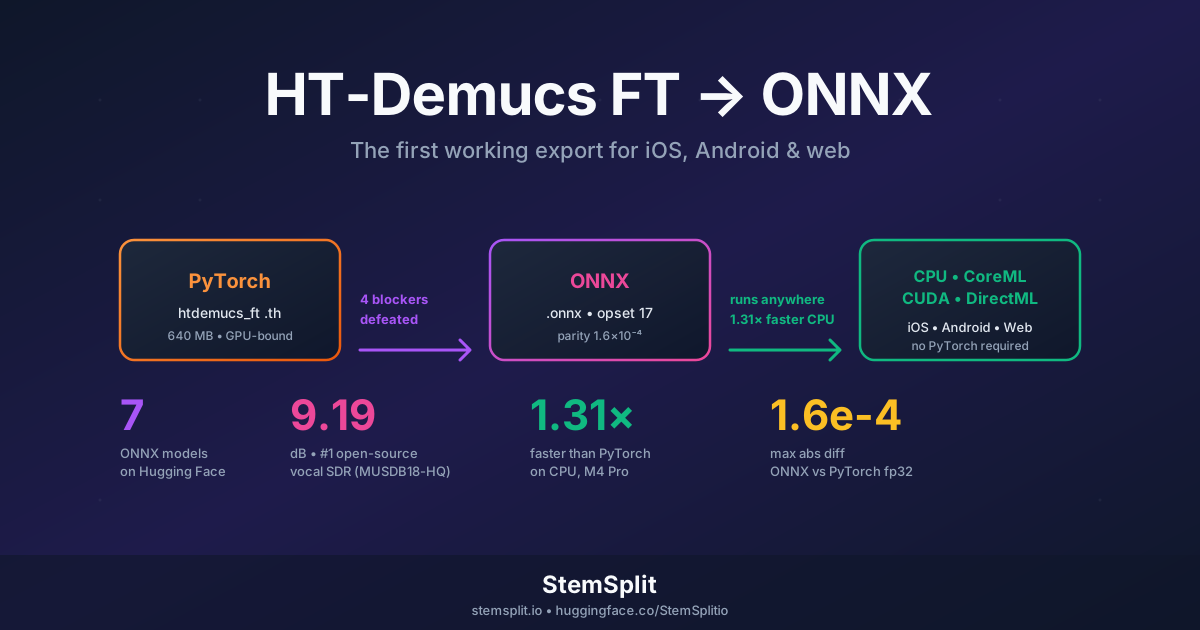
…and the ONNX graph runs in onnxruntime CPU at 1.31× the speed of
PyTorch CPU on Apple M4 Pro (no GPU).
Pre-trained ONNX models on Hugging Face
We host seven companion ONNX model repos (plus four PyTorch source repos for parity-checking your own exports). The Python package downloads from these automatically on first run; you can also fetch them by hand.
| Repo | Stems | Size | Use case |
|---|---|---|---|
StemSplitio/htdemucs-ft-onnx |
all 4 (bag) | 1.26 GB | Full FT bag, best SDR, default |
StemSplitio/htdemucs-onnx |
all 4 (single) | 316 MB | Fastest 4-stem startup, ~30% faster than the bag |
StemSplitio/htdemucs-6s-onnx |
6 (incl. guitar + piano) | 258 MB | The only 6-stem ONNX export on the Hub |
StemSplitio/htdemucs-ft-drums-onnx |
drums | 316 MB | Drum extraction, beat transcription |
StemSplitio/htdemucs-ft-bass-onnx |
bass | 316 MB | Bassline isolation, mix rebalancing |
StemSplitio/htdemucs-ft-other-onnx |
other | 316 MB | Karaoke instrumental, sample-flipping |
StemSplitio/htdemucs-ft-vocals-onnx |
vocals | 316 MB | #1 open-source vocal SDR — vocal removal, acapella, karaoke |
Every repo also ships a *_fp16weights.onnx variant (~half the
download) with identical runtime memory / latency. All MIT-licensed
and parity-verified to < 1e-3 vs PyTorch fp32. See the
Models page in the docs
for full size / speed / quality tables.
Performance
Real measurements on Apple M4 Pro (8-core CPU, no GPU):
| Mode | Per 7.8-s segment | Per 3-min song | RTF |
|---|---|---|---|
demucs-onnx, single specialist (CPU) |
1.59 s | ~22 s | 0.20 |
demucs-onnx, full bag (CPU) |
6.4 s | ~88 s | 0.49 |
| PyTorch CPU (single specialist) | 2.09 s | ~29 s | 0.26 |
| PyTorch MPS (full bag) | 1.0 s | ~12 s | 0.07 |
CUDA / DirectML / CoreML ONNX EPs are all ≥ 5× faster than the CPU EP on real GPUs — see the model card on each HF repo for hardware-specific numbers.
API
demucs_onnx.separate(input, output_dir=None, *, model="htdemucs_ft", stems=None, providers="auto", precision="fp32", cache_dir=None, token=None, verbose=False, progress=True, output_format="wav", bitrate_kbps=192, mix_stems=None, mix_output_name="mix") -> dict[str, np.ndarray]
Run separation on an audio file. Returns
{stem_name: (channels, samples)} in float32 at the input file's
native sample rate (we auto-resample for inference and back). If
output_dir is given, also writes <stem>.wav (or .mp3) files into
it; pass mix_stems=("drums","bass","other") to additionally write a
single karaoke instrumental file.
model accepts:
"htdemucs_ft"(default) — full 4-stem fine-tuned bag"htdemucs"— single-file 4-stem, ~30% faster than the bag"htdemucs_6s"— single-file 6-stem (drums, bass, other, vocals, guitar, piano)"htdemucs_ft_<stem>"or just"<stem>"— single specialist (drums/bass/other/vocals)
providers accepts:
"auto"(default) — auto-detect the best EP for this host (CoreML / CUDA / DML / CPU)- A short alias (
"cpu","coreml","cuda","dml"), an explicit ORT provider name, or a list of either
precision accepts "fp32" (default) or "fp16weights". The latter
downloads a 166 MB variant per stem (1.91× smaller) with identical
runtime memory and latency; max abs diff vs fp32 is ~6e-5.
demucs_onnx.separate_stem(input, stem, output_dir=None, **kwargs) -> np.ndarray
Shorthand: run only one specialist and return the single stem as a
numpy array. ~4× faster than running the full bag when you only need
one stem. Accepts guitar / piano (auto-routes to htdemucs_6s).
demucs_onnx.separate_all(input, output_dir=None, **kwargs) -> dict[str, np.ndarray]
Shorthand for separate(..., model="htdemucs_ft").
demucs_onnx.prewarm(models=("htdemucs_ft",), **kwargs) -> None
Pre-download and pre-compile ORT sessions so the first separate()
call doesn't pay the CoreML graph-compile or HF-download tax.
demucs_onnx.auto_select_providers() -> list[str]
Return the EP list separate() would pick on this host. Useful for
debugging — print it from your code if auto selects something
surprising.
demucs_onnx.describe_runtime() -> dict[str, object]
Returns {system, machine, python, onnxruntime, available_providers, in_browser}. Print this if auto doesn't pick the EP you expect.
demucs_onnx.export.export_to_onnx(checkpoint, output, *, stem=None, stems=None, opset=17, parity_check=True, parity_tolerance=1e-3, ...) -> dict[str, Path]
Convert a demucs/htdemucs PyTorch checkpoint (by name or .th path) to
one or more ONNX files. Applies all four patches, runs a numerical
parity check before writing, and aborts if max abs diff > tolerance.
demucs_onnx.export.patch_htdemucs_for_onnx(model) -> nn.Module
Apply all four patches in place, return the same model. Useful when you want to keep the patched model around for alternative tracers.
Individual patches
Each blocker is a single-purpose module so you can pull just one fix into a different project:
demucs_onnx.export.coerce_segment_to_float— Fraction → floatdemucs_onnx.export.disable_random_pos_shift— droprandom.randrangedemucs_onnx.export.onnx_friendly_mha_forward— manual MHA forwarddemucs_onnx.export.RealSTFT/RealISTFT— complex STFT replacement
Skip the infrastructure — use the StemSplit API
Don't want to bundle a 316 MB model in your app, manage a GPU pool, or write overlap-add chunking? Use the StemSplit API instead — same models under the hood, hosted for you, with credits and a dashboard.
Or use the no-code tools that ship the same model family: Vocal Remover · Karaoke Maker · Acapella Maker · YouTube Stem Splitter.
License & attribution
This package is MIT-licensed, matching the original HT-Demucs. Please cite the original authors if you use the model in research:
@inproceedings{rouard2023hybrid,
  title     = {Hybrid Transformers for Music Source Separation},
  author    = {Rouard, Simon and Massa, Francisco and D{\'e}fossez, Alexandre},
  booktitle = {ICASSP},
  year      = {2023}
}
- Original PyTorch model:
facebookresearch/demucs - ONNX export, parity verification, packaging, and host inference by StemSplit


Download files
Download the file for your platform. If you're not sure which to choose, learn more about installing packages.
Source Distribution
Built Distribution
Filter files by name, interpreter, ABI, and platform.
If you're not sure about the file name format, learn more about wheel file names.
Copy a direct link to the current filters
File details
Details for the file demucs_onnx-0.3.2.tar.gz.
File metadata
- Download URL: demucs_onnx-0.3.2.tar.gz
- Upload date:
- Size: 87.3 kB
- Tags: Source
- Uploaded using Trusted Publishing? No
- Uploaded via: uv/0.11.7 {"installer":{"name":"uv","version":"0.11.7","subcommand":["publish"]},"python":null,"implementation":{"name":null,"version":null},"distro":{"name":"macOS","version":null,"id":null,"libc":null},"system":{"name":null,"release":null},"cpu":null,"openssl_version":null,"setuptools_version":null,"rustc_version":null,"ci":null}
File hashes
| Algorithm | Hash digest | |
|---|---|---|
| SHA256 |
3e821e737b6c7b4f4c9c112773f569a9b6a14999b9ffc0b02d3df34d46b53d9d
|
|
| MD5 |
6a0dc7020ea4343db595b881e2db94fe
|
|
| BLAKE2b-256 |
32601ff3f304c235e80a4530d4738c6804fee3914ec3d4781332f114692d4b7c
|
File details
Details for the file demucs_onnx-0.3.2-py3-none-any.whl.
File metadata
- Download URL: demucs_onnx-0.3.2-py3-none-any.whl
- Upload date:
- Size: 58.7 kB
- Tags: Python 3
- Uploaded using Trusted Publishing? No
- Uploaded via: uv/0.11.7 {"installer":{"name":"uv","version":"0.11.7","subcommand":["publish"]},"python":null,"implementation":{"name":null,"version":null},"distro":{"name":"macOS","version":null,"id":null,"libc":null},"system":{"name":null,"release":null},"cpu":null,"openssl_version":null,"setuptools_version":null,"rustc_version":null,"ci":null}
File hashes
| Algorithm | Hash digest | |
|---|---|---|
| SHA256 |
a69cf4ff4e11ca107a7ed4e972d2ac02ca20ca5c0b044b430bcea03b1e92dc90
|
|
| MD5 |
59d9aaf64c2530a1fb40768cefd6a537
|
|
| BLAKE2b-256 |
49ccb597fa8a03fd8d1841e785cf03becdaec597e0f1ddf736a79fda82e9a594
|






