
A high-level toolkit for de-overlapping Shapely geometries.

Project description
Deoverlap
A high-level Python module for de-overlapping a set of Shapely geometric objects. It offers two main modes of operation: a fast "flat" mode that returns simple geometries, and a more powerful "structured" mode that preserves geometry types and can track the origin of removed pieces.
Version Compatibility
This is the legacy version of deoverlap designed for compatibility with Shapely 1.8.x and Python 3.11 or earlier.
- For Shapely 2.0+: Use
deoverlap>=0.2.0 - For Shapely 1.8.x: Use
deoverlap>=1.0.0(this version)
Requirements
- Python: 3.11 or earlier (due to Shapely 1.8.x compatibility)
- Shapely: >=1.8.2, <2.0
- tqdm: For progress bars
Motivation
When working with geospatial data, it's common to encounter datasets where geometries (such as lines representing roads or polygons representing land parcels) overlap one another. For many analysis and visualization tasks, it is desirable to remove these overlaps, ensuring that each point in space is covered by at most one geometry. This process, which we call "de-overlapping," can be complex to implement efficiently.
This module provides a robust and easy-to-use solution for de-overlapping Shapely geometries. It intelligently handles various geometry types and provides fine-grained control over the output, making it a valuable tool for data cleaning and preparation in geospatial workflows.
Installation
For Shapely 1.8.x (Legacy)
pip install "deoverlap>=1.0.0"
For Shapely 2.0+ (Modern)
pip install "deoverlap>=0.2.0"
Note: Make sure you have the appropriate Shapely version installed for your use case.
How to Use
The core of this module is the deoverlap function. It takes an iterable of Shapely geometries and a tolerance value as input and returns the de-overlapped geometries.
Basic Usage: Flat Mode
The default mode of operation is the "flat" mode (preserve_types=False). This mode is optimized for speed and returns a simple list of LineString and Point geometries. In this mode, any input Polygon objects are converted to their boundary LineString.
Here's a simple example of de-overlapping two overlapping LineString:
from shapely.geometry import LineString
from deoverlap import deoverlap

geoms = [LineString([(0, 0), (2, 0)]), LineString([(1, 0.05), (3, 0.05)])]
tolerance = 0.1

kept_geoms, removed_geoms, mask = deoverlap(geoms, tolerance)

print(f"Kept geometries: {len(kept_geoms)}")
print(f"Removed geometries: {len(removed_geoms)}")
Advanced Usage
The deoverlap function offers several parameters to control its behavior:
preserve_types(bool): WhenTrue, the function will attempt to preserve the original geometry types (e.g.,Polygon,MultiLineString). This is more computationally intensive but provides a more structured output.keep_duplicates(bool): IfTrue, the function will also return the portions of the geometries that were removed due to overlap.track_origins(bool): Only applicable whenpreserve_types=True. IfTrue, the output is a dictionary that maps the removed parts to their original index in the input list. This is useful for understanding which original geometries were affected by the de-overlapping process.mask(List[Polygon], optional): An optional, pre-existing list of polygon masks. If provided, geometries will be de-overlapped against this mask first. This is useful for iterative processing or for ensuring consistency across multiple, separate calls. The returned mask will include these initial polygons.
Preserving Geometry Types
Set preserve_types=True to maintain the original geometry types in the output. This is particularly useful when working with Polygons or when you need to maintain the distinction between single and multi-part geometries.
Example: De-overlapping a LineString that intersects another. With preserve_types=True, the intersected LineString is returned as a MultiLineString.
preserve_types=False(default, flat output):preserve_types=True(structured output):
Keeping Removed Portions
Set keep_duplicates=True to get a list of the geometries (or portions of geometries) that were removed.
Example: Visualizing the removed portion of an engulfed LineString.
keep_duplicates=False(default):keep_duplicates=True(showing removed parts):
Multi-Stage Processing with Mask
The mask parameter enables multi-stage processing by allowing you to pass pre-existing mask polygons. This is particularly useful when you need to process geometries in batches while maintaining consistency across all stages.
Example: Processing geometries in multiple stages:
from shapely.geometry import LineString, Polygon
from deoverlap import deoverlap

# Stage 1: Process first batch
batch1 = [LineString([(0, 0), (2, 0)]), LineString([(1, 0.05), (3, 0.05)])]
tolerance = 0.1

kept1, _, removed1, mask1 = deoverlap(batch1, tolerance, keep_duplicates=True)

# Stage 2: Process second batch using the mask from stage 1
batch2 = [LineString([(2, 0.1), (4, 0.1)]), LineString([(3, 0.15), (5, 0.15)])]

kept2, _, removed2, final_mask = deoverlap(
    batch2,
    tolerance,
    keep_duplicates=True,
    mask=mask1  # Use the mask from the previous stage
)

print(f"Stage 1 kept: {len(kept1)}, removed: {len(removed1)}")
print(f"Stage 2 kept: {len(kept2)}, removed: {len(removed2)}")
print(f"Final mask contains {len(final_mask)} polygons")
This approach ensures that geometries in the second batch are de-overlapped against both their own batch and the geometries from the first batch, maintaining complete consistency across the entire processing pipeline.
Tracking the Origin of Removed Parts
For detailed analysis of which input geometries were modified, use track_origins=True in conjunction with preserve_types=True. This returns a dictionary containing the kept geometries, a map of removed parts to their original indices, a list of indices of geometries that were wholly removed, and the overlap mask.
Example:
from shapely.geometry import LineString
from deoverlap import deoverlap

geoms = [
    LineString([(0, 0), (4, 0)]),
    LineString([(1, 0.05), (2, 0.05)]),  # This line will be wholly removed
    LineString([(3, 0.05), (5, 0.05)])
]
tolerance = 0.1

results = deoverlap(
    geoms,
    tolerance,
    preserve_types=True,
    keep_duplicates=True,
    track_origins=True
)

print(f"Kept geometries: {len(results['kept'])}")
print(f"Removed parts map: {results['removed_parts']}")
print(f"Wholly removed indices: {results['wholly_removed_indices']}")
This will produce the following output, clearly indicating that the geometry at index 1 was completely removed:
Kept geometries: 2
Removed parts map: {0: [<MultiLineString object>], 1: [<LineString object>], 2: [<LineString object>]}
Wholly removed indices: [1]
Working with Polygons and Mixed Geometries
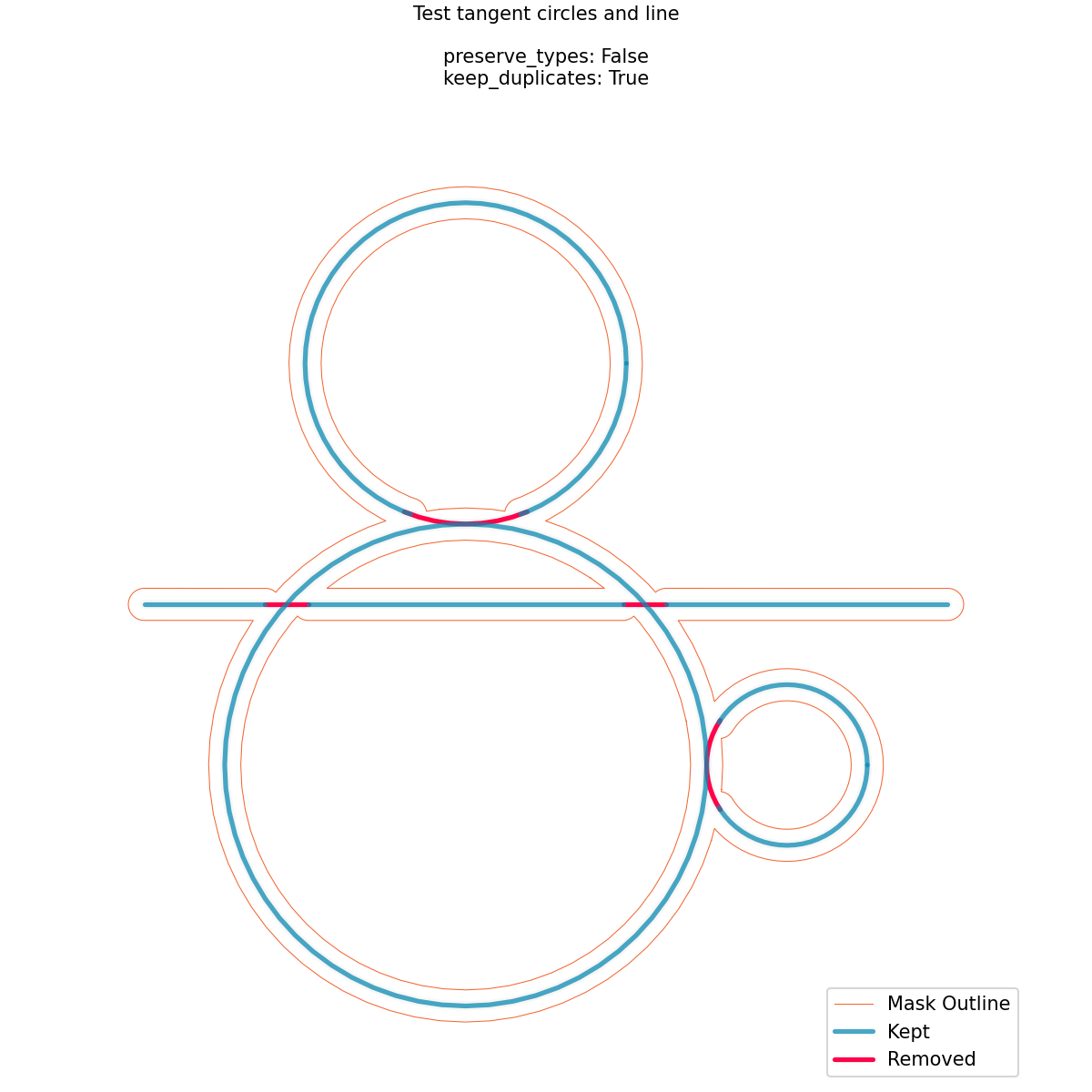
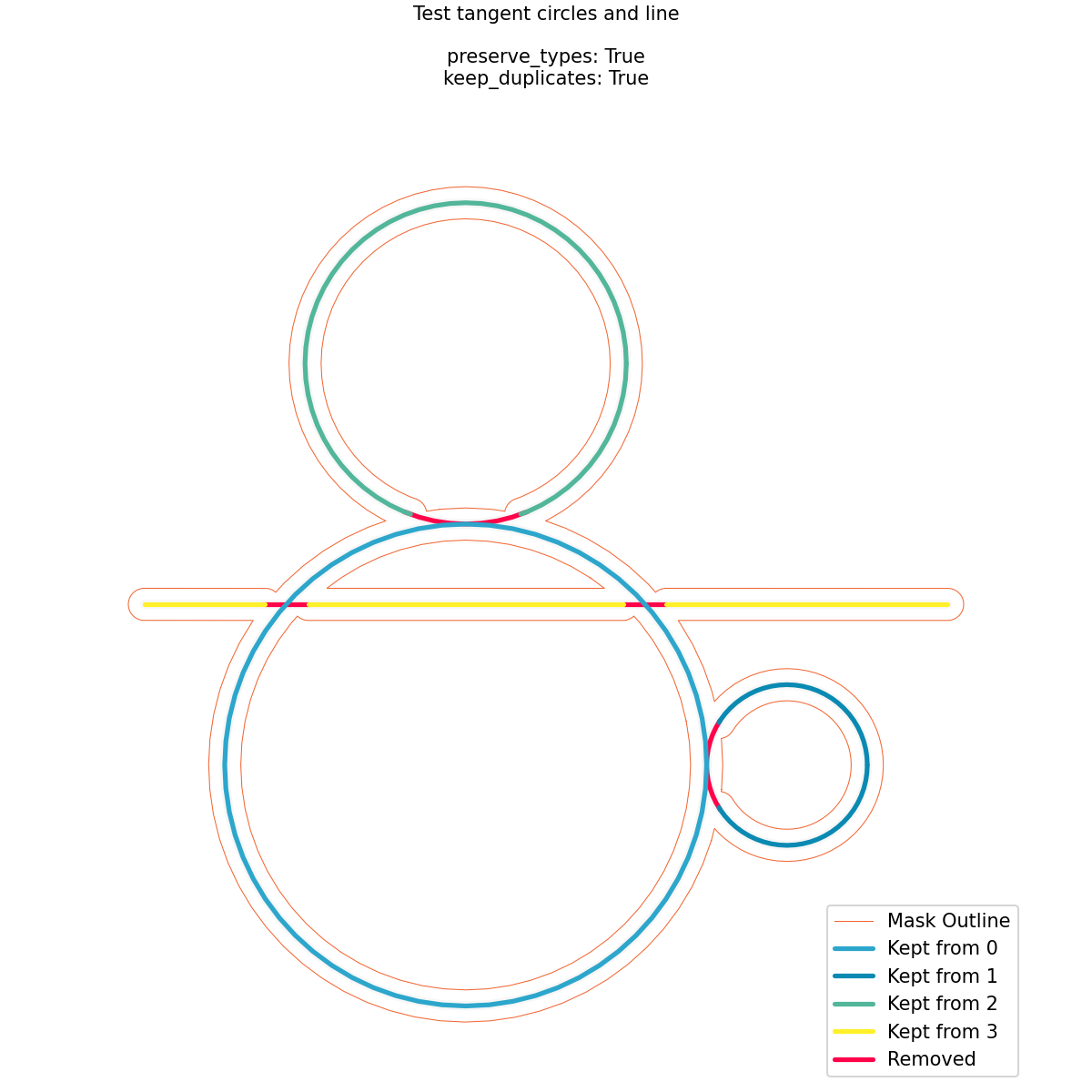
The deoverlap function can handle a mix of geometry types, including Polygons. When preserve_types is False, polygons are treated as their boundary lines. When preserve_types is True, the function attempts to preserve the Polygon objects, clipping them as necessary.
Example: De-overlapping a set of tangent circles and a line.
preserve_types=False(flat output):preserve_types=True(structured output):
API Reference
deoverlap(geometries, tolerance, preserve_types=False, keep_duplicates=False, track_origins=False, progress_bar=False, mask=None)
De-overlaps a list of geometries with extensive options for output format and origin tracking.
Parameters:
geometries(GeomInput): An iterable of Shapely geometries.tolerance(float): The buffer distance to consider geometries as overlapping.preserve_types(bool, optional):False(Default): Fast mode. Returns a flat list of simpleLineStrings andPoints.True: Powerful mode. Returns structured geometries (e.g.,MultiLineString). Slower.
keep_duplicates(bool, optional): IfTrue, the removed/overlapping portions are returned. Defaults toFalse.track_origins(bool, optional): Only applies whenpreserve_types=True. IfTrue, returns a detailed dictionary mapping removed parts to their original index. Defaults toFalse.progress_bar(bool, optional): IfTrue, displays a tqdm progress bar. Defaults toFalse.mask(List[Polygon], optional): An optional, pre-existing list of polygon masks. If provided, geometries will be de-overlapped against this mask first. This is useful for iterative processing or for ensuring consistency across multiple, separate calls. The returned mask will include these initial polygons. Defaults toNone.
Returns:
- The return type depends on the flags:
- If
preserve_types=False(flat mode):(kept_geoms, kept_map, removed_geoms, mask)kept_geoms: List of kept (non-overlapping) geometries (LineString, Point)kept_map: Always an empty dict in this moderemoved_geoms: List of removed (overlapping) geometries (ifkeep_duplicates=True, else empty list)mask: List of mask polygons used for clipping
- If
preserve_types=Trueandtrack_origins=False(structured mode):(kept_geoms, kept_map, removed_geoms, mask)kept_geoms: List of kept (non-overlapping) structured geometrieskept_map: Dict mapping input index to list of kept geometriesremoved_geoms: List of removed (overlapping) geometries (ifkeep_duplicates=True, else empty list)mask: List of mask polygons used for clipping
- If
preserve_types=Trueandtrack_origins=True(structured mode with origin tracking): A dictionary with keys:"kept": List of kept (non-overlapping) structured geometries"kept_parts": Dict mapping input index to list of kept geometries"removed_parts": Dict mapping input index to list of removed geometries (ifkeep_duplicates=True, else empty dict)"wholly_removed_indices": List of indices of geometries that were wholly removed"mask": List of mask polygons used for clipping
- If
Release history Release notifications | RSS feed


Download files
Download the file for your platform. If you're not sure which to choose, learn more about installing packages.
Source Distribution
Built Distribution
Filter files by name, interpreter, ABI, and platform.
If you're not sure about the file name format, learn more about wheel file names.
Copy a direct link to the current filters
File details
Details for the file deoverlap-1.0.2.tar.gz.
File metadata
- Download URL: deoverlap-1.0.2.tar.gz
- Upload date:
- Size: 16.5 kB
- Tags: Source
- Uploaded using Trusted Publishing? No
- Uploaded via: twine/6.1.0 CPython/3.13.5
File hashes
| Algorithm | Hash digest | |
|---|---|---|
| SHA256 |
5d0110e99c3b4deb58ae1c365108e191ac9065b82ec3ca2f40e475f937452d17
|
|
| MD5 |
fe7e12c9f8d580f50bdb21b294c88b55
|
|
| BLAKE2b-256 |
6900bc4dcc62d1b49f2cd594835bd056c71c4f05892fb11231e95a01d2a2a21f
|
File details
Details for the file deoverlap-1.0.2-py3-none-any.whl.
File metadata
- Download URL: deoverlap-1.0.2-py3-none-any.whl
- Upload date:
- Size: 10.3 kB
- Tags: Python 3
- Uploaded using Trusted Publishing? No
- Uploaded via: twine/6.1.0 CPython/3.13.5
File hashes
| Algorithm | Hash digest | |
|---|---|---|
| SHA256 |
ac4314263b00098d2bab61ff749a5249ca866e6dd21fcf9f4770aa410288f992
|
|
| MD5 |
03f553da310b5dc3920d50340eac4d42
|
|
| BLAKE2b-256 |
da4a081478ef4c873c0b5c92579a81ee08cc713e2c7b5378d554041e4a3ce64c
|






