
Run multiple Python package versions together without dependency conflicts
Verified details
These details have been verified by PyPIProject links
GitHub Statistics
Maintainers

Project description
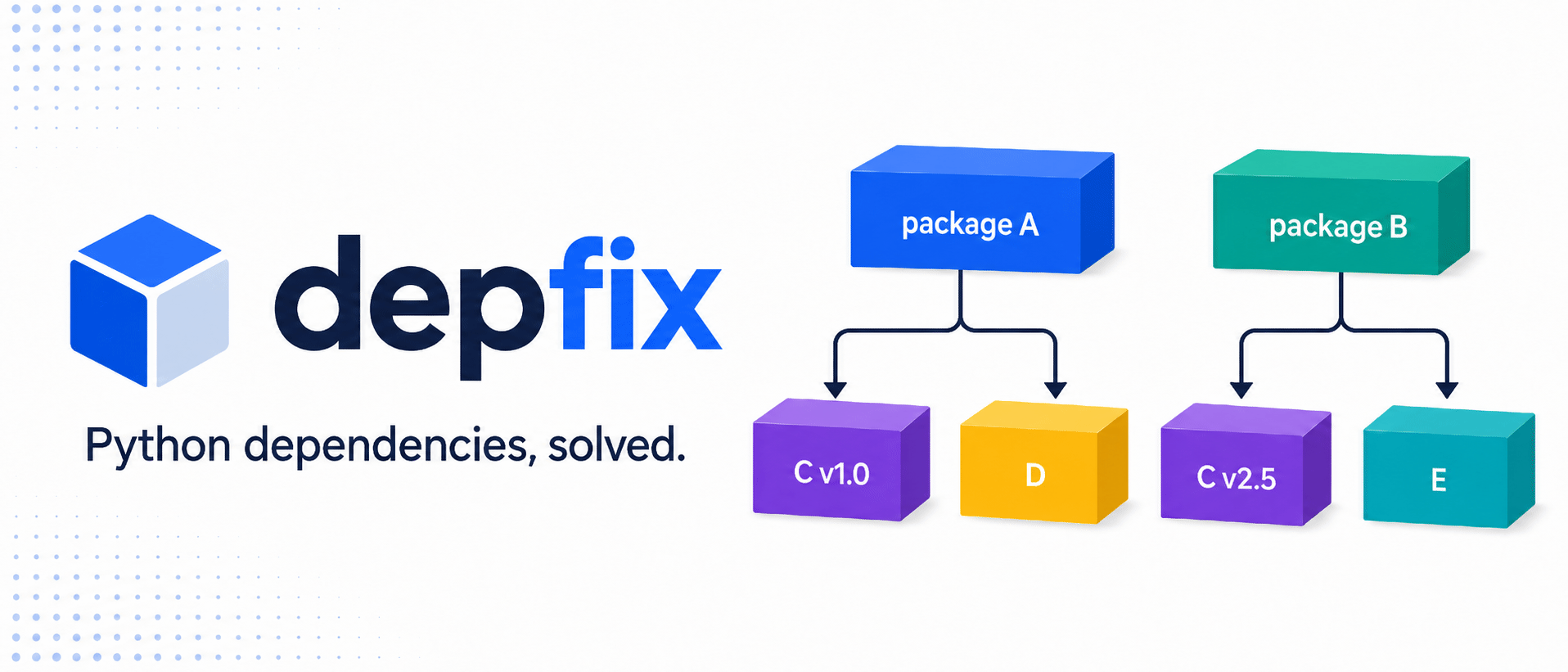



No more Python dependency pain!
| The win | What it means |
|---|---|
| 🧩 No dependency conflicts | Every package keeps the dependency versions it needs. |
| 🔀 Multiple versions together | Import two versions of the same package in one Python process. |
| ⚡ Install at runtime | Packages are downloaded when your code first needs them, then cached. |
| 🧹 No dependency files | No requirements.txt or dependency list in pyproject.toml is required. |
| 🐍 Normal Python imports | Select a version, then keep writing ordinary import package. |
| 🌱 Start with one line | No environment redesign or separate installation workflow. |
| 🚀 Production ready | Built-in CLI and Python APIs let you preinstall or vendor packages for predictable deployments. |
import depfix

with depfix.using("requests==2.31.0"):
    import requests as requests_old

with depfix.using("requests==2.32.3"):
    import requests as requests_new

assert requests_old is not requests_new
That is the idea: put the version next to the import and let Depfix handle the rest.
No requirements.txt needed. No dependency list in pyproject.toml. No virtual-environment juggling because two packages
want different versions of the same dependency. Depfix downloads packages when they are first used, keeps them cached, and
makes sure each package continues using the dependencies it was installed with.
Your imports become the source of truth. Dependency conflicts stop being a project-wide problem.
Your imports are the package manager
Install Depfix once:
python -m pip install depfix
Then choose whichever import style fits your code.
Set a default version
Use default() when the rest of the file or application should import selected versions normally. You can select one or
several packages together:
import depfix

depfix.default(
    "requests==2.32.3",
    "PyYAML==6.0.2",
)

import requests
import yaml

response = requests.get("https://raw.githubusercontent.com/pypa/pip/main/.pre-commit-config.yaml")
workflow = yaml.safe_load(response.text)
There is no separate install step. The first default() call prepares the requested packages, and later runs reuse the
cache.
Use a version temporarily
Use using() when one part of your program needs a specific version:
import depfix

with depfix.using("openai==0.7.0"):
    import openai as openai_0_7

with depfix.using("openai==0.28.1"):
    import openai as openai_0_28
The imported objects keep working after the block ends:
with depfix.using("requests==2.31.0"):
    import requests as legacy_requests

response = legacy_requests.get("https://example.com")
using() also works as a function decorator:
import depfix


@depfix.using("requests==2.31.0")
def fetch_with_legacy_requests(url: str):
    import requests

    return requests.get(url)
The selected version is active every time the function runs. Async functions work too.
Import a package directly
Use import_module() when you want the module returned immediately:
import depfix

requests = depfix.import_module("requests==2.32.3")
This is especially convenient for dynamic code:
version = "2.32.3"
requests = depfix.import_module(f"requests=={version}")
Most packages expose one obvious import. If a package exposes several and you already know which ones you need, select
each with module=:
import depfix

setuptools = depfix.import_module(
    "setuptools==75.0.0",
    module="setuptools",
)

pkg_resources = depfix.import_module(
    "setuptools==75.0.0",
    module="pkg_resources",
)
Use load_package() when you want to inspect package metadata or discover its available module names before importing:
package = depfix.load_package("setuptools==75.0.0")

print(package.name, package.version)
print(package.module_names)
print(package.dependencies)
Dependency conflicts just work
Imagine two packages that cannot be installed together conventionally:
awscli==1.32.0  needs botocore==1.34.0
boto3==1.36.0   needs botocore>=1.36,<1.37
With Depfix, import both:
import depfix

with depfix.using("awscli==1.32.0", "boto3==1.36.0"):
    import awscli.clidriver
    import boto3
Each package receives the Botocore version it needs. You do not have to pin the shared dependency, split the application, or create another environment. See the runnable AWS CLI and Boto3 example.
More than PyPI
The same APIs accept version ranges and common Python package sources:
requests = depfix.import_module("requests>=2.31,<3")
requests_with_socks = depfix.import_module("pypi:requests[socks]~=2.32")
sdk = depfix.import_module("git:https://github.com/acme/sdk.git@v2.4.0")
local_package = depfix.import_module("file:../my-local-package")
helpers = depfix.import_module("file:./helpers.py")

module = depfix.import_module("url:https://packages.example/acme_sdk-2.4.0-py3-none-any.whl#sha256=<digest>")
Standard PEP 508 direct references work as well.
Start simple, lock it later
For local development, just run your Python file. Depfix installs and caches packages as the code reaches them. It does not create project files.
When you want a repeatable deployment, Depfix can scan the same imports and prepare everything in advance:
depfix export . -o .depfix/imports.lock
depfix install .depfix/imports.lock --frozen
python application.py
This is optional. You can start with one import and add deployment controls only when you need them. Offline bundles, containers, and generated IDE aliases are also available.
Good to know
- Importing
depfixalone does nothing expensive. Installation starts only when you call a loading function. - Package preparation is shown on stderr, so you can see what is happening. Set
DEPFIX_LOG_LEVEL=WARNINGfor quiet mode. - Depfix currently focuses on pure-Python packages on CPython 3.11–3.13.
- Packages that require native extensions may need a separate worker process.
- Depfix isolates dependency versions; it is not a sandbox for untrusted code.
Documentation
Created by Agent Zero
Depfix is an open-source project by agent0ai, creator of Agent Zero, Space Agent, and DOX.
- Found a bug or compatibility gap? Open an issue.
- Want to contribute? Read CONTRIBUTING.md.
- Want to support agent0ai's work? Sponsor on GitHub.
License
Depfix is released under the MIT License.
Project details
Verified details
These details have been verified by PyPIProject links
GitHub Statistics
Maintainers


Download files
Download the file for your platform. If you're not sure which to choose, learn more about installing packages.
Source Distribution
Built Distribution
Filter files by name, interpreter, ABI, and platform.
If you're not sure about the file name format, learn more about wheel file names.
Copy a direct link to the current filters
File details
Details for the file depfix-0.2.0.tar.gz.
File metadata
- Download URL: depfix-0.2.0.tar.gz
- Upload date:
- Size: 118.0 kB
- Tags: Source
- Uploaded using Trusted Publishing? Yes
- Uploaded via: twine/7.0.0 CPython/3.13.14
File hashes
| Algorithm | Hash digest | |
|---|---|---|
| SHA256 |
453dff9dcc6284a21dfd68d55efda760d9bd81dda0ad4397a41de96dc4877dec
|
|
| MD5 |
f05e1749406ae0ca84c563e5793c44d8
|
|
| BLAKE2b-256 |
d4d5f08dbc53277e5327ba78226d352adb712bb99e99c0403a6bd5ec1f0e7583
|
Provenance
The following attestation bundles were made for depfix-0.2.0.tar.gz:
Publisher:
publish-pypi.yml on agent0ai/depfix
-
Statement:
-
Statement type:
https://in-toto.io/Statement/v1 -
Predicate type:
https://docs.pypi.org/attestations/publish/v1 -
Subject name:
depfix-0.2.0.tar.gz -
Subject digest:
453dff9dcc6284a21dfd68d55efda760d9bd81dda0ad4397a41de96dc4877dec - Sigstore transparency entry: 2310852806
- Sigstore integration time:
-
Permalink:
agent0ai/depfix@3781777608545b2d3985e550242e3076910d4a26 -
Branch / Tag:
refs/tags/v0.2.0 - Owner: https://github.com/agent0ai
-
Access:
public
-
Token Issuer:
https://token.actions.githubusercontent.com -
Runner Environment:
github-hosted -
Publication workflow:
publish-pypi.yml@3781777608545b2d3985e550242e3076910d4a26 -
Trigger Event:
release
-
Statement type:
File details
Details for the file depfix-0.2.0-py3-none-any.whl.
File metadata
- Download URL: depfix-0.2.0-py3-none-any.whl
- Upload date:
- Size: 93.4 kB
- Tags: Python 3
- Uploaded using Trusted Publishing? Yes
- Uploaded via: twine/7.0.0 CPython/3.13.14
File hashes
| Algorithm | Hash digest | |
|---|---|---|
| SHA256 |
e27edc6d1b9b9ce323d0356c623fbb1ce5828c3ff279b875be6aca103ee867ba
|
|
| MD5 |
06e56b6a4e06594b7ee7e4d147aece9a
|
|
| BLAKE2b-256 |
6e14b63c6d58013a2a8b2ad2c2797ce87fa1153f98e183f80e8f6c36aadb4c58
|
Provenance
The following attestation bundles were made for depfix-0.2.0-py3-none-any.whl:
Publisher:
publish-pypi.yml on agent0ai/depfix
-
Statement:
-
Statement type:
https://in-toto.io/Statement/v1 -
Predicate type:
https://docs.pypi.org/attestations/publish/v1 -
Subject name:
depfix-0.2.0-py3-none-any.whl -
Subject digest:
e27edc6d1b9b9ce323d0356c623fbb1ce5828c3ff279b875be6aca103ee867ba - Sigstore transparency entry: 2310852886
- Sigstore integration time:
-
Permalink:
agent0ai/depfix@3781777608545b2d3985e550242e3076910d4a26 -
Branch / Tag:
refs/tags/v0.2.0 - Owner: https://github.com/agent0ai
-
Access:
public
-
Token Issuer:
https://token.actions.githubusercontent.com -
Runner Environment:
github-hosted -
Publication workflow:
publish-pypi.yml@3781777608545b2d3985e550242e3076910d4a26 -
Trigger Event:
release
-
Statement type:






