
depquiet





Cut through vulnerability alert noise. Surface the signal.
depquiet triages your npm audit / pip-audit / trivy / grype / Dependabot / Snyk alerts and tells you which CVEs actually matter — in seconds, not hours. It can also scan lockfiles directly using the OSV.dev API — no external scanner required.
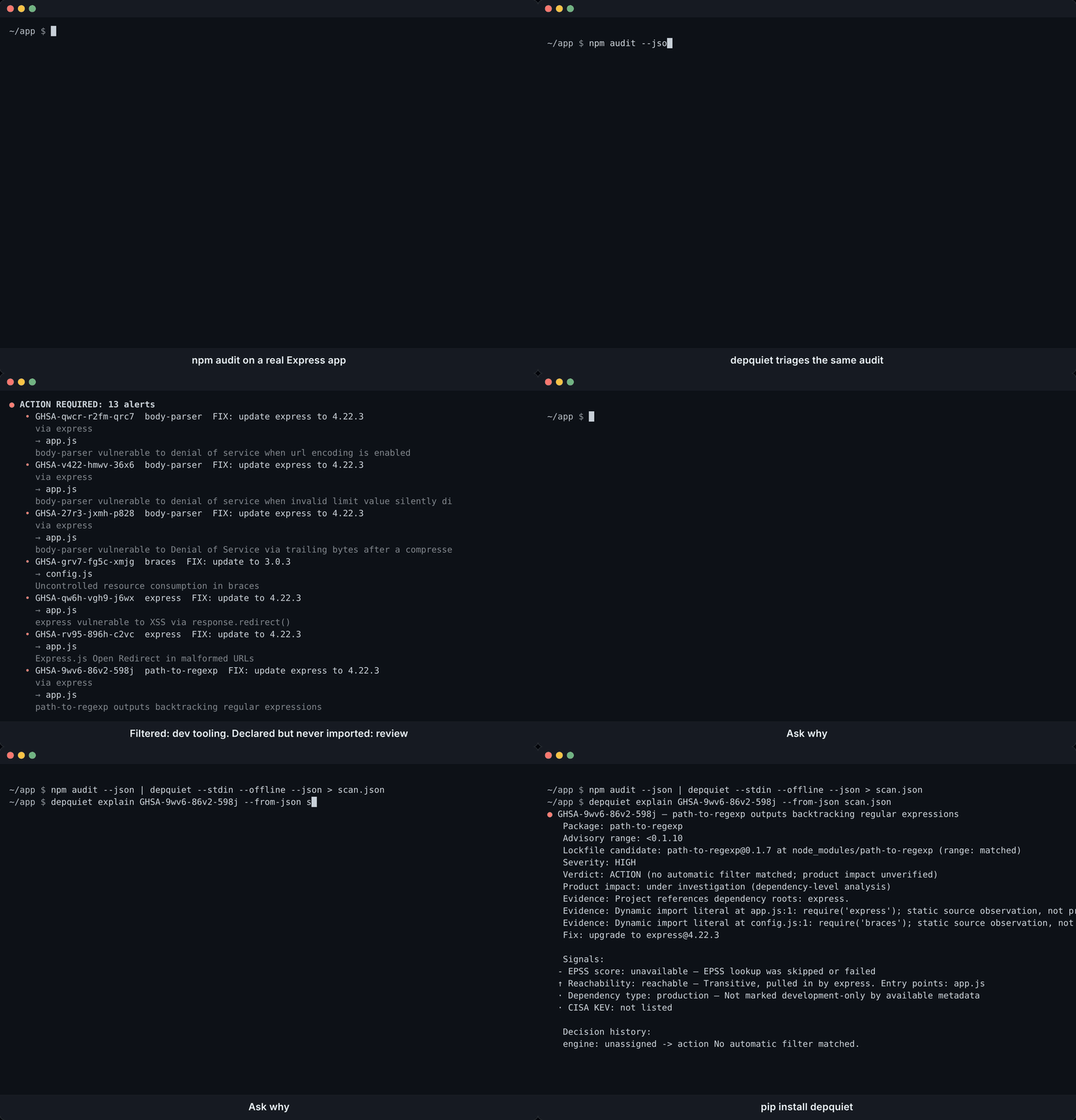
Every line in the recording is real command output (how it's made). The same run as text (reproduce it):
$ npm audit --json | depquiet --stdin

depquiet scan — npm (14 packages)

✅ FILTERED: 13 alerts (45%)
   ├─ 13 unreachable — not imported, directly or via a parent
   └─ 8 devDependency only — never reaches production
   (an alert can match more than one reason)

⚠️  REVIEW: 3 alerts
   GHSA-pxg6-pf52-xh8x  cookie                    low        no EPSS
   ...

🔴 ACTION REQUIRED: 13 alerts
   • GHSA-9wv6-86v2-598j  path-to-regexp  FIX: update express to 4.22.3
     via express
     → app.js
     path-to-regexp outputs backtracking regular expressions
   ...

Total: 29 alerts — 13 actionable | 3 review | 13 filtered
path-to-regexp is never imported by the app, but Express calls it on every request, so
depquiet keeps it. The 13 filtered alerts are in packages that only build tools pull in
(eslint, nodemon, webpack-dev-middleware) or that the app declares but never imports.
Quick start
pip install depquiet pip-audit             # pip-audit is optional; without it Python
                                           # projects are scanned through OSV.dev
cd your-project
depquiet                                   # runs npm audit / pip-audit, or scans lockfiles via OSV.dev
npm audit --json | depquiet --stdin        # or triage any scanner's output
depquiet explain GHSA-9wv6-86v2-598j       # why did this alert get its verdict?
Works on npm, yarn, Python (uv, Poetry, pip-tools, Pipfile), Rust, Ruby, PHP, .NET, Dart, Go and Maven projects. In CI, use the GitHub Action.
The problem
Dependency scanners report every advisory that matches a version range, whether or not your application can reach the vulnerable code:
- npm audit is "broken by design" (Dan Abramov)
- Dependabot is a "noise machine": Filippo Valsorda recommends turning it off in favor of reachability-aware tools like
govulncheck
The result is alert fatigue: teams either spend hours triaging noise or start ignoring alerts, real ones included.
How it works
depquiet applies five deterministic filters to separate signal from noise:
| Filter | Filters an alert when |
|---|---|
| Reachability | No source file imports the package, and (for a transitive package) no source file imports any direct dependency that pulls it in |
| Test-only use | The package is imported, but only from test files (tests/, e2e/, *.test.*, *.spec.*, test-runner configs), it is not run as a project command, and no application file names it |
| Dev dependencies | Every known dependency path is for development, with no production parent |
| EPSS scoring | The CVE's probability of exploitation is below the threshold (default 10%) |
| Community templates | A matching template's dismissal conditions can be verified against the project |
See benchmarks for measured results on a real project.
Conservative by design
depquiet would rather let a false positive through than dismiss a real vulnerability:
- Transitive dependencies are judged by their parents. Your code never imports
path-to-regexp; Express does. depquiet reads your manifests and lockfiles to find the direct dependencies that pull a package in, and keeps the alert if your code imports any of them. See Direct vs. transitive. - Unknown means not filtered. If no manifest or lockfile says whether a package is direct or transitive, or a file fails to parse, the alert is not filtered on reachability.
- Production paths override development labels. A package listed in
devDependenciesis still kept when a production dependency also pulls it in. A transitive package imported by the application is kept even when its declared parent is unused. - Import-level, not call-graph. Reachability means "the package enters your app", not
"the vulnerable function is called". It removes packages your app never loads; it does not
prove an imported package's vulnerable function is unused. For Go,
govulncheckdoes symbol-level analysis and is the better tool.
Supported inputs
depquiet accepts output from any vulnerability scanner — natively or via SARIF:
| Scanner | Format | Input method |
|---|---|---|
| None (standalone) | Lockfiles | depquiet (auto-detects lockfiles, queries OSV.dev) |
| npm audit | JSON | npm audit --json | depquiet --stdin |
| pip-audit | JSON | pip-audit --format json | depquiet --stdin |
| Trivy | JSON or SARIF | trivy fs --format json . | depquiet --stdin |
| Grype | JSON | grype dir:. -o json | depquiet --stdin |
| Snyk | JSON | snyk test --json | depquiet --stdin |
| Dependabot | API JSON | gh api /repos/O/R/dependabot/alerts | depquiet --stdin |
| Any SARIF scanner | SARIF v2.1.0 | <scanner> --sarif | depquiet --stdin |
| CycloneDX SBOM | JSON | depquiet --from-sbom vendor.cdx.json |
| SPDX SBOM | JSON | depquiet --from-sbom vendor.spdx.json |
The SARIF parser handles output from CodeQL, Semgrep, Trivy SARIF, Grype SARIF, Snyk SARIF, Checkmarx, Fortify, and any other tool that emits SARIF v2.1.0. CVE, package name, severity (CVSS or level-based), and fix version are extracted automatically from the standard SARIF fields and common scanner-specific properties.
npm component evidence
For npm audit input, JSON keeps the legacy version value and identifies it as
version_kind: advisory_range. Separate components record exact lockfile
versions, node locations, source hashes and stable instance IDs. Each candidate
has its own range_match; npm's package-level node list is not a per-advisory
affected-version list. Unknown or partial resolution remains explicit.
CycloneDX, SPDX and OpenVEX use those component identities instead of presenting an advisory range as a component version. No lockfile resolution claims an observed installation or product impact. See npm component evidence for the JSON contract, matching limits and export behavior. Explicitly scoped reports support instance baselines and diffs; unscoped legacy reports retain their existing identities.
Standalone scanning with OSV.dev
When no scanner output is piped in and no native package manager is detected, depquiet falls back to lockfile scanning via OSV.dev — Google's open, free vulnerability database. Just run depquiet in any project with a lockfile:
| Lockfile | Ecosystem |
|---|---|
package-lock.json / yarn.lock |
npm |
requirements.txt / Pipfile.lock |
PyPI |
go.sum |
Go |
Cargo.lock |
crates.io |
pubspec.lock |
Pub (Dart/Flutter) |
Gemfile.lock |
RubyGems |
composer.lock |
Packagist (PHP) |
packages.lock.json |
NuGet (C#) |
Multiple lockfiles in the same project are merged and deduplicated. OSV.dev queries
are batched in groups of up to 1000 packages, then each distinct advisory is fetched
for its severity, CVE aliases and fixed versions. All pages and advisory lookups must
succeed before the scan is considered complete. Use --offline to skip OSV.dev queries.
SBOM generation (CycloneDX + SPDX)
depquiet generates both major SBOM standards required by US Executive Order 14028:
# CycloneDX 1.5 (OWASP standard)
depquiet --sbom sbom.json              # CycloneDX JSON
depquiet --sbom sbom.xml               # CycloneDX XML (auto-detected)
depquiet --sbom out.cdx --sbom-format xml

# SPDX 2.3 (ISO/IEC 5962:2021)
depquiet --sbom sbom.spdx.json         # SPDX JSON (auto-detected)
depquiet --sbom out.spdx --sbom-format spdx
Both formats include full component inventory with Package URLs (purl), vulnerability references for known CVEs, depquiet triage verdicts, and tool creator metadata. CycloneDX additionally maps verdicts to analysis states; SPDX uses SECURITY external references with NVD links.
SBOM output works alongside all other flags — combine --sbom with --sarif to generate both in one pass.
SBOM import — triage from third-party SBOMs
depquiet can consume CycloneDX and SPDX SBOMs as input, enabling triage on third-party SBOMs from vendors, container registries, or build systems — without needing the original lockfile:
# Explicit file input
depquiet --from-sbom vendor-sbom.cdx.json    # CycloneDX 1.4/1.5 JSON
depquiet --from-sbom vendor-sbom.spdx.json   # SPDX 2.3 JSON

# Piped via stdin (auto-detected)
cat container-sbom.json | depquiet --stdin
Two-mode operation:
- Vulnerability mode — if the SBOM contains vulnerability data (CycloneDX
vulnerabilitiesarray or SPDX SECURITY external refs), those are extracted and triaged directly - Package mode — if no vulnerability data is present, the package inventory is extracted and queried against OSV.dev for known advisories
An inventory-only SBOM cannot be scanned with --offline. Missing packages or a failed
OSV.dev lookup produce "nothing scanned" and exit code 2, rather than a clean report.
All standard depquiet flags work with SBOM input: --epss-threshold, --kev, --sbom (re-export), --sarif, --html, etc.
Workspace and dynamic-import coverage
Declared npm workspaces and uv [tool.uv.workspace] members have independent
dependency graphs, command metadata and source scopes. Deep declared members are
discovered beyond the legacy depth limit. A package used by a production member
cannot be classified as dev-only solely from the root's declaration.
Scan JSON and saved explain output retain per-workspace usage, dependency roots
and coverage. Unreadable/malformed manifests, ambiguous shared-lock versions or
recognized loaders with nonliteral targets block automatic absence-based
decisions. Positive imports remain visible alongside uncertainty.
The analysis is bounded: initial workspace support covers npm and uv declarations, and finding-to-workspace associations use conservative dependency names rather than claiming an installed instance or verified call path. Other layouts retain legacy discovery. See workspace and dynamic-import coverage for patterns, limits, aggregation and compatibility.
Reachability analysis in depth
Import detection works differently for each language:
Python — AST extraction via ast.parse() observes ordinary imports and
recognized importlib.import_module / __import__ calls, including direct aliases.
Literal targets provide positive import evidence; nonliteral, conditional or
rebound loader bindings retain uncertainty. Comments and strings are not executed
as loader calls. Files that fail AST parsing retain the existing regex fallback;
this does not establish complete parse or dynamic-loader coverage.
JavaScript / TypeScript — Comment-stripping pipeline + pattern matching on actual import syntax. Handles all major import styles:
- ESM:
import X from 'pkg',import {a, b} from 'pkg',import 'pkg'(side-effect) - CommonJS:
require('pkg') - Dynamic:
import('pkg') - Re-exports:
export {a} from 'pkg',export * from 'pkg' - Scoped packages:
@scope/nameresolved correctly - Strips
//and/* */comments so commented-out imports don't cause false positives - Zero runtime dependencies — no external JS parser needed
A bounded lexer additionally observes require(...), import(...) and
module.require(...) calls. Nonliteral targets retain explicit uncertainty with
file/line evidence. This is lexical analysis, not a full JavaScript/TypeScript
parser or arbitrary loader/dataflow resolution.
Go — Import statement parsing with comment stripping. Handles:
- Single imports:
import "pkg" - Grouped imports:
import ( "pkg1" ; "pkg2" ) - Aliased, dot, and blank imports:
import m "pkg",import _ "pkg" - Module path resolution:
github.com/user/repo/sub→github.com/user/repo golang.org/x/*packages resolved correctly- Skips
vendor/directory
Rust — Import statement parsing with comment stripping. Handles:
use crate_name::...anduse crate_name;extern crate crate_name;andextern crate crate_name as alias;- Nested use:
use crate_name::{a, b}; - Hyphen-to-underscore normalization:
my-cratein Cargo.toml →my_cratein source - Skips Rust-internal path roots:
self,super,crate,std,core,alloc - Skips
target/directory
Java / Kotlin — Import statement parsing with comment stripping. Handles:
- Standard imports:
import com.example.Foo; - Static imports:
import static org.junit.Assert.assertEquals; - Wildcard imports:
import com.example.*; - Kotlin imports (no semicolons):
import com.example.Foo - Maven coordinate splitting:
groupId:artifactId→ matches againstgroupIdprefix - Package-path heuristic: walks dot-separated segments until an uppercase class name or
* - Skips
build/directory
C# — Using directive parsing with comment stripping. Handles:
- Standard usings:
using Newtonsoft.Json; - Static usings:
using static System.Math; - Alias usings:
using Json = Newtonsoft.Json.JsonConvert; - Global usings:
global using System.Linq; - NuGet namespace matching: package name matches the root namespace prefix
- Skips
build/directory
PHP — Use statement parsing with comment stripping. Handles:
- Standard use:
use Monolog\Logger; - Function use:
use function GuzzleHttp\Promise\all; - Const use:
use const GuzzleHttp\Promise\FULFILLED; - Composer vendor/package convention: first two namespace segments lowercased and joined with
/ - Case-insensitive matching (PHP namespaces are case-insensitive)
- Strips
//,#, and/* */comments - Skips
vendor/directory
Ruby — Require statement parsing with comment stripping. Handles:
require 'gem_name'(single and double quotes)require 'gem_name/sub'→ extracts top-levelgem_namerequire_relativeskipped (project-internal files)- Hyphenated gem convention:
aws-sdk-s3matches bothrequire 'aws-sdk-s3'andrequire 'aws/sdk/s3' - Strips
#and=begin/=endcomments - Skips
vendor/directory
Swift — Import statement parsing with comment stripping. Handles:
- Standard imports:
import ModuleName - Kind imports:
import struct Module.Type,import class Module.Class,import func Module.func - Testable imports:
@testable import ModuleName - SwiftPM package-to-module mapping: hyphens become underscores (
swift-argument-parser→swift_argument_parser) - Top-level module name extraction from dotted imports
- Skips
.build/directory
Dart / Flutter — Import statement parsing with comment stripping. Handles:
- Package imports:
import 'package:name/file.dart'; - Subpath imports:
import 'package:name/src/sub.dart';→ extractsname dart:SDK imports skipped (SDK-internal)- Relative imports skipped (project-internal)
- Hyphen-to-underscore normalization for scanners that report with hyphens
- Skips
.dart_tool/directory
All ten analyzers map aliased package names (e.g., my-package → my_package for Python, @scope/name/sub → @scope/name for JS, github.com/user/repo/sub → github.com/user/repo for Go, my-crate → my_crate for Rust, com.fasterxml.jackson.core:jackson-databind → com.fasterxml.jackson.core for Java, Newtonsoft.Json.Linq → Newtonsoft.Json for C#, Monolog\Logger\Handler → monolog/logger for PHP, aws-sdk-s3 → matches require 'aws/sdk/s3' for Ruby, swift-argument-parser → swift_argument_parser for Swift, flutter-bloc → flutter_bloc for Dart) and check all source files in the project, skipping node_modules, .git, __pycache__, dist, build, .build, .dart_tool, vendor, target, and other vendored directories.
Direct vs. transitive dependencies
The import check only answers "does my code import this package?", which is the right question for direct dependencies and the wrong one for transitive ones. Since v0.28.0 depquiet builds a dependency graph from the project before filtering:
| Ecosystem | Direct dependencies from | Dependency paths from |
|---|---|---|
| npm | package.json, package-lock.json |
package-lock.json (v1-v3), yarn.lock (v1, berry) |
| Python | uv.lock, pyproject.toml (PEP 621, PEP 735, Poetry), Pipfile, requirements.in, hand-written requirements.txt |
uv.lock, poetry.lock, pip-compile # via comments |
| Rust | Cargo.lock workspace crates |
Cargo.lock |
| Ruby | Gemfile.lock |
Gemfile.lock |
| PHP | composer.json |
composer.lock |
| .NET | packages.lock.json |
packages.lock.json |
| Dart | pubspec.lock |
— |
| Go | go.mod (// indirect) |
— |
| Java (Maven) | pom.xml |
— |
Rules, in order:
- Direct dependency: filtered when nothing imports it, the project never runs it as a command, and no used direct dependency also pulls it in.
- Transitive dependency: filtered only when none of the direct dependencies that pull it in are used. With no known path (Go, Dart, Maven), it is never filtered.
A direct dependency is used when any of these holds:
- a source file imports it. Python distribution names are mapped to module names
(
PyYAML→yaml,llama-index-core→llama_index) from installed metadata in the project's virtualenv, a table of known mismatches, and naming rules; - the project runs one of its executables:
pm2 startin apackage.jsonscript, aProcfileentry, or a Dockerfile command; - it is named in the project's code, scripts or config (
INSTALLED_APPS = ["allauth"],postgresql+psycopg2://,celery flowerin a service script). Docs, manifests and lockfiles don't count; - a used dependency loads it itself (FastAPI loads
python-multipart, SQLAlchemy loads database drivers).
Every rule only ever keeps alerts: a wrong match makes depquiet filter less, never more.
3. Unknown: never filtered. This includes a requirements.txt where every line is pinned
with == and there are no # via comments, since that is indistinguishable from
pip freeze output.
depquiet explain <CVE> shows the dependency type and the packages that pull it in, and
--json output includes dependency_type and introduced_by for every alert.
Install
pip install depquiet
Usage
# Auto-detect lockfiles and scan (no scanner needed — uses OSV.dev)
depquiet

# Scan a specific directory
depquiet --path ./my-app

# Pipe in existing audit output
npm audit --json | depquiet --stdin
pip-audit --format json | depquiet --stdin
trivy fs --format json . | depquiet --stdin
grype dir:. -o json | depquiet --stdin
snyk test --json | depquiet --stdin
gh api /repos/OWNER/REPO/dependabot/alerts --paginate | depquiet --stdin

# SARIF input — any scanner that emits SARIF works
semgrep --sarif . | depquiet --stdin
codeql database analyze db --format=sarif-latest | depquiet --stdin
trivy fs --format sarif . | depquiet --stdin
checkmarx-cli scan --output-format sarif | depquiet --stdin

# Fully offline (skip EPSS API)
depquiet --offline

# SARIF output for GitHub Code Scanning
depquiet --sarif results.sarif

# SBOM (EO 14028 compliance)
depquiet --sbom sbom.json                     # CycloneDX 1.5 JSON
depquiet --sbom sbom.xml --sbom-format xml    # CycloneDX 1.5 XML
depquiet --sbom sbom.spdx.json               # SPDX 2.3 JSON

# JSON output for scripting
depquiet --json

# Custom EPSS threshold
depquiet --epss-threshold 0.05

# Use a custom config file
depquiet --config ./ci-config.yaml

# Auto-fix ACTION items that have a known fix version
depquiet --fix

# See what --fix would do without changing anything
depquiet --fix --dry-run

# License compliance scan
depquiet --license

# Use a suppression file (auto-detected from project root)
depquiet   # reads .depquiet-ignore if present

# Explicit ignore file
depquiet --ignore ./custom-ignore.yaml

# Write GitHub-flavored Markdown summary (for CI)
depquiet --summary report.md

# Self-contained HTML report (share via email/Slack/artifact)
depquiet --html report.html

# Configurable CI gate — fail only on critical findings
depquiet --fail-on critical

# Fail on high and above (skip moderate/low)
depquiet --fail-on high

# Never fail on findings (informational mode)
depquiet --fail-on none
Auto-remediation (--fix)
depquiet --fix upgrades packages that have ACTION verdicts and a known fix version.
It runs npm install <pkg>@<ver> or pip install <pkg>==<ver> under the hood.
$ depquiet --fix

depquiet scan — npm (847 packages)
...

✅ Fixed 2 vulnerabilities:
   CVE-2024-4068  braces 3.0.2 → 3.0.3
   CVE-2024-33883  ejs 3.1.9 → 3.1.10

⚠️  1 ACTION items have no fix available:
   CVE-2024-21538  semver 7.5.4
Use --dry-run to preview changes without touching node_modules or site-packages:
$ depquiet --fix --dry-run

[dry-run] ✅ Fixed 2 vulnerabilities:
   CVE-2024-4068  braces 3.0.2 → 3.0.3   Would run: npm install braces@3.0.3
   CVE-2024-33883  ejs 3.1.9 → 3.1.10    Would run: npm install ejs@3.1.10
Exit codes with --fix: returns 0 when every ACTION item is resolved; returns 1 when any remain unfixed (no fix version, or the upgrade command failed).
License compliance (--license)
depquiet --license scans every installed dependency for license risk — copyleft contamination, unknown licenses, and restrictive terms that could block enterprise adoption or open-source distribution.
$ depquiet --license

depquiet license scan — npm (847 packages)

LOW (permissive):  812 packages
   MIT, Apache-2.0, BSD-2-Clause, ISC, ...

MEDIUM (weak copyleft):  4 packages
   LGPL-2.1   libfoo 3.2.1
   MPL-2.0    bar-utils 1.0.0
   ...

🔴 HIGH (copyleft):  2 packages
   GPL-3.0    gpl-thing 1.0.0
   GPL-2.0    another-gpl 2.1.0

🔴 CRITICAL (network copyleft / non-OSS):  1 package
   AGPL-3.0   agpl-server 0.5.0

⚠️  UNKNOWN:  1 package
   ???        mystery-pkg 1.2.3

License scan: FAIL — 4 packages need review
Risk levels:
| Level | Licenses | Meaning |
|---|---|---|
| LOW | MIT, BSD, Apache-2.0, ISC, Unlicense, ... | Permissive — safe for any use |
| MEDIUM | LGPL-2.1, LGPL-3.0, MPL-2.0, EPL-2.0 | Weak copyleft — check linking requirements |
| HIGH | GPL-2.0, GPL-3.0 | Strong copyleft — derivative works must be GPL |
| CRITICAL | AGPL-3.0, SSPL-1.0, BUSL-1.1 | Network copyleft or non-OSS — high legal risk |
| UNKNOWN | Unrecognized or missing | Needs manual review |
SPDX expressions are handled automatically: MIT OR GPL-3.0 picks the most permissive (MIT → LOW), MIT AND GPL-3.0 picks the most restrictive (GPL-3.0 → HIGH). Common non-SPDX strings like "Apache License 2.0" and "GPLv3" are normalized to their SPDX IDs.
Exit codes with --license: returns 0 when all dependencies are LOW or MEDIUM; returns 1 when any HIGH, CRITICAL, or UNKNOWN licenses are found.
Combine with JSON output for CI integration:
depquiet --license --json
With --json, the command emits one scan document. License results are included in its
license field; the vulnerability summary and results fields keep their existing shape.
Suppression file (.depquiet-ignore)
Teams need a way to acknowledge accepted risk without disabling the tool. The .depquiet-ignore file provides per-CVE and per-package suppressions with accountability:
ignores:
  # Suppress a specific CVE (any package)
  - cve: CVE-2024-1234
    reason: "Mitigated by WAF rule WR-123"
    expires: 2025-06-01
    author: alice

  # Suppress a CVE only for a specific package
  - cve: CVE-2024-5678
    package: lodash
    reason: "Only used in tests, no production exposure"

  # Suppress all CVEs for a package (migration planned)
  - package: deprecated-pkg
    reason: "Migration to replacement-pkg planned for Q2"
    expires: 2025-07-01
Place .depquiet-ignore in the project root (auto-detected) or pass --ignore path/to/file.yaml.
Match priority: CVE+package > CVE-only > package-only. Only ACTION and REVIEW items are suppressed — already-filtered items are left as-is.
Expiry dates: When an entry's expires date passes, it stops suppressing and depquiet prints a warning. This prevents suppressions from rotting forever — teams must re-evaluate periodically.
Audit trail: The reason field (recommended) explains why the risk was accepted. The author field records who made the decision.
Scan comparison (depquiet diff)
Compare two saved depquiet reports to see new or absent finding contexts and
verdict changes. Reports with the same explicit project_id automatically use
instance contexts: npm candidates match on advisory, exact version, node location,
lockfile path and advisory range/status. A newly added version or location remains
visible even when the advisory was already present. Partial or unknown evidence
stays explicit. Other scanners retain literal reported-version contexts.
When both reports lack a project ID, matching retains the legacy exact advisory,
package and reported-version string. A scanner range stays a range; the diff does
not infer an installed version or advisory aliases. Use --project-id team/service
to bind missing scopes explicitly, --instances to require instance mode, or
--legacy-identities for an explicit compatibility comparison. Declared project
IDs must agree in every mode; a CLI option cannot override a conflicting ID.
The historical fixed field means a finding context is absent from the head
report. It does not establish remediation or product non-affectedness. A version
replacement can therefore appear as one absent context and one new context.
Compare the same declared project/input scope when interpreting these changes.
# Compare a base branch scan against a PR branch scan
depquiet diff base-scan.json pr-scan.json

# Machine-readable output
depquiet diff base-scan.json pr-scan.json --json

# Fail CI only when new ACTION items appear
depquiet diff base-scan.json pr-scan.json --fail-on-new

# Require scoped instance comparison (both reports must be complete)
depquiet diff base-scan.json pr-scan.json --instances --project-id team/service --fail-on-new
An explicit incomplete scan (scanned: false), malformed report, incompatible scope
or duplicate finding identity is rejected with exit code 2 and a diagnostic
on stderr, without a successful diff or overwriting an existing summary. Other
operational errors also return 2. Exit 1 is used for new ACTION findings
with --fail-on-new; a missing input file retains its legacy exit code 1.
Legacy comparisons accept structurally valid older reports without scanned,
but their completion cannot be verified from that missing flag. Instance mode
requires scanned: true; older npm-project reports without version_kind require
a rescan or explicit legacy comparison. See identity and migration details.
Typical CI workflow:
- name: Scan base
  run: git stash && depquiet --json > /tmp/base.json && git stash pop

- name: Scan head
  run: depquiet --json > /tmp/head.json

- name: Diff
  run: depquiet diff /tmp/base.json /tmp/head.json --fail-on-new
Output shows new, fixed, and changed findings with severity, EPSS scores, and verdict transitions:
🆕 2 new | ✅ 1 fixed | 🔄 1 changed | — 12 unchanged

── New findings ──────────────────────────────────────
  [HIGH] CVE-2024-0001 in lodash@4.17.20 — Prototype Pollution → ACTION (EPSS: 42.0%)
GitHub PR comments
Post scan diff results directly on pull requests as rich Markdown comments — severity badges, EPSS scores, fix versions, and verdict changes at a glance.
# Markdown output for piping to gh pr comment
depquiet diff base.json head.json --markdown

# Write markdown to a file (e.g. for $GITHUB_STEP_SUMMARY)
depquiet diff base.json head.json --summary diff-report.md
GitHub Action — automatic PR comments with the diff-base and pr-comment inputs:
- uses: samuelrojas-dev/depquiet@v0
  with:
    diff-base: base-scan.json    # path to a base branch scan
    pr-comment: true             # post/update a PR comment with the diff
The action auto-updates the comment on re-runs (deletes previous depquiet comments first), writes a diff summary to $GITHUB_STEP_SUMMARY, and exposes diff-new / diff-fixed outputs for downstream steps.
Config scaffolder (depquiet init)
Bootstrap a .depquiet.yaml for your project in seconds. init auto-detects the package manager, CI provider, and existing scanners, then generates a config with sensible defaults.
# Interactive — shows detection results, asks before writing
depquiet init

# Non-interactive — accept all defaults (great for scripts)
depquiet init --yes

# Overwrite an existing config
depquiet init --yes --force

# Write to a custom path
depquiet init -o configs/depquiet.yaml
Detection covers 11 package managers (npm, pip, Go, Cargo, Maven, Gradle, Gem, Composer, Pub, NuGet), 6 CI providers (GitHub Actions, GitLab CI, Jenkins, CircleCI, Bitbucket, Azure DevOps), and 6 scanner tools (Snyk, Trivy, Grype, OSV-Scanner, Dependabot, Renovate). GitHub Actions projects automatically get SARIF and summary outputs enabled.
Verdict explainer (depquiet explain)
Understand exactly why a CVE received its verdict. Every contributing signal — EPSS score, reachability, dependency type, community template, KEV status, ignore rules — is laid out step-by-step so developers and security teams can audit triage decisions.
# Explain a CVE from a previous scan (saved with --json)
depquiet explain GHSA-9wv6-86v2-598j --from-json scan.json

# Machine-readable output
depquiet explain GHSA-9wv6-86v2-598j --from-json scan.json --json

# Live scan and explain
depquiet explain GHSA-9wv6-86v2-598j --path ./my-project
Each signal shows its effect on the final verdict:
🔴 GHSA-9wv6-86v2-598j — path-to-regexp outputs backtracking regular expressions
   Package: path-to-regexp@<0.1.10
   Severity: HIGH
   Verdict: ACTION (no automatic filter matched; product impact unverified)
   Fix: upgrade to express@4.22.3

   Signals:
  - EPSS score: unavailable — EPSS lookup was skipped or failed
  ↑ Reachability: reachable — Transitive, pulled in by express. Entry points: app.js
  · Dependency type: production — Included in production builds
  · CISA KEV: not listed
(The real Express benchmark, scanned with --offline, so no EPSS.)
Scan statistics (depquiet stats)
Get aggregate metrics for security dashboards and management reports. Works from --json output or a live scan.
# Stats from a saved scan
depquiet stats --from-json scan.json

# Machine-readable JSON
depquiet stats --from-json scan.json --json

# Top 5 affected packages
depquiet stats --from-json scan.json --top 5
Output includes verdict breakdown, severity distribution, filter reason analysis, top affected packages, EPSS distribution, and fix availability:
depquiet scan statistics
========================================

Total vulnerabilities: 29
Total dependencies:   14
Filter rate:          44.8%

Verdicts:
  🔴 ACTION       13 ( 44.8%) █████████░░░░░░░░░░░
  🟡 REVIEW        3 ( 10.3%) ██░░░░░░░░░░░░░░░░░░
  🟢 FILTERED     13 ( 44.8%) █████████░░░░░░░░░░░

Filter reasons:
  unreachable                 13 ( 61.9%)
  dev dependency               8 ( 38.1%)
...
CISA KEV integration (--kev)
The CISA Known Exploited Vulnerabilities (KEV) catalog lists CVEs with confirmed active exploitation. Under BOD 22-01, federal agencies must remediate KEV-listed CVEs within strict deadlines — and any organization should treat them as top priority.
# Check scan results against the KEV catalog
depquiet --kev

# Air-gapped environments: use a local copy of the catalog
depquiet --kev-file /path/to/known_exploited_vulnerabilities.json
How it works: KEV-listed CVEs are auto-escalated to ACTION regardless of other filters. A low-EPSS, devDependency, or unreachable vulnerability that's on the KEV catalog gets promoted to ACTION because active exploitation trumps all other signals.
The KEV feed is cached locally for 24 hours. On network failure, depquiet falls back to the expired cache. In --offline mode, only the cache is used.
JSON output includes KEV enrichment:
{
  "cve": "CVE-2021-44228",
  "verdict": "action",
  "kev": {
    "date_added": "2021-12-10",
    "due_date": "2021-12-24",
    "required_action": "Apply updates per vendor instructions.",
    "ransomware_use": true
  }
}
Combine with baseline and fail-on for maximum control:
# Accept known debt, but always flag KEV-listed CVEs
depquiet --baseline .depquiet-baseline.json --kev --fail-on high
HTML report (--html)
Generate a self-contained interactive HTML report — zero external dependencies, all CSS and JS inline, ready to share via email, Slack, or upload as a CI artifact.
depquiet --html report.html
The report includes a severity donut chart, collapsible sections (review auto-collapses when >5 findings, filtered always starts collapsed), dark mode support, and client-side text search. All data is embedded as JSON for future extensibility. XSS-safe: user-controlled values are escaped in both HTML and embedded JSON contexts.
PR annotations (--annotations)
Post vulnerability findings as inline annotations on PR diffs — like CodeQL or ESLint. Each ACTION or REVIEW finding becomes a GitHub Check Run annotation pointing at the package manifest or the file that imports the vulnerable package.
# Generate annotations JSON
depquiet --annotations annotations.json
In the GitHub Action, just add annotations: true:
- uses: samuelrojas-dev/depquiet@v1
  with:
    annotations: true
Annotations are automatically posted via the Check Runs API. Critical/high findings appear as errors, moderate as warnings, and low/info as notices. Each annotation includes the CVE, severity, EPSS score, fix version, and a link to the NVD advisory.
OpenVEX documents (--vex)
Generate OpenVEX documents that communicate the exploitability status of every vulnerability in your project. VEX (Vulnerability Exploitability eXchange) is the CISA-recommended format for telling downstream consumers which CVEs actually affect your software — and which don't.
# Generate an OpenVEX document
depquiet --vex vex.json
Priority and product impact are separate. The current engine observes dependency relationships and imports; it does not prove vulnerable-function execution or product-specific mitigations. Automatic exports preserve this uncertainty:
| Output | Automatic impact state | Priority and context |
|---|---|---|
| OpenVEX | under_investigation |
status_notes contains priority, observations and limits |
| CycloneDX JSON/XML | in_triage |
analysis.detail and per-component depquiet:triage properties |
| Scan JSON | assessment.status: under_investigation |
Existing verdict, plus evidence and decision_trace |
A low EPSS, dev-only metadata, baseline, ignore or policy match never becomes an
automatic not_affected claim. The existing remediation priorities and exit-code
policy remain available. See the assessment contract.
The output is consumable by policy engines like Sigstore's policy-controller and OPA/Gatekeeper to gate container deployments.
# In the GitHub Action
- uses: samuelrojas-dev/depquiet@v1
  with:
    vex: depquiet-vex.json
Accepted baselines (--baseline)
Baseline v2 records explicit project-scoped acceptance of exact npm component contexts. Create a completed report, review its findings, then create the acceptance document with your reason and author metadata:
depquiet --project-id team/service --json > current-scan.json
# A completed scan may exit 1 when ACTION findings exist; inspect the saved report.
depquiet baseline create current-scan.json -o .depquiet-baseline-v2.json \
  --reason "Reviewed dependency debt; tracked for remediation" --author "Security team"
depquiet --project-id team/service --baseline .depquiet-baseline-v2.json --fail-on high
Creation accepts only fully resolved npm findings whose associated candidates all
match the advisory range. Partial, unknown and other scanner contexts appear in
unaccepted; a valid document may contain zero acceptances. A finding is demoted
from ACTION/REVIEW to FILTERED only when every current context is eligible and
accepted. New versions, locations or advisory range/status contexts remain visible.
The project ID must match, and the decision trace retains reason, author and path.
Acceptance changes priority; product impact remains under investigation.
Existing scan JSON files used directly with --baseline keep their broad
CVE:package legacy semantics, including across versions and node locations.
They are not migrated automatically. A declared project ID is enforced even for
this legacy format. For v2 migration, rescan with an explicit scope and review the
new acceptance document. See baseline format and compatibility.
Configurable CI gate (--fail-on)
By default, depquiet exits 1 whenever any ACTION item exists — just like Snyk's --severity-threshold. The --fail-on flag lets you control the minimum severity that fails the build:
--fail-on value |
Fails on |
|---|---|
| (default) | Any ACTION item, regardless of severity |
critical |
Critical only |
high |
High + Critical |
moderate |
Moderate + High + Critical |
low |
Low + Moderate + High + Critical |
none |
Never fails on findings (informational mode) |
This is useful for gradual adoption: start with --fail-on critical to block only the most dangerous vulnerabilities, then tighten the threshold as the team addresses lower-severity items.
# Block only critical and high vulnerabilities in CI
depquiet --fail-on high

# Informational mode — report everything, block nothing
depquiet --fail-on none --summary $GITHUB_STEP_SUMMARY
CI Integration
Exit codes
0— No ACTION items at or above the--fail-onthreshold (safe to pass)1— ACTION items found at or above the threshold (fail the build)2— Nothing was scanned: no supported manifest or lockfile, or a lockfile that needs OSV.dev while--offlineis set. depquiet never reports an unscanned project as clean.
GitHub Actions (Marketplace)
- name: Triage vulnerabilities
  uses: samuelrojas-dev/depquiet@v0
  with:
    sarif: results.sarif
    epss-threshold: "0.1"
    policy: .depquiet-policy.yaml
    sbom: sbom.cdx.json
The action installs depquiet, runs it, uploads SARIF to GitHub Code Scanning, uploads the SBOM as a build artifact, and fails the build if ACTION items are found.
The action automatically writes a Job Summary to the PR checks page with severity badges, EPSS scores, fix versions, and a filtered breakdown.
Action inputs: path, epss-threshold, offline, sarif, templates, policy, sbom, sbom-format, ignore, license, baseline, kev, kev-file, html, annotations, vex, fail-on-action, fail-on, python-version.
Note:
fail-on(severity-based) supersedesfail-on-action(boolean). Whenfail-onis set,fail-on-actionis ignored.
fail-on-action: false only permits vulnerability findings. Scanner failures still fail
the step. Diff summaries and PR comments use the saved scan, including when findings
cause the scanning step to fail; they do not run another scan.
GitHub Actions (manual)
- name: Triage vulnerabilities
  run: |
    pip install depquiet
    depquiet --sarif results.sarif

- name: Upload SARIF
  uses: github/codeql-action/upload-sarif@v3
  with:
    sarif_file: results.sarif
Community templates
depquiet ships with 21 built-in templates and uses nuclei-style YAML to encode community knowledge about known false positives:
Built-in templates require readable project source and evidence that the package and
its dependency ancestors are unused. Absence of a vulnerable function name in application
code does not prove that an imported library never calls it. Unverifiable conditions
keep the alert. Custom templates without conditions are explicit unconditional dismissal
rules, so add not-imported conditions when that is not your intention.
| Template | CVE | What it catches |
|---|---|---|
| lodash prototype pollution | CVE-2020-8203, CVE-2019-10744 | Only merge/defaultsDeep affected |
| semver ReDoS | CVE-2022-25883 | Only untrusted input to semver.clean() |
| express open redirect | CVE-2024-29041 | Only unvalidated res.redirect() |
| axios SSRF | CVE-2023-45857 | Server-side only, cookies header |
| json5 prototype pollution | CVE-2022-46175 | Only parse() with reviver |
| webpack-dev-middleware | CVE-2024-29180 | devDependency only |
| ip SSRF | CVE-2023-42282 | isPrivate() bypass, private networks only |
| requests proxy-auth leak | CVE-2023-32681 | Only proxy + redirect |
| cryptography null dereference | CVE-2024-0727 | Only PKCS12 loading |
| minimist prototype pollution | CVE-2021-44906, CVE-2020-7598 | Only direct argv parsing |
| nth-check ReDoS | CVE-2021-3803 | Only attacker-controlled CSS selectors |
| postcss ReDoS | CVE-2023-44270 | Only attacker-controlled CSS input |
| glob-parent ReDoS | CVE-2020-28469 | Only attacker-controlled glob patterns |
| node-forge timing attack | CVE-2022-24771 | Network-level timing measurement needed |
| shell-quote injection | CVE-2021-42740 | Only untrusted input to shell-quote |
| qs prototype pollution | CVE-2022-24999 | Mitigated by Express 4.x defaults |
| word-wrap ReDoS | CVE-2023-26115 | Only very long strings without spaces |
| tough-cookie prototype pollution | CVE-2023-26136 | Only attacker-controlled cookie jar |
| js-yaml code execution | CVE-2013-4660 | Only yaml.load() with default schema |
| certifi root CA removal | CVE-2023-37920 | Only chains through distrusted CAs |
id: prototype-pollution-lodash
reason: "Only defaultsDeep/merge are affected. Other lodash functions are safe."
cves:
  - CVE-2020-8203
  - CVE-2019-10744
not-imported: ["lodash.defaultsDeep", "lodash.merge"]
Contributing a template
- Create a YAML file in
templates/dismiss/ - Add the CVE, affected package, and dismiss conditions
- Open a PR — the community reviews and merges
Templates are the growth engine: each contribution helps every depquiet user.
Configuration
Create .depquiet.yaml in your project root (or pass --config path/to/config.yaml).
Every key is optional — add only what you need:
# Triage tuning
project_id: team/service     # stable explicit scope for instance baselines/diffs
epss_threshold: 0.05          # EPSS score cutoff (default: 0.1)
offline: false                # skip EPSS API (default: false)
always_flag:                  # packages that must never be filtered
  - lodash
  - express
template_dirs:                # extra template directories
  - ./my-templates

# CI gate
fail_on: high                 # severity threshold: critical | high | moderate | low | none

# Integrations
kev: true                     # check CISA KEV catalog
kev_file: data/kev.json       # local KEV catalog (air-gapped)
license: true                 # run license compliance analysis

# Input paths (relative to project root)
policy: .depquiet-policy.yaml
ignore: .depquiet-ignore
baseline: reports/baseline.json

# Output files (relative to project root)
sarif: reports/depquiet.sarif
html: reports/depquiet.html
summary: reports/summary.md
sbom: reports/sbom.cdx.json
sbom_format: json             # json | xml | spdx
vex: reports/vex.json
annotations: reports/annotations.json
CLI flags always override config values when explicitly passed. template_dirs from both sources are merged. This enables zero-flag CI — just run depquiet and the config drives everything.
Policy engine
Commit security policies alongside your code. Rules match on vulnerability attributes and override the default triage verdict — first matching rule wins.
Create .depquiet-policy.yaml in your project root (or pass --policy path/to/policy.yaml):
rules:
  # Always block critical CVEs, even if filters would dismiss them
  - id: block-critical
    action: action
    severity: critical

  # Dismiss low-EPSS noise in dev dependencies
  - id: dismiss-low-epss-dev
    action: filter
    is_dev: true
    epss_below: 0.01

  # Always flag these core packages
  - id: block-core-packages
    action: action
    packages: [express, lodash]

  # Specific CVE override
  - id: accept-cve-1234
    action: filter
    cves: [CVE-2024-1234]
Match conditions
All conditions on a rule must match (AND logic):
| Condition | Type | Description |
|---|---|---|
severity |
string or list | critical, high, medium, low, info |
packages |
string or list | Package names to match |
epss_below |
float | EPSS score below this threshold |
epss_above |
float | EPSS score above this threshold |
is_dev |
bool | Match dev dependencies only |
has_fix |
bool | Match vulnerabilities with a known fix |
cves |
string or list | Specific CVE IDs |
Actions
| Action | Aliases | Effect |
|---|---|---|
action |
block |
Escalate to ACTION REQUIRED |
review |
Mark for review | |
filter |
filtered, dismiss, ignore |
Filter out |
Benchmarks
Six real projects: five popular open-source apps pinned to a commit, plus a small Express
app pinned to 2022 versions. npm projects are audited with npm audit, Python projects with
pip-audit on every version in their uv.lock / poetry.lock. Every verdict is listed in
benchmarks/RESULTS.md.
| Project | Scanner | Alerts | Filtered by 0.27 | Filtered now | Filtered by 0.27, kept now |
|---|---|---|---|---|---|
| mealie-recipes/mealie | pip-audit | 229 | 200 | 31 | 170 |
| hagopj13/node-express-boilerplate | npm audit | 163 | 115 | 18 | 97 |
| gothinkster/node-express-realworld-example-app | npm audit | 95 | 59 | 74 | 16 |
| Express app, 2022 versions | npm audit | 29 | 26 | 13 | 13 |
| paperless-ngx/paperless-ngx | pip-audit | 17 | 17 | 0 | 17 |
| sahat/hackathon-starter | npm audit | 2 | 2 | 2 | 0 |
| Total | 535 | 419 (78%) | 138 (26%) | 313 |
0.27 dismissed 313 alerts without evidence. It counted any package the app didn't import
itself as unreachable, which is true of nearly every transitive package, and it compared
Python distribution names literally, so Django, PyYAML or llama-index-core never matched
import django, import yaml or import llama_index.
What depquiet filters now is almost entirely packages that only development tooling pulls in
(jest, eslint, nx, nodemon, pre-commit, mkdocs). On the npm projects those are alerts
npm audit --omit=dev also removes, with one exception: the realworld app declares axios under
dependencies but imports it only from its end-to-end tests, so 33 axios and form-data
alerts that --omit=dev keeps are filtered as test-only. On these projects nearly every
other production dependency is in use, so the useful output is less the filtering than the trace: each kept
alert names the direct dependency it comes through and where the app uses it.
Run them yourself: python -I benchmarks/run_benchmark.py. The first run clones the pinned
commits into benchmarks/.cache/; benchmarks/capture_real.py re-captures the audits. The
synthetic fixtures in the same report are parser regression tests, not evidence.
Compared to
depquiet ingests reports from npm audit, pip-audit, Trivy, Grype, Dependabot, Snyk and SARIF-producing tools. It adds dependency/import context, configurable priorities and decision history, and can query OSV directly from lockfiles.
The alert-reduction figures above describe captured scans; they do not establish false-positive rates or superiority over another scanner. The new reference evaluator checks labelled cases, including missing findings and unsafe dismissals. Two explicitly synthetic contract examples exercise its mechanics:
python benchmarks/reference/run.py --output synthetic-scan.json
python benchmarks/evaluate.py --labels benchmarks/reference/synthetic.labels.json --scan synthetic-scan.json --snapshot benchmarks/reference/synthetic.snapshot.json --json
The separate upstream reference set contains
10 selected advisory contexts from four pinned npm/Python projects, with frozen
audits, source hashes and review evidence. CI checks that five retain and five
unknown cases remain visible. Labels are agent-reviewed; human review is pending.
A separate configuration extension
adds two identities from the same pinned RealWorld project, preserving the original
inputs. The combined deliberate sample has 12 contexts: six retain, six
unknown, no filter labels and no human adjudications. It does not measure safe
noise reduction.
The review workflow prepares pending records, binds
them to exact label/snapshot/case identities and reports caller-declared human,
external and agent coverage separately. Disagreements remain uncertain; a human
filter record cannot weaken a proposed retain or unknown. Optional coverage
gates require explicit records without treating metadata as authenticated review.
There are no real filter labels, so this set does not measure safe dismissal,
full-project coverage or real-world accuracy. Replay requires no upstream code
execution or package installation.
License
MIT
Contributing
depquiet is designed to grow through community templates. Every template you contribute helps thousands of developers skip a false positive.
See CONTRIBUTING.md for guidelines.
1 maintainer

Metadata
1 maintainer
Release files for depquiet 0.32.0
For a detailed explanation of source distributions (sdists) and built distributions (wheels), please see the package formats documentation.
Source distribution (sdist)
| File | Size | Uploaded | Provenance | Actions |
|---|---|---|---|---|
| depquiet-0.32.0.tar.gz | 440.2 kB | With provenance | Details for depquiet-0.32.0.tar.gz |
Built distribution (wheel)
| File | Interpreter | ABI | Platform | Actions Reset |
|---|---|---|---|---|
| depquiet-0.32.0-py3-none-any.whl | Python 3 | none | any | Details for depquiet-0.32.0-py3-none-any.whl |
Total release size: 633.7 kB
Release files / depquiet-0.32.0.tar.gz
| Download URL | depquiet-0.32.0.tar.gz |
|---|---|
| Size | 440.2 kB |
| Tags | Source |
|
SHA-256 checksum How to use checksums |
a063ffe68bea3ff45035a8c563c4b1ac9a0bb24ee549bdfe30e5b50d810d5f1a
|
|
BLAKE2b-256 checksum How to use checksums |
6dca70bb52c8022a28165f5429218c3f697aecff866aef32bfd6ffc3d61a5841
|
| Upload date | |
|
Uploaded using Trusted Publishing? What is trusted publishing? |
Yes |
| Uploaded via |
twine/7.0.0 CPython/3.13.16
|
Provenance
Provenance describes where a file came from. On PyPI, provenance is shared via attestations, which provide a verifiable record of the build or publishing details. View details, limitations and caveats.


PyPI Publish Attestation
PyPI verified that this artifact, at this checksum, originated from the publisher listed below.
Signed by GitHub Actions, verified by PyPI on Nov 10, 2026.
Transparency logRelease files / depquiet-0.32.0-py3-none-any.whl
| Download URL | depquiet-0.32.0-py3-none-any.whl |
|---|---|
| Size | 193.5 kB |
| Tags | Python 3 |
|
SHA-256 checksum How to use checksums |
5a55479245518e9c2201be43d2f2e555e8e4dcbb89dac0a4bcae171589370bc8
|
|
BLAKE2b-256 checksum How to use checksums |
f450ebad6b4731eefb403f2084d4e2d854549dcf7fe334e66b2b8912beb18620
|
| Upload date | |
|
Uploaded using Trusted Publishing? What is trusted publishing? |
Yes |
| Uploaded via |
twine/7.0.0 CPython/3.13.16
|
Provenance
Provenance describes where a file came from. On PyPI, provenance is shared via attestations, which provide a verifiable record of the build or publishing details. View details, limitations and caveats.
PyPI Publish Attestation
PyPI verified that this artifact, at this checksum, originated from the publisher listed below.
Signed by GitHub Actions, verified by PyPI on Nov 10, 2026.
Transparency logSecurity for depquiet 0.32.0
Provenance
Provenance describes where a file came from. On PyPI, provenance is shared via attestations, which provide a verifiable record of the build or publishing details. View details, limitations and caveats.
Full provenance
Both files in this release have been uploaded with provenance metadata.
Attestation for depquiet-0.32.0.tar.gz
PyPI Publish Attestation
PyPI verified that this artifact, at this checksum, originated from the publisher listed below.
Signed by GitHub Actions, verified by PyPI on Nov 10, 2026.
Transparency logA note on package security
PyPI is a repository for distributing packages, not a service for auditing them. While third-party security researchers and our staff do their best to detect and remove malicious packages, PyPI cannot guarantee the quality, security or suitability of any given package.
To learn more about protecting yourself from malicious actors, visit our package security documentation.














