
🛡️ Desktop-2FA
A secure, offline two-factor authentication (2FA) manager for desktop environments. Built with Python, featuring strong encryption and no cloud dependencies.
🌐 Landing Page: desktop-2fa.org






✨ Features
| Feature | Description |
|---|---|
| 🔐 Vault Security | AES-256-GCM encryption with Argon2id key derivation |
| ⏱️ TOTP Generation | RFC 6238 compliant code generation |
| 💻 Full CLI | Complete command-line interface for managing tokens |
| 📋 Clipboard Support | Automatic copying of TOTP codes to clipboard |
| 🔓 Stateless Design | Every command requires explicit password authentication |
| 🛡️ Password Policy | Configurable password strength enforcement with zxcvbn |
| 🧪 Well Tested | 289 tests passing with comprehensive coverage |
| 📖 Security Model | Detailed threat analysis and cryptographic design documentation |
📸 Screenshots
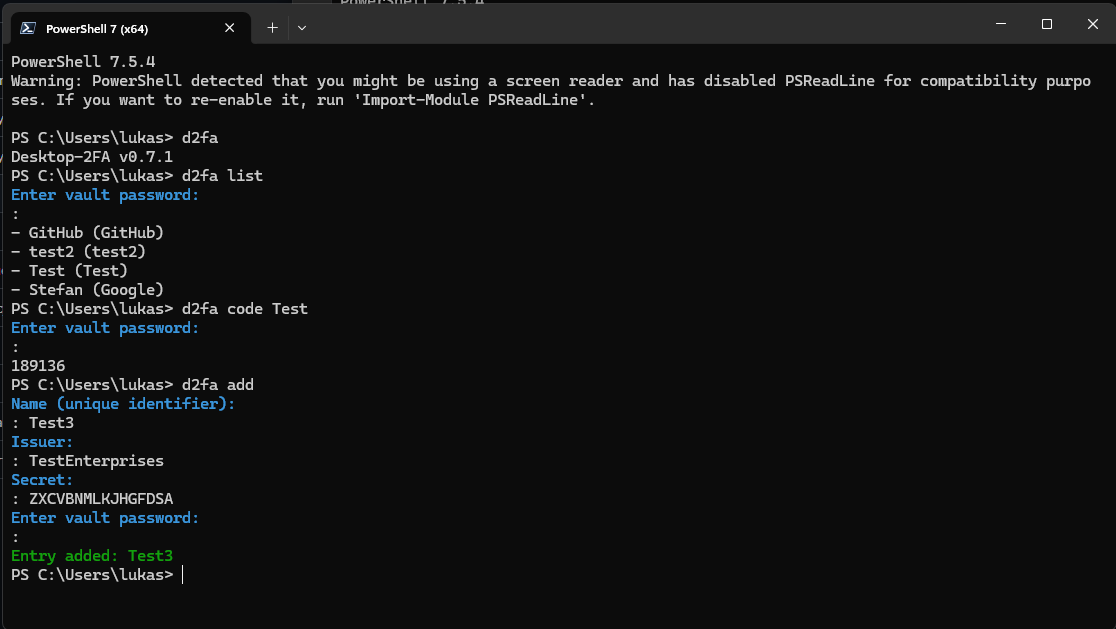
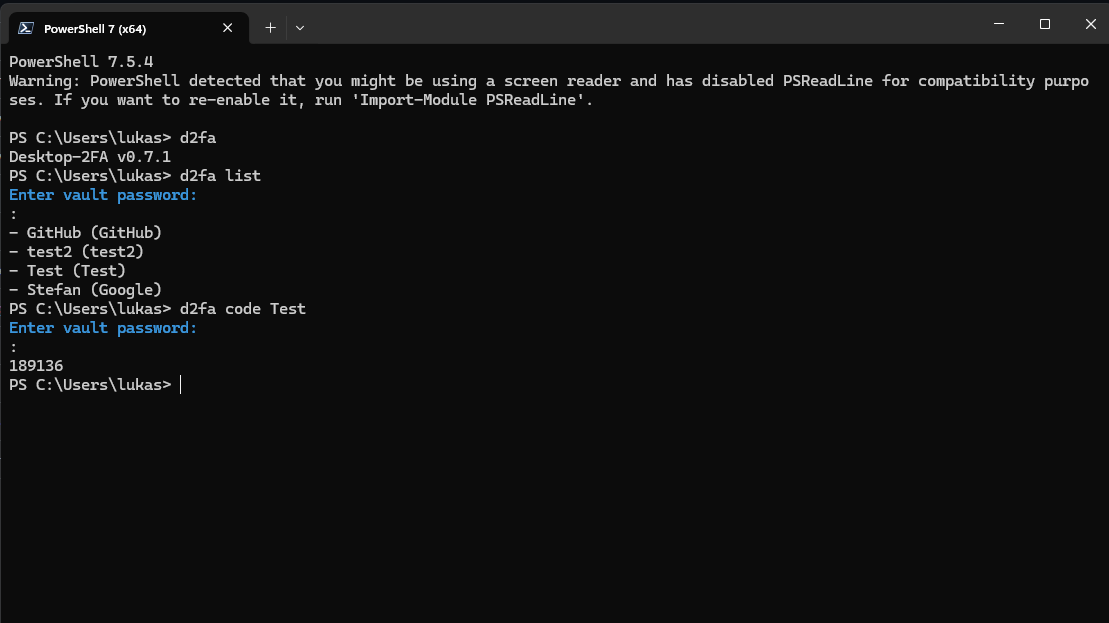
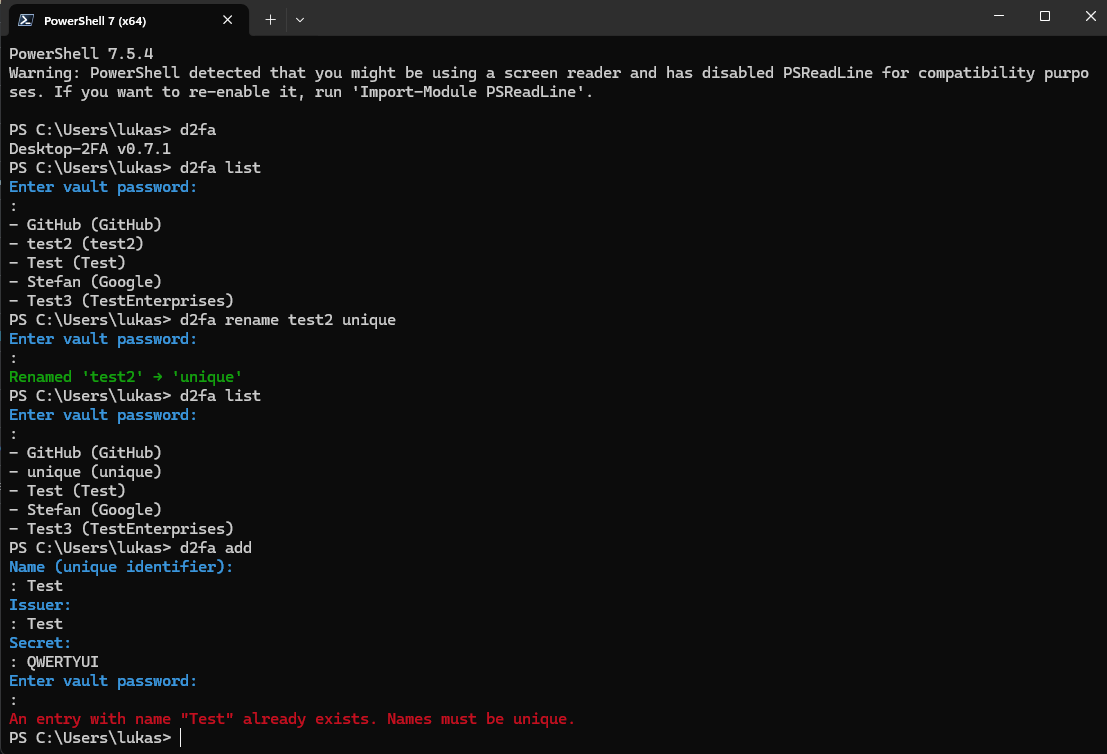
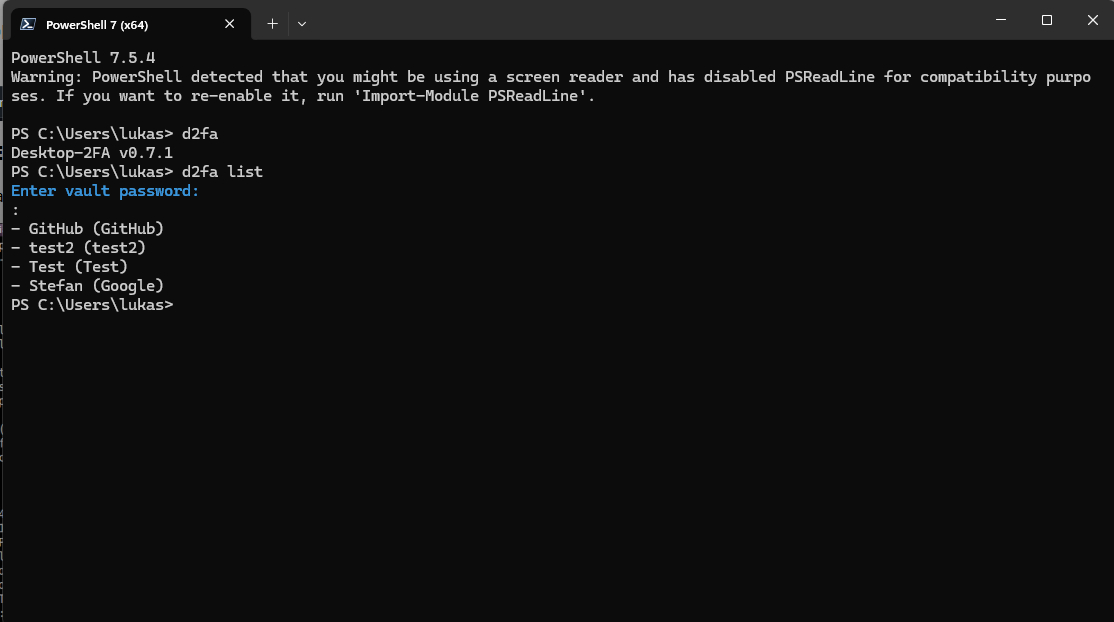
🚀 Quick Start
Installation
pip install desktop-2fa
Verify installation:
python -c "import desktop_2fa; print(desktop_2fa.__version__)"
# Output: 0.8.1dev
Basic Usage
# Add a new TOTP token
d2fa add GitHub GitHub JBSWY3DPEHPK3PXP

# List all entries
d2fa list

# Generate a code
d2fa code GitHub

# Initialize a new vault
d2fa init-vault
Non-Interactive Usage
# Provide password via command line
d2fa --password mypassphrase add GitHub GitHub JBSWY3DPEHPK3PXP

# Provide password via file
d2fa --password-file /path/to/passphrase.txt add GitHub GitHub JBSWY3DPEHPK3PXP
📁 Vault Lifecycle
The vault is an encrypted storage file located at ~/.desktop-2fa/vault.
Vault Creation
When a command requires a vault and none exists:
- The CLI prompts for a new password (interactive mode) or requires
--password/--password-file(non-interactive mode) - An empty encrypted vault is created
- A confirmation message is always printed:
Vault created at <path>
Vault Loading
When a command requires a vault and it exists:
- The CLI prompts for the existing password (interactive mode) or requires credentials (non-interactive mode)
- The vault is decrypted and loaded
- If the password is invalid, the CLI exits with
typer.Exit(1)
Duplicate Entry Handling
The rename command enforces deterministic behavior when multiple entries match the target name:
- If multiple entries match the provided name (issuer or account_name), the rename is aborted
- Error message:
Error: Multiple entries named '<name>' exist. Operation aborted. Resolve duplicates first. - No entry is renamed in this case
- This check occurs before any mutation
📖 CLI Commands
Core Commands
| Command | Description |
|---|---|
d2fa add <name> <issuer> <secret> |
Add a new TOTP entry |
d2fa list |
List all stored TOTP entries |
d2fa code <name> [--copy|--copy-only] |
Generate TOTP code with clipboard copy options |
d2fa rename <old> <new> |
Rename an entry |
d2fa remove <name> |
Remove an entry |
Vault Management
| Command | Description |
|---|---|
d2fa init-vault [--force] |
Initialize a new vault |
d2fa unlock-vault |
Open vault with non-blocking weak password warning |
d2fa change-password |
Change the vault password |
d2fa backup |
Create an encrypted backup of the vault |
Import/Export
| Command | Description |
|---|---|
d2fa export <path> |
Export vault entries to JSON |
d2fa import <path> [--force] |
Import entries from JSON |
Global Options
| Option | Description |
|---|---|
--password <pwd> |
Provide vault password directly |
--password-file <path> |
Read vault password from file |
--json |
Output in JSON format |
--raw |
Raw output (no formatting) |
--quiet |
Suppress non-essential output |
--copy |
Copy TOTP code to clipboard and display |
--copy-only |
Copy TOTP code to clipboard only |
--force |
Force operation (bypass confirmations) |
🔒 Security
The vault uses:
- AES-256-GCM for authenticated encryption
- Argon2id for key derivation (time_cost=4, memory_cost=128MiB, parallelism=2)
- zxcvbn for password strength evaluation
- Versioned header for forward compatibility
Every command requires explicit password authentication. No session-based access.
Password Strength Evaluation
Desktop-2FA uses zxcvbn to evaluate password strength when creating or changing vault passwords:
- Score 0-2 (Weak): Easily guessable passwords (e.g., "password123")
- Score 3-4 (Strong): Resistant to common attacks (recommended)
Examples:
- ❌ Weak:
password,123456,qwerty,admin2024 - ✅ Strong:
Battery-Horse-Staple-Correct,Mountain@River*2024,MySecureVault#42
Configuration (~/.config/d2fa/config.toml):
[security]
# Require strong passwords (score >= 3)
reject_weak_passwords = false  # warn but allow | true: reject weak passwords
When reject_weak_passwords = false:
- Weak passwords trigger a yellow warning
- User is prompted to confirm continuation
- Password acceptance is non-blocking
When reject_weak_passwords = true:
- Weak passwords are rejected immediately
- Command exits with error
- User must choose a stronger password
Backward Compatibility:
If you have min_password_entropy set in your config (legacy option), it is recognized and treated as equivalent to requiring zxcvbn score >= 3.
Security Hardening (v0.8.0)
Version 0.8.0 maintains all previous security hardening from v0.7.3 and introduces modular architecture for better code isolation:
- Empty passwords are immediately rejected with a clear error message
- Permission errors are distinguished from missing vault files
- No Python stack traces are shown to users
- User-friendly error messages for filesystem permission issues
- Modular design separates CLI and core cryptographic components for enhanced security boundaries
- zxcvbn-based password strength evaluation (new in v0.8.0)
📚 Documentation
| Document | Description |
|---|---|
| User Manual | Complete usage guide |
| Security Model | Detailed threat analysis and cryptographic design |
| CLI UX Specification | UX contract and behavior |
| Cryptography | Security implementation details |
🧪 Testing
pytest tests/              # Run all tests
pytest --cov=src/desktop_2fa  # Run with coverage
🏗️ Project Structure
src/desktop_2fa/
├── app/           # Application components
├── cli/           # Command-line interface
├── crypto/        # Encryption utilities
├── totp/          # TOTP generation
├── ui/            # User interface components
├── vault/         # Vault management
└── utils/         # Utilities
📄 License
Apache License 2.0. See LICENSE file.
👤 Author
Łukasz Perek
🏆 Sponsorship
desktop‑2fa is supported through the Kilo OSS Sponsorship Program.
📧 Contact
For questions or support, contact us at contact@desktop-2fa.org
💖 Support the Project
Desktop‑2FA is an independent open‑source tool built with a focus on autonomy, transparency, and offline security. If you find it useful and want to support ongoing development, you can do so through the platforms below:
- Ko‑fi: https://ko-fi.com/lukaszperek
- Buy Me a Coffee: https://buymeacoffee.com/lukaszperek
- AirTM: https://airtm.me/lukper
1 maintainer

Metadata
1 maintainer
Release files for desktop-2fa 0.8.1
For a detailed explanation of source distributions (sdists) and built distributions (wheels), please see the package formats documentation.
Source distribution (sdist)
| File | Size | Uploaded | |
|---|---|---|---|
| desktop_2fa-0.8.1.tar.gz | 331.9 kB | Details |
Built distribution (wheel)
| File | Interpreter | ABI | Platform | Reset |
|---|---|---|---|---|
| desktop_2fa-0.8.1-py3-none-any.whl | Python 3 | none | any | Details |
Total release size: 370.2 kB
Release files / desktop_2fa-0.8.1.tar.gz
| Download URL | desktop_2fa-0.8.1.tar.gz |
|---|---|
| Size | 331.9 kB |
| Tags | Source |
|
SHA-256 checksum How to use checksums |
347b3eaf9d213160a9fd25cfa75acebaf7751048dea98c657eba2fb1eba8caa2
|
|
BLAKE2b-256 checksum How to use checksums |
c525194d538ae07fd42c65f882b4b53decafbfa9fd4cae594a6a16c7578495b1
|
| Upload date | |
|
Uploaded using Trusted Publishing? What is trusted publishing? |
No |
| Uploaded via |
twine/6.2.0 CPython/3.12.12
|
Release files / desktop_2fa-0.8.1-py3-none-any.whl
| Download URL | desktop_2fa-0.8.1-py3-none-any.whl |
|---|---|
| Size | 38.3 kB |
| Tags | Python 3 |
|
SHA-256 checksum How to use checksums |
094d70b26e4650974ab5ec2600373a3c86b55fa5021ec1592a4ba0b1a9989d94
|
|
BLAKE2b-256 checksum How to use checksums |
ef0fbe7af79739c942516686422f3f86128f73bb5f3ce0e8025284eff26267a2
|
| Upload date | |
|
Uploaded using Trusted Publishing? What is trusted publishing? |
No |
| Uploaded via |
twine/6.2.0 CPython/3.12.12
|














