
Local, single-user analysis of Claude Code session histories — surfaces engineering trajectory over time per domain, with evidence on hover.

Project description
dev-trajectory
A local, single-user CLI that ingests your Claude Code session histories, scores each session along five engineering capability dimensions using an LLM judge, and renders your trajectory over time as a per-domain or per-language summary with evidence quotes.
Status: alpha. Phases 0–2 of the project plan are complete — discover → parse → sample → score → aggregate, plus a local browser dashboard. Phase 4 (MCP server) and Phase 5 (Claude skill) are not built yet.
What it does
Claude Code writes JSONL transcripts of every session you run. They sit in ~/.claude/projects/ and are read by no one. Across hundreds of sessions, patterns aggregate: how you frame ambiguous tasks, whether you catch the model's mistakes, how you redirect when an approach is going wrong. dev-trajectory summarizes each session, scores it, and aggregates weekly so you can see where you're operating like a senior engineer and where you're still learning.
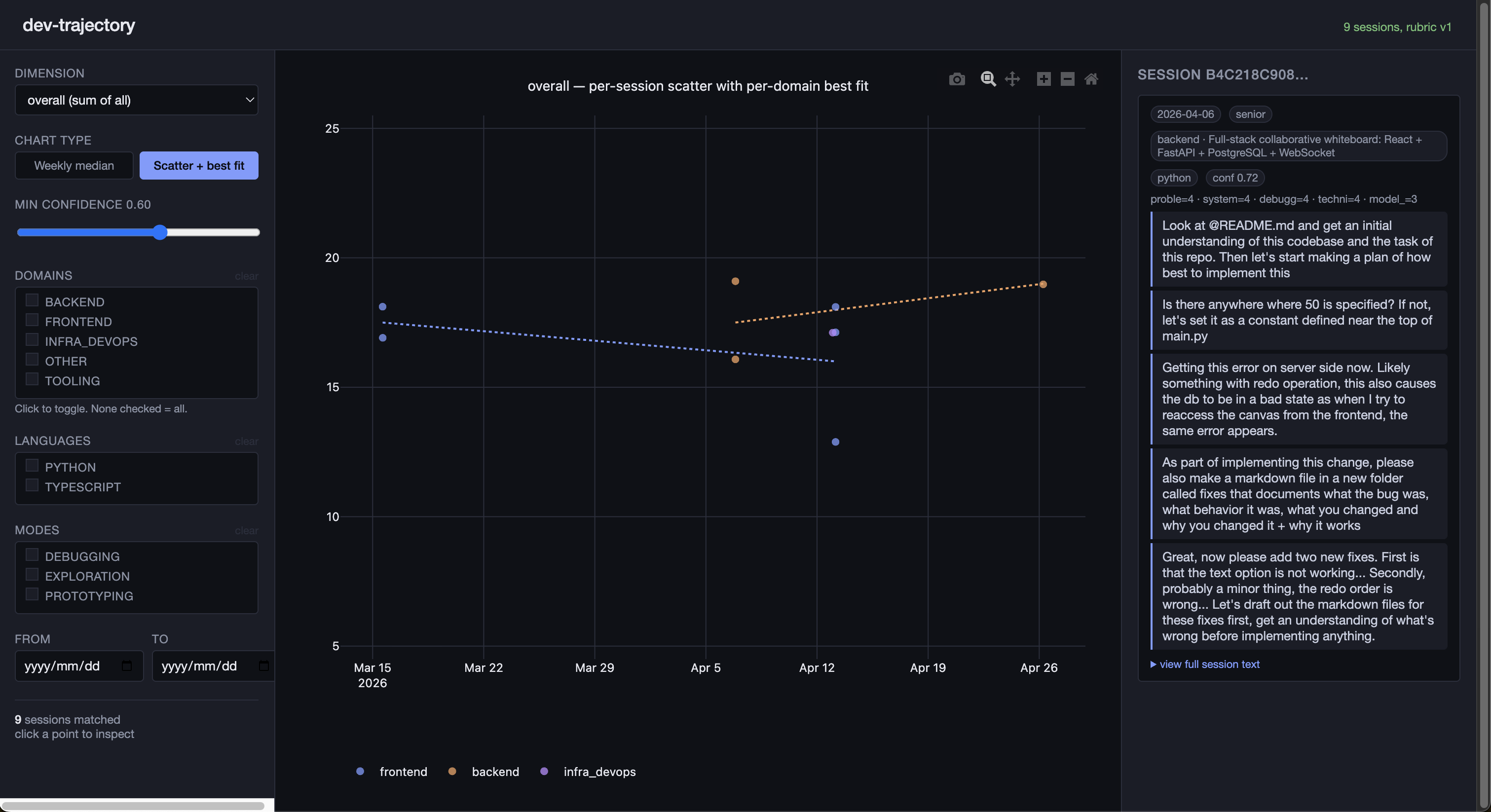
The local dashboard (devtraj serve): per-session scatter with per-domain best-fit lines on the left, evidence quotes from the clicked session on the right.
Privacy
- Local-only storage. Sessions and scores live in a SQLite file under your user data directory. Nothing is uploaded.
- Your own API key. Scoring uses your Anthropic API key. No proxying.
- Zero telemetry in this build. A consent flag and toggle command exist (
devtraj telemetry on|off|status) for a planned future opt-in aggregate study, but the uploader is hard-disabled — no endpoint is wired up. - No automatic redaction. Evidence quotes are stored verbatim because they're what makes the dashboard credible. Since data never leaves the machine, this is a deliberate trade-off rather than a leak risk. See docs/PROJECT.md §10 for the full posture.
What this can't tell you
These shape the architecture, not just the README — read them before drawing strong conclusions from the output:
- You only use AI for things you don't already know. This tool measures your behavior on those topics, which are usually your blind spots. A staff backend engineer learning Rust will look junior in their Rust sessions. The score reflects growth areas, not absolute capability.
- LLM judges drift. Single-shot scoring on subjective work has real variance. Median-of-3 voting, forced verbatim evidence quotes, and a fixed anchored rubric narrow the noise but don't eliminate it. Treat individual session scores as soft; trust trends over many weeks.
- A flat or declining line is real information you didn't ask for. During a hard quarter the chart will reflect that. The dashboard slices per-domain so a slump in one area doesn't drown out growth elsewhere — but the signal is honest, not encouraging.
See docs/PROJECT.md §2 for the longer treatment.
Install
pipx install dev-trajectory
export ANTHROPIC_API_KEY=sk-ant-...
Requires Python 3.11+ and an Anthropic API key. To persist the key instead of exporting it each session, run devtraj init. Plain pip install dev-trajectory inside a venv works too. From source: see CONTRIBUTING.md.
Quickstart
After install + API key setup:
devtraj analyze                     # summarize + score new sessions
devtraj report                      # per-week trajectory by domain (text)
devtraj report --slice-by language  # alternate slice
devtraj explain 2026-04-13          # evidence quotes for a given week
devtraj serve                       # interactive dashboard at http://127.0.0.1:8765/
By default analyze samples up to 3 sessions per ISO week to control cost. Sampling is deterministic — re-runs pick the same sessions every time, so re-running analyze is safely idempotent. Set sessions_per_week = 0 in config (or pass --sessions-per-week 0) to score every session.
Sessions are processed in parallel (default 10 at a time). Inside each session the median-of-3 scoring runs 3 calls in parallel, so total in-flight LLM calls is roughly max_concurrent_sessions * 4. Override with --max-concurrent-sessions N, or set max_concurrent_sessions in config.
CLI reference
| Command | What it does |
|---|---|
devtraj init |
Detect Claude Code session paths, write a default config, verify the rubric loads, and surface the telemetry toggle. |
devtraj analyze |
Walk new sessions, summarize each (Haiku 4.5), score 3× with median voting (Sonnet 4.6), persist to SQLite. Skips sessions already scored at the current rubric version. |
devtraj analyze --rebuild |
Force re-summary and re-score for every sampled session. |
devtraj analyze --sessions-per-week N |
Override the per-week sampling cap for this run (0 disables). |
devtraj analyze --max-concurrent-sessions N |
Override how many sessions are processed in parallel (default 10). |
devtraj report [--slice-by domain|language|all] |
Print a weekly median table per slice. |
devtraj report --min-confidence 0.7 |
Drop scores below the given confidence floor. |
devtraj explain YYYY-MM-DD |
Show evidence quotes for the ISO week starting on that date. |
devtraj rescore |
Re-score sessions whose stored rubric version is older than the current one. |
devtraj serve [--port N] [--no-open] |
Launch the local dashboard. Two chart modes: weekly-median lines per domain, and a per-session scatter with per-domain best-fit. Click any point or bucket to load evidence quotes in the side panel; expand a session card to see the full user-turn text. Default 127.0.0.1:8765. |
devtraj telemetry status |
Show the local consent flag (uploader is disabled regardless). |
devtraj paths |
Print the config and database paths. |
devtraj rubric [--prompt] |
Show the active rubric (version, source, bands, dimensions). With --prompt, dump the full system prompt sent to the judge. |
How scoring works
Five dimensions, each scored 1 (junior) to 5 (principal):
problem_decomposition— how well you break ambiguous tasks into structured sub-problems.systems_thinking— whether you reason about effects beyond the immediate change.debugging_methodology— hypothesis quality, use of evidence, willingness to bisect.technical_communication— precision of language; whether you give the model what it needs to answer well.model_redirection— whether you catch and correct the model when it's wrong. Weighted most heavily because it's the dimension least confounded by topic familiarity.
Each session also gets a seniority_band (junior / mid / senior / staff / principal — the primary surfaced signal), an inferred_ic_level (IC2–IC6), a domain_category, a language, and 3–5 verbatim evidence quotes. See docs/PROJECT.md §4.4 for the full schema.
The rubric anchors are paraphrased from CircleCI's published engineering competency matrix. The exact rendered system prompt lives in src/dev_trajectory/rubric/v1.yaml — edit it and bump the version to iterate.
Configuration
Config lives at ~/.config/dev-trajectory/config.toml (Linux/macOS) or the platform equivalent. Run devtraj paths to see the exact location.
api_key = "sk-ant-..."          # optional; ANTHROPIC_API_KEY env var takes precedence
rubric_version = "v1"
min_confidence = 0.5            # scores below this are hidden from the report by default
tool_output_token_limit = 2000  # tool outputs longer than this are stripped from the user-turn extraction
sessions_per_week = 3           # 0 = no cap (score every discovered session)
max_concurrent_sessions = 10    # how many sessions to process in parallel
telemetry_enabled = false
custom_session_paths = []       # extra directories to scan for *.jsonl beyond ~/.claude/projects/
Cost
A year of heavy Claude Code use is roughly 500–2000 sessions. With prompt caching on the rubric system prompt, median-of-3 scoring, and the default 3/week sampling cap, total spend on a fresh run is single-digit dollars. Subsequent runs are effectively free since they only score new weeks.
Roadmap & contributing
See docs/ROADMAP.md for what's planned and roughly when. Suggestions to reprioritize, add, or drop items are welcome — open an issue or a PR against the roadmap itself.
For everything else (bug reports, rubric tweaks, new tool support, dashboard polish), see CONTRIBUTING.md.
License
MIT. See LICENSE.
Release history Release notifications | RSS feed


Download files
Download the file for your platform. If you're not sure which to choose, learn more about installing packages.
Source Distribution
Built Distribution
Filter files by name, interpreter, ABI, and platform.
If you're not sure about the file name format, learn more about wheel file names.
Copy a direct link to the current filters
File details
Details for the file dev_trajectory-0.1.1.tar.gz.
File metadata
- Download URL: dev_trajectory-0.1.1.tar.gz
- Upload date:
- Size: 619.2 kB
- Tags: Source
- Uploaded using Trusted Publishing? No
- Uploaded via: twine/6.2.0 CPython/3.12.8
File hashes
| Algorithm | Hash digest | |
|---|---|---|
| SHA256 |
e76bc2494fd417308fefebe7c895e63bc9059e5a650a08454fc851cf8783242b
|
|
| MD5 |
09e8b817d284540c194415a8d90e7d98
|
|
| BLAKE2b-256 |
4e12ab8db0f79dd2c626129d0d8576c9475dc737a995b077c144ad7c605bb5f9
|
File details
Details for the file dev_trajectory-0.1.1-py3-none-any.whl.
File metadata
- Download URL: dev_trajectory-0.1.1-py3-none-any.whl
- Upload date:
- Size: 46.8 kB
- Tags: Python 3
- Uploaded using Trusted Publishing? No
- Uploaded via: twine/6.2.0 CPython/3.12.8
File hashes
| Algorithm | Hash digest | |
|---|---|---|
| SHA256 |
a747dd909dd5749a1aa0379884ff08abef409af04f6460972b900ef579aa9078
|
|
| MD5 |
0ca495833fc5557b4c8dfd16e8663c4e
|
|
| BLAKE2b-256 |
fc3e0a1379fe11ea76ef8c2aa77f6d33e9e28922eb11eba2b9a2a4511fefec5b
|






