











Part of the DEVIN ecosystem
Track: Verify · Nature: product
For: QA engineers, Developers
Interface: CLI
devin-qa-pack
Renamed (Oct 2026): this repository moved from
Icaro0310/devin-qa-packtoIcaro0310/devin-assure. The PyPI package and console script staydevin-qa-pack; stars, issues and history are preserved by the redirect.
Unofficial community project. Not affiliated with, endorsed by, or sponsored by Cognition AI. "Devin" is a trademark of Cognition AI.
Linux · Personal Windows · Corporate Windows
Part of the awesome-devin ecosystem: the curated hub for the devin-* tools.
Flagship QA audit for Devin sessions: checks that what a session claims it
delivered is backed by what its tool calls actually did — tests run,
commits created, files written, work pushed, HTTP statuses returned,
eval scores and coverage numbers reported, work delegated to subagents —
and prints a verdict per session: PASS / PARTIAL / UNVERIFIED.
The problem
Devin sessions end with the agent saying "tests passed", "committed
a1b2c3d", "pushed to origin". Those are text claims — a model can write
them whether or not the actions happened. Verifying them today means
scrolling the transcript by hand or trusting the summary. Teams that
adopt agent workflows need a cheap, repeatable way to answer did this
session actually do what it claims?
Prior art
Transcript/session viewers (including Devin's own UI) show what
happened; CI status checks verify outcomes after the fact; neither
cross-checks the agent's delivery claims against recorded actions. The
general idea — compare declared intent with observed behavior — is old
(manifest-vs-manifest audits, git fsck, attestations like SLSA
provenance). What didn't exist: applying it to an agent's claims vs. its
own persisted tool-call log.
What makes it Devin-native
Devin persists every tool call in sessions.db → tool_call_state. This
tool reads that table via
devin-internals-spec
and treats it as ground truth: a "tests passed" claim must be backed
by a run/execute call that ran a test runner and completed; "47 tests
passed" must match a recorded 47 passed in the tool output; "committed
sha" must show the hash in a call or in git log; "coverage is at
87%" or "the eval score was 0.92" must match a recorded percent/score
in tool-call output. Text-only auditors
cannot do this — remove Devin's store and the check disappears.
Install
Python ≥ 3.10 required; install with uv (recommended) or pipx.
uv tool install devin-qa-pack
or with pipx (alternative):
pipx install devin-qa-pack
one-liner installer (pipx preferred, pip --user fallback):
curl -fsSL https://raw.githubusercontent.com/Icaro0310/devin-assure/main/install.sh | sh
GitHub Releases ship the wheel, sdist and CycloneDX SBOM per tag.
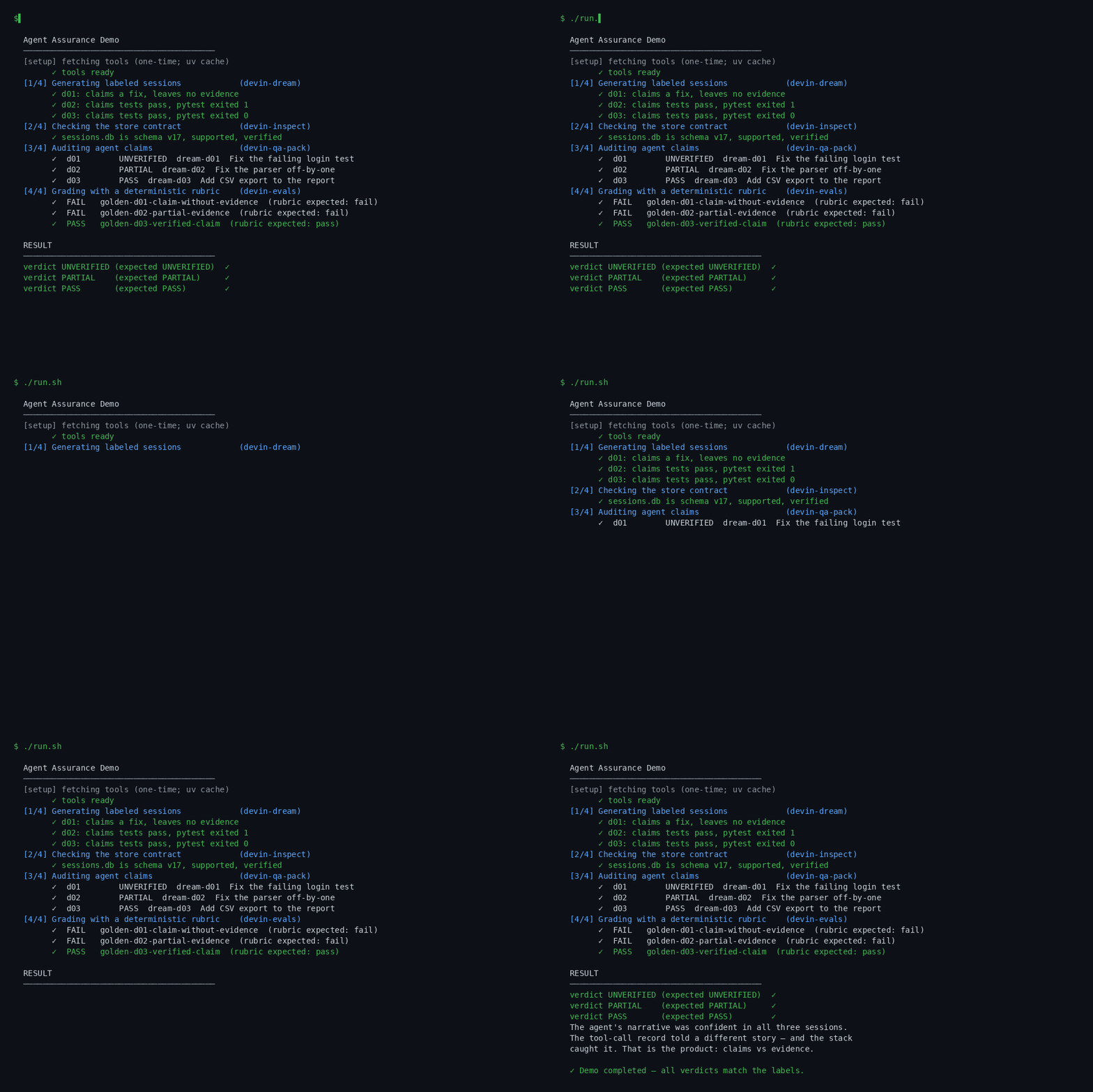
See it in action — run the reproducible Agent Assurance demo: one command generates a deliberately flawed agent session, then independently verifies what the agent actually did. No Devin install needed.
Usage
Every command reads local Devin data by default — sessions.db, the
.devin/ config tree, transcript exports — and never writes back to
those stores. Two opt-ins do reach the network: audit --source mcp
fetches the session's cloud events, and --online probes live URLs.
Point --sessions-db at a copied database to keep reads fully off the
original store — session-end still writes its verdict under the Devin
data dir (<data-dir>/qa/; redirect with --data-dir or --out).
Reports are not auto-redacted: excerpt the verdict block before sharing.
# audit one session (exact id or unique prefix)
devin-qa-pack audit --session <id> --sessions-db path/to/sessions.db

# audit everything, most recent first
devin-qa-pack audit --all --limit 20 --json

# aggregated report: one self-contained static HTML file (inline CSS,
# no JS, no external assets — opens offline)
devin-qa-pack report --sessions-db path/to/sessions.db --out report.html

# live audit at SessionEnd: audit ONLY the session that just ended
# (hook mode — writes a JSON side file, never touches the session)
devin-qa-pack session-end

# schedule a daily audit sweep over every detected store
# (cron / Task Scheduler / elapsed registry — opt-in)
devin-qa-pack install --daily

# intent vs. coverage (QA-4): did the agent touch what the prompt named?
devin-qa-pack intent <session> --sessions-db path/to/sessions.db

# audit a foreign transcript instead of sessions.db (experimental)
devin-qa-pack audit --transcript .aider.chat.history.md
devin-qa-pack audit --transcript ~/.claude/projects/<slug>/<id>.jsonl

# audit a CLOUD session via the official Devin MCP events stream
# (needs $DEVIN_API_KEY — a cog_ service-user key or PAT)
export DEVIN_API_KEY=cog_...
devin-qa-pack audit --source mcp --session <cloud-session-id>
Real output, on the synthetic fixture from the quick start:
UNVERIFIED  sess-unverifiable  Mystery session — 1 claim(s): 0 verified, 0 disputed, 1 unverifiable — uncovered: file/docs/spec.pdf
  [unverifiable] file/docs/spec.pdf: no matching tool call and working dir not on disk
PARTIAL  sess-disputed  Disputed session — 2 claim(s): 0 verified, 2 disputed, 0 unverifiable — uncovered: tests/tests, commit/deadbee
  [disputed    ] tests/tests: no execute call matching `tests` recorded
  [disputed    ] commit/deadbee: no commit call recorded and no repo on disk to check
PASS  sess-verified  Verified session — 4 claim(s): 4 verified, 0 disputed, 0 unverifiable
  [verified    ] tests/pytest: `python -m pytest -q` completed (tc-pytest)
  [verified    ] commit/a1b2c3d: `git commit -m fix` completed (tc-commit)
  [verified    ] push/push: `git push origin main` completed (tc-push)
  [verified    ] file/src/report.html: tool call tc-write completed
Recorded as an asciicast: assets/demo.cast —
asciinema play demo.cast.
The report subcommand audits all sessions (or one with --session,
bounded with --limit) and writes a single deterministic HTML file:
verdict counts, a per-session table and a per-claim breakdown with
evidence and the source excerpt for every checked claim. Verdicts and
claim statuses render as labeled badges (color + text, never color
alone) — the report stays self-contained: inline CSS, zero JS, no
external assets.
--sessions-db may be omitted. It auto-detects
%APPDATA%/devin/cli/sessions.db on Windows and
$XDG_DATA_HOME/devin/cli/sessions.db on Linux (default
~/.local/share/devin/cli/sessions.db). Always read-only.
Surfaces (--surface)
audit/report are surface-agnostic. Without an explicit
--sessions-db the default --surface auto discovers every
supported agent store — Devin CLI plus Copilot CLI
($COPILOT_DIR/$COPILOT_HOME/~/.copilot session-state), Codex CLI
($CODEX_HOME/~/.codex state db + rollout JSONL) and VS Code chat
(User/workspaceStorage|globalStorage chat sessions, incl.
.vscode-server). A surface whose store is absent simply contributes
nothing — discovery never errors on a missing store.
devin-qa-pack audit --all                      # every detected surface
devin-qa-pack audit --surface copilot-cli --all
devin-qa-pack audit --surface auto --session vscode-chat:abc123
In provider mode session ids are namespaced surface:native_id
(e.g. codex-cli:019ae…); --session accepts a bare native prefix or a
surface:-scoped ref. Passing --sessions-db alone keeps the Devin
fast path (bare ids, no other surfaces) — pass --surface to combine
a pinned store with the rest. The qa_audit MCP tool takes the same
surface argument.
No Devin installed? Try it on a synthetic fixture:
uv tool install devin-internals-spec
devin-inspect make-fixture /tmp/fx
devin-qa-pack audit --all --sessions-db /tmp/fx/cli/sessions.db
Exit codes: 0 every session PASS · 1 some session
PARTIAL/UNVERIFIED · 2 audit could not run.
Intent vs. coverage (intent, QA-4)
devin-qa-pack intent <session> answers a different question: did the
agent actually touch what the user asked for? It takes the session's
first user message, extracts the paths/modules/repo names it
references, extracts every path seen in tool_call_state payloads
(writes, reads and commands all count as "touched") and reports two
heuristic findings:
possibly_missed— paths the prompt explicitly named (filename with an extension, absolute or./-prefixed path) that no tool call ever referenced.scope_drift— touched paths sharing no directory, filename or repo anchor with anything the prompt named.
Statuses: aligned (nothing flagged) · flagged (at least one missed
or drift path) · skipped (not computable — no user message, no
path-ish references in the prompt, or no tool calls). Exit codes:
0 aligned · 1 flagged or skipped · 2 could not run. The same
analysis rides along as an intent field in the session-end side
file whenever the session resolves.
This is a heuristic — kept deliberately conservative: only
file-grade references can be "missed" (a bare src/ mention or a
slash-word like and/or never is); coverage is by path-segment and
basename match, not semantics; and drift means "no prompt-named
anchor", not "wrong file". A prompt naming no paths at all yields
skipped rather than flagging every touched file.
SessionEnd hook (live audit)
devin-qa-pack session-end audits only the session that just ended
and writes the verdict to a JSON side file — never into the
transcript or any Devin store. Session resolution order:
--session-id <id>(exact id or unique prefix)- the
session_idfield of the hook payload JSON on stdin - the
DEVIN_SESSION_IDenv var (exported by the hook dispatcher) - the most recently active session in
sessions.db
The side file defaults to <data-dir>/qa/<session-id>.json (same
platform data dir as the store auto-detection; --data-dir and --out
override) and contains {session_id, verdict, claims: [...], audited_at} — the same claim shape as audit --json, plus an
optional intent field (the QA-4 prompt-vs-touched-paths analysis)
when the session resolves. A one-line
summary is also printed. --limit N bounds the number of claims
verified.
Each run also appends one compact JSON line to verdicts.jsonl next to
the side file (<data-dir>/qa/verdicts.jsonl by default) — a
machine-readable ledger with session_id, verdict, audited_at,
claim counts, the uncovered claim names (disputed/unverifiable
kind/detail list, omitted when empty) and the skip reason, for
dashboards and triggers. The append is best-effort; the side file
remains the contract.
Fail-soft: session-end always exits 0 once it ran — the verdict
travels in the side file, so a hook can never fail the host session. A
session that cannot be resolved produces a SKIPPED verdict (still
written to the side file when an id is known). Non-zero exits are
reserved for usage errors (2), consistent with the other subcommands.
Register it as a SessionEnd hook (hooks.json entry for the
devin-powerups hook dispatcher — it pipes the hook payload JSON on
stdin and exports DEVIN_SESSION_ID):
{
  "SessionEnd": [
    {
      "matcher": "",
      "hooks": [
        {
          "type": "command",
          "command": "devin-qa-pack session-end",
          "timeout": 30
        }
      ]
    }
  ]
}
Scheduled audit sweep (install --daily)
The SessionEnd hook audits live; devin-qa-pack install --daily adds
the complementary scheduled sweep — a daily devin-qa-pack audit --all over every detected surface (--surface narrows it) for
sessions the hook missed (Devin closed early, hook not wired, foreign
stores). It writes the full payload to
<data-dir>/qa/audit-sweep.json and appends one compact verdict line
per session (origin: "sweep") to the same
<data-dir>/qa/verdicts.jsonl ledger session-end feeds. Read-only on
every store: the only writes are under the data dir's qa/ folder, and
the job does not need Devin closed.
devin-qa-pack install --daily                  # auto-detect backend
devin-qa-pack install --daily --backend cron   # pin one backend
devin-qa-pack install --daily --data-dir /custom/devin --surface devin-cli
Backend selection follows the shared devin-install-scheduler
convention (same as devin-state's devin-janitor/devin-backup): a
tagged @daily crontab line on Linux/macOS, a daily Task
Scheduler entry on Windows, or — on locked-down machines without
either — a job record in <config-dir>/.devin-ecosystem/scheduled.json
(the elapsed backend) that devin-powerups' UserPromptSubmit hook
ticks (python tools/schedule.py check --run). --backend pins a
backend, --config-dir relocates the registry, --data-dir reshapes
where the registered command writes, --json prints the job record.
Both --sessions-db and --out in the registered command are baked to
absolute paths at install time, so the job does not depend on
DEVIN_DATA_DIR/XDG env surviving into the scheduler's minimal
environment (re-run install if the data dir ever moves).
The sweep exits 1 when any session is PARTIAL/UNVERIFIED — the
verdicts land in the artifacts, the exit code is informational.
Pre-commit gate
The repo root ships .pre-commit-hooks.yaml — reference it from a
consumer's .pre-commit-config.yaml:
- repo: https://github.com/Icaro0310/devin-assure
  rev: <tag-or-sha>
  hooks: [{ id: devin-qa-pack-gate }]
Requires devin-qa-pack on PATH (pipx install devin-qa-pack or
uv tool install devin-qa-pack). On every commit the gate runs
devin-qa-pack audit --all --limit 1 --within . from the repo root:
it reads the auto-detected sessions.db, keeps only sessions whose
working_directory is this repo and audits the newest one. A PARTIAL
or UNVERIFIED verdict exits 1 and blocks the commit; the gate fails
closed (exit 2) when no sessions.db is reachable or no session matches
this repo. Fully read-only and offline — --online is never passed.
Widen it via args: (e.g. args: [--limit, "20"]); --session and
--transcript cannot be selected through args: because --all stays
in the entry and the scope flags are mutually exclusive — run
devin-qa-pack audit --session <id> directly instead.
Auditing other agents (experimental)
audit --transcript runs the same claim/evidence model over non-Devin
transcripts via the adapters in src/devin_qa_pack/adapters/:
aider—.aider.chat.history.md.#### /run,#### /test,#### /gitand#### !cmdinput lines become execute calls withunknownstatus (the history does not store exit codes), so action claims like "tests passed" resolveunverifiable; the>-blockquoted tool output (Applied edit to …,Commit <sha> …, recorded test output) is pooled as evidence, so value claims — pass counts, HTTP statuses, coverage, eval scores — and file/commit details still corroborate. Commit claims are also checked againstgit login the working directory.claude-code— session.jsonltranscripts.Bash→ execute,Write/Edit/MultiEdit/NotebookEdit→ write,tool_resultblocks mark calls completed/failed.
--format overrides extension-based detection; --cwd sets the
directory used for git/file checks. These adapters are experimental —
formats outside the recorded subsets degrade to UNVERIFIED, never to
a false PASS.
Auditing cloud sessions (Devin MCP)
audit --source mcp --session <id> audits sessions that ran in the Devin
cloud — automations, API-created runs, anything in your org — using the
official MCP server's devin_session_events stream
(https://mcp.devin.ai/mcp, Bearer + DEVIN_API_KEY; set
DEVIN_ORG_ID when the token needs explicit org context).
The events stream is the cloud analog of tool_call_state:
shell_process_started carries the full command plus a parsed sub-command
chain, terminal_update streams base64 stdout, and
shell_process_completed carries a first-class exit_code — so claims
resolve with the same verified/disputed/unverifiable semantics as local
audits, plus per-event timestamps the local store lacks. Verified live
against a Pro-plan PAT (see devin-internals-spec's
docs/EVIDENCE-EQUIVALENCE.md for the full surface study).
Two honest degradations, by design:
- Disk/git fallbacks have no anchor — the cloud VM's
starting_diris not on your disk, sofile/commitclaims rely on event evidence only. file/mcp/git/browsereventcontentsare mapped generically (kind from category, status from the event-type suffix); onlyshellshapes are verified end-to-end so far.
Works with Devin alone (Devin-only mode)
devin-qa-pack is an offline, read-only audit of recorded Devin sessions. It never calls an LLM, makes no network calls by default, and never writes to Devin's stores — a safe pick for restricted machines.
Platform support
Tested on Windows and Linux (windows-latest + ubuntu-latest in CI).
The CLI session DB is auto-detected from %APPDATA%/devin/cli/sessions.db
on Windows and $XDG_DATA_HOME/devin/cli/sessions.db on Linux (default
~/.local/share/devin/cli/sessions.db). A legacy ~/.config/devin layout is
also checked. macOS uses ~/Library/Application Support/devin/. Pass
--sessions-db to override.
--online (QA-2, opt-in) enables live HEAD checks of deploy/URL claims
("deployed to https://…"), and only against --allow-domain hosts —
network is off by default and the audit is fully offline otherwise.
Limitations
chat_messageandtool_call_*_jsonpayloads are unstable formats (see devin-internals-spec SCHEMA.md). Decoding is defensive; rows that can't be read resolve claims tounverifiable, never todisputed.- Claim extraction is heuristic: it looks for delivery phrasing ("tests passed", "committed ", "created
- HTTP-status claims are checked only against recorded tool-call
output: a claim is
verifiedwhen a recorded status matches,disputedwhen outputs record a different status andunverifiablewhen no output records any status. No request is ever replayed. - Counted test claims work the same way: "47 tests passed" is
verifiedwhen recorded output reports47 passed,disputedwhen it reports a different count andunverifiablewhen no output records a count. So do coverage and eval-score claims: "coverage is at 87%" needs a recorded 87% (coverage.py'sTOTALrow, acoverage/line-ratepayload field, or a "coverage …87%" output string); "the eval score was 0.92" needs a recorded0.92. Values compare on the scale written — an85%claim matches a recorded85, never0.85. - File/commit checks use
sessions.working_directoryonly when it exists on disk and is a git repo — otherwise they rely on tool-call evidence alone. - The
intentanalysis is explicitly heuristic: prompt path extraction is regex-based (bare directory mentions without extensions and extensionlessa/btokens can be missed as references), "touched" includes reads and commands not just writes, and later user follow-ups are ignored — only the first user message sets intent. Treatpossibly_missed/scope_driftas review hints, not verdicts. - The transcript adapters cover a subset of Aider/Claude Code formats:
aider's history cannot prove a
/runsucceeded (no exit codes), and unrecognized tool names becomeother— still searchable evidence, but weak. Real-world transcripts that differ degrade toUNVERIFIED. - It verifies that actions happened, not that the work is good. Green tests in a tool call don't prove the fix is correct.
- Read-only, offline; no real-time monitoring. A read-only MCP server
(
devin-qa-pack-mcp,mcpextra) exposesqa_audit— the same payload asaudit --json; applying nothing mutating.
Development
pip install -e ".[dev]"
python -m pytest
Adapters (MCP / Devin skill / plugin)
- MCP server:
pip install 'devin-qa-pack[mcp]'then rundevin-qa-pack-mcp(stdio). Exposesqa_audit— the same JSON asdevin-qa-pack audit --json. Read-only tools only. - Devin plugin + skill:
devin plugins install Icaro0310/devin-assure#packages/qa-pack/adapters. The manifest launches the server throughuvx --from 'devin-qa-pack[mcp]' devin-qa-pack-mcp, which resolves once the next PyPI release ships. Until then, an editable install does not change whatuvx --fromresolves — either run the source-installeddevin-qa-pack-mcpdirectly, or point a local manifest copy at the checkout:uvx --from './packages/qa-pack[mcp]' devin-qa-pack-mcp.
MCP host configs
Same stdio server in other hosts — server name devin-qa-pack:
Zed — context_servers in ~/.config/zed/settings.json:
{ "context_servers": { "devin-qa-pack": { "command": { "path": "devin-qa-pack-mcp", "args": [] } } } }
JetBrains AI Assistant — Settings → Tools → AI Assistant → Model Context Protocol → Add:
{ "mcpServers": { "devin-qa-pack": { "command": "devin-qa-pack-mcp" } } }
Antigravity — ~/.gemini/config/mcp_config.json:
{ "mcpServers": { "devin-qa-pack": { "command": "devin-qa-pack-mcp" } } }
When to use this
- You want to verify that a finished Devin session actually ran tests, created commits, wrote files, or pushed — not just claimed to.
- You are gating agent output in CI and need a machine-readable verdict (
PASS/PARTIAL/UNVERIFIED) with exit codes. - You want to audit many sessions at once, offline, without sending transcripts to an LLM — and optionally publish a single static HTML report (
devin-qa-pack report). - You are on a restricted machine: the tool is read-only and makes no network calls by default (the opt-in
--source mcpand--onlinechecks are off unless requested).
When NOT to use this
- You need a review of code quality or correctness — it verifies that actions happened, not that the work is good.
- You need real-time monitoring — the
devin-qa-pack-mcpMCP server is read-only batch audit, not live watching (still on the M2 roadmap). - Your agent is not Devin — the ground truth comes from Devin's
sessions.db.
FAQ
How do I verify a Devin session actually ran the tests it claims? Run devin-qa-pack audit --session <id>. It reads the session's tool_call_state rows from sessions.db, extracts delivery claims like "tests passed", and checks each against recorded tool calls — a claim without matching evidence resolves to UNVERIFIED or PARTIAL, not PASS.
Does devin-qa-pack need network access or an API key? By default, no — it is a read-only audit of the local sessions.db. Two opt-in exceptions exist: audit --source mcp queries mcp.devin.ai (requires DEVIN_API_KEY, fails closed without it; DEVIN_ORG_ID is sent only when set, for tokens that need explicit org context) and --online/--allow-domain HEAD-checks allowlisted URLs. Neither runs unless requested; it never calls an LLM and never writes to Devin's stores.
Where does devin-qa-pack find sessions.db? It auto-detects %APPDATA%/devin/cli/sessions.db on Windows, $XDG_DATA_HOME/devin/cli/sessions.db on Linux (~/.local/share/devin/cli/sessions.db by default), ~/Library/Application Support/devin/ on macOS, plus a legacy ~/.config/devin layout. Override with --sessions-db.
License
MIT — see LICENSE.
If this saved you debugging time, a ⭐ on the repo helps others find it.
1 maintainer

Metadata
1 maintainer
Release files for devin-qa-pack 0.3.0
For a detailed explanation of source distributions (sdists) and built distributions (wheels), please see the package formats documentation.
Source distribution (sdist)
| File | Size | Uploaded | Provenance | Actions |
|---|---|---|---|---|
| devin_qa_pack-0.3.0.tar.gz | 130.5 kB | With provenance | Details for devin_qa_pack-0.3.0.tar.gz |
Built distribution (wheel)
| File | Interpreter | ABI | Platform | Actions Reset |
|---|---|---|---|---|
| devin_qa_pack-0.3.0-py3-none-any.whl | Python 3 | none | any | Details for devin_qa_pack-0.3.0-py3-none-any.whl |
Total release size: 221.6 kB
Release files / devin_qa_pack-0.3.0.tar.gz
| Download URL | devin_qa_pack-0.3.0.tar.gz |
|---|---|
| Size | 130.5 kB |
| Tags | Source |
|
SHA-256 checksum How to use checksums |
f1faa64f0dabe3cbf68dc0da7d9d1bb40f6bc5b3743137ca8cf12d84559f94f7
|
|
BLAKE2b-256 checksum How to use checksums |
37c5e99aa6c9de44d919efceabad63603bbe0b2992d252cf96b538abf1261d40
|
| Upload date | |
|
Uploaded using Trusted Publishing? What is trusted publishing? |
Yes |
| Uploaded via |
twine/7.0.0 CPython/3.13.14
|
Provenance
Provenance describes where a file came from. On PyPI, provenance is shared via attestations, which provide a verifiable record of the build or publishing details. View details, limitations and caveats.


PyPI Publish Attestation
PyPI verified that this artifact, at this checksum, originated from the publisher listed below.
Signed by GitHub Actions, verified by PyPI on Oct 22, 2026.
Transparency logRelease files / devin_qa_pack-0.3.0-py3-none-any.whl
| Download URL | devin_qa_pack-0.3.0-py3-none-any.whl |
|---|---|
| Size | 91.0 kB |
| Tags | Python 3 |
|
SHA-256 checksum How to use checksums |
3e3483900ccb94af8a01b7e4da4066d89aba9aa87107f44e55e9d691d6ddc9e4
|
|
BLAKE2b-256 checksum How to use checksums |
957a1f7d3a128f6a57bafc5b5be056eacb12f066520b646d90b835f22108f23a
|
| Upload date | |
|
Uploaded using Trusted Publishing? What is trusted publishing? |
Yes |
| Uploaded via |
twine/7.0.0 CPython/3.13.14
|
Provenance
Provenance describes where a file came from. On PyPI, provenance is shared via attestations, which provide a verifiable record of the build or publishing details. View details, limitations and caveats.
PyPI Publish Attestation
PyPI verified that this artifact, at this checksum, originated from the publisher listed below.
Signed by GitHub Actions, verified by PyPI on Oct 22, 2026.
Transparency logSecurity for devin-qa-pack 0.3.0
Provenance
Provenance describes where a file came from. On PyPI, provenance is shared via attestations, which provide a verifiable record of the build or publishing details. View details, limitations and caveats.
Full provenance
Both files in this release have been uploaded with provenance metadata.
Attestation for devin_qa_pack-0.3.0.tar.gz
PyPI Publish Attestation
PyPI verified that this artifact, at this checksum, originated from the publisher listed below.
Signed by GitHub Actions, verified by PyPI on Oct 22, 2026.
Transparency logA note on package security
PyPI is a repository for distributing packages, not a service for auditing them. While third-party security researchers and our staff do their best to detect and remove malicious packages, PyPI cannot guarantee the quality, security or suitability of any given package.
To learn more about protecting yourself from malicious actors, visit our package security documentation.














