
The Developer-First Automation Framework for Python.
Verified details
These details have been verified by PyPIProject links
GitHub Statistics
Maintainers

Project description
devrpa

The Developer-First Automation Framework for Python.
[!WARNING] 🚧 Project Status: Under Development (Beta)
devrpais currently in active development (v0.9.0). APIs and features may change. We welcome feedback and contributions!
devrpa makes building, running, and monitoring automation workflows as simple as writing Python code. It combines the reliability of enterprise RPA with the joy of modern developer tools.
Key Features (v0.9 - TUI Update)
- Visual Workflow Builder (New!): Interactively build workflows using a powerful Terminal User Interface (TUI).
- Fluent Chain API: Build complex code-first workflows with regular Python method chaining.
- Type-Safe Context: Use Pydantic models for strict validation and IDE autocomplete.
- Built-in Integrations: GitHub, Slack, Web Scraping, File I/O, Database, and more.
- Production Resilience: Automatic retries, circuit breakers, backoff strategies, and resources pooling.
Installation
pip install -e .
playwright install
(Note: Requires Python 3.10+)
🚦 Basic Usage: 3 Steps to Automation
1. Install
Install the package and browser drivers.
pip install -e .
playwright install
2. Build (The Visual Way)
Use the new interactive builder to design your workflow without writing code.
devrpa create --interactive
- Add Steps: Choose from API, Database, or Transform steps.
- Configure: Set URLs, queries, and retries in the right panel.
- Save: Click "Save JSON" to keep your work (
workflow.json).
3. Run
You can run your workflow directly from the builder (Click "Run") or export it to Python code (my_workflow.py) to run in production:
python my_workflow.py
Visual Workflow Builder
New in v0.9: Build workflows without writing code first!
Run the interactive builder:
devrpa create --interactive
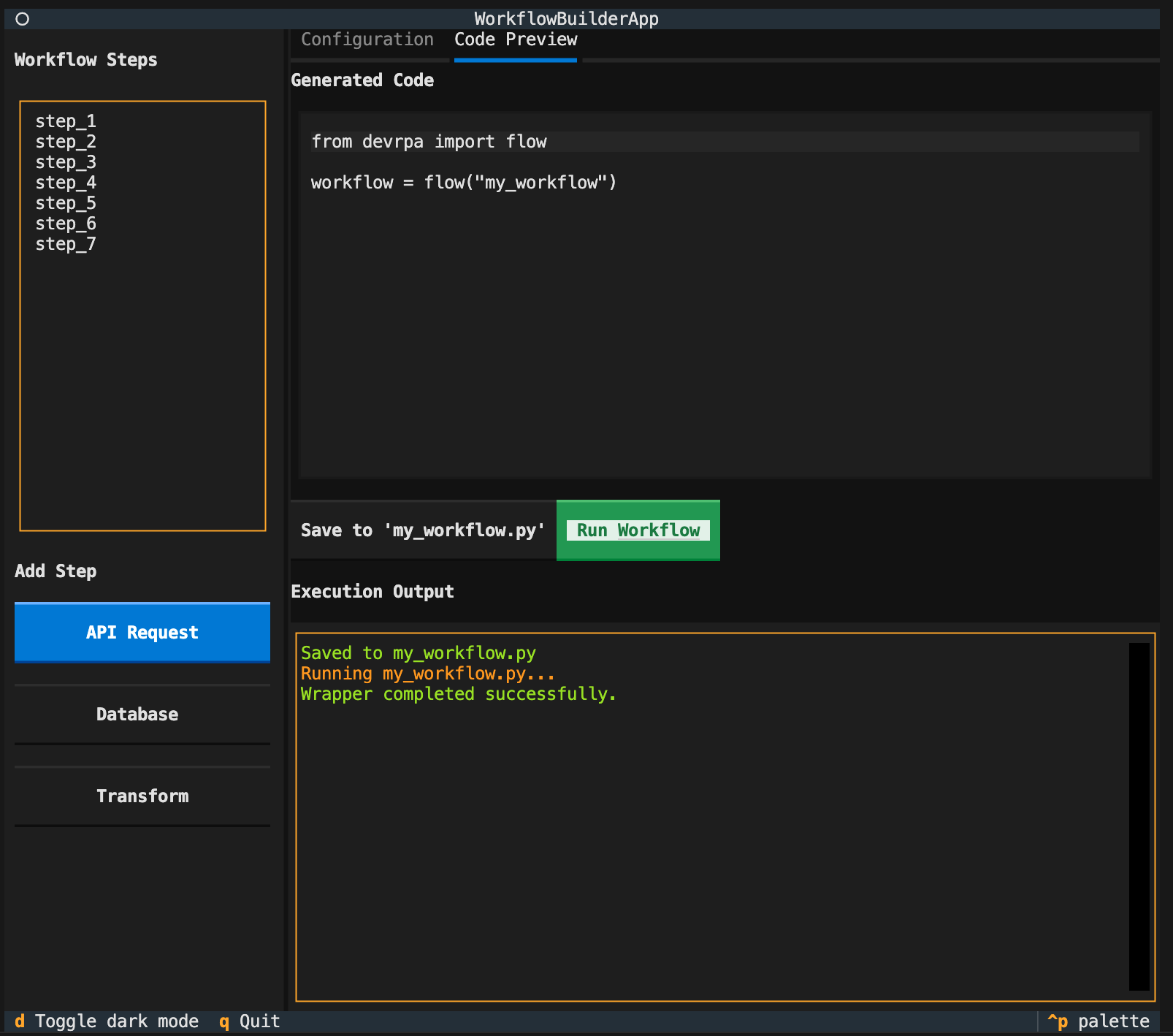
Key Capabilities
1. Interactive Design
- Rich UI: Use the TUI to add, reorder (
Up/Down), and delete steps easily. - Instant Feedback: See steps visualized with type icons (
[API],[DB],[TF]) and status indicators.
2. Advanced Configuration
Configure every aspect of your steps directly in the panel:
- API: Set Method, Headers, Timeout, and Validation rules.
- Resilience: Enable Retries and Response Caching with a single click.
- Variables: specificy
Output Variablesto pass data between steps.
3. Real-Time Testing & Execution
Don't wait until the end to find bugs.
- Test Step: Click to actually execute the step in real-time.
- API: Sends real HTTP requests (via
httpx). - DB: Runs real SQL queries (via
sqlalchemy). - Transform: Executes Python code snippets instantly.
- API: Sends real HTTP requests (via
- Live Logs: View execution status, duration, and errors immediately.
4. Smart Validation
The builder validates your workflow before you run it:
- Checks for missing required fields (URLs, Queries).
- Static Analysis: Detects references to undefined variables (e.g., using
{user_id}before it's assigned).
5. Project Management
- Persistence: Save your workflow to JSON (
workflow.json) and load it back later to continue working. - Code Export: Automatically generates python code (
my_workflow.py) that you can run in production.
Use Cases
1. API Integration & ETL
Fetch data from multiple sources, transform it, and load it into your database.
workflow = (
    flow("user_sync")
    .from_api("https://api.example.com/users", output="users")
    .transform(lambda users: [u for u in users if u['active']], output="active_users")
    .from_db("INSERT INTO users (id, email) VALUES ...")
)
2. Intelligent Automation
Combine web scraping with AI processing.
workflow = (
    flow("market_research")
    .browser_goto("https://competitor.com/pricing")
    .browser_scrape_text("#price-table", output="pricing_data")
    .llm_analyze("Extract price points", input="pricing_data", output="report")
    .slack_notify("#strategy", "{report}")
)
3. DevOps & Monitoring
Monitor systems and auto-remediate issues.
workflow = (
    flow("system_health")
    .github_list_issues("owner", "repo", output="issues")
    .where("label == 'critical'", input="issues", output="critical_issues")
    .if_condition("len(critical_issues) > 0")
        .pagerduty_trigger("High load detected")
    .end_if()
)
Quick Start (Code-First)
The Fluent Way
The fluent API helps you write readable, chainable workflows.
from devrpa import flow

workflow = (
    flow("github_tracker")
    # Fetch issues from GitHub (GitHub Integration)
    .github_list_issues("owner", "repo", output="issues")

    # Filter for bugs (Selector Syntax)
    .where("title.startswith('[Bug]')", input="issues_response", output="bugs")

    # Notify team (Slack Integration)
    .slack_notify("#alerts", "Found {bugs.count} bugs!")
)

# Run it
import asyncio
asyncio.run(workflow.run())
The Type-Safe Way
Leverage Pydantic to ensure your workflow data is always correct.
from pydantic import BaseModel
from devrpa import flow

# Define your context model
class UserContext(BaseModel):
    user_id: int
    email: str
    active: bool = False

# Build workflow
wf = (
    flow("user_sync", context_model=UserContext)
    .from_api("https://api.com/users/{user_id}", output="api_user")
    .transform(lambda d: d['is_active'], input="api_user", output="active")
)

# Run with validation
wf.run(initial_data=UserContext(user_id=123, email="test@example.com"))
Core Concepts
Workflow & Steps
A Workflow is a sequence of Steps. Steps are atomic units of work (API calls, browser actions, data transformations).
Execution Context
Data is shared between steps via the ExecutionContext. You can access it using {variable_name} templates in step parameters or pass it safely via Pydantic models.
Integrations
devrpa comes with built-in integrations for popular services:
- Web:
WebStep(Playwright) - API:
ApiStep(HTTPX) - GitHub:
GitHub.get_repo,GitHub.list_issues - Slack:
Slack.post_message - Files:
ParseCSVStep,GenerateCSVStep - Database:
DatabaseStep(SQLAlchemy async)
Contributing
We welcome contributions! Please see examples/ for more usage patterns.
- Fork the repository
- Create your feature branch (
git checkout -b feature/amazing-feature) - Commit your changes (
git commit -m 'Add amazing feature') - Push to the branch (
git push origin feature/amazing-feature) - Open a Pull Request
Project details
Verified details
These details have been verified by PyPIProject links
GitHub Statistics
Maintainers


Download files
Download the file for your platform. If you're not sure which to choose, learn more about installing packages.
Source Distribution
Built Distribution
Filter files by name, interpreter, ABI, and platform.
If you're not sure about the file name format, learn more about wheel file names.
Copy a direct link to the current filters
File details
Details for the file devrpa-0.9.4.tar.gz.
File metadata
- Download URL: devrpa-0.9.4.tar.gz
- Upload date:
- Size: 691.8 kB
- Tags: Source
- Uploaded using Trusted Publishing? Yes
- Uploaded via: twine/6.1.0 CPython/3.13.7
File hashes
| Algorithm | Hash digest | |
|---|---|---|
| SHA256 |
0e2dc56ba1a91f3501d8c9296ad3288ad83c8fbc20e244a8408269f330c9ab85
|
|
| MD5 |
8b90e850ccaa45405a572ae94898600a
|
|
| BLAKE2b-256 |
1a9cc0ed04ac49bd7caa3b469f87380ccf11705e3dfd4a64bb7dfddbfb3f2ea7
|
Provenance
The following attestation bundles were made for devrpa-0.9.4.tar.gz:
Publisher:
workflow.yml on prathameshfuke/devrpa
-
Statement:
-
Statement type:
https://in-toto.io/Statement/v1 -
Predicate type:
https://docs.pypi.org/attestations/publish/v1 -
Subject name:
devrpa-0.9.4.tar.gz -
Subject digest:
0e2dc56ba1a91f3501d8c9296ad3288ad83c8fbc20e244a8408269f330c9ab85 - Sigstore transparency entry: 855159371
- Sigstore integration time:
-
Permalink:
prathameshfuke/devrpa@02c70e35537a0c6137420322a946e93977469575 -
Branch / Tag:
refs/tags/v0.9.4 - Owner: https://github.com/prathameshfuke
-
Access:
public
-
Token Issuer:
https://token.actions.githubusercontent.com -
Runner Environment:
github-hosted -
Publication workflow:
workflow.yml@02c70e35537a0c6137420322a946e93977469575 -
Trigger Event:
push
-
Statement type:
File details
Details for the file devrpa-0.9.4-py3-none-any.whl.
File metadata
- Download URL: devrpa-0.9.4-py3-none-any.whl
- Upload date:
- Size: 43.5 kB
- Tags: Python 3
- Uploaded using Trusted Publishing? Yes
- Uploaded via: twine/6.1.0 CPython/3.13.7
File hashes
| Algorithm | Hash digest | |
|---|---|---|
| SHA256 |
8cb9f64f729a36c1c3971bc4bae09c9fe6d7f3e3edbee0adb5a94caa63c557e6
|
|
| MD5 |
670b7c5f9f0e29fb4863a600a75d47ff
|
|
| BLAKE2b-256 |
03006c1a76db5935ca2b05b79da17a9066dc2f576637b35dd29a14aa57b351df
|
Provenance
The following attestation bundles were made for devrpa-0.9.4-py3-none-any.whl:
Publisher:
workflow.yml on prathameshfuke/devrpa
-
Statement:
-
Statement type:
https://in-toto.io/Statement/v1 -
Predicate type:
https://docs.pypi.org/attestations/publish/v1 -
Subject name:
devrpa-0.9.4-py3-none-any.whl -
Subject digest:
8cb9f64f729a36c1c3971bc4bae09c9fe6d7f3e3edbee0adb5a94caa63c557e6 - Sigstore transparency entry: 855159375
- Sigstore integration time:
-
Permalink:
prathameshfuke/devrpa@02c70e35537a0c6137420322a946e93977469575 -
Branch / Tag:
refs/tags/v0.9.4 - Owner: https://github.com/prathameshfuke
-
Access:
public
-
Token Issuer:
https://token.actions.githubusercontent.com -
Runner Environment:
github-hosted -
Publication workflow:
workflow.yml@02c70e35537a0c6137420322a946e93977469575 -
Trigger Event:
push
-
Statement type:






