
dexpot

Synchronous Python APIs that adapt concurrency to the interpreter.
A synchronous Python API framework that compiles routes once, validates JSON with msgspec, can parse request heads in Rust through an optional PyO3 extension, and adapts concurrency to the interpreter running it.





Quick start · Why dexpot · Execution model · Rust parser · Boundaries · Examples · Community · Roadmap · Contributing
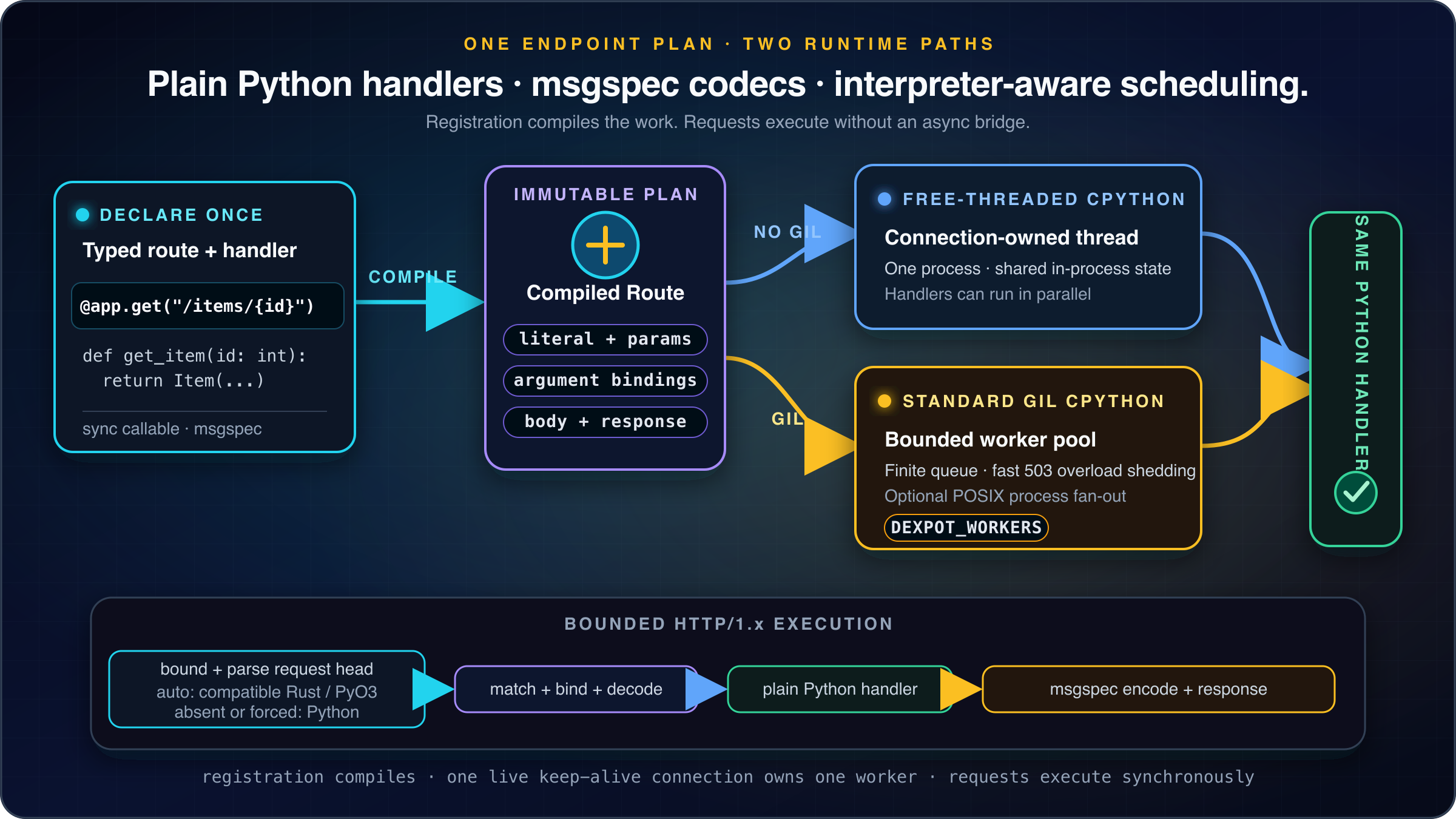
dexpot is interpreter-adaptive and agent-ready. The same synchronous application adapts to standard GIL and free-threaded execution, can use a compatible Rust parser on the request hot path, and ships project-local skills so coding agents understand the framework's real contract and runtime boundaries.
Why dexpot
Most Python API frameworks were designed around a permanent GIL: async I/O in one process, or several worker processes for CPU parallelism. Free-threaded CPython changes that tradeoff. Threads can execute Python simultaneously and share normal in-process state.
dexpot supports both runtimes instead of optimizing for one and treating the other as a compatibility mode. It uses bounded threads and optional process fan-out on standard GIL builds, then uses real parallel threads in one process when the GIL is disabled. The application keeps the same plain synchronous handlers in both modes:
- Plain synchronous handlers. No
async def, event loop, or coroutine bridge. - Compiled endpoint plans. Route matching metadata, argument sources, path conversions, and msgspec codecs are prepared when a handler is registered.
- Interpreter-adaptive scheduling. Free-threaded builds use one process and a real thread
per connection, capped at 1,024 active connections by default. GIL builds use a bounded
thread pool with fast 503 overload shedding and can fan out through
SO_REUSEPORTworkers. - msgspec request bodies. JSON decoding and validation happen together in compiled C codecs.
- Optional Rust/PyO3 request-head parser. A compatible
dexpot-nativeinstallation handles request-line and header parsing while Python retains sockets, bounded accumulation, deadlines, bodies, routing, handlers, and scheduling. - A small, owned HTTP core. Routing, parsing, scheduling, draining, and response writes are dexpot code—not a wrapper around another web framework.
dexpot is alpha software and is not yet recommended for untrusted production traffic. Its socket core now fails closed on malformed framing and enforces request limits, but production operations such as access logging, metrics, trusted-proxy policy, TLS guidance, middleware, OpenAPI, streaming, and authentication remain on the roadmap.
Quick start
1. Install
pip install "dexpot[cli]"
2. Define an application
Create main.py:
import msgspec

from dexpot import Dex


class ItemIn(msgspec.Struct):
    name: str
    price: float


class ItemOut(msgspec.Struct):
    id: int
    name: str
    price: float


app = Dex()


@app.get("/items/{item_id}", response=ItemOut)
def get_item(item_id: int) -> ItemOut:
    return ItemOut(id=item_id, name=f"item-{item_id}", price=9.99)


@app.post("/items", body=ItemIn, response=ItemOut)
def create_item(item: ItemIn) -> tuple[int, ItemOut]:
    return 201, ItemOut(id=1, name=item.name, price=item.price)
The path capture is converted from text because item_id is annotated as int. The POST
body is decoded directly into ItemIn; malformed JSON or a validation failure returns 422.
3. Serve it
dexpot serve main:app --host 127.0.0.1 --port 8000
Call the real HTTP surface:
curl -s http://127.0.0.1:8000/items/7
curl -s -X POST http://127.0.0.1:8000/items \
  -H 'Content-Type: application/json' \
  -d '{"name":"keyboard","price":79.0}'
The responses are JSON:
{"id":7,"name":"item-7","price":9.99}
{"id":1,"name":"keyboard","price":79.0}
You can also run the file directly with app.serve():
if __name__ == "__main__":
    app.serve(host="127.0.0.1", port=8000)
HTTP limits
Every connection enforces conservative defaults: an 8 KiB request line, 64 KiB request head, 100 headers, a 16 MiB body, a five-second idle read timeout, a ten-second absolute head deadline, and a thirty-second absolute body deadline. Override them as one typed, immutable policy rather than adding transport options to route decorators:
from dexpot import Dex, HttpLimits

app = Dex(
    limits=HttpLimits(
        request_line_bytes=4 * 1024,
        header_bytes=32 * 1024,
        header_count=64,
        body_bytes=2 * 1024 * 1024,
        idle_read_seconds=10.0,
        head_read_seconds=15.0,
        body_read_seconds=60.0,
    )
)
Values must be positive, and the total request-head allowance must exceed the request-line allowance. Oversized or timed-out requests receive a stable error and the connection closes.
Optional Rust/PyO3 parser
The pure-Python request-head parser remains the behavioral reference and fallback. The
experimental dexpot-native subproject implements the same request-line, header, Host,
framing, and keep-alive semantics in Rust through a parser-only PyO3 extension. Python still owns
sockets, deadlines, bodies, pipelining, target decoding, routing, handlers, scheduling, and
worker supervision.
Backend selection happens once when dexpot is imported:
DEXPOT_HTTP_PARSER=python dexpot serve main:app  # force the Python reference parser
DEXPOT_HTTP_PARSER=native dexpot serve main:app  # require dexpot-native
DEXPOT_HTTP_PARSER=auto dexpot serve main:app    # compatible native, or Python if absent
native fails clearly when the extension is unavailable. The default auto mode falls back
only when the native module is absent; ABI and initialization failures remain visible. The
accelerator is not yet published, so installing or building it remains the opt-in decision.
Contributors can build it from
native/; its wheel matrix, parity suite, and promotion gates are tracked
in issue #18.
Route contract
Use @app.get, @app.post, @app.put, @app.patch, and @app.delete.
@app.post(
    "/accounts/{account_id}/items",
    body=ItemIn,
    response=ItemOut,
)
def create_for_account(item: ItemIn, account_id: int) -> ItemOut:
    return ItemOut(id=account_id, name=item.name, price=item.price)
The handler signature does not have to mirror URL order. dexpot binds path captures by name, treats the first non-path, non-Request parameter as the declared body, preserves Python signature order, and supports keyword-only parameters. Put default-only parameters after that body parameter. Registration fails before serving when:
- a required parameter has no matching path capture, request body, or default;
- a path capture is not accepted by the handler;
- the handler uses
*argsor**kwargs; or - another route already owns the same method and structural path shape.
For example, GET /users/{id} and GET /users/{name} conflict because only one can ever
match a request.
A handler may return a JSON-encodable value, a msgspec struct, or (status, payload).
response= precompiles the successful-response encoder, but the current release does not
yet enforce the returned type at runtime.
Annotation namespaces
Route decorators never read caller locals. Postponed annotations resolve against the
original handler's module globals and captured closure bindings, including handlers using
functools.wraps. For annotation-only aliases local to a factory or class, pass an explicit
namespace on any route decorator:
from __future__ import annotations
from dexpot import Dex


def build():
    from dexpot import Request as Context

    app = Dex()

    @app.get("/context", annotation_locals={"Context": Context})
    def context(request: Context):
        return {"method": request.method}

    return app
annotation_locals is shallow-copied when the decorator is created. Pass only the needed
bindings, not an entire frame's locals(). For delayed registration, retain and pass the
original alias bindings; Python does not preserve annotation-only locals after a factory
returns. Captured closure bindings take precedence over the supplied namespace, which takes
precedence over module globals. Unresolved parameter annotations fail registration with an
annotation_locals error, even when the parameter has a default. An explicit body= schema
continues to bind the first non-path, non-Request parameter without needing its annotation.
Annotations are resolved afresh for each registration, and body=/response= belong to that
route declaration rather than the handler function, so one handler can be reused safely across
applications with different route contracts.
Request context
Annotate a handler parameter with the public Request type to receive the parsed request
through the endpoint's precompiled direct-call path:
from dexpot import Request


@app.post("/accounts/{account_id}/items", body=ItemIn)
def create_with_context(item: ItemIn, account_id: int, *, request: Request) -> dict:
    return {
        "account_id": request.params["account_id"],
        "method": request.method,
        "query": request.query,
        "same_body": request.body is item,
    }
request.method and request.path are decoded routing values. request.params contains the
decoded path-capture strings before handler type conversion, while request.query is the raw
query string and request.headers contains lowercase header names. request.raw_body retains
the received bytes; request.body is the same validated object passed to the declared body
parameter. The request object is frozen and GC-tracked. Handlers without a Request annotation
do not allocate one. Freezing prevents attribute reassignment; it does not deep-freeze the
request-local params, headers, or validated body values. Returning a Request directly is
always rejected. On Request-aware routes, nested Request values in supported response containers
are also rejected. Explicit extraction of sensitive fields and nested, manually created Request
values returned by requestless handlers are outside the recursive guard.
Execution model
dexpot chooses its scheduler once when the module is imported.
| Runtime | Default serving model | Overload behavior |
|---|---|---|
Free-threaded CPython (sys._is_gil_enabled() == False) |
One process; each admitted connection owns a thread | Active connections capped at 1,024 by default; excess connections receive 503 before thread creation |
| Standard GIL CPython | Bounded pool of CPU * 2 + 2 connection-owning threads |
Queue capped at 2 * pool; excess connections receive 503 |
Standard GIL CPython with DEXPOT_WORKERS>1 |
POSIX SO_REUSEPORT processes, each with its own bounded pool |
Each worker sheds independently |
A worker owns a keep-alive connection until it closes. This avoids putting idle keep-alive sockets back into a shared queue, where they can consume admission capacity and stall a worker waiting for the next request.
Tune admission before the process imports dexpot:
# Set the free-threaded process-wide active-connection cap.
DEXPOT_MAX_CONNECTIONS=512 dexpot serve main:app

# Set the GIL thread pool and queue.
DEXPOT_POOL=16 DEXPOT_MAX_QUEUE=32 dexpot serve main:app
Use process fan-out on supported POSIX systems:
DEXPOT_WORKERS=4 dexpot serve main:app
DEXPOT_WORKERS>1 requires POSIX fork and SO_REUSEPORT; dexpot rejects that setting on
unsupported platforms rather than pretending multiprocess serving is active. Free-threaded
builds intentionally remain single-process because their threads can execute Python in
parallel.
SIGINT and SIGTERM stop admission and allow active connections up to five seconds to drain. The GIL supervisor restarts a worker that exits unexpectedly.
Current architecture
Registration builds immutable EndpointPlan objects for handler binding, capture conversion,
and body and response codecs. When serving starts, dexpot freezes those endpoints into one
ApplicationPlan and a RouterPlan grouped by path length with parameter positions already
classified. Compilation happens before opening a listener, and late route registration fails
instead of silently diverging from the plan used by traffic.
Request processing consumes the same plan for literal and parameterized matching, 404/405 resolution, direct handler invocation, and response encoding without inspecting the handler again.
Parser selection is orthogonal to scheduling: each bounded request head uses a compatible
Rust/PyO3 dexpot-native installation in automatic mode, or the Python reference when the
native module is absent or Python mode is forced. A selected native adapter also preserves the
Python path for configured head limits beyond Rust's usize range. Incompatible or broken
native installations fail visibly. Python continues to own sockets, deadlines, bodies, and routing.
The interpreter changes admission and scheduling, not application code. Free-threaded CPython gives each admitted connection its own thread in one process and sheds above the configured process-wide cap. Standard GIL CPython uses a bounded pool, sheds above its queue limit, and can add POSIX process fan-out. Both paths enforce the same HTTP limits and execute the same compiled route, synchronous handler, and msgspec response pipeline shown above.
Protocol and configuration policy
Once a request reaches parsing, HEAD responses never include body bytes, including parser and
handler errors; admission can reject an unread connection before its method is known. Automatic
GET-to-HEAD routing is not provided. Requests with an Expect header are rejected with 417 and connection close
before reading their body. Retry without Expect when appropriate.
DEXPOT_POOL=0 retains automatic sizing. Negative pool sizes and nonpositive
DEXPOT_MAX_QUEUE or DEXPOT_MAX_CONNECTIONS values fail at import, before a listener can
open; zero queue or connection capacity is not a supported no-wait mode. These validation
rules apply in both interpreter modes.
Current boundaries
The current alpha release has these boundaries:
- HTTP/1.0 and HTTP/1.1 requests with validated
Content-Lengthframing are supported; transfer encodings, including chunked request bodies, are rejected and the connection closes. - Request-line, total-header, header-count, and body limits plus idle and absolute head/body deadlines are enforced before request data can accumulate or drip indefinitely.
- Request targets are currently origin-form only (
/path?query); absolute-form proxy targets are rejected during this alpha milestone. - The optional native request-head parser is experimental. Automatic detection is the default, but it activates Rust only when a compatible separately installed extension is present; Python remains the reference and fallback.
- Routing distinguishes 404 from 405, returns
Allowfor method mismatches, percent-decodes UTF-8 paths safely, and treats duplicate or trailing slashes as distinct paths. - Query strings and headers are parsed internally but are not yet injectable handler parameters.
- There is no middleware, OpenAPI generation, authentication, TLS termination, streaming, WebSocket support, or proxy-header policy.
response=selects an encoder but does not validate the handler's return type.- Uncaught handler exceptions produce a stable public 500 body while the traceback is logged server-side. Structured logging and request IDs remain production-operations work.
- Multiprocess serving is POSIX-only. Windows users must use one process in the current release.
These are explicit roadmap items, not hidden features. See ROADMAP.md for the implementation order.
Give your coding agent dexpot context
Install project-local guidance for Claude Code, Cursor, Windsurf, GitHub Copilot, Cline, or OpenAI Codex:
# Auto-detect agents already configured in the project
dexpot add skills

# Or target one explicitly
dexpot add skills --agent claude
dexpot add skills --agent cursor
dexpot add skills --agent windsurf
dexpot add skills --agent copilot
dexpot add skills --agent cline
dexpot add skills --agent codex

# Install into another project
dexpot add skills --path ./my-api
The installed skill teaches the shipped route contract, msgspec body model, concurrency modes, operational boundaries, and verification requirements. Shared Copilot and Codex instruction files use a bounded managed block, so existing project guidance is preserved.
CLI reference
dexpot serve <module:attribute> [--host HOST] [--port PORT]
dexpot add skills [--agent AGENT] [--path DIRECTORY]
dexpot version
dexpot --version
The CLI extra is optional, so applications that call Dex.serve() directly do not need
Typer:
pip install dexpot          # framework runtime
pip install "dexpot[cli]"   # framework runtime + dexpot command
Examples
The runnable progression under examples/ exercises the shipped framework
through its real socket server:
minimal.py: typed path capture and response;typed_crud.py: thread-safe shared state, typed JSON writes, and a complete create/read/update/delete lifecycle; andbounded_api.py: customHttpLimits, 413/422 failures, 405 method handling, and/contextwith an explicit factory-local annotation namespace.
Each example runs directly with uv run python examples/<name>.py, and the test suite launches
every example as a subprocess and validates its public HTTP behavior. Examples will continue to
grow only as middleware, schemas, deployment support, and other roadmap capabilities ship.
Roadmap
The shipped foundation now includes the HTTP-hardening gate and the optional native request-head seam. Remaining work is organized around four gates:
- extend the shipped request context with decoded query parameters, cookies, and client metadata, and complete middleware, schemas, and richer response handling;
- publish reproducible GIL and free-threaded benchmarks with correctness parity; and
- add production operations without replacing the synchronous execution model; and
- grow runnable examples, testing support, deployment guidance, and stable extension points.
The detailed milestones and non-goals live in ROADMAP.md.
Community
The ModePot Discord is the shared community for dexpot, intpot, summonpot, and the rest of the project family. Join to discuss synchronous API design, free-threaded Python, implementation questions, and real application use cases.
Use GitHub issues for reproducible bugs and scoped feature proposals. Use Discussions for durable project Q&A, and Discord for exploratory design, early ideas, and cross-project help.
Contributing
Start with CONTRIBUTING.md, then read
docs/reviewing.md before opening a change. Useful contributions
include:
- executable examples under
examples/; - real-client HTTP acceptance tests and malformed-request coverage;
- reproducible
wrkbenchmarks that compare successful equivalent responses; - parser, shutdown, and overload correctness;
- roadmap features with a focused issue and end-to-end tests; and
- documentation that clearly separates current behavior from planned architecture.
Open an issue before substantial handler, routing, parser, scheduler, protocol, or execution contract work. Focused fixes, tests, documentation, and maintenance may be direct pull requests when they do not introduce a new public contract.
Set up and run the complete local gate with:
uv sync --all-extras
make check
User-facing changes require a Towncrier fragment. See
changelog.d/README.md.
Support dexpot
- Run one of the checked-in examples and report any friction through the issue forms.
- Share a real synchronous API or free-threaded Python use case in Discussions or the ModePot Discord.
- If dexpot's execution model is useful to you, use the Star control on the repository so other Python developers can find it.
License
MIT — see LICENSE.
1 maintainer

Metadata
1 maintainer
Release files for dexpot 0.5.0
For a detailed explanation of source distributions (sdists) and built distributions (wheels), please see the package formats documentation.
Source distribution (sdist)
| File | Size | Uploaded | |
|---|---|---|---|
| dexpot-0.5.0.tar.gz | 1.4 MB | Details |
Built distribution (wheel)
| File | Interpreter | ABI | Platform | Reset |
|---|---|---|---|---|
| dexpot-0.5.0-py3-none-any.whl | Python 3 | none | any | Details |
Total release size: 1.4 MB
Release files / dexpot-0.5.0.tar.gz
| Download URL | dexpot-0.5.0.tar.gz |
|---|---|
| Size | 1.4 MB |
| Tags | Source |
|
SHA-256 checksum How to use checksums |
7d6831c66edaed4c9e7b2cd199c4a4102d84d95c260b06f698bd89036edf6b25
|
|
BLAKE2b-256 checksum How to use checksums |
ec1b04962d73b1c07de346aed66128f01d3fdb7535f2441703acddb896982289
|
| Upload date | |
|
Uploaded using Trusted Publishing? What is trusted publishing? |
Yes |
| Uploaded via |
twine/7.0.0 CPython/3.13.14
|
Provenance
Provenance describes where a file came from. On PyPI, provenance is shared via attestations, which provide a verifiable record of the build or publishing details. View details, limitations and caveats.


PyPI Publish Attestation
PyPI verified that this artifact, at this checksum, originated from the publisher listed below.
Signed by GitHub Actions, verified by PyPI on Sep 20, 2026.
Transparency logRelease files / dexpot-0.5.0-py3-none-any.whl
| Download URL | dexpot-0.5.0-py3-none-any.whl |
|---|---|
| Size | 37.4 kB |
| Tags | Python 3 |
|
SHA-256 checksum How to use checksums |
bbe9c826479fb8c696c7de6dc35c30a23536fffe1f03cdd51a60aa7fb64e45d9
|
|
BLAKE2b-256 checksum How to use checksums |
c640dc09b0f1b32d899c6672e8b5fb4ee4ed5f51bb4e654e38d2abd690d954bc
|
| Upload date | |
|
Uploaded using Trusted Publishing? What is trusted publishing? |
Yes |
| Uploaded via |
twine/7.0.0 CPython/3.13.14
|
Provenance
Provenance describes where a file came from. On PyPI, provenance is shared via attestations, which provide a verifiable record of the build or publishing details. View details, limitations and caveats.
PyPI Publish Attestation
PyPI verified that this artifact, at this checksum, originated from the publisher listed below.
Signed by GitHub Actions, verified by PyPI on Sep 20, 2026.
Transparency log













