
DHL-MM: Dynamic Hodge-Lie Matrix Multiplication



Fast Lie algebra multiplication for all five exceptional algebras (G₂, F₄, E₆, E₇, E₈) using sparse structure constants. Eight modules: equivariant PyTorch layers, JAX backend, lattice gauge theory, RKMK Lie group integrators, quantum simulation, PyTorch Geometric integration, and a C++ extension hitting 993× over dense.
pip install dhl-mm
$$z_k ;=; \Pi^{h^2}\varphi ;\frac{1}{2} !!!\sum{(i,,j,,k),\in, \mathcal{F}(\mathfrak{g})} !!! x_i ; y_j ; f_{ij}^{;k} ;, \qquad 3 \notin \lbrace \deg C_p(\mathfrak{g}) \rbrace ;;\forall; \mathfrak{g} \in \lbrace G_2,, F_4,, E_6,, E_7,, E_8 \rbrace$$
Left: the computation — sparse gather-multiply-scatter over nonzero structure constants $\mathcal{F}(\mathfrak{g})$, with Z[φ] lattice projection $\Pi^{h^2}_\varphi$ for error control. Right: why it works — no exceptional algebra has a degree-3 Casimir invariant, so the symmetric $d$-tensor vanishes and antisymmetric constants capture the full product.
Quick Start
import dhl_mm

# Load any exceptional algebra — cached, <25ms
e8 = dhl_mm.algebra("E8")
g2 = dhl_mm.algebra("G2")

# Sparse Lie bracket (913× fewer ops than dense for E8)
import numpy as np
x, y = np.random.randn(248), np.random.randn(248)
z = e8.bracket(x, y)
Differentiable PyTorch bracket
from equivariant import SparseLieBracket
import torch

bracket = SparseLieBracket.from_algebra("E8")  # or "G2", "F4", "E6", "E7"
x = torch.randn(248, requires_grad=True)
y = torch.randn(248)
z = bracket(x, y)       # full autograd support
z.sum().backward()       # gradients flow through sparse scatter-add
Adjoint-equivariant neural network
from equivariant import ExceptionalEGNN

model = ExceptionalEGNN(
    in_dim=14, hidden_dim=32, out_dim=1,
    n_layers=3, algebra_name="G2", equivariant=True
)
nodes = torch.randn(10, 14)
edge_index = torch.tensor([[0,1,2,3],[1,2,3,0]], dtype=torch.long)
prediction = model(nodes, edge_index)
PyTorch Geometric
from dhl_mm.pyg import LieBracketConv  # requires torch_geometric

conv = LieBracketConv("E8", equivariant=True)
out = conv(node_features, edge_index)   # equivariant message passing
Lattice gauge theory
from dhl_mm import GaugeLattice

lat = GaugeLattice((8, 8), algebra_name="E8")  # 8×8 lattice, E8 gauge group
lat.hot_start(scale=0.5)
result = lat.thermalize(n_sweeps=100, beta=1.0)
print(f"Average plaquette: {result['average_plaquettes'][-1]:.4f}")
RKMK Lie group integrators
from dhl_mm import RKMKIntegrator

rk = RKMKIntegrator("E8")
flow = lambda t, y: rk.alg.bracket(H, y)  # adjoint flow dy/dt = [H, y]
result = rk.solve(flow, y0, t_span=(0, 1), dt=0.01, method='rk4')
# 4th-order convergence with BCH bracket corrections
Quantum simulation
from dhl_mm import E8SpinLattice

lattice = E8SpinLattice(n_sites=8, algebra_name="E8")
state = lattice.random_initial_state()
trajectory = lattice.evolve(state, dt=0.001, steps=500, order=2)
# 8 sites × 500 steps in ~4 seconds on CPU
JAX backend
from dhl_mm import jax_algebra

alg = jax_algebra("E8")                     # JIT-compiled sparse bracket
z = alg.bracket(x, y)                       # automatic differentiation via custom_jvp
zs = alg.batch_bracket(xs, ys)              # vmap over batch dimension
Quantum Simulation Results
Lie-algebra-valued lattice dynamics under adjoint commutator flow. The sparse bracket makes it feasible to simulate E₈-valued spin chains on CPU.
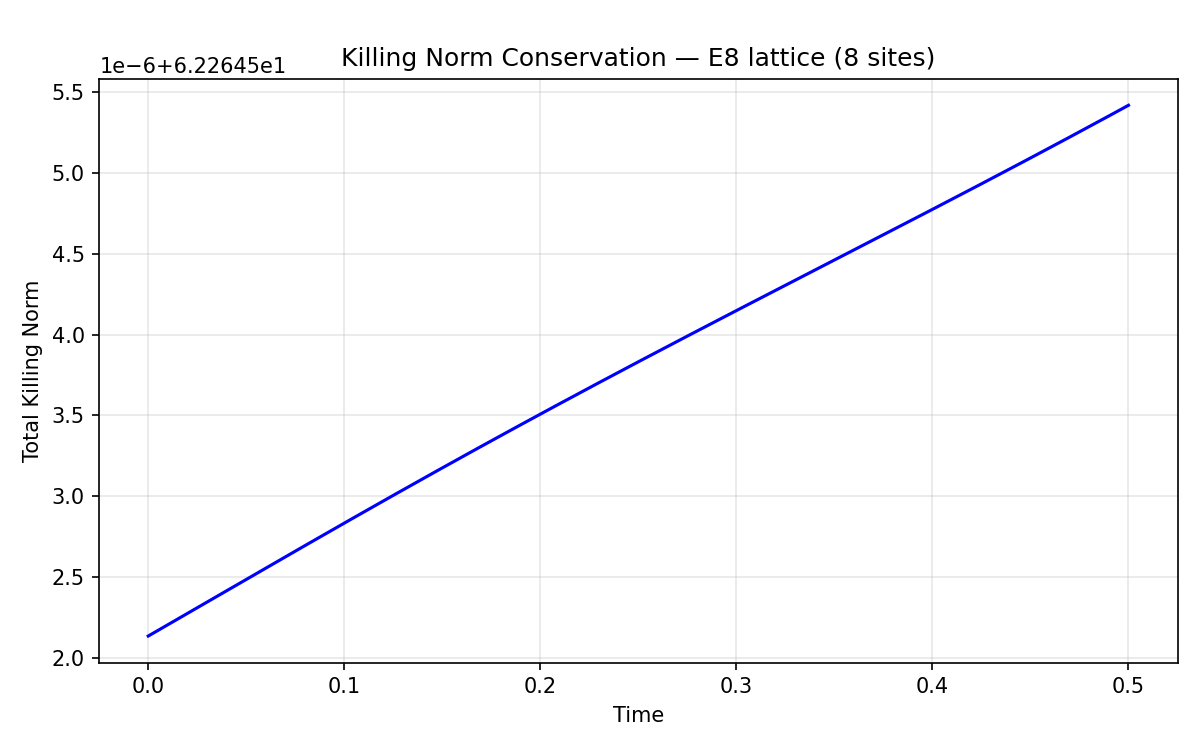
Killing norm conservation — flat line proves the integrator preserves algebraic structure. Drift ~3×10⁻⁶ over 500 steps.
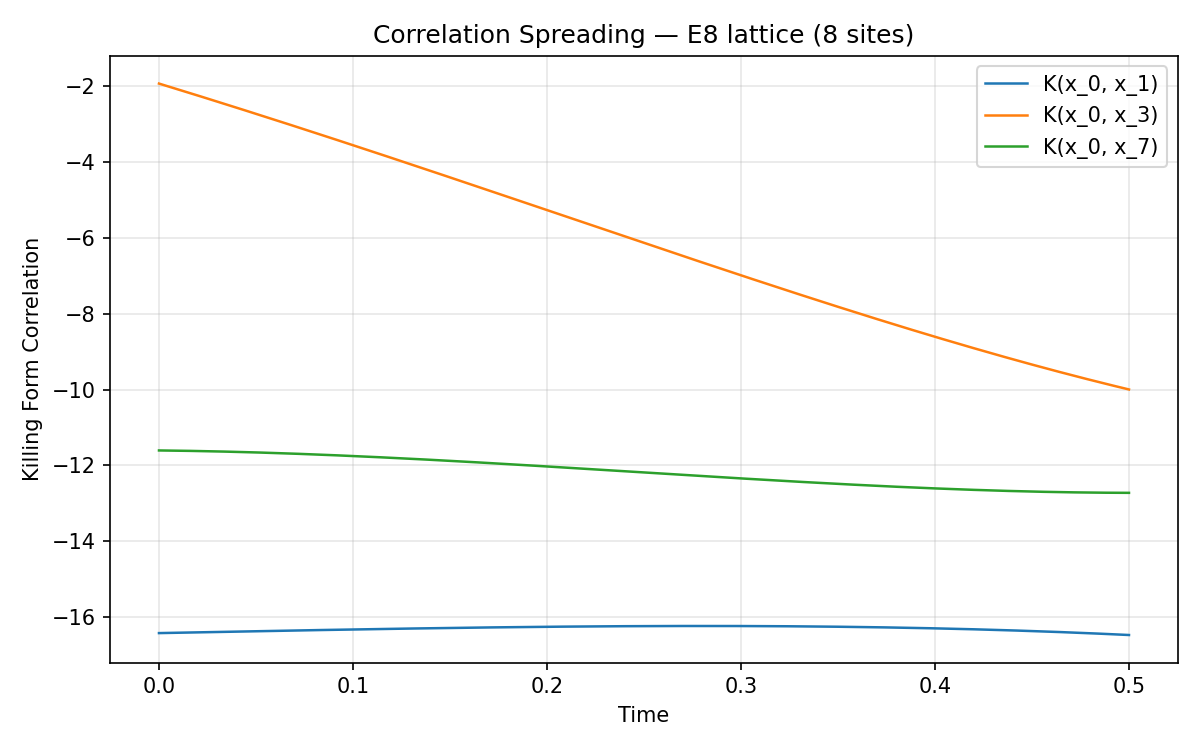
Correlation spreading — Killing inner product between sites shows information propagation across the lattice.
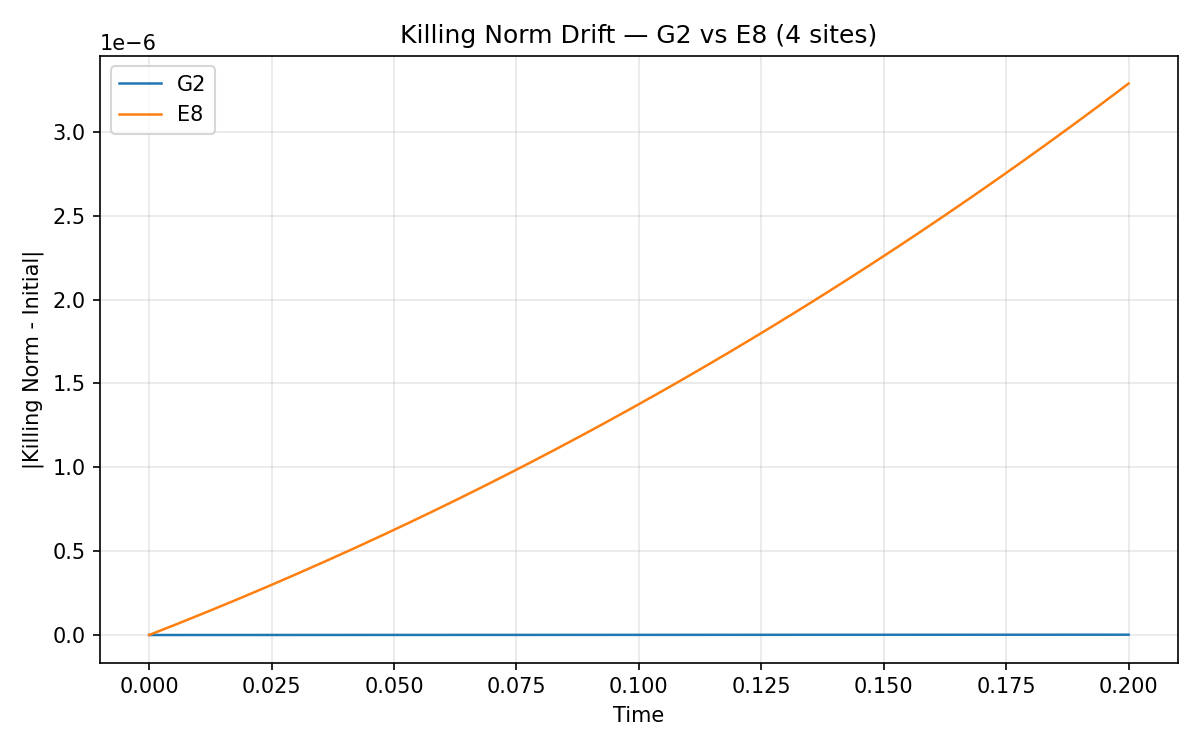
G₂ vs E₈ — same lattice geometry, different algebras. G₂ (14-dim) drifts ~10⁻⁹, E₈ (248-dim) drifts ~10⁻⁶. Both well-conserved.
Compression Table
| Algebra | Dim | Roots | Nonzero f | Full n³ | Compression | Jacobi Error |
|---|---|---|---|---|---|---|
| G₂ | 14 | 12 | 120 | 2,744 | 22.9× | ~1e-14 |
| F₄ | 52 | 48 | 1,196 | 140,608 | 117.6× | ~1e-16 |
| E₆ | 78 | 72 | 2,208 | 474,552 | 215× | ~1e-13 |
| E₇ | 133 | 126 | 5,544 | 2,352,637 | 424× | ~1e-13 |
| E₈ | 248 | 240 | 16,694 | 15,252,992 | 913× | ~1e-16 |
All algebras verified to machine epsilon. No approximations. See NUMERICAL_PRECISION.md for detailed FP64 error bounds.
Why It Works
None of the exceptional Lie algebras have a cubic Casimir invariant:
| Algebra | Casimir Degrees |
|---|---|
| G₂ | 2, 6 |
| F₄ | 2, 6, 8, 12 |
| E₆ | 2, 5, 6, 8, 9, 12 |
| E₇ | 2, 6, 8, 10, 12, 14, 18 |
| E₈ | 2, 8, 12, 14, 18, 20, 24, 30 |
No degree 3 means the symmetric structure constants d_{ij}^k vanish identically for all five. The full product T_i·T_j projected onto the Lie algebra equals [T_i, T_j]/2 exactly. The entire product is determined by the antisymmetric structure constants alone.
How It Works
1. Sparse Structure Constant Engine
Instead of multiplying n×n matrices, the product of two Lie algebra elements X = Σ xᵢTᵢ, Y = Σ yⱼTⱼ is:
(XY)_k = (1/2) Σ_{(i,j,k) ∈ f} xᵢ · yⱼ · f_{ij}^k
where f_{ij}^k are precomputed sparse entries. This is a gather-multiply-scatter operation. Structure constants are precomputed and shipped as .npz files — first algebra load takes <25ms.
2. Z[φ] Exact Arithmetic
Coefficients stored as integer pairs (a, b) representing a + bφ where φ is the golden ratio. Multiplication uses φ² = φ + 1. No floating-point accumulation errors for algebraic inputs.
3. Defect Equation Monitor
h²(t) = h²_Λ - (κ/3) · ρ_defect(t)
Tracks accumulated deviation from the Z[φ] lattice. When h²(t) drops below threshold, coefficients are projected back to the nearest lattice point. Self-correcting computation.
4. Adjoint-Equivariant Neural Network Layers
AdjointLinearLayer— by Schur's lemma, the only linear map commuting with the adjoint action is a scalar multiple of the identity. Single learnable parameter.AdjointBilinearLayer— the two independent adjoint-invariant bilinear operations: antisymmetric bracket + symmetric Killing form scalar.EquivariantLieConvLayer— message passing with bracket-based nonlinearityx + α·[agg, W(agg)], following the Lie Neurons pattern (Lin et al. 2024). Adjoint equivariance verified to ~1e-15 for all 5 algebras.LieBracketConv— PyTorch GeometricMessagePassinglayer, drop-in compatible with any PyG pipeline.
5. Quantum Simulation
LieHamiltonian— sparse commutator[H, ρ]for Lie-algebra-valued time evolution.EquivariantTrotterSuzuki— first and second-order integrators with Killing norm drift tracking.E8SpinLattice— nearest-neighbor coupled evolution on a 1D lattice of algebra-valued sites. 8-site E₈ lattice evolves in ~4s on CPU with Killing norm drift ~3×10⁻⁶.
6. Lattice Gauge Theory
GaugeLattice— link variables, plaquettes, staples, Wilson loops (rectangular + Polyakov), and Metropolis updates for exceptional gauge groups. First open-source tooling for E₈/F₄ lattice gauge theory.- 8×8 E₈ lattice thermalizes in ~1.4s (100 sweeps). Acceptance rate ~52%.
7. RKMK Lie Group Integrators
RKMKIntegrator— Euler, RK2, and RK4 with Baker-Campbell-Hausdorff bracket corrections for geometric structure preservation. Verified 4th-order convergence.LieGroupFlow— convenience wrappers for rigid body dynamics, adjoint flow, and Yang-Mills evolution.- E₈ rigid body Killing norm drift ~2×10⁻⁹ over 1000 steps.
8. JAX Backend
JaxSparseBracket— JIT-compiled sparse bracket withcustom_jvpfor forward-mode AD.vmapbatch support.JaxLieAlgebra— convenience wrapper withbracket(),killing_form(),batch_bracket().- JAX is optional — module imports cleanly without it.
from dhl_mm import jax_algebra
alg = jax_algebra("E8")
z = alg.bracket(x, y)  # JIT-compiled, differentiable
9. C Extension + Prebuilt Wheels
A pybind11 C++ sparse kernel with OpenMP batched support is included (dhl_mm/csrc/). 993× speedup over dense on CI hardware. Falls back to NumPy if not compiled. Prebuilt wheels for Linux, macOS, and Windows are built automatically via cibuildwheel on each release.
pip install pybind11 && python setup.py build_ext --inplace # manual build
Project Structure
dhl_mm/                    Core library (pip install dhl-mm)
  __init__.py                algebra() / jax_algebra() factories, cached loading
  exceptional_engine.py      ExceptionalAlgebra class for all 5 algebras
  roots.py                   Root system builders (G2, F4, E6, E7, E8)
  structure.py               Structure constant computation (Chevalley basis)
  casimir.py                 Casimir degree analysis + d-tensor verification
  quantum.py                 Trotter-Suzuki evolution + E8 spin lattice
  lattice.py                 Lattice gauge theory (plaquettes, Wilson loops, Metropolis)
  integrators.py             RKMK Lie group integrators (Euler, RK2, RK4 + BCH)
  jax_backend.py             JAX sparse bracket with custom_jvp + vmap
  e8.py                      E8 root system + Frenkel-Kac cocycle
  engine.py                  DHLMM class (original E8 engine)
  zphi.py                    Exact Z[phi] arithmetic
  defect.py                  Friedmann-style h²(t) error tracker
  pyg.py                     PyTorch Geometric LieBracketConv layer
  csparse.py                 C extension wrapper with numpy fallback
  csrc/sparse_bracket.cpp    pybind11 C++ sparse kernel with OpenMP (optional)
  data/*.npz                 Precomputed structure constants (5 algebras)

equivariant/               PyTorch equivariant neural network layers
  sparse_kernel.py           SparseLieBracket, SparseKillingForm (differentiable)
  layers.py                  LieConvLayer, EquivariantLieConvLayer, AdjointLinearLayer
  model.py                   ExceptionalEGNN architecture
  benchmark.py               Multi-algebra benchmark suite
  tests/test_equivariance.py Equivariance, gradients, consistency (8 tests)

exceptional/               Backward-compatible re-exports (delegates to dhl_mm/)
  tests/test_all.py          All 5 algebras: Jacobi, antisymmetry, Killing (7 tests)
  benchmarks.py              Compression ratio table

tests/                     Test suites
  test_quantum.py            Quantum simulation: conservation, Trotter accuracy (9 tests)
  test_lattice.py            Lattice gauge: plaquettes, Metropolis, Wilson loops (7 tests)
  test_integrators.py        RKMK: convergence order, Killing conservation (7 tests)
  test_jax_backend.py        JAX: correctness, gradients, vmap, JIT (8 tests)
  test_fp64.py               FP64 precision bounds, dtype enforcement (4 tests)

examples/                  Demo scripts with output plots
  quantum_sim_demo.py        E8 spin lattice simulation + G2 vs E8 comparison
  lattice_gauge_demo.py      E8 lattice gauge thermalization + Wilson loops
  integrators_demo.py        RKMK convergence test + rigid body demo

notebooks/                 Interactive demos (Colab-ready)
  e8_in_5_minutes.ipynb      All 5 algebras, benchmarks, equivariance
  equivariant_gnn_demo.ipynb Train an equivariant GNN on synthetic data

benchmarks/                Performance benchmarks
  sparse_kernel_bench.py     C extension vs numpy vs dense, all algebras

scripts/                   Build utilities
  precompute.py              Generate .npz structure constant caches

.github/workflows/         CI/CD
  ci.yml                     Build, test, benchmark on push (Python 3.10 + 3.12)
  wheels.yml                 cibuildwheel: prebuilt C extension wheels on release
Running Tests
50+ tests across 7 suites:
# Core algebra tests
python exceptional/tests/test_all.py              # All 5 algebras: Jacobi, antisymmetry, Killing (7)
python test_structure.py                           # E8 structure constants verification
python test_full_algebra.py                        # E8 full 248-dim algebra

# Module tests
python equivariant/tests/test_equivariance.py      # Equivariance, gradients, consistency (8)
python tests/test_quantum.py                       # Quantum sim: conservation, Trotter accuracy (9)
python tests/test_lattice.py                       # Lattice gauge: plaquettes, Metropolis (7)
python tests/test_integrators.py                   # RKMK: convergence order, conservation (7)
python tests/test_jax_backend.py                   # JAX: correctness, gradients, vmap (8)
python tests/test_fp64.py                          # FP64 precision bounds, dtype enforcement (4)

# Benchmarks
python equivariant/benchmark.py                    # Sparse vs dense timing, all algebras
python benchmarks/sparse_kernel_bench.py           # C extension vs numpy vs dense

# Demos (generate plots in examples/)
python examples/quantum_sim_demo.py                # E8 spin lattice + conservation plots
python examples/lattice_gauge_demo.py              # Thermalization + Wilson loops
python examples/integrators_demo.py                # RKMK convergence + rigid body
Applications
Shipped — working modules in the package:
- Quantum simulation — Trotter-Suzuki evolution on Lie-algebra-valued spin lattices
- Lattice gauge theory — first open-source tooling for E₈/F₄ gauge groups
- Lie group integration — RKMK integrators with BCH corrections
- Equivariant neural networks — adjoint-equivariant layers, PyG compatible
- JAX-accelerated computation — JIT-compiled sparse brackets with vmap
Future directions:
- Post-quantum cryptography (E₈ lattice operations)
- Tensor network contraction (exceptional symmetry groups)
- Clifford algebra acceleration (geometric computing)
- E₈ error-correcting codes
See APPLICATIONS_ROADMAP.md for details.
Requirements
- Python ≥3.9
- NumPy ≥1.20
Optional:
- PyTorch ≥2.0 — equivariant layers, differentiable bracket
- JAX ≥0.4 — JAX backend with JIT and custom_jvp
- SciPy ≥1.10 — equivariance tests (matrix exponential)
- torch_geometric —
LieBracketConvPyG layer - pybind11 — build C++ extension from source (993× speedup)
- matplotlib — demo plots
License
MIT
1 maintainer

Download files
Download the file for your platform. If you're not sure which to choose, learn more about installing packages.
Source Distribution
Built Distribution
Filter files by name, interpreter, ABI, and platform.
If you're not sure about the file name format, learn more about wheel file names.
Copy a direct link to the current filters
File details
Details for the file dhl_mm-0.2.2.tar.gz.
File metadata
- Download URL: dhl_mm-0.2.2.tar.gz
- Upload date:
- Size: 121.2 kB
- Tags: Source
- Uploaded using Trusted Publishing? No
- Uploaded via:
twine/6.2.0 CPython/3.11.9
File hashes
| Algorithm | Hash digest | |
|---|---|---|
| SHA256 |
806030c53ac35c2f6a6632e4c53bf6e17e73bf971865454eaf59ac1872547a9e
|
|
| MD5 |
590f6c2dc009a0fb3715813199415479
|
|
| BLAKE2b-256 |
3f18227de6566eca9786ce9b8624ce1e731acfac9cb3aee5c65a6a64d0f9d23b
|
File details
Details for the file dhl_mm-0.2.2-py3-none-any.whl.
File metadata
- Download URL: dhl_mm-0.2.2-py3-none-any.whl
- Upload date:
- Size: 114.5 kB
- Tags: Python 3
- Uploaded using Trusted Publishing? No
- Uploaded via:
twine/6.2.0 CPython/3.11.9
File hashes
| Algorithm | Hash digest | |
|---|---|---|
| SHA256 |
ad2499bbe856f96b452a00ce6fe29cc0c8c2d7bde41342f8cb63d3be08416397
|
|
| MD5 |
ca2761dc0b81a466dee7847965f385d6
|
|
| BLAKE2b-256 |
96d9664577a5e3b3e09821321c4718d9d8105b2bd471a049e63e6aa0c0b28cd9
|














