

Dialectus CLI
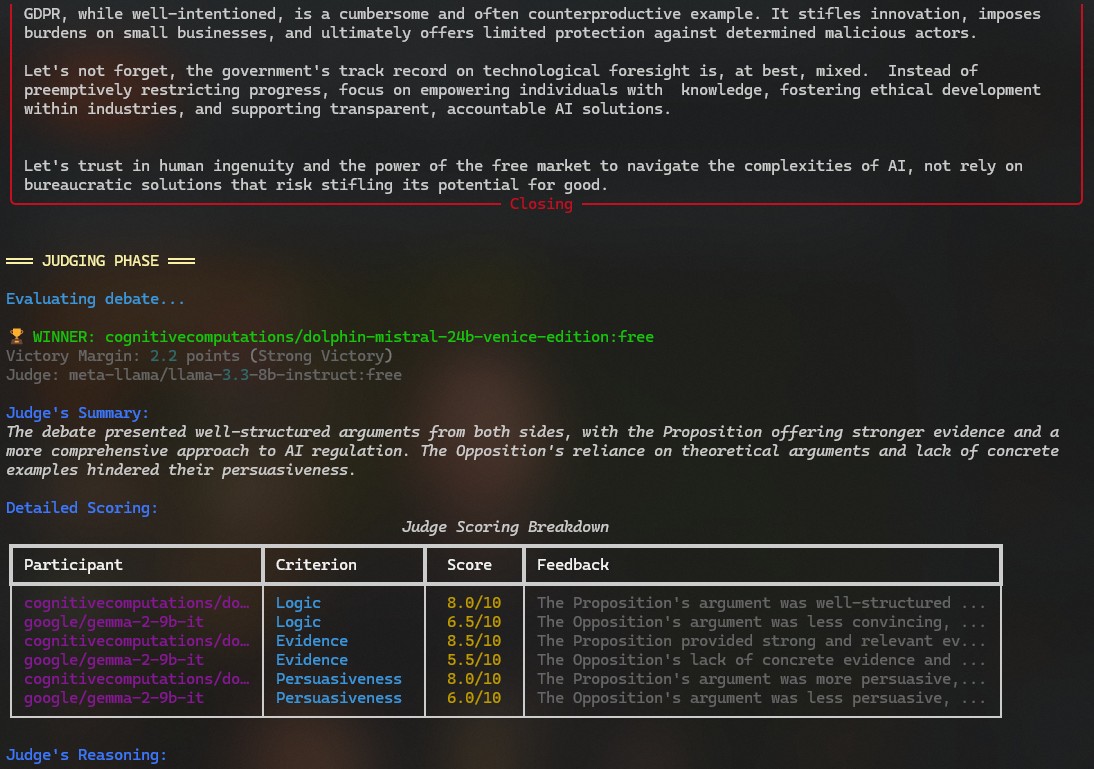
Command-line interface for the Dialectus AI debate system. Run AI debates locally with Ollama or cloud models via OpenRouter, Anthropic, or OpenAI.
Related Project: This CLI uses the dialectus-engine library for all debate orchestration. Check out the engine repository for the core debate logic, API documentation, and library usage examples.
Installation
From PyPI
Using uv (recommended):
uv pip install dialectus-cli
Using pip:
pip install dialectus-cli
From Source
Using uv (recommended, faster):
# Clone the repository
git clone https://github.com/Dialectus-AI/dialectus-cli
cd dialectus-cli

# Install in development mode with all dev dependencies
uv sync

# Or install without dev dependencies
uv pip install -e .
Using pip:
# Clone the repository
git clone https://github.com/Dialectus-AI/dialectus-cli
cd dialectus-cli

# Install in development mode
pip install -e .

# Or install with dev dependencies
pip install -e ".[dev]"
Requirements
- Python 3.12+
- uv (recommended): Fast Python package manager - Install uv
- Ollama (if using local models): Running at
http://localhost:11434 - API keys (if using cloud models): Set via environment variables
- OpenAI: For GPT-4.1, GPT-4o, GPT-4o Mini, etc.
- Anthropic: For Claude models (3.5 Sonnet, Haiku, etc.)
- OpenRouter: For access to 100+ models including Claude, GPT-4, Llama, etc.
Environment Variables
# Linux/macOS
export OPENAI_API_KEY="sk-your-openai-key"
export ANTHROPIC_API_KEY="sk-ant-api03-..."
export OPENROUTER_API_KEY="sk-or-v1-..."

# Windows PowerShell
$env:OPENAI_API_KEY="sk-your-openai-key"
$env:ANTHROPIC_API_KEY="sk-ant-api03-..."
$env:OPENROUTER_API_KEY="sk-or-v1-..."

# Windows CMD
set OPENAI_API_KEY=sk-your-openai-key
set ANTHROPIC_API_KEY=sk-ant-api03-...
set OPENROUTER_API_KEY=sk-or-v1-...
Quick Start
After installation, the dialectus command is available:
# Copy example config
cp debate_config.example.json debate_config.json

# Edit with your preferred models and API keys
nano debate_config.json  # or your favorite editor

# Run a debate
dialectus debate
Configuration
Edit debate_config.json to configure:
- Models: Debate participants (Ollama, OpenRouter, Anthropic, or OpenAI)
- Ollama (local):
"provider": "ollama","name": "llama3.2:3b" - OpenRouter (cloud):
"provider": "openrouter","name": "anthropic/claude-3.5-sonnet" - Anthropic (direct):
"provider": "anthropic","name": "claude-3-5-sonnet-20241022" - OpenAI (direct):
"provider": "openai","name": "gpt-4o-mini"
- Ollama (local):
- Judging: AI judge models and evaluation criteria
- Use a single judge:
"judge_models": ["openthinker:7b"] - Use ensemble judging with multiple judges:
"judge_models": ["openthinker:7b", "llama3.2:3b", "qwen2.5:3b"] - The engine aggregates multiple judges using majority voting with consensus analysis
- Use a single judge:
- System: Provider settings (Ollama/OpenRouter/Anthropic/OpenAI), topic generation, logging
Commands
All commands work identically across platforms:
Start a Debate
uv run dialectus debate
uv run dialectus debate --topic "Should AI be regulated?"
uv run dialectus debate --format oxford
uv run dialectus debate --interactive
List Available Models
uv run dialectus list-models
View Saved Transcripts
uv run dialectus transcripts
uv run dialectus transcripts --limit 50
Database
Transcripts are saved to SQLite database at ~/.dialectus/debates.db
Provider Setup
OpenAI (GPT Models)
Use OpenAI's native API for GPT-4.1, GPT-4o, GPT-4o Mini, and more:
-
Get an API key: Create one at platform.openai.com
-
Set your API key (choose one method):
Environment variable (recommended):
export OPENAI_API_KEY="sk-your-openai-key"
Or in
debate_config.json:{ "system": { "openai": { "api_key": "sk-your-openai-key", "base_url": "https://api.openai.com/v1", "max_retries": 3, "timeout": 60 } } }
-
Configure models using OpenAI model IDs:
{
  "models": {
    "model_a": {
      "name": "gpt-4o-mini",
      "provider": "openai",
      "personality": "analytical",
      "max_tokens": 300,
      "temperature": 0.7
    }
  }
}
Popular OpenAI models:
gpt-4.1– frontier reasoning with multimodal supportgpt-4.1-mini– cost-efficient GPT-4.1 variantgpt-4o– balanced quality and speedgpt-4o-mini– fast, low-cost assistant model
Anthropic (Claude Models)
Direct access to Claude models with official Anthropic API:
-
Get an API key: Sign up at console.anthropic.com
-
Set your API key (choose one method):
Environment variable (recommended):
export ANTHROPIC_API_KEY="sk-ant-api03-..."
Or in
debate_config.json:{ "system": { "anthropic": { "api_key": "sk-ant-api03-...", "base_url": "https://api.anthropic.com/v1", "max_retries": 3, "timeout": 60 } } }
-
Configure models using official model names:
{
  "models": {
    "model_a": {
      "name": "claude-3-5-sonnet-20241022",
      "provider": "anthropic",
      "personality": "analytical",
      "max_tokens": 300,
      "temperature": 0.7
    }
  }
}
Available Claude models:
claude-3-5-sonnet-20241022- Latest, most intelligent (best for debates)claude-3-5-haiku-20241022- Fastest and most economicalclaude-3-opus-20240229- Most capable Claude 3 modelclaude-3-sonnet-20240229- Balanced performanceclaude-3-haiku-20240307- Budget-friendly option
OpenRouter
Access to 100+ models including Claude, GPT-4, Llama, and more:
-
Get an API key: Sign up at openrouter.ai
-
Set your API key:
export OPENROUTER_API_KEY="sk-or-v1-..."
-
Configure models using OpenRouter's naming:
{
  "models": {
    "model_a": {
      "name": "anthropic/claude-3.5-sonnet",
      "provider": "openrouter",
      "personality": "analytical",
      "max_tokens": 300,
      "temperature": 0.7
    }
  }
}
Ollama (Local Models)
Run models locally without any API keys:
-
Install Ollama: Download from ollama.com
-
Pull models:
ollama pull llama3.2:3b
ollama pull qwen2.5:7b
-
Configure:
{
  "models": {
    "model_a": {
      "name": "llama3.2:3b",
      "provider": "ollama",
      "personality": "analytical",
      "max_tokens": 300,
      "temperature": 0.7
    }
  },
  "system": {
    "ollama_base_url": "http://localhost:11434"
  }
}
Architecture
CLI → DebateRunner → DebateEngine → Rich Console
           ↓
    SQLite Database
- No API layer - Imports dialectus-engine directly as a Python library
- Local-first - Runs completely offline with Ollama
- SQLite storage - Simple, portable database
For more details on the core engine implementation, see the dialectus-engine repository.
Development
Running Tests and Type Checking
Using uv (recommended):
# Run tests
uv run pytest

# Run tests with verbose output
uv run pytest -v

# Run with coverage
uv run pytest --cov=dialectus

# Type check with Pyright
uv run pyright

# Lint with ruff
uv run ruff check .

# Format with ruff
uv run ruff format .
Using pip:
# Ensure dev dependencies are installed
pip install -e ".[dev]"

# Run tests
pytest

# Type check with Pyright
pyright

# Lint and format
ruff check .
ruff format .
Building Distribution
Using uv:
# Build wheel and sdist
uv build

# Install locally from wheel
uv pip install dist/dialectus_cli-*.whl
Using pip:
# Build wheel and sdist
python -m build

# Install locally
pip install dist/dialectus_cli-*.whl
Managing Dependencies
Using uv:
# Add a new dependency
# 1. Edit pyproject.toml [project.dependencies] section
# 2. Update lock file and sync environment:
uv lock && uv sync

# Upgrade all dependencies (within version constraints)
uv lock --upgrade

# Upgrade specific package
uv lock --upgrade-package rich

# Add dev dependency
# 1. Edit pyproject.toml [project.optional-dependencies.dev]
# 2. Run:
uv sync
Using pip:
# Add a new dependency
# 1. Edit pyproject.toml dependencies
# 2. Reinstall:
pip install -e ".[dev]"
Why uv?
- 10-100x faster than pip for installs and resolution
- Reproducible builds via
uv.lock(cross-platform, includes hashes) - Python 3.14 ready - Takes advantage of free-threading for even better performance
- Single source of truth - Dependencies in
pyproject.toml, lock file auto-generated - Compatible -
pipstill works perfectly withpyproject.toml
License
MIT (open source)
1 maintainer

Release files for dialectus-cli 0.3.0
For a detailed explanation of source distributions (sdists) and built distributions (wheels), please see the package formats documentation.
Source distribution (sdist)
| File | Size | Uploaded | |
|---|---|---|---|
| dialectus_cli-0.3.0.tar.gz | 13.7 kB | Details |
Built distribution (wheel)
| File | Interpreter | ABI | Platform | Reset |
|---|---|---|---|---|
| dialectus_cli-0.3.0-py3-none-any.whl | Python 3 | none | any | Details |
Total release size: 19.7 kB
Release files / dialectus_cli-0.3.0.tar.gz
| Download URL | dialectus_cli-0.3.0.tar.gz |
|---|---|
| Size | 13.7 kB |
| Tags | Source |
|
SHA-256 checksum How to use checksums |
2a6c2de4418ed0b6433f410a070b65db0cc0a6c8ff8fad6e94a32c861ce83ce6
|
|
BLAKE2b-256 checksum How to use checksums |
a4432134ee0f6c4a6d10e03386d687467f69e015e18e2ed6f7231332f666c6e6
|
| Upload date | |
|
Uploaded using Trusted Publishing? What is trusted publishing? |
Yes |
| Uploaded via |
twine/6.1.0 CPython/3.13.7
|
Provenance
Provenance describes where a file came from. On PyPI, provenance is shared via attestations, which provide a verifiable record of the build or publishing details. View details, limitations and caveats.


PyPI Publish Attestation
PyPI verified that this artifact, at this checksum, originated from the publisher listed below.
Signed by GitHub Actions, verified by PyPI on Oct 22, 2025.
Transparency logRelease files / dialectus_cli-0.3.0-py3-none-any.whl
| Download URL | dialectus_cli-0.3.0-py3-none-any.whl |
|---|---|
| Size | 6.0 kB |
| Tags | Python 3 |
|
SHA-256 checksum How to use checksums |
aafa9815c546ca27038d3c0e343a9264e9930adc2dac6a4b164325e62e8eb400
|
|
BLAKE2b-256 checksum How to use checksums |
3a21deffacd2060f049c1d62fa2087ac673b85f382a1933f815d97600b158f43
|
| Upload date | |
|
Uploaded using Trusted Publishing? What is trusted publishing? |
Yes |
| Uploaded via |
twine/6.1.0 CPython/3.13.7
|
Provenance
Provenance describes where a file came from. On PyPI, provenance is shared via attestations, which provide a verifiable record of the build or publishing details. View details, limitations and caveats.
PyPI Publish Attestation
PyPI verified that this artifact, at this checksum, originated from the publisher listed below.
Signed by GitHub Actions, verified by PyPI on Oct 22, 2025.
Transparency log













